Cylindrical, Prismatic and Pouch Cells: What Do Battery Form Factor Differences Change?
Share This Page
Cell format selection in electric vehicle batteries; is an engineering decision that directly determines manufacturing cost, mechanical durability, cooling strategy and pack architecture. Cylindrical cells offer mature automation and thermal management advantages, prismatic cells high capacity and efficient stacking, and pouch cells lightness and design flexibility; there is no single format that is superior in every condition.
Highlights
- The 18650, 21700 and 4680 sizes are defined by IEC; the first two digits give the diameter, the next two the length in millimeters
- Cylindrical cells generally offer 2.5-5 Ah capacity, while prismatic cells offer 20-100 Ah and above
- A vehicle pack based on 21700 cells may contain 4,000-5,000 cells; with prismatic cells the same job can be done with 30-100 cells
- The gaps of round cells within the pack create roughly 10-15% wasted volume
- Prismatic cells form the foundation of cell-to-pack and cell-to-chassis designs
What is the difference between cylindrical, prismatic and pouch cells?
What distinguishes the three formats is not the cell's internal chemistry, but its external geometry and enclosure style. In a cylindrical cell, the electrode layers are wound around a tube together with the separator into a coil called the jelly roll and placed in a steel or aluminum cylinder. In a prismatic cell, the electrodes are stacked in layers and fitted inside a rigid aluminum box. In a pouch cell, there is no rigid enclosure at all: the stacked layers are sealed inside a soft envelope made of aluminum-polymer laminate film.
Although this difference may seem like a detail at first glance, it has a cascading effect on every decision that goes from cell to pack. Body stiffness determines swelling behavior, geometry determines heat flow, and size determines both manufacturing automation and how many cells the pack will need. Battery chemistry - NMC or LFP - can be used in all three formats; the format is the framework that shapes how the chemistry behaves within the pack.
Sizing rule and typical capacities
Cylindrical cells have a universal naming scheme: an 18650 cell is 18 mm in diameter and 65 mm in length; the 21700 measures 21x70 mm, while the 4680 measures 46x80 mm. Since these definitions are based on the IEC standard, cells from different manufacturers can be interchangeable - a significant logistical advantage in large-scale production. Prismatic and pouch cells have no such universal standard; dimensions are defined individually for almost every project.
The capacity difference also stems from this scale. A classic 18650 cell ranges from 2,000-3,600 mAh, while the 21700 falls in the 3,500-5,000 mAh range; new-generation 4680 cells reach the 25-30 Ah level. As a general rule, cylindrical cells stay in the 2.5-5 Ah band, while prismatic cells can reach 20-100 Ah and beyond. As capacity increases, the number of cells in the pack decreases: An 21700 -based pack can hold 4,000–5,000 cells, while 4680 cells can deliver the same energy with fewer than 1,000 cells. Fewer cells mean fewer BMS channels, fewer connections, and fewer assembly steps.
| Feature | Cylindrical | Prismatic | Pouch |
|---|---|---|---|
| Housing | Metal tube, wound electrodes | Rigid aluminum box | Aluminum-polymer film |
| Typical capacity | 2.5–5 Ah (4680: 25–30 Ah) | 20–100+ Ah | Variable, thin profile |
| Cycle life (typical) | 800–1,500 | 1,000–2,000 | 500–1,200 |
| Standardization | IEC-defined dimensions | Mostly custom dimensions | Mostly custom dimensions |
| Strength | Automation, thermal management | Capacity, mechanical strength | Lightweight, flexibility |
| Weakness | 10–15% volume gap in the pack | Sensitivity to swelling | Vulnerable to puncture |
Production and cost: per cell, or per kWh?
Cylindrical cells have been produced at industrial scale for more than two decades, and their production lines are fully automated. The winding process is a highly repeatable operation; this means a low error rate, high consistency, and the lowest production cost per cell. One reason the cylindrical format is so widespread in the automotive industry is precisely this mature production infrastructure and the deep, well-developed supply chain built around it.
The cost argument for larger cells is somewhat more nuanced. According to academic comparisons, larger cells or thicker electrodes offer lower cost per kWh; prismatic cells, whose size can in practice be increased further, therefore open up wider room for cost reduction. The apparent contradiction here mostly stems from how the measurement is defined: the cylindrical form can be the cheapest per cell, while the prismatic form can be more efficient per kWh. Which format actually wins depends on which cost - per cell or per unit of energy - is dominant in the architecture in question.
Another cost item for prismatic cells is the lack of standardization. The fact that each manufacturer uses its own custom dimensions makes it harder to ensure automation and quality consistency; setting up a universal 21700 winding line was more predictable in terms of risk than setting up a prismatic line dedicated to a single customer.
Mechanical durability and safety: how much does geometry protect?
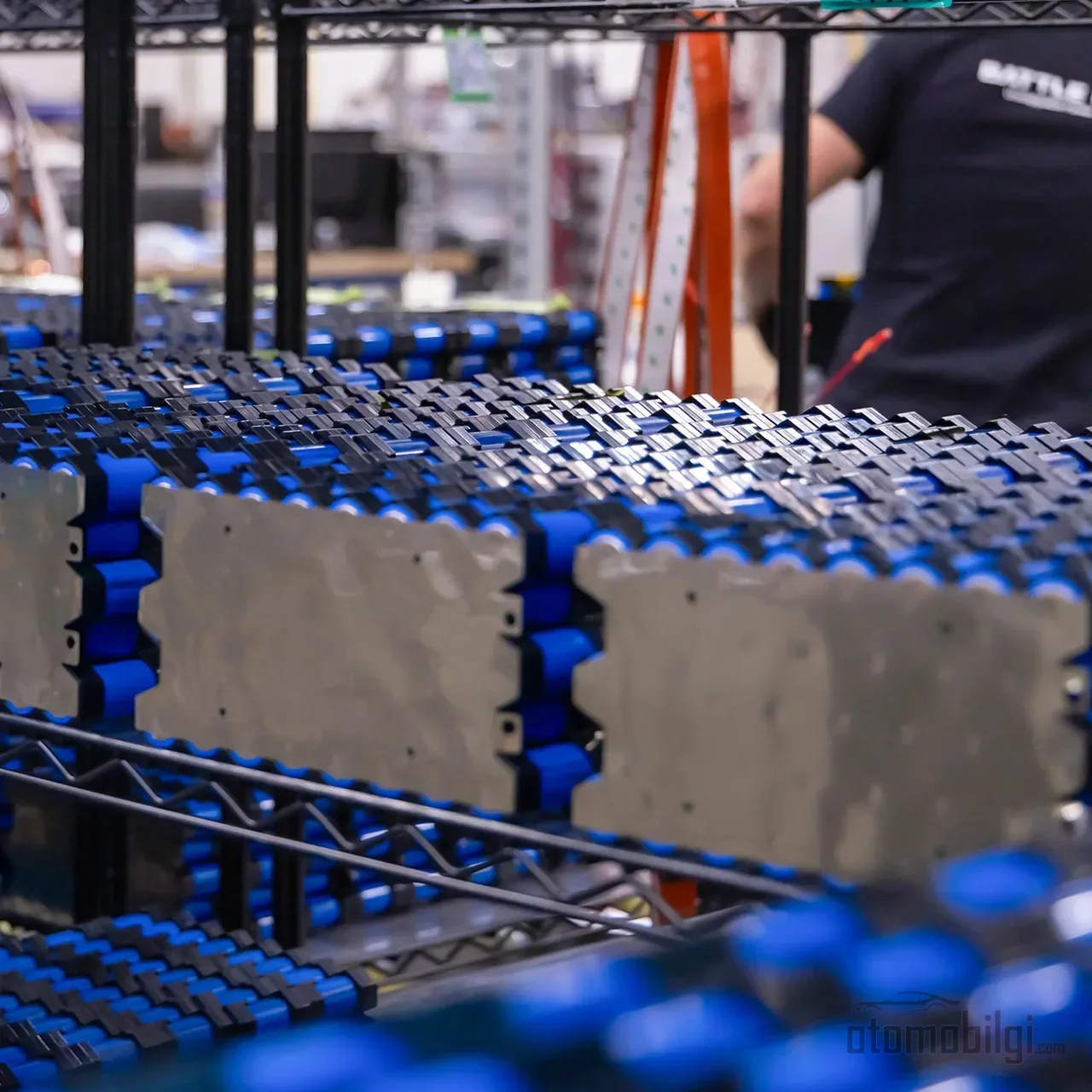
The circular cross-section is an elegant geometry from a pressure standpoint: it distributes internal stresses evenly across the cell wall, making the cylindrical form the most resistant to swelling. Moreover, the safety hardware of cylindrical cells is embedded inside the body so that it works independently of the BMS. The pressure relief vent, the current interrupt device (CID), the PTC resistance, and the separator's thermal shutdown form a layered passive safety chain; measurements show that the CID activates at around 212 ± 15 °C, approximately 16 seconds before the vent bursts. This few-second advantage at the front is a serious time saving at pack level.
The rigid body of the prismatic cell provides noticeably better protection against external impacts than the pouch. Its weak side, however, is the gas buildup inside: when internal pressure rises, a closed and rigid box absorbs the swelling by straining its body. In tightly stacked prismatic packs, thermal runaway developing in one cell carries the risk of spreading to neighboring cells; therefore prismatic systems generally need separate cooling plates and carefully designed propagation barriers.
In a pouch cell, the containment role is transferred entirely to the pack itself. The thin lamination film offers almost no protection against punctures and crushing; a puncture can lead directly to a short circuit. That is why pouch-based packs cannot be built without rigid enclosures, compression, and padding systems. Comparative mechanical tests - including puncture and crush scenarios - confirm that the three formats respond markedly differently under abuse. The most common failure mode of the pouch, however, is swelling: gas formed inside the sealed case expands the cell, turning into performance loss and a safety risk. High-temperature storage, sitting at full charge, and low-quality cell manufacturing accelerate this process; the expansion of aged cells also increases the pressure inside the pack. On the other hand, swelling management is not an entirely unsolvable problem: thick internal windings and foam padding parts can absorb the expansion and reduce electrode curvature.
Thermal management: which form makes cooling easier?
The fundamental task of the thermal management system is to keep the pack temperature within the permitted range and minimize the temperature gradient between cells. As the gradient shrinks, the cells age evenly; this directly extends the total life of the pack. Form geometry affects this equation in three different ways.
- Cylindrical: The round body distributes heat evenly across the surface, and the gaps between the cells can be used as liquid cooling channels without requiring an additional cooling plate. This is largely the engineering basis for why some manufacturers stick with cylindrical cells.
- Pouch: The thin profile transfers heat quickly to the surface, but heat can accumulate in the middle of the wide surface; cooling the cell evenly across its surface is the main design challenge.
- Prismatic: Large, flat surfaces make perfect contact with the cooling plate; in return, thermal barrier design becomes critical in tight stacking due to the risk of propagation.
With cylindrical cells, a thermally conductive layer (TIM) between the cell and the cooling plate is used when needed; it fills the gap between the round surface and the flat plate, lowering contact thermal resistance. In a properly managed system, the difference is measured concretely: when prismatic cells are kept in the 20-40 °C operating window and deep discharge is avoided, lifespans exceeding 2,000 cycles are within reach. Since inter-cell thermal imbalance makes the pack only as good as its weakest cell, cooling design is the pack's life factor regardless of form.
Why do manufacturers choose different cell formats?
Format choice is not merely a technical contest; it is a geographic and strategic divide. Prismatic LFP cells - with their solid, compact and efficiently stackable structure - hold the dominant format position in China and are the fastest-growing segment globally. Cylindrical cells, on the other hand, stand out among manufacturers outside China; many brands, led primarily by American and European electric vehicle manufacturers, choose this format for its mature supply chain and thermal management advantages. Although pouch cells are very strong in consumer electronics, their share in automotive remains relatively limited.
The engineering rationale behind the choice is also concrete. Those opting for cylindrical emphasize ease of thermal management and automation maturity; those moving toward large-format prismatic cells target energy density, range and the possibility of direct mounting into the pack. For some, chemistry is also decisive: When LFP's high cycle life (2,000-5,000 cycles, versus 500-2,000 for NMC) combines with large prismatic cells, the balance of both longevity and cost shifts south - that is, toward large and cheap cells.
The shift toward large format: cell-to-pack and cell-to-chassis designs
The current agenda of electric vehicle batteries is designs that eliminate the module concept. Cell-to-pack (CTP) architecture eliminates the module layer by placing cells directly into the pack housing, while cell-to-chassis (CTC) integrates the entire pack into the body structure, saving weight and volume; the pack also becomes a structural element that reinforces the body. Owing to their compact and rigid structure, prismatic cells form the natural foundation of these architectures, and the industry is shifting in this direction in parallel with the rapid growth in EV battery distribution.
This efficiency gain comes at a price: mounting cells very close to one another eliminates the physical separation that modules provide and magnifies the risk of thermal runaway developing in a single cell across the entire pack. For this reason, in CTP and CTC designs, cells must be safer on their own - that is, they must have higher intrinsic failure tolerance. Advocates of modular design, however, remind that separability is still valuable in terms of thermal runaway containment, serviceability and recycling - this tension between efficiency and tolerance will shape the pack architecture debate of the coming years.
The cylindrical front is not standing idle either. Silicon-anode 4680 cells have entered use in large single-body electric pickup trucks; they combine high capacity per cell with mechanical robustness. Silicon-anode technology has also jumped to classic dimensions: new-generation silicon-anode 21700 cells with 6.3 Ah capacity and 315 Wh/kg energy density - about 25% more than a standard graphite-anode 21700 - have reached customers at the early commercial stage. This development shows that gaining energy density without changing form factor is still possible.
Which cell form is better: is there a single winner?
The short answer is no. The reason all three formats continue to exist is that each is optimized for a different engineering problem. If the priority is mechanical safety and large system integration, prismatic wins; for thermal management and manufacturing maturity, cylindrical; and for maximum lightness and system-level energy density, pouch takes the lead. The final choice is a decision made jointly by the thermal management strategy, supply chain, and package architecture; it cannot be considered independently of battery chemistry.
Scale is also a lasting criterion. While cylindrical cells remain the cheapest unit per cell, prismatic cells are advancing in terms of cost per kWh and pack efficiency. Since vehicle batteries are typically designed with a 15-20 year lifespan target, cycle life data is an indispensable input to the decision; in this picture, the prismatic form usually represents the upper band and the pouch form the lower band. Therefore, rather than looking for the "winning format" of the next year, asking which architecture requires which form is a more accurate engineering approach.
Sources
- Cylindrical Cell Guide (2026): Sizes, Applications
- Cylindrical vs Prismatic vs Pouch Cells: Which Battery Cell Type Is Better?
- Electric vehicle batteries - Global EV Outlook 2026
- Comparison between cylindrical and prismatic lithium-ion - Ciez & Whitacre
- Comparative study of mechanical-electrical-thermal responses of pouch, cylindrical and prismatic cells
- Progress in battery thermal management systems
- Degradation mechanism and assessment for different formats
- Battery Swelling Explained
- Cell-to-pack batteries
- Choosing the right EV battery format
- How Long Does an Electric Car Battery Last?