How Muscle Cars Shaped American Popular Culture
Share This Page
Muscle cars are performance automobiles with big-block V8 engines, rear-wheel drive, and a price tag within young people's reach - cars that turned American car culture into a phenomenon in its own right, independent of the movies. This class began in 1964 with the Pontiac GTO and became a symbol of freedom and rebellion in the 1960s, lost its breath in the 1970s due to insurance hikes and the oil crisis, and returned in the 2000s as one of the brightest stars of the collector market.
Highlights
- Pontiac GTO was born on September 3, 1963, as a $296 option package.
- Instead of the targeted ~5,000 sales in 1964, 32,450 GTOs were sold.
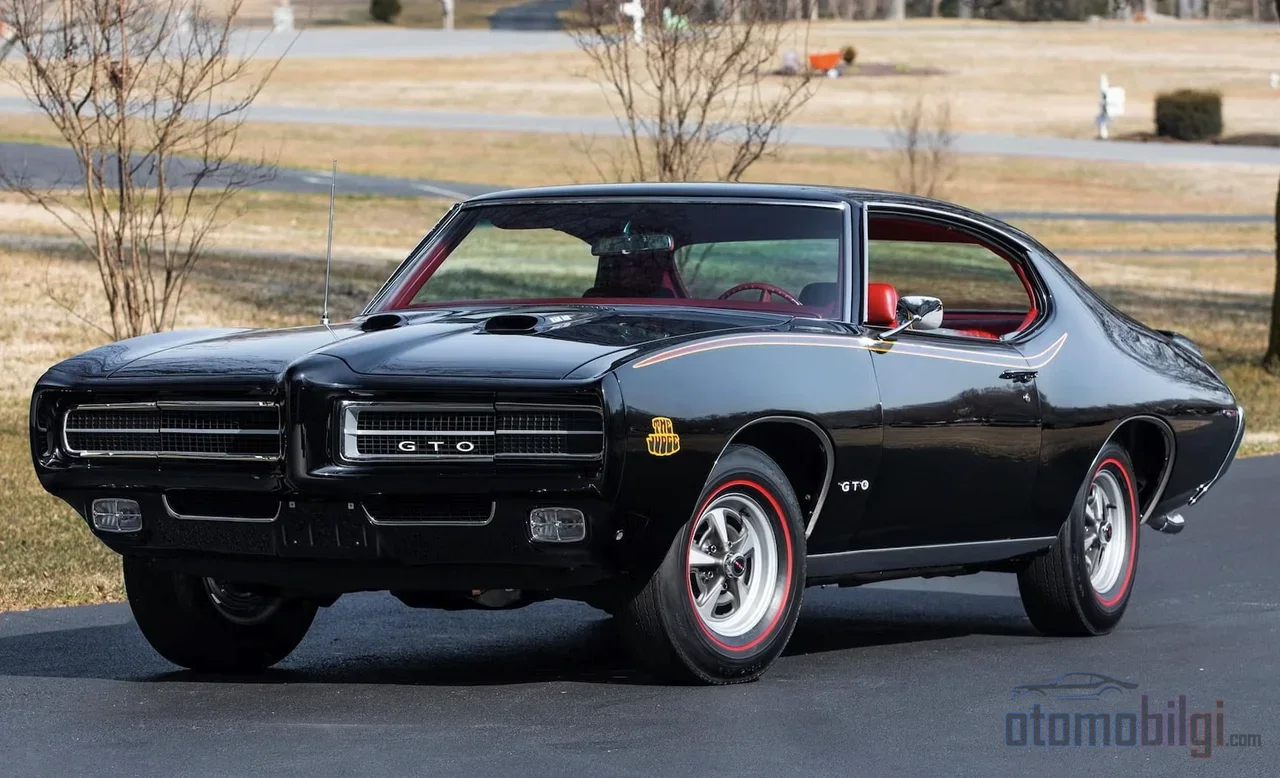
- Only 6,833 units of the 1969 6.833 The Judge were produced; with the model discontinued in 1971, rare copies now exceed $200,000 at auctions.
- The 1973 oil crisis and rising insurance rates effectively ended the muscle car era.
- In 2026, Dodge is bringing the Charger name back to life - only with an NHRA-approved drag racing vehicle.
How Did Muscle Cars Shape American Popular Culture?
Think of it this way: in Europe, if you were a speed enthusiast, you would buy an expensive, refined sports car. In America, the same passion was satisfied by stuffing a huge V8 under the hood of an ordinary family sedan, with a budget close to the price of second-hand clothes. Muscle cars were born precisely from this gap. Four decades of hunger turned into tires exploding at the stop lights before dawn and the sense of freedom young people carried on their shoulders. These cars were not just means of transportation - they were declarations of identity.
A Legend Born from an Engineering Loophole: The Pontiac GTO
The story actually begins with an unofficial rule. In 1963, GM issued a directive limiting the engine that could be fitted to mid-size cars to 330 cubic inches. Pontiac's engineers - John DeLorean, Bunkie Knudsen, Bill Collins, and Russ Gee - saw a wonderful loophole in this rule: while the 326 cubic inch V8 remained standard, a 389 cubic inch V8 could be offered as an option package. It wasn't against the rule - it was simply brilliant.
And so, on September 3, 1963, the GTO was born as a $296 option package. Even its name was bold: "Gran Turismo Omologato" - a title borrowed from Ferrari's legendary 250 GTO. DeLorean made the name defensible by actually homologating the car with the FIA in 1964. The engine produced 325 hp and 428 lb-ft of torque, while the three-carburetor Tri-Power option raised this to 348 hp. As you might guess, around 8,250 buyers couldn't say no to the triple carburetors.
The marketing team had acted sensibly, targeting ~5,000 units for 1964. The result: 32,450 sales. By the end of that year, no one was arguing anymore - the GTO went down in history as "the first true muscle car" and single-handedly raised the bar for the class. In 1966, sales climbed to 96,946, the second-generation body arrived in 1968, and the GTO won Motor Trend magazine's "Car of the Year" award.
The Judge: A Legend Born on Television
Introduced in February 1969, the The Judge, one of the sweetest examples of how deeply muscle car culture is intertwined with popular culture. Its name came from the "Here come da Judge" sketch on the famous comedy show. Under the hood was a 366 hp Ram Air III 400 V8, behind it a 60-inch wing, and on top, that famous Carousel Red color. 6,833 units were sold - of which only 108 were convertibles. Even fewer, the Ram Air IV (370 hp) was found in only ~200 cars. In 1970, sales fell to 3,797, and in 1971 to just 374, and the Judge's story came to a close. Original GTO production ended in 1974.
Charger, Hemi and the Legend of the Drag Strip
If the GTO made the equipment of speed accessible, the Dodge Charger drew the face of this culture. The aerodynamic body of 1968 also made the car a serious contender on NASCAR tracks. The peak weapon was the same: the ~425 hp 426 cubic inch Hemi V8. The Hemi's history in drag racing is long, controversial, and entirely unique - so much so that it remains the only engine still used in Top Fuel category cars today. Even after five decades of technological progress, nothing has replaced a Hemi.
The sweetest part of the story is this: the Hemi returned under the Charger name. 2026 Dodge Charger "Hustle Stuff" Drag Pak is the first race car built by Dodge's re-established SRT division and is NHRA-approved. Under the carbon fiber hood runs a 354 cubic inch supercharged Hemi V8 - and this is the first Charger to carry the "Drag Pak" badge. It is not sold for street use; it is designed entirely for the drag strip. Dodge had replaced the Hemi in street cars with a twin-turbo six-cylinder, but the flapping tradition on the tracks never ended. This car is also the power behind Dodge's consecutive championships in NHRA Factory Stock.
The Decline: Insurance or the Oil Crisis?
As with every legend, this era too came to an end, and most people point to the 1973 oil crisis as the sole culprit. In reality, the story is more complex - and starts earlier. Between 1970 and 1973, insurance companies significantly raised premiums for high-horsepower cars. For example, the annual insurance for a 1970 Chevelle SS could reach three times that of an ordinary car. The most eager buyer base was young people, and these figures did not fit their budgets. Muscle cars practically became "uninsurable." Add federal safety regulations to that, and the foundation of the era was cracking well before 1973.
Then came the 1973 embargo and new emission rules. Big block engines choked as if a handkerchief had been stuffed directly into the engine's mouth. From roughly early 1970 to the mid-1980s this period of stagnation, lasting until, is known in automotive history as the "Malaise era." The debate is not entirely closed - some analyses argue that the fuel crisis and fuel economy standards alone did not kill the high-horsepower models, and that the decline started earlier. Perhaps the healthiest summary is this: the trio of insurance companies, regulations, and the oil crisis together closed this era.
The Comeback: A Renaissance Spanning the 1980s to the 2000s
The fire never completely died out. In the early 1980s, models like the Ford Mustang GT and Chevrolet Camaro Z28, with high-output V8s, enabled performance to rise again. But the real renaissance came in the 2000s: manufacturers brought iconic muscle cars back to life with modern technology and safety features. The Dodge Charger returned in 2006, the Challenger in 2008, and the Chevrolet Camaro in 2010. The Ford Mustang, meanwhile, never went extinct and continuously reinvented itself.
The GTO's own comeback, however, is a sadder story. In 2004, the fifth generation, based on the Australian-built Holden Monaro and equipped with an LS1 V8, arrived with a starting price of around $34,000. The performance was real, but the styling was deemed "too conservative," it failed to meet expectations, and production ended in 2006. The lesson was clear: in a muscle car, the name alone is not enough - the looks have to talk too.
So what is the situation in 2026? A striking fact: the only brand-new muscle car still sold at dealerships is the Ford Mustang, and its price does not drop below $45,000. On Dodge's side, the Hemi lives on only in a track-purpose Charger, as described above. So the species has shrunk but is not dead.
The Collector Market: How Much Does a Muscle Car Cost Today?
Here is the financial side of things, and if you ask me, this is the truly crazy part. A well-kept 1964 GTO changes hands at auctions for around $50,000. Rare examples like the 1970 Judge Ram Air IV easily exceed $200,000. One of the examples collectors call the "gold standard" is the 1969 convertible version - production was only around 2,200 units. Another sought-after name is the 1971 Plymouth Superbird 440.
The pulse of the market is not a flat line, as you might think. At classic car auctions, the segments have split in two: in the top segment, that is, vehicles that attract the interest of rare and young collectors, there is strong interest; the lower segment is sluggish. The overall picture is described as "mixed," and some classic categories are hovering near historic lows relative to inflation. But there is a hopeful note too: the classic car market is predicted to have a strong year in 2026, and the new generation of collectors prefers buying online - online classic car sales rose by 12% over the past year, reaching $2.5 billion. reached.
The Restoration Reality: How Much Money, and Original or Restored?
If you want to buy a classic, here are the real numbers on the table: as of 2025, rebuilding a Mustang 289 engine costs $3,500-8,000, while a Camaro big block crate engine can run somewhere between $6,000 and $15,000. So restoration is a hobby that keeps straining your wallet even after the car's purchase price.
The question then is: original or restored? This is still a contentious topic among collectors. An original car is like a historical document bearing the marks of time; a restored one, having drifted into a beauty sleep, looks like it did on day one. The ownership experience of the two is completely different - you want to grow one in a display case and drive the other on the road. Neither is "right"; what matters is which one you want. To give some reference values, 1995-1998 Nissan Skyline GT-R is currently priced around ~$82,350, while the Corvette Z06 sits in the ~$55,900 range.
Why Are They Still Unmatched?
In my view, the magic of muscle cars lies hidden in the formula: a huge engine, rear-wheel drive, an accessible price, and endless potential for personalization. Throughout history, this formula has never changed. The GTO was born out of an engineering loophole, and insurance rates and an oil crisis brought it down, but collectors and the drag strip always kept it alive. The fact that even in 2026 there is a single all-new muscle car sold at a dealership is proof of this. If it were you, which legend would you put in your garage - a Judge or a Charger?
Sources
- Pontiac GTO History: From Street Sleeper to Icon
- Pontiac GTO - Wikipedia
- The First Muscle Car: Pontiac GTO Through the Years
- Pontiac GTO History: 1964 Rebel Muscle Car to 2006 LS2
- A Full History of American Muscle Cars
- How the 1970s Oil Crisis Ended the Classic Muscle Car Era
- The Real Reason The Muscle Car Era Ended In The '70s
- Why Did Muscle Cars Disappear in the 1970s?
- The Muscle Car Era Ended in 1973 - But the Forces That Ended It Were Already in Motion
- Malaise era - Wikipedia
- Ode to the Hemi
- Dodge Charger Drag Pak by Direct Connection
- Dodge to Offer Hemi V-8 in 2026 Charger Hustle Stuff Drag Pak
- Muscle car - Wikipedia
- The Enduring Legacy of Muscle Cars
- The Evolution of American Muscle Cars from the '60s to Today
- The Best Muscle Cars You Can Get in 2026
- 10 Most Sought-after Classic Muscle Cars
- Are Classic Car Prices Dropping in 2026?
- The 2026 Collector Car Market Has a Strong Top End, But a Soft Underbelly
- Classic-car market poised for strong 2026, says Hagerty CEO
- 10 Collector Cars Gaining Value in 2026
- Original vs Restored Classic Cars
- Best Muscle Cars to Restore