Mad Max's V8 Interceptor Became the Car of a Collapsing World
Share This Page
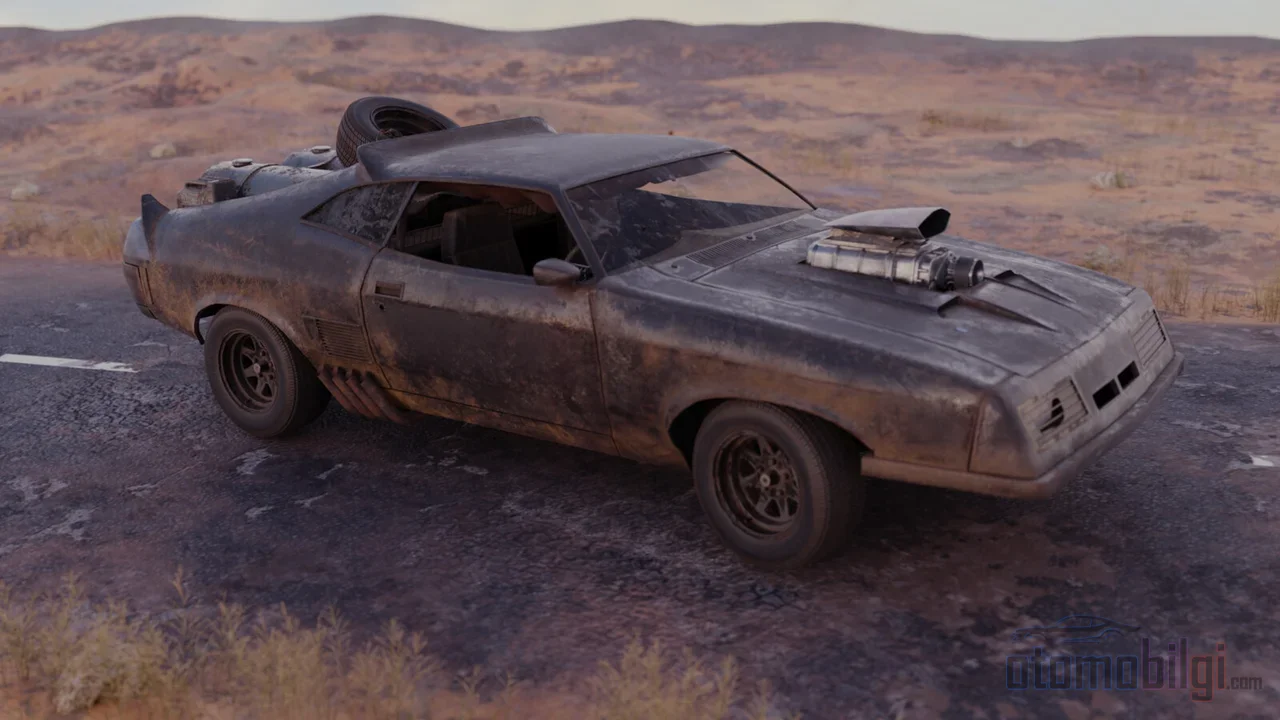
Mad Max's V8 Interceptor, based on a 1973 Ford Falcon XB GT Coupe , is a black-on-black painted Australian muscle car and has been the most recognizable movie vehicle in cinema history since 1979. In this article, I tell where that famous black coupé came from, how it was transformed, and why it is still talked about today.
Highlights
- The basis of the movie car 1973 Ford Falcon XB GT Coupe; not a Mustang, entirely Australian-made.
- The film's total budget $350,000 ; the share allocated to vehicles was only $20,000.
- In the 1979 film, the Weiand 6-71 supercharger was decorative; it did not actually work.
- The car destroyed in The Road Warrior is not the original, but a Fairmont replica; the real GT survived.
- The original car is now being put up for sale from a museum collection in Florida.
What car is Mad Max's car actually based on?
The answer to the question surprises most people, because the car comes from a very different place than the Dodge Charger or a Trans Am: Australia's own muscle car tradition. Ford produced the Falcon in Australia from 1960 to 2016 , and this model was long regarded as a symbol of the country's manufacturing industry. The GT, the peak of the XB generation, carried a 351 cubic inch (351 Cleveland) V8 under its hood; producing an estimated 300 horsepower and 380 ft-lb of torque, this engine directly inspired the "the last of the V8s" line in the film.
So let's offer a correction to those who think of an American car when they hear Interceptor: what we have before us is a coupé born on Australian roads, carrying Australia's muscle power tradition. Mel Gibson, who played Max Rockatansky, became one of the coolest heroes in cinema history at the wheel of this car.
A legend that started with $20,000
In 1976, George Miller and Byron Kennedy allocated a $350,000 budget for the film. Within this figure, equivalent to the price of a single supercar today, the share for all vehicles and props was only $20,000; moreover, the budget set aside for keeping the vehicles roadworthy was even smaller, $5,000. Under these conditions, the crew went to a vehicle auction in Frankston, Victoria, and for under $20,000 bought three vehicles: two retired police V8 XB sedans and a repossessed white V8 XB GT coupé. One of the sedans became Big Boppa, the other Max's yellow Interceptor; the white coupé was the vehicle that would go down in history as the "Last of the V8 Interceptors."
Interestingly, the designers initially envisioned a much more futuristic vehicle. The early designs, featuring a roof and trunk spoiler, curved wheel flares, and a completely modified front end, were so stylized that at one point the crew seriously considered having Max drive a modified Mustang . Film mechanic Murray Smith objected to this idea, pointing out that finding spare parts would become a nightmare. Thank goodness he did; without the Falcon's distinctive silhouette, there would have been no icon called the Interceptor.
How was the black coupé transformed into the Interceptor?
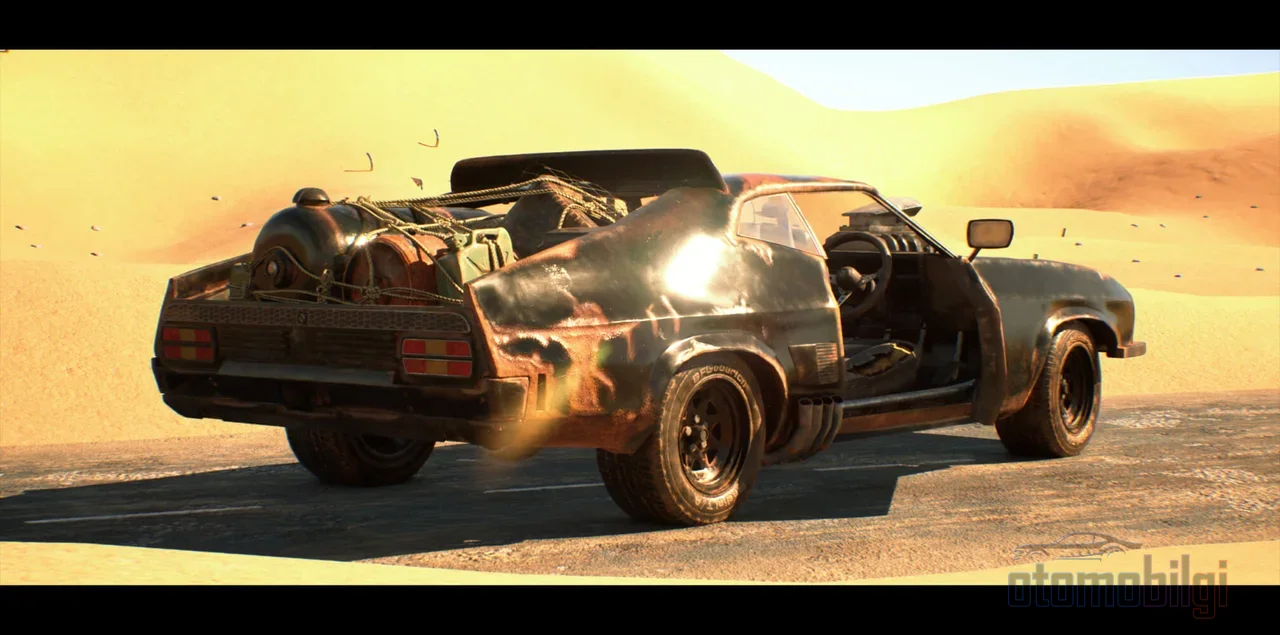
The list of modifications made for the 1979 film is still among the classics of car culture today: a Weiand 6-71 supercharger, nitrous oxide injection, roof and trunk spoilers, flare arches, a front nose cone and air dam, and exhaust pipes protruding from the sides. But do you know the most crucial detail of all? The supercharger never actually ran during filming. That famous mechanism rising from the hood was a transparent prop made specifically for the camera. That is exactly what movie magic is: part of the power we admired on screen was, in truth, just for show.
The names behind it also deserve to be discovered. The Monza-style front nose came from the hands of former Ford stylist Peter Arcadipane. The spoilers were adapted from Bob Jane's Monaro Sports Sedan and produced by Errol Platt. The wheel widening was the work of Rod Smyth and his brother. The paint scheme is a whole different story: on the brief of art director Jon Dowding, Ray Beckerley of Graf-X International created that famous black-on-black look, layering gloss and matte black. It may seem simple, but it must be admitted that the paint is the detail that alone defines the car's character.
Filming was completed in 1978, and the film was released in Australia in April 1979, becoming a far bigger hit than expected. The Interceptor was the star of the promotional visuals, and for fans worldwide, the name "Interceptor" effectively became its official name.
How did the car change in the sequels?
The Interceptor showed a different face in every film; I think this transformation is one of the favorite aspects of everyone who followed the series.
| Film | Base vehicle | Notable differences |
|---|---|---|
| Mad Max (1979) | 1973 XB GT Coupe | Non-functional supercharger, nose cone, black paint |
| Mad Max 2 / The Road Warrior (1981) | 1975 XB GT Hardtop | Working supercharger, twin cylindrical fuel tanks, matte black paint |
| Mad Max Beyond Thunderdome | 1977 XB GT Sedan | Turbocharged engine version |
| Mad Max: Fury Road | The Interceptor is back before us | The bare metal-clad "Razor Cola" off-road transformation |
For the crash and burn scene required by the script in Road Warrior, a clever move was made: instead of the original GT, a replica roughly made from an automatic-transmission Fairmont was used. The replica rolled down the hillside multiple times and was burned in a huge explosion; the original GT remained largely intact. So the car we watched burn in that famous execution was not the car we thought it was.
What happened to the original car?
After the first film was shot, the producers were strapped for cash and put the car up for sale for $7,500. No buyer came forward, and the car passed to mechanic Murray Smith as payment for unpaid work. When the film became a hit, the producers bought the car back for the sequel - we can safely say it was one of history's greatest bargain buy-backs.
After Road Warrior, the car was put up for resale again, but it was in a sorry state: its front end was missing, its trunk had been cut for the fuel tank, and its interior had been stripped out. Rather than restoring it, its new owner put it on display; after an owner near Adelaide, Bob Fursenko rediscovered and restored the car. In the early 1990s it was displayed at the Birdwood Motor Museum in Adelaide, put up for sale again, and once again found no buyer. In 1992, at a car meet in Germany, collector Peter Nelson-owner of the Cars of the Stars Motor Museum in England-learned of the car; Nelson authenticated it and brought it to England. Nelson regarded this car as the most important car for a country, and probably saw Mad Max as one of the most important Australian films. Meanwhile, an interesting detail: Nelson had implied that he wanted the car to return to Australia if it ever left the museum; sensitivity over an important film car having gone abroad is still very much alive.
The car later passed into the Miami Auto Museum / Orlando Auto Museum collection in Florida and is currently up for sale. Although its market history is thin, it is clear that anyone wanting to take this car home will have to write a rather large check.
If you want an Interceptor: the replica market
Not everyone dreaming of Mad Max can reach for the original, of course; but the replica market is lively and has a surprisingly wide price range. What a replica will cost depends entirely on its authenticity and depth of restoration-the word "replica" is an unstandardized, flexible notion in this business.
- $15,000-30,000: the estimate range given for a Falcon XB Interceptor replica auctioned in 2020.
- Over $120,000: the amount a fan paid to convert a 1972 Falcon into an Interceptor.
- $139,000: the price of a 1973 Falcon XB GT listed for sale.
- $198,888: the asking price for a V8 Interceptor replica offered for sale in Melbourne, promising 600 horsepower at the wheels.
The official side of the business now exists too: Mad Max Factory , a company under the patronage of George Miller and producer Doug Mitchell, produces officially licensed Mad Max vehicles. So the name of a car that once failed to find a buyer for $7,500 is today a living brand through licensed production. Also, at the 2020 SEMA show, a Falcon XB-based GT351 off-road concept was introduced; the car's cult stance still inspires the design world. On the collector side, the National Film and Sound Archive's collection includes a limited-edition scale model of Max's yellow MFP Interceptor dated 2020 .
The auction side is not idle either: at Lloyd's Auctions' sale in May 2026, highly faithful and weathered-looking Interceptor replicas featured in the film cars showcase; a "film-perfect" MFP Interceptor replica, fully restored and presented with authentic film details, was also in the collection.
Why is it still so important?
What made the Interceptor special was not power or speed - indeed, part of the on-screen power was masterful decoration and illusion. What made it an icon was its ability to distill the aesthetic of a collapsing world into a single car. Born from Australian muscle car tradition and becoming a cornerstone of apocalyptic vehicle design, this black coupé serves as a benchmark for every dystopian vehicle that followed. A non-functional supercharger on a painted hood could become a symbol of an era in the right hands; we have been seeing the proof of it again every movie night for more than 40 years.
If it were you, which path would you choose to rebuild this icon: hunting for a classic XB GT, or reaching for one of Mad Max Factory's officially licensed vehicles?