The 30 Minutes of the WRC Service Park
Share This Page
The service park is the designated area where WRC teams can take their cars for maintenance, repairs and preparation during the rally; mechanical crews work there within strict time limits, typically 10, 30 or 45 minutes. Outside this window, no one other than the driver and co-driver pair at the wheel may touch the car. So beneath the action you see on the stages, there is also a crew of technicians racing against the clock. If you're ready, let's step inside the service park!
Highlights
- On a typical rally day there are 3 service periods : a short one in the morning, 30 minutes midday, and 45 minutes at the end of the day.
- Exceeding the service time means a time penalty ; arriving late to a time control usually incurs a penalty of 10 seconds per minute.
- Outside service, only the driver and co-driver may work on the car; outside technical assistance is completely forbidden.
- The number of tires per car is limited throughout the rally; in the 2023 season, Rally1 drivers could use a maximum of 28 tires including shakedown.
- Under the Super Rally rule, mechanics get 3 hours to rebuild a damaged car.
What Is the Service Park and Why Is It So Critical?
By its official definition, the service park is the area where teams can take their cars in for maintenance, repair them, and prepare them for the next group of stages. It is usually set up near the rally headquarters; if the headquarters is too far away, a remote service point comes into play for simple repairs. A WRC round features roughly 4 to 8 service stops - meaning that the hand gestures that decide the outcome of the rally happen right there.
You can think of the service park like a pit stop in formula racing, with one difference: here it's not just tires being changed - the car essentially gets a full health check. Apart from the large service area near the headquarters, the remote service set up when distances grow can only handle basic tasks with more limited equipment.
What Gets Done in 30 Minutes? The Mechanical Crew's Minute-by-Minute Pace
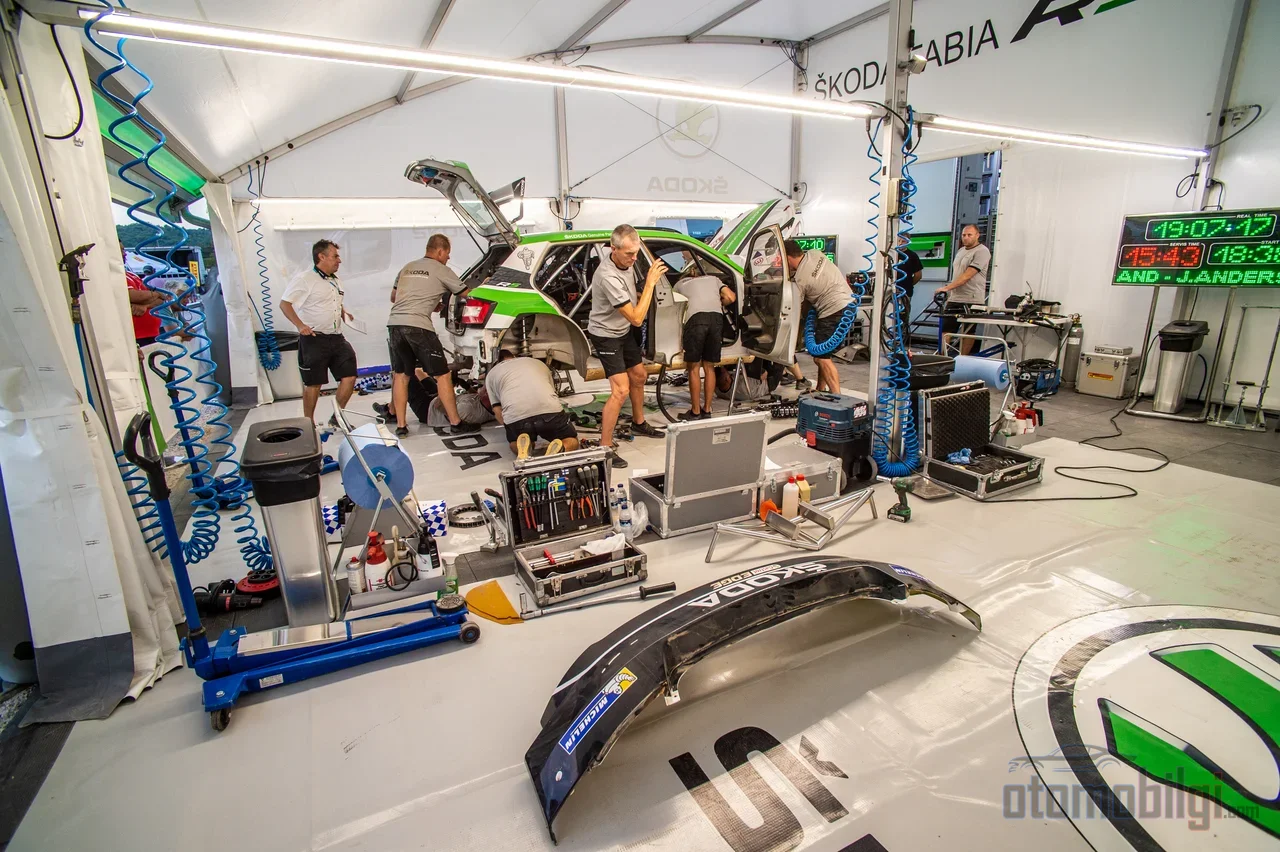
Service times can vary slightly from rally to rally, but the classic setup is as follows: morning service is 15 minutes, midday service is 30 minutes, and end-of-day service is 45 minutes. At some rallies, each service stop is set at 10, 30 or 45 minutes. There are exceptions too: at a Spanish asphalt rally, up to 75 minutes was allowed after the Friday stage, since switching from gravel to asphalt required changing tires, dampers, springs and brakes. In the 2026 season, the final service is subject to the Flexi Service rule.
So what exactly happens during those minutes? A standard stop looks something like this:
- Complete replacement of all four wheels and tires
- Checking and topping up all fluids
- A general tightness pass in which every nut and bolt is checked
- Reviewing damper and suspension settings
- Wear inspection of all four brake discs
- Reading of onboard data systems and analysis by the engineer
- Cleaning the windshield and washing the car
Wiping the windows may sound like luxury, but it's not: it is much harder to spot a crack or damage on a dirty car. So washing is actually a safety precaution. The car is lifted onto four triangular stands for technicians working divided by their areas of expertise; one mechanic at each corner, one technician in the engine bay. The team chief watches the whole process, notes the problem areas and counts down the remaining time out loud. Just like a chef shouting "plates are going out!" in a kitchen, except here every second means points.
This is why the service park is the stage for the rally's unsung heroes. When a heavily damaged car returns to service, almost the entire crew gathers around a single car and a repair marathon compressed into minutes begins. For cars continuing under the Super Rally rule, mechanics are given a 3-hour rebuild period overnight; after that, the car must be moved into secured parc fermé.
What Is Prohibited Outside Service? Parc Fermé and DIY Rules
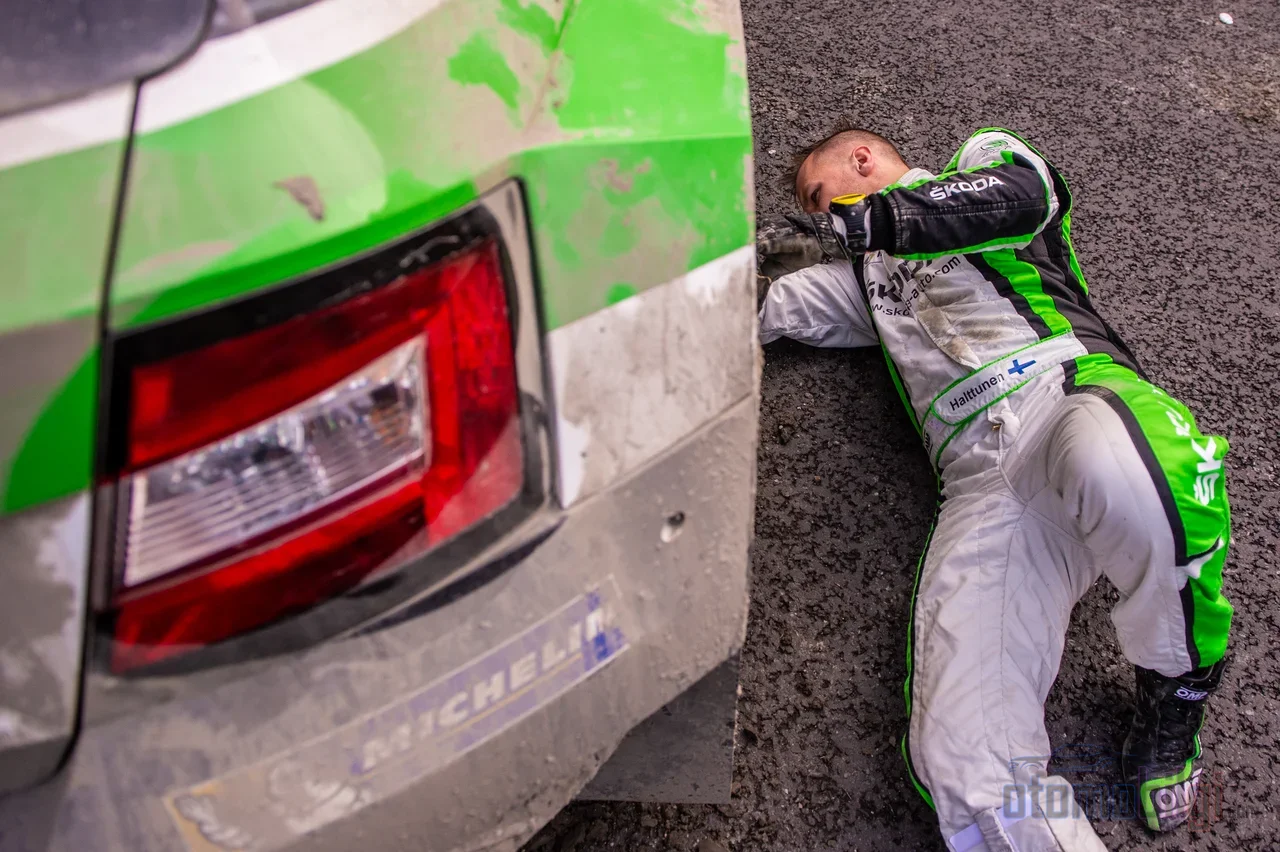
Once the service periods are over, the rule is simple: the only touch-up right now belongs to the duo at the wheel. The driver and co-driver are the car's only mechanics between services. They can accept spectators' help to push the car out of a ditch, but changing a tire or repairing damage is their job. No technical assistance from outside is allowed - no tool, no advice.
If structural damage occurs, things get even harsher: welding to continue is forbidden, because such a repair is only possible in service. A crew facing a problem that cannot be solved at the roadside has two options left: either limp slowly back to service or retire from the rally. In Türkiye too, the TOSFED National Rally Rules follow the same logic; outside the service areas, any maintenance, repair, refueling and servicing by persons who are not crew members is prohibited.
Another critical prohibition is fuel: refueling with cans or barrels is not allowed in the service park. Moreover, these rules do not exist only on paper, but for safety as well; FIA officials are present in the service tents, inspecting every operation. At night, the cars are not free - they are locked in secured parc fermé and not opened to anyone until morning.
Tire Strategy: How to Plan with a Limited Number of Tires?
The number of tires in rallying is not free; an upper limit is set for each event. In 2018 this limit was around 20 tires per car, while in the 2023 season Rally1 drivers could use a maximum of 28 tires throughout the rally, including shakedown. In addition, starting in 2023, tire warming zones (TWZ) that organizers could optionally add were defined.
This limit, combined with the service constraints, creates a serious strategy game. Tires are selected based on the surface type, air temperature, and the length of the loop. A wrong tire choice can cost seconds on a stage, and using the limited tire supply in the wrong place can leave the team exposed toward the end of the rally. The service crews act according to this plan too: which tires will be changed, and which ones will last one more loop? The answers to these questions are given within minutes in the pit.
Team Logistics: Mobile Workshops and Intercontinental Spare Parts Operations
Perhaps the least talked about but most impressive aspect of the WRC is its logistics. Teams transport everything needed for each championship rally - the cars, spare parts, tools - by air, land, and sea. For intercontinental moves, the job is entrusted to giant sea containers: some of the containers a team ships contain 5 recce cars, a kitchen, two workshops, and a spare parts stock. In other words, that gleaming tent you see in the service park is actually a portable factory that has come from the other side of the world.
There are no wind tunnels or giant laboratories; in rallying, engineering is on the move. Engineers reading data inside the service tent, technicians who turn the results into suspension settings within seconds, and the mechanics who keep the team running all work under the same roof. The organization also covers customer teams: some manufacturers send a spare parts truck to selected events, and teams can buy the parts they need directly from the service area.
The Service Park in Türkiye: The Pit on the Hill Above Marmaris
Türkiye took an early step in rally history: professional rallying began in 1972 with an event organized by Ali Sipahi. The country entered the World Rally Championship calendar in 2003 and hosted the WRC event for three years until 2006; it was removed from the calendar in 2007. When it returned in later years, the location of the service park also remained memorable: at the 2019 Rally Türkiye, the service area was set up on a hill close to the center of Marmaris, and spectators could watch the mechanics' race against time right from outside the tents.
By the way, did you know that the service park is open to spectators? You can't go inside the tents, but you can stand outside and watch the technicians at work. In my opinion, if you go to a rally, it's worth spending at least half an hour here, just like at the stages - once you see how the team breathes, you start reading the car's stage runs with completely different eyes.
Penalty Rules: The 10 Seconds Per Minute Reality
The time you spend in service is not a target, it is a strict limit. Exceeding your time is penalized with a time penalty. Additionally, arriving late (or even early) at the time controls at the entrance and exit of the service park also incurs a penalty; this penalty is generally applied as 10 seconds per minute. The limits are also clear: a 30-minute delay at a time control or stage, or a 60-minute delay at the rally, can result in disqualification. So a technician in the pit "counting down the remaining time out loud" is not a luxury at all, but a necessity.
Frequently Asked Questions: Things People Wonder About the Service Park
What happens if the car breaks down outside of service?
Since outside assistance is forbidden, repairs fall entirely to the driver and co-driver. If the problem cannot be solved at the roadside, the only option is to limp slowly back to service or withdraw from the rally. If there is structural damage, welding it up and continuing is also not possible, so the race ends.
How much is the penalty if I am late?
The general rule is 10 seconds per minute. At larger delays, thresholds come into play: a 30-minute delay at a time control or stage, or a 60-minute delay at the rally, can result in disqualification.
Where do the cars stay overnight?
After the end-of-day service, the vehicles are locked away in secured parc fermé. Until morning, no one can even open the hood - everyone starts the new day on equal footing.
Final Word: Who Actually Wins the Rally?
On the stages, it is the driver's skill that gets talked about, and it is they who lift the trophy. But there is also this truth: the heart of a rally weekend beats in the service park, and the ones who keep that heart beating are the technicians who rebuild the car in 30 minutes against the stopwatch. The next time you watch a rally, try pointing your camera at the service area during a lull that coincides with a mid-stage service - the rally's real thriller may be filmed there.
Sources
- What Happens at Service Park | Beginner's Guide to Rally
- ABC of Rally - Rally Türkiye | WRC
- This is how WRC works
- ABOUT WRC
- WRC A-Z
- Knowledge Is Power. WRC Dictionary
- The most common WRC questions answered
- Rally Guide 1 - Rally Japan
- Supplementary Regulations - Rally Islas Canarias 2026
- Škoda Motorsport truck: a load of parts to support customers
- What it takes to move a WRC operation across continents
- What's changing in WRC this year
- TOSFED Rulebook - National Rally Regulations
- Event History - ETİ Odunpazarı Esok Rally