Where Does the Electricity Lost During Charging Go?
Share This Page
Electricity lost during charging is the portion of energy drawn from the grid that turns into heat before reaching the battery and is consumed by auxiliary systems; electric vehicle charging typically operates at 80-95% efficiency , meaning 5-20% of the electricity you pay for is not stored in the battery. This loss does not occur at a single point: AC-DC conversion, cable resistance, connector resistance, and the battery management system's consumption stack up. The difference between the kWh you see on the meter and the charge amount your vehicle displays is the sum of this chain.
Highlights
- Typical charging efficiency is in the 80-95% range; it is lost as heat and auxiliary consumption.
- Slow AC charging operates at 90-95%, while DC fast charging generally operates at 85-90% efficiency.
- A typical Level 2 cable plugged into a 32 A circuit can generate 100-300 watts of heat during charging.
- Charging from 80% to 100% noticeably increases losses compared to the 20-80% range.
- A driver traveling 1,600 km per month may consume approximately 350-400 kWh of extra electricity due to efficiency losses.
What is charging efficiency and how is it calculated?
Charging efficiency is the ratio of energy drawn from the grid to the energy actually stored in the battery. The formula is simple: you divide the energy stored in the battery by the energy drawn from the grid and multiply by 100. For example, if 60 kWh passed through the meter but only 54 kWh reached the battery, the efficiency is 90%; the remaining 6 kWh went to heat in the cable and connector, electronic loss in the conversion stage, and the operation of the battery management system.
Measurements show that AC/DC conversion efficiency can vary over a wide range during charging: academic measurements have shown a 83.5-99.2% band. The reason for this width is that efficiency shifts depending on charging power and component quality. A 2024 measurement revealed that in low-power regions where AC charging power drops below 25-40% of the nominal value, efficiency can fall below 85%. In short, the same device operates at different efficiencies depending on the operating point, even in the same vehicle.
Where does the loss go: four main consumption points
Reducing the loss to a single item would be misleading. On the path from the outlet to the battery, energy leaks at four separate points, and each has a different share.
AC-DC conversion: the largest item of losses
The grid provides you with alternating current (AC); your battery stores direct current (DC). This conversion is done in the on-board charging unit inside the vehicle for home charging, and at the station for DC fast charging. The losses of the conversion electronics layer can account for 10-15% of the total efficiency loss; in chargers with quality components and good cooling, this rate drops to 5-8% . The industry's direction is also clear: by 2030, conversion efficiency is projected to rise to the 88-95% band.
Heat in cables and connectors
Every conductor has resistance, and lost current turns into heat according to the product of the square of the current and the resistance, i.e. the I²R principle. A typical Level 2 charging cable has 0.1-0.3 ohms of resistance; at a 32-amp charge, this means 100-300 watts means. Low-quality or damaged cables can double or triple this loss. Long, thin-gauge extension cables amplify the same mechanism.
The battery management system's share
The battery management system (BMS) does not sleep during charging: it balances cells, monitors temperatures, and runs safety circuits. These functions can consume 2-5% of the charging energy. Additionally, while the vehicle is parked, the BMS and safety and connectivity systems can consume standby power at a level of 0.5-2 kWh per day depending on the model; charging stations also draw 5-20 watts of standby power while plugged in. If the vehicle remains plugged in even after it is full, the meter keeps turning.
Is fast charging or slow charging more efficient?
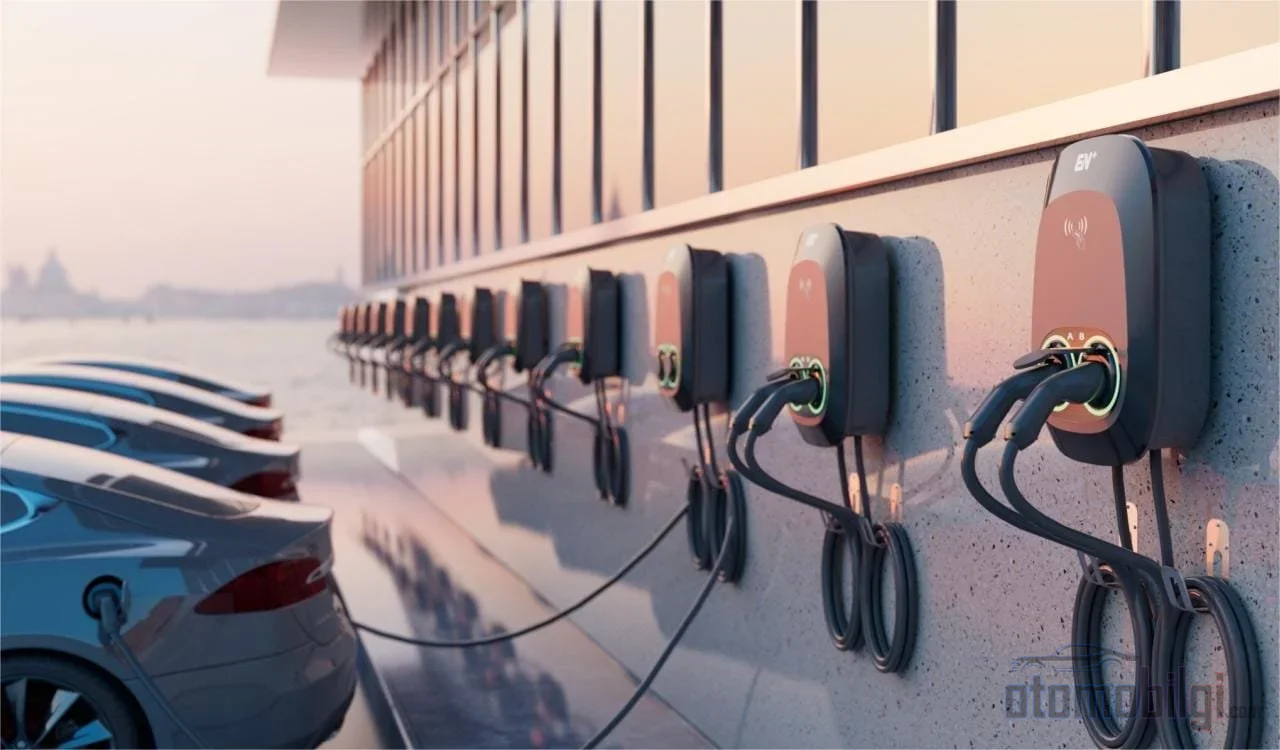
Contrary to intuitive expectation, the fastest charge is not the most efficient charge. DC fast charging bypasses the on-board charger, shifting the conversion to the station, but generally operates at 85-90% efficiency due to high currents. Slow and medium-speed AC charging, on the other hand, can reach 90-95% efficiency; many vehicles approach peak efficiency at around 60-80% of maximum charging speed. Although the manufacturer data of a 90 kW DC station shows 92-94% efficiency, field-measured values usually drop to around 90%; the difference comes from the interaction between the station's power electronics and the battery's acceptance behavior.
The final stretch of charging deserves a separate heading. In the 80-100% state of charge (SoC) range, losses roughly double compared to the 20-80% range: as the battery fills, acceptance voltage rises, current decreases, and constant auxiliary consumption takes an increasingly larger share. In daily use, staying within the 20-80% band is a sensible choice both for efficiency and battery health.
Why do losses increase in winter?
Lithium-ion batteries operate optimally between 20-25°C. When the temperature drops below 0°C, the cell's internal resistance increases, chemical reactions slow down; the vehicle may sometimes use 20-30% more electricity to heat the battery. In very cold regions, drivers report drops of up to 30-50% in effective charging efficiency. On the hot side, the picture deteriorates in the opposite direction: in temperatures above 40°C, cooling systems add a 10-20% extra load to charging energy, and stations may restrict the power they deliver.
This picture turns where and when you charge into a strategic decision. Charging in an enclosed space such as a garage provides an environment 5-10°C warmer in winter and can increase efficiency by 10-15% in extreme weather. On cold days, plugging in immediately after driving, while the battery is still warm, reduces heating energy; on hot days, charging at night eases the cooling load. Preconditioning while plugged in also draws heating power from the grid.
How much does the efficiency loss show up on the electricity bill?
Rather than leaving the loss as an abstract percentage, let's convert it to lira. A driver traveling an average of 1,600 km per month consumes about 350-400 kWh of extra electricity per month, including efficiency loss. In Türkiye, home charging at the residential tariff costs roughly per kilowatt-hour 2.33-5 TL keeps it within a range; the night tariff can lower this figure to a 3-4 TL band, and with a suitable subscription down to 3.26 TL. The picture is different at public stations: as of August 2026, AC charging is 9.90-11 TL/kWh, while DC fast charging is around 12.90-15.95 TL/kWh . Charging a 60 kWh battery at home costs 240-360 TL, while the same job at a station comes more than half as expensive.
Let's set up a scenario to make the effect of efficiency on your bill concrete: a vehicle with a 75 kWh battery charges five times a week, and let's say the tariff is 3 TL per kWh. At 85% efficiency you draw roughly 88 kWh from the grid at each session; when you raise efficiency to 92%, the same charge drops to 82 kWh. A 6 kWh difference per session means roughly 1,300 kWh a year, or about 4,000 TL. This calculation shifts depending on the assumptions you make with your home tariff, but the logic is constant: every point of efficiency is directly reflected in your bill.
| Charging scenario | Typical efficiency | Main loss item |
|---|---|---|
| Slow/medium-speed AC charging (home, wallbox) | 90-95% | AC-DC conversion in the on-board unit |
| DC fast charging (station) | 85-90% | Power electronics and heat loss at high current |
| Low-power AC charging | Can drop below 85% | Proportional growth of fixed auxiliary consumption |
| 80-100% charge range | Losses are doubled | Decreasing acceptance current, increasing proportional loss |
What should you do to reduce losses?
Eliminating loss entirely is physically impossible, but a few percentage points can be gained with small decisions. The most effective measures are:
- Use the shortest possible, thick-gauge, high-quality copper cable; keep connections clean and tight.
- Charge in an enclosed space such as a garage in winter; plug in the vehicle while the battery is still warm after driving.
- In daily use, charge within the 20-80% range, and leave a full charge for before a long trip.
- Unplug after a full charge and use scheduled charging to keep both standby consumption and your bill under control.
- When buying a wallbox, prefer a certified Level 2 device with at least 85% efficiency.
An additional note on wallboxes: a charge that takes up to 30 hours on a standard outlet drops to 8-10 hours with a wallbox delivering 3.7-22 kW of power. Cable gauge, required permits and load management are critical in the installation; these three factors determine both safety and long-term efficiency.
Conclusion: accept the difference, don't let it grow
The 5-20% difference between the meter and the battery is not an error, but the inevitable accounting of electrical engineering. What matters is not the existence of the difference but its size: charging in the right power zone, choosing the right cable, managing temperature and making the habit of stopping at 80% allow you to cover the same distance with fewer kWh. In engineering terms, this is a free gain.
Sources
- EV Charging Energy Loss Explained & Reduced
- Charging Efficiency Explained: A Complete Guide
- Data analysis and estimation of the conversion efficiency (Iwafune et al., 2024)
- Efficiency measurement and maximization for EV charging (Yasko et al., 2024)
- Experimental validation of onboard electric vehicle chargers (Sevdari et al., 2023)
- Is your EV battery getting all the energy you pay for?
- What is the charging efficiency of a 90kW DC fast charging station
- Electric Vehicle Charging Fees 2026
- Electric Vehicle Charging Prices 2026
- Attention Those Charging Their Electric Car at Home: The 5,000 kWh Limit
- Wallbox Installation for Home Charging 2026