How Does a Differential Distribute Power in Corners?
Share This Page
The differential is a gear mechanism that splits the torque produced by the engine and transmits it to the two wheels on the same axle, allowing the wheels to rotate at different speeds from each other. When a car enters a corner, the outer wheel must rotate faster than the inner wheel because it travels a longer distance; the differential manages this speed difference mechanically. In doing so, it follows one basic rule: the speed of the crown gear is the exact average of the speeds of the two wheels.
Highlights
- The differential distributes the power coming from the transmission shaft to the left-right wheel pair and allows for a speed difference.
- The speed equation is clear: the axle speed equals the average of the speeds of the two wheels.
- In an open differential, torque is always equal to both wheels; the wheel with the weakest traction sets the limit.
- The gear system works with three meshes and typically delivers 94-97% efficiency.
- The patent for automotive use was obtained by Onésiphore Pecqueur in 1827.
Why Must the Differential Exist?
You can solve the problem with a simple geometry experiment. Imagine taking a car into a tight corner: the outer wheel moves along a larger circle; the inner wheel traces the smaller circle. The outer wheel, which has to cover a longer distance in the same time, must rotate faster than the inner wheel. The difference is greater than you would expect; as the corner radius shrinks, the speed difference opens up.
Imagine the two wheels rigidly connected to the same shaft. In this case, the inner wheel slips under strain because it is trying to rotate faster than its own path requires; the outer wheel drags because it cannot rotate fast enough. This condition not only wears down the tire surface: it builds up constant stress in the axle shafts and throughout the entire drivetrain. Karting vehicles and some trams operate without a differential, but these are designs that deliberately accept wheel slip in corners; in a car, this solution is not sustainable.
This is why the differential has four separate tasks: thanks to the pinion and ring gear pair, to turn the direction of power by approximately 90 degrees, to split the power between the two wheels of the same axle, to increase torque through gear reduction, and to allow the two wheels to rotate at different speeds relative to each other. All four are solved within the same compact housing.
How Does the Differential Distribute Power in a Corner?
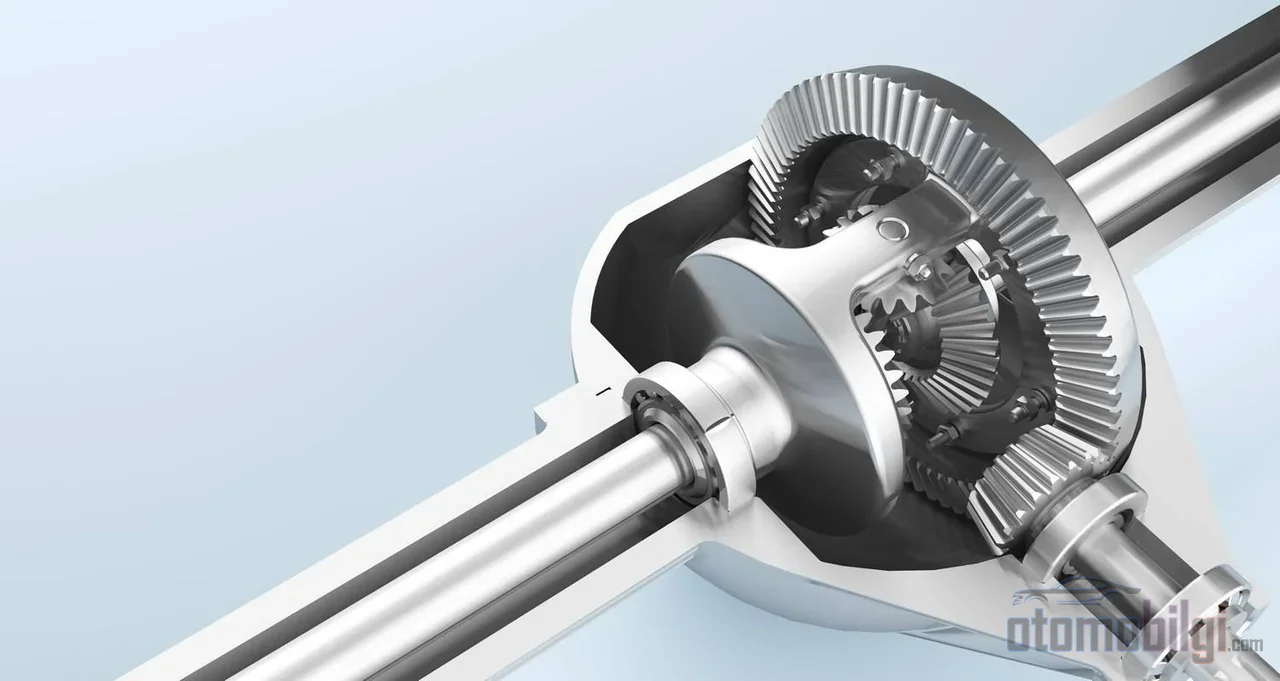
The answer lies hidden in its internal structure. The rotation coming from the transmission is transferred from the pinion gear to the ring gear; the ring gear carries the differential carrier. The small planet gears (spider gears) sitting inside the carrier connect the two sun gears (side gears) to each other, and the sun gears transmit the torque to the axle shafts. So the journey of power works like this: pinion, ring gear; ring gear, carrier; carrier, planet gears; planet gears, the two axles.
What changes when driving straight and in a corner?
On a straight road, both wheels encounter the same resistance and the planet gears do not rotate on their own axes; the system works as a single block, both wheels rotate at the ring gear speed. When you enter a left turn, the inner left sun gear shows more resistance. This difference in resistance rotates the planet gears on their own axes, and it is precisely this extra rotation that slows the inner wheel while speeding up the outer wheel at the same rate. The mechanism instantly converts the resistance difference into a speed difference.
The mathematical summary of all this is a single line: the rotational speed of the axle equals the average of the two wheels' speeds. However much the outer wheel speeds up, the inner wheel slows down by exactly that much; the total is preserved. This symmetry is the fundamental logic that makes the differential understandable.
On the efficiency side, the picture is also good: each gear pair contact creates a loss of about 1-2%. A system passing through three contact points from the transmission to the half shafts typically operates with 94-97% efficiency.
The Open Differential's Weak Point: Why Does the Wheel Spin Freely?
The most critical feature of the open differential is that it has a structure that transmits torque equally to both wheels. This seems harmless in a corner, but it produces a serious consequence when traction is lost: the torque going to both wheels drops to the level that the wheel with the least traction can hold. In short, the weakest wheel limits the entire axle.
Let's make it concrete. Let one wheel of your vehicle be on icy or muddy ground and the other on dry asphalt. The wheel on the ice cannot grip; the open differential directs power to this freely spinning wheel, and the wheel on dry ground, which could actually provide traction, receives almost zero power. The vehicle cannot free itself. Contrary to a common misconception, it does not direct power to the opposite wheel; on the contrary, it accumulates at the slipping wheel.
The same physics applies when exiting a corner. When exiting a corner with strong acceleration, the vehicle's weight shifts to the outside; this reduces the load on the inner wheel, and therefore its traction. The open differential begins to spin this lightened inner wheel, the throttle is cut, and you experience a loss of power. The equivalent while driving is familiar: when you accelerate mid-corner, the acceleration ahead of you is suddenly cut off, and the torque flows away uselessly.
What Difference Does a Limited-Slip (LSD) Differential Make?
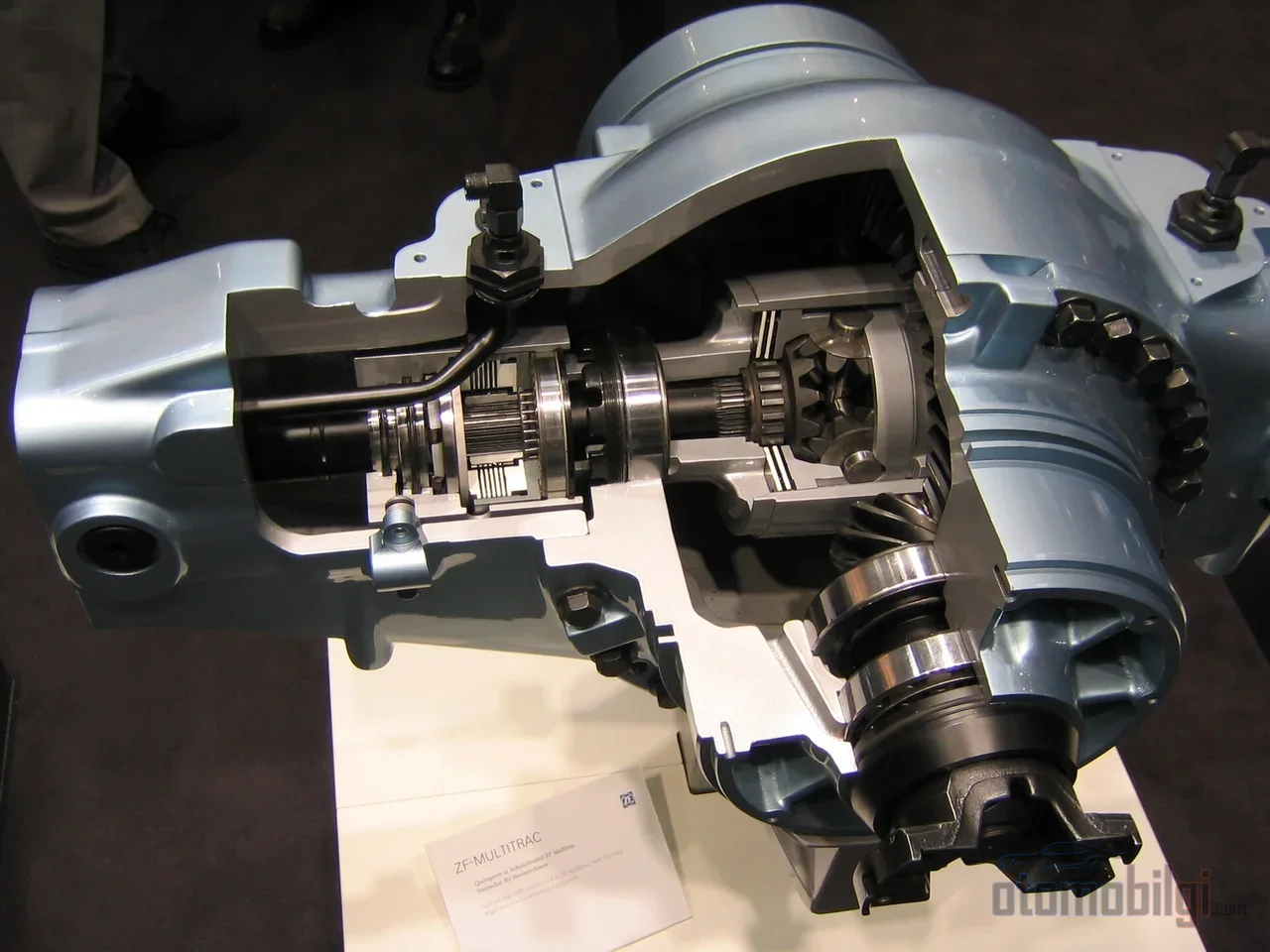
The limited-slip differential is the logical compromise between the open differential and the locked differential: it behaves like an open one under normal conditions, and starts to behave like a locked one when the speed difference between the wheels exceeds a certain threshold. This transition is usually provided by a clutch pack or a viscous coupling system.
Returning to the ice example above: when one wheel starts to slip, the LSD prevents the slipping wheel from freely over-rotating and ensures that torque is also transmitted to the wheel on dry ground. In the corner example, the result is this: when the inner wheel tries to spin freely, the clutch system applies friction to both sides of the axle and directs torque to the outer wheel. There is no throttle cut, and the exit acceleration is preserved. This predictable grip is the main reason the LSD is preferred in high-performance vehicles.
The LSD also has a known history: The Torsen-type limited-slip differential was patented by Vernon Gleasman in 1958. Beyond the purchase price, you also need to factor in that an axle with an LSD may require more maintenance than an open differential; clutch plates or viscous components wear out of service over time.
Locking Differential and Torque Vectoring: Solutions at Each End
The locking differential is a more radical approach: it turns both wheels together as a single shaft, regardless of traction conditions. It completely prevents a wheel from spinning freely and leaving you stranded in mud, snow, or rocky terrain; that's why it's most commonly found in off-road vehicles. But the trade-off is obvious: forcing both wheels to spin at the same speed in asphalt corners creates unwanted stress in the tire and drivetrain.
At the electronic end of the spectrum sits torque vectoring. This technology can send variable amounts of torque to each half-shaft and instantly orchestrates the inner-outer torque distribution within a corner. The result is greater stability and better cornering capability; you can think of it as software added as a layer on top of the differential's mechanical heritage.
Comparison of Differential Types
| Type | Operating principle | Standout feature |
|---|---|---|
| Open | Acts like an open differential normally, and behaves like a locked one once the speed difference exceeds a limit | Sufficient for everyday driving; directs power to the slipping wheel when traction is lost |
| Limited-slip (LSD) | Normally behaves like an open differential, but locks in once a limited speed difference is exceeded | Transmits torque to the wheel with traction via clutch or viscous coupling |
| Locked | Turns both wheels together as a single shaft | The strongest traction solution in off-road conditions |
| Torque vectoring | Sends variable torque to each half-shaft via electronic control | Improves stability and cornering capability |
A Surprisingly Old History
The roots of the idea reach back far further than the automobile. It is thought that the Antikythera mechanism (around 100 BC) may have contained a differential gear, but this is not certain. The first proven use of a differential belongs to Joseph Williamson's clock in 1720. Its entry into the automotive scene is an invention dated 1827: Onésiphore Pecqueur patented the differential for a steam wagon, defining the fundamental solution in our wheels today. Some sources suggest the mechanism also emerged in China in the 3rd century; however, this dating has not been definitively verified.
A Practical Way to Understand the Differential in Your Vehicle
One of the questions drivers ask most often is how to tell whether their vehicle has an open differential or an LSD. There is a practical indicator: when you launch at full throttle on dry ground, does one wheel spin, or do both wheels work together? A single wheel spinning freely is the classic signature of an open differential. In a vehicle with an LSD, on the other hand, you feel more predictable traction when cornering and on wet surfaces; tire wear is also distributed more evenly during aggressive driving.
Whether an LSD is really necessary in daily use is a debate that divides the driver community in two. While one side says it provides traction and safety in sporty driving, the other argues that, in ordinary use, an open differential allowing the loss of the rear with the slipping rear wheel is more defensible under some conditions. The honest engineering summary is this: an open differential is comfortable, efficient and cheap; an LSD, on the other hand, proves its worth on surfaces where you don't know where the torque will go. Your surface and driving style determine which one is right for you.
Conclusion: The Average-Taking Simple Intelligence
What makes the differential so elegant is that it solves two necessities at once without any complex control unit: distributing torque and allowing a speed difference. The speed-average rule quietly handles corners as the natural consequence of the resistance difference. The open type's weakness in traction loss is precisely the problem that LSD and locking types exist to solve. Behind that smooth traction you feel through a corner lies roughly two centuries of engineering intelligence that can be summarized in a single line of mathematics.
Sources
- Differential (mechanical device) - Wikipedia
- 2.972 How A Differential Works - MIT
- How Does a Differential Work | Diagram, Animation, and Images - H&R Parts
- How Does A Differential Work? - MAT Foundry Group
- How does a differential gear work? - tec-science
- Limited-slip differential - Wikipedia
- Understanding the Differences: Open, Locking, Limited Slip - AZ Backroads