How Does a Dual-Mass Flywheel Absorb Vibration?
Share This Page
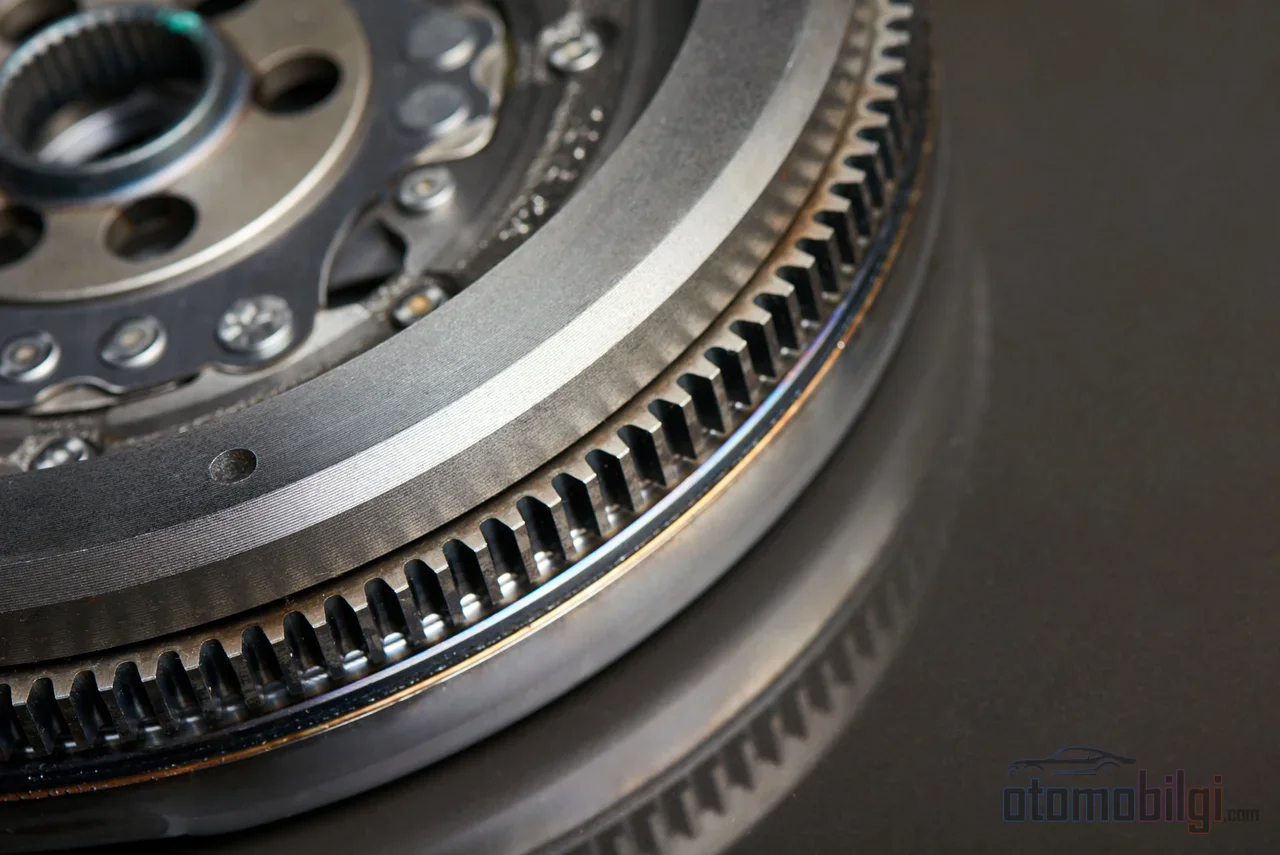
A dual-mass flywheel is a type of flywheel consisting of two separate masses that damps the torsional vibrations coming from the engine before transmitting them to the transmission and the driveline. Its primary mass works connected to the crankshaft, while its secondary mass transmits torque to the clutch; the spring and damping system in between eliminates idle vibration and shift harshness, especially in diesel and high-torque engines.
Highlights
- The resonance zone is shifted to an rpm range lower than the usual 1200–2400 rpm band, thus providing damping even at idle.
- A 4-cylinder engine 3000 rpm performs 6000 ignitions per minute at 1200 rpm this number drops to about 40 per second, and the vibration becomes pronounced.
- In most vehicles, the service life is expected to exceed 160,000 km excessive heat is its greatest enemy.
- A dual-mass flywheel cannot be repaired and can only be replaced; the total cost along with the clutch can reach 1000–2500 $ band.
Why Does the Engine Vibrate: Combustion-Induced Torsional Oscillations
Power production in an internal combustion engine is intermittent. During the power stroke in each cylinder, the in-cylinder pressure rises rapidly and sends a torque pulse that peaks at the crankshaft. Each cylinder of a four-stroke engine fires only once in two crankshaft revolutions; that is, the torque it applies to the crankshaft is not a smooth line but a sequence of pulses arriving one after another. Since these pulses twist and release the crankshaft, oscillations known as torsional vibration arise.
The intensity of the vibration is directly related to engine speed. A 4-cylinder engine performs 6000 ignitions per minute at 3000 rpm; that means 100 pulses per second, a flow of pulses whose differences are almost imperceptible. When the engine speed drops to 1200, however, the number of ignitions falls to about 40 per second, and each pulse begins to separate from the previous one. The situation is even more concrete in the idle zone: an engine running at a nominal 975 rpm fluctuates rapidly between 925 and 1050 rpm even within a sampling window of only 100 milliseconds.
When this irregularity reaches the transmission input shaft, it causes the gears to strike each other, that is, the rattling noise known as idle rattle. A single-mass flywheel does not solve this problem, because its mass is firmly connected to the crankshaft and transmits the pulses as they are. The solution to the problem was to cut the vibration not at its source, but along the transmission path.
How Does a Dual-Mass Flywheel Work?
A dual-mass flywheel is a single-piece steel disc divided in two. The primary mass is bolted to the crankshaft and carries the starter ring gear; the secondary mass transmits torque to the clutch disc. The two masses can rotate relative to each other on a ball bearing or a plain bearing; the connection between them is established by a spring system seated in spring channels and lubricated with grease. Passive damping takes place right here: the pulses from the crankshaft first load onto the primary mass, the energy is stored in the springs and damped during the rotation of the springs; the torque reaching the secondary mass is noticeably smoother than when it arrived.
Spring design is not uniform. Single-stage, two-stage parallel, series, and three-stage arrangements exist; the aim is to match the damping characteristic to the engine's torque curve and the vehicle's usage profile. In some designs, the allowance for angular displacement is particularly large; for example, solutions offering working angles of up to 80 degrees engage two separate spring sets in series to filter even the harshest shocks at start-up.
There is also a separate physical side to the matter: adding extra mass to the transmission input shaft shifts the resonance range - normally the 1200–2400 rpm band - to a lower speed. The result is complete damping even at idle, leaving the system at ease in the rev ranges where the engine operates most. That is why in vehicles with a dual-mass flywheel, the clutch disc is usually of the rigid type without its own torque damper; the damping task is already solved in the flywheel.
Why Do Diesel and High-Torque Engines Need This Part More?
A diesel engine operates with compression ignition, and its compression ratios are markedly higher than those of a gasoline engine. High compression means a harsher pressure rise at the start of combustion; torque spikes on the crankshaft grow. When low idle speed is added to this, the picture gets even worse, because as we saw just above: as the number of ignitions decreases, the pulses separate from one another and the vibration becomes more pronounced. Since diesel also dominates usage habits with high torque at low revs, the dual-mass flywheel became standard equipment on these engines years ago.
Two trends of the last fifteen years carried the job over to gasoline engines as well: downsizing and downspeeding. For fuel consumption and CO2 targets, cylinder volume is reduced - a turbocharged four-cylinder replaces a six-cylinder, with power preserved through forced induction - and maximum torque is pulled to a lower rev range; torque peaks dropping from 2500 rpm to 1500 rpm are now commonplace. Mass inertia has decreased, torque drawn at low revs has increased; the combination of the two means higher crankshaft vibration. Today, in some modern high-torque gasoline and diesel engines, even a classic dual-mass flywheel may not be sufficient; in that case, developers move on to advanced designs carrying a centrifugal pendulum absorber.
Single-Mass vs Dual-Mass Flywheel Comparison
| Feature | Single-Mass Flywheel | Dual-Mass Flywheel |
|---|---|---|
| Construction | Single-piece steel/metal, no moving parts | Primary + secondary mass, with spring and damping mechanisms |
| Vibration transmission | Transmits crankshaft pulses directly to the transmission | Dampens the pulses in the springs and transmits smooth torque |
| Comfort | Low; idle vibration and gear rattle are felt | High; smooth gear shifts and quiet idle |
| Throttle response | Sharper and quicker-revving thanks to lower inertia | Somewhat soft/deliberate due to added mass |
| Cost | Significantly cheaper | At least twice the price of a normal flywheel; typically 800–1100 $ per part |
| Typical use | Low-torque engines, performance and conversion projects | Diesels, high-torque turbo engines, comfort-oriented vehicles |
The summary from the table is this: since the single-mass flywheel is lighter and has reduced rotational inertia, it offers sharper throttle response; the dual-mass flywheel wins on the side of comfort, freedom from vibration, and fuel economy. The trade-off between the two is an engineering choice, not a superiority contest. It should be added that even in performance-oriented single-mass flywheels, sprung damper designs are used; because a completely rigid disk puts the transmission at risk at high torque.
What Are the Symptoms of a Faulty Dual-Mass Flywheel?
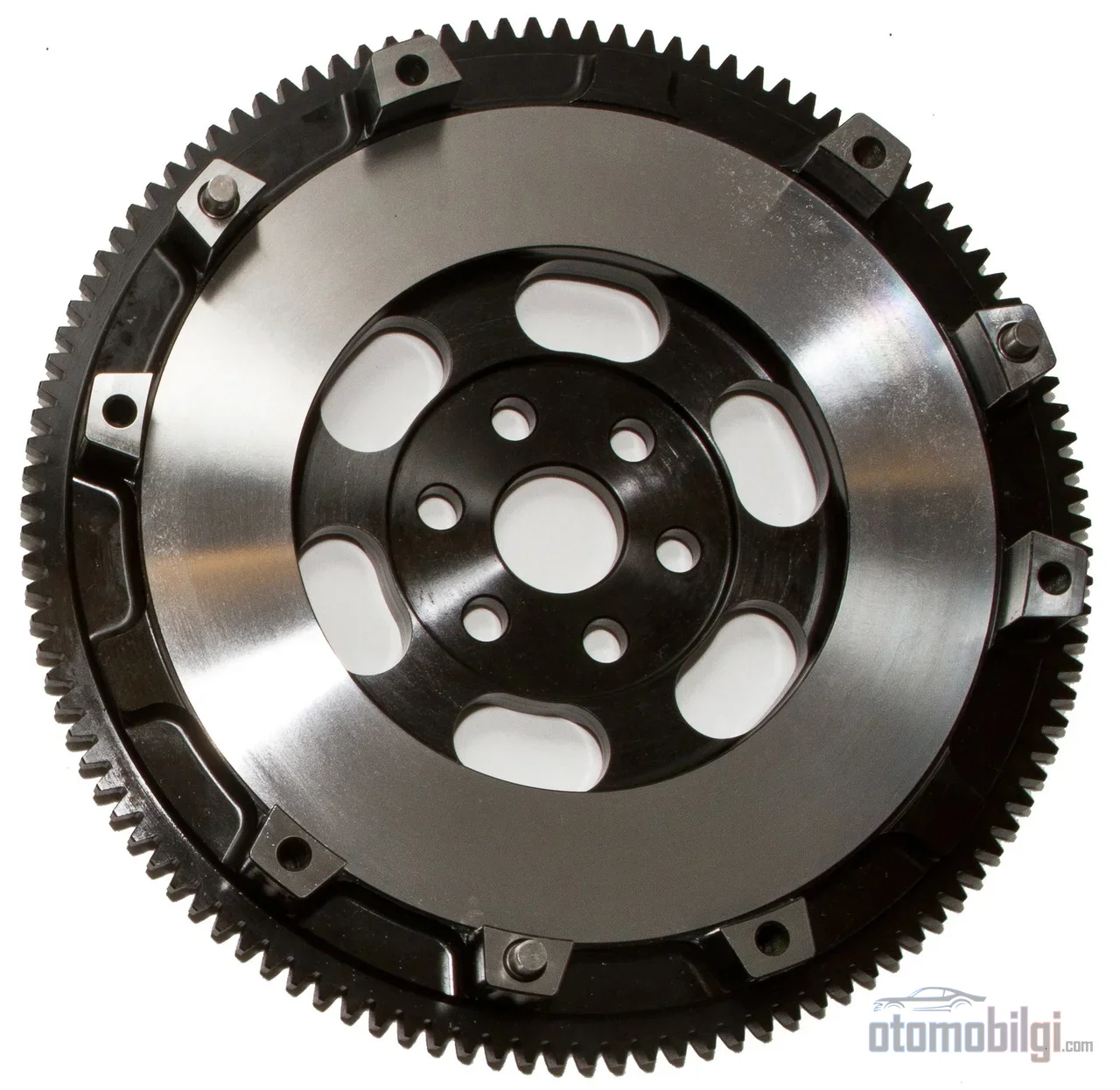
A dual-mass flywheel failure is a part that announces itself; its symptoms are usually felt most clearly at idle. As the springs and damping elements wear, the controlled play between the two masses grows, the impacts can no longer be fully dampened, and vibration reaches the steering wheel and seats. The three basic signals to watch for are:
- Noticeable, severe vibration in the steering wheel and seats at idle; the body rumbles even when the tachometer appears steady.
- Rattling and clatter sounds when the clutch is released; the transmission gears knock against each other.
- Clutch judder, difficulty engaging gears, and fluctuating revs; in some vehicles a roughness that worsens only around 1200 rpm is noticed.
The failure does not follow a single path; different forms of wear in the internal architecture produce different vibration signatures. For this reason, in some vehicles the symptom is only a slight roughness at idle, while in others it appears as unusual behavior such as a need to downshift at high revs. The common rule is this: excessive rattling and abnormal noises almost always signal the onset of this flywheel's failure, and delaying diagnosis puts the transmission at risk too.
Driving Habits That Extend and Shorten Its Lifespan
In most vehicles, the lifespan of the dual-mass flywheel is expected to exceed 160,000 km. Driving style shifts this figure significantly in both directions: with gentle use the part can last the vehicle's lifetime, while aggressive use can noticeably shorten it. The biggest damaging factor is excessive heat; harsh acceleration-deceleration cycles and the habit of holding the vehicle on the clutch at stops accelerate the heating of the springs and damping elements.
There are a few behavioral rules that make things easier in practice: holding the vehicle on a hill with the clutch without fully releasing it, making flashy clutch slips at takeoff, and holding the clutch at the halfway point for a long time in stop-and-go traffic all directly shorten this part's lifespan. None of these is a mechanical margin without consequences; the springs in the flywheel absorb energy with every slip, and this energy turns into heat, wearing out the damping elements.
Replacement Cost: No Repair, Only Replacement
In the dual-mass flywheel, the springs and damping system between the masses cannot be serviced; the part cannot be repaired, only replaced. This directly determines the cost picture: the list price of the flywheel alone is typically $800–1100 range; a few hundred more dollars are added for the clutch kit and labor. As of 2026, most general flywheel replacements are completed between 600-1500 $ , while in vehicles with dual-mass flywheels the total reaches 1000-2500 $, and in some cases exceeds it. Therefore, the workshop opening up the job is expected to follow three rules: never attempt to repair the flywheel, install the new flywheel's bolts at the manufacturer's torque values, and always replace the clutch kit as a complete set - an old disc and new flywheel pairing will fail again in the short term.
The natural result of the high cost is the conversion question frequently asked in workshops: does it make sense to switch to a single-mass flywheel? Some diesel users advocate this conversion on the grounds of long service life and low part cost. The opposing argument is also concrete: the torsional loads damped by the dual-mass flywheel fall directly on the transmission gears and the driveline in a single-mass design; in addition to the loss of comfort, there is the risk of driveline wear. This risk should not be ignored in conversions not performed with manufacturer calibration.
Conclusion: The Price of the Part That Absorbs the Shudder
The dual-mass flywheel is an elegant engineering choice that solves the engine's indispensable flaw - pulsating torque production - before it reaches the transmission. The high compression of diesel engines and the downsizing trend of modern engines have placed this part at the center of today's drivelines. The price is the eventual necessity of complete replacement; but its expected lifespan of over 160,000 km is a genuinely attainable goal with the right usage habits.
Sources
- Dual Mass Flywheel (DMF)
- Dual Mass Flywheel origins and development
- The Dual Mass Flywheel - Schaeffler Symposium
- Dual Mass Flywheel for Torsional Vibrations Damping
- Dual-mass flywheel
- What is a dual mass flywheel? - RAC
- Dual-Mass vs. Single-Mass Flywheel: What's the Difference?
- Single Mass Vs. Dual Mass Flywheels - AmTech OEM
- Dual Mass Flywheel Failure: Symptoms And Replacement Cost
- How Much Does Flywheel Replacement Cost in 2026?
- Dual Mass Flywheel Replacement - Underhood Service
- What Is a Dual Mass Flywheel? DMF Function and Care