How Does Drafting Determine the Race Outcome in NASCAR?
Share This Page
In NASCAR, drafting means tucking in behind another car to break air resistance, and on oval tracks it is the real trump card of racing: a car that enters the low-pressure air zone left by the car ahead goes faster with less drag, and the two together can even run quicker than a single car. Pit window calculations, green flag stops, and last-lap slingshots - most of the time this invisible air game determines the outcome of the race.
Highlights
- Drafting works strongest at high speed; a pair of cars running at 200 mph (~320 km/h) experiences 16 times more drag than a car at 50 mph.
- Daytona is 2.5 miles, Talladega 2.66 miles - the superspeedways are the royal lands of drafting.
- At Daytona in 2011, the Brad Keselowski-Kyle Busch tandem drafted laps 15 mph faster than a single-car lap.
- Kevin Harvick ended a 115-race winless streak with a last-second slingshot at Talladega in 2010.
- At short tracks like Phoenix, a lap takes 26-28 seconds; pit road is a separate strategy layer there.
The Physics of Drafting: Why Are Two Cars Faster Than One?
Think of it this way: pedaling alone against the wind on a bicycle is hard, but if you tuck in behind someone, they do the wind's work and you just glide. That is exactly what happens in NASCAR. As the lead car moves forward, it leaves a turbulent, low-pressure wake behind it. When the second car's nose enters this zone, the high-pressure air hitting its nose decreases; that means less aerodynamic resistance, meaning less drag.
Here is the beautiful part: the lead car also benefits from this. As the car behind approaches, it pushes the high-pressure air in front of it forward, which reduces the fast air hitting the lead car's spoiler. The result? Less drag and higher speed for both cars. According to airflow simulations, two cars that get close enough begin to behave almost like a single long aerodynamic body; when the distance shrinks further, the lead car's wake nearly disappears entirely.
So why doesn't it work on every track? Because drag increases with the square of speed. At 50 mph you barely feel it, but at 200 mph the figure grows exponentially. That is why the drafting effect is truly felt at speeds above 80 km/h - and NASCAR ovals are always in that region anyway.
Drafting in numbers: a simulation example
Let's look at a concrete example: for a single car running at about 180 mph, the drag coefficient (CD) is around 0.805, while for a car following just one axle distance behind (about 3.5 meters), this value drops to 0.625. In other words, the car at the back gains speed almost "for free." Well, not exactly free, because it also loses front-end downforce in the corners - we will get to that shortly.
Superspeedways and the Dynamics of Pack Racing
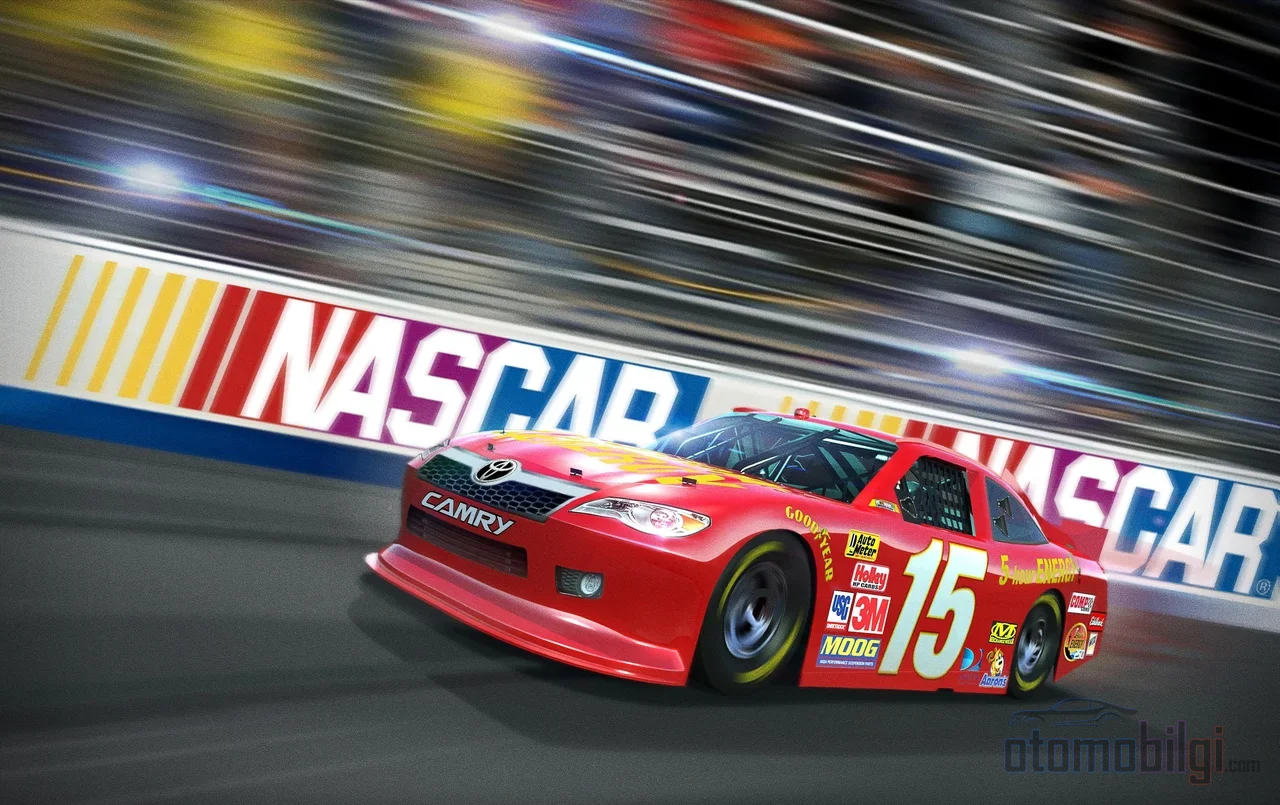
The real stages of the draft are the big ovals: Daytona International Speedway (2.5 miles) and Talladega Superspeedway (2.66 miles). Talladega is the largest oval on the calendar, while Daytona hosts the biggest race of the season, the Daytona 500. In the past, these tracks used restrictor plates; the plates limited the engine's power to push the large bodies through the air, and since the highest speeds were seen here, aerodynamic effects were felt most strongly. Today the plates have been replaced with the tapered spacer, but the term "plate track" is still used to describe this superspeedway style.
Racing at these tracks is generally not about escaping one by one, but about circling in a big pack - pack racing. The logic is simple: a car alone has no draft and cannot pass, so everyone leans on each other's slipstream and moves forward like a giant flock of birds. Breaking away from the formation you're in means facing air resistance alone; sometimes you even need to lean on a rival to move forward. That's why the draft in pack racing is like loyalty: if someone is pushing or pulling you, you hold your position, otherwise the pack swallows you.
Intermediate tracks and the dirty air problem
Ovals between 1.33 and 2 miles, the intermediate tracks, tell a different story. Here the cars race more scattered and the following car has a harder job. The reason: dirty air, meaning the disturbed, turbulent air left by the car ahead. While at a superspeedway this air gives you speed, at intermediate tracks it tires the front end of your car in the corners; it gives the car behind what's called "aero push," the feeling of your nose struggling to turn in. Because of this effect, similar to what happens in open-wheel racing, passing becomes harder - as long as the car ahead leaves its dirty air behind, it makes staying in the lead easier.
Slingshot: The Most Dramatic Move of the Final Lap
The most talked-about maneuver related to drafting is the slingshot. Toward the end of the straightaway, the follower uses the wake of the car ahead to build up maximum momentum, then suddenly pulls out alongside. The physics is elegant: up to that moment, air resistance was fighting you while your follower wasn't fighting it, and the instant he pulls alongside, he releases the energy he has stored up. He enters the corner with a high line, cuts through the leader's wake, and slides down - the combination of the drop and passing through the lowest-drag zone carries him past the leader.
Let's give two examples from history: Dale Earnhardt Jr. made a slingshot jump from 4th to 2nd with 12 laps to go at Daytona. Even more striking is Kevin Harvick: at Talladega in 2010, he passed Jamie McMurray with a last-second slingshot and a winless streak of 115 races was ended with that move. Watching it, I get goosebumps, I tell you.
But be careful: the slingshot wasn't equally effective in every era. In the restrictor plate era, cars didn't have enough power to sustain draft speed on their own, so you lost speed the moment you pulled out and often had to fall back in behind. That's why passing on plate tracks is done more through cooperation, even with a technique called side drafting: you "suck" the air from beside the rival next to you, meaning you pull the air hitting their side surface toward yourself, slowing them down while you pass through the gap. It's an advanced trick, but the effect is incredible.
Bump Drafting: The Excitement and Risk of Push Drafting
Bump drafting starts like a normal draft but takes it one step further: the trailing car actually makes contact with the car ahead, pushes it, and the momentum of both is preserved. Its popularity began in the late 1980s in the SCCA Sportruck series with the Archer Brothers. Done smoothly and properly, it's great, but in the wrong place - for example, near a corner entry - it destabilizes the leading car and causes crashes. Its rough use is called "slam drafting" and NASCAR punishes it: it limited bumper reinforcements, banned bump drafting in corners, and designated "no bump zones" in certain track sections.
The story of the two-car tandem draft going to the extremes is also interesting. Kyle Busch asked Ryan Newman to push him from behind during the 2007 Talladega test, and they found they were two seconds faster than a single car. At Daytona in 2011, the tandem draft became possible all the way around the track: Kyle Busch, pushed by Kurt Busch's teammate Brad Keselowski, was turning laps 15 mph faster than a single car. That year's Daytona 500 and Aaron's 499 were dominated by tandems; duos like Jimmie Johnson-Dale Earnhardt Jr. and Jeff Gordon-Mark Martin formed teams and drafted together. But in 2012, the cars were changed to bring back pack racing; in 2014, bump drafting was banned in the Nationwide and Truck series. After the switch to the tapered spacer, the tandem returned for a while, until the Ryan Newman crash at the 2020 Daytona 500: NASCAR then removed the aero ducts and reduced the throttle body size to cut tandem speeds and closing rates. So this tactic is a "rules game" that changes from track to track and era to era - both the pusher and the pushed take the risk, because a badly timed push can end both of their races.
Pit Strategy: The Draft's Invisible Partner
So the draft is great, pack racing is amazing... But what if you run out of fuel? This is where the race's second brain comes into play: pit strategy. On tracks like New Hampshire, pit stops often determine the race outcome, and the saying "tires and fuel windows determine the race as much as raw speed" is not said in vain in this sport.
Pit window and green flag stops
The pit window is the range of laps a car can endure before being called to pit - calculated based on fuel consumption, track length, and the likelihood of caution (yellow flag). A green flag pit stop means a stop made while the race is fully live, with everyone running at full speed. The risk is huge: while you enter the pits, the pack keeps going ahead and you lose seconds. An extended green flag stop - for example an extra stop for a front adjustment - can cost the leading driver serious time. Who comes out ahead at pit exit depends entirely on the speed of the stops: the pass between two cars that pit is shaped by which team works faster.
The strategy changes from track to track. At short tracks like Phoenix, where lap times run 26-28 seconds, pit road adds a separate strategic layer. At plate tracks, since it is pack racing, tires often fall to second place; if a stop is to be made under green flag, two tires are usually preferred, while under yellow flag teams debate this seriously. Team strategy also makes a difference: Joe Gibbs Racing locked in a 1-2-3 finish in one race by splitting pit strategies among its drivers in the final stage. In other words, pit road can win what the draft cannot - or it can ruin the winner.
Getting Stuck in the Draft: Help or Trap?
There is a question readers often ask: what is the difference between the draft and getting caught (stuck) in the draft? The answer lies in control. If you have found a useful partner, you are building momentum, and you have a passing plan, the draft is your weapon. But the car in front can drag you wherever it wants: it can separate you from the pack, force you into a stop you do not want or even into the pits, or stall you in dirty air without letting you make a move. So the draft is a partnership; if the partner is good, it is gold, if bad, it is a dungeon.
There is a similar confusion about "sticky air". No separate technical term called "sticky draft" appears in the sources; what is described colloquially is actually a combination of dirty air and aero push: while your partner gives you speed, they can wear out your front end in the corners and "stick" you into a line you do not want. As a tactical detail, do not forget this: the draft balance changes in the corners. The car in front has normal front downforce but reduced rear downforce; the car behind experiences reduced front and normal rear downforce. A car that has a draft partner on both ends loses downforce from both ends. That is why when choosing the car you tuck behind in a corner, you need to think not only about speed but also about the car's grip balance.
Is the bump worth the risk?
In terms of principles: bump drafting risk is always two-sided due to the possibility of upsetting the balance of the car in front. A good driver pushes on the straights and with an agreed partner; never near a corner, with an unknown or shaken car. A badly timed bump can cause the car in front to spin and turn into a multi-car crash. Although the detail of the rules in the Cup series changes from period to period, the general stance is clear: rough pushing is penalized.
What Determines the Winner on the Final Lap?
On the final lap of the race, the cards are laid on the table: who has fuel, who has fresh tires, who still has a drafting partner? There are unwritten rules for last-lap passes, and some of the most thrilling finishes of recent years were born precisely from these combinations. Ross Chastain, on the last lap of the Xfinity 500, hugged the wall and passed five cars at once to go from 10th to 5th - a move combining aerodynamics and courage. Moments like Kevin Harvick's Talladega slingshot and Dale Earnhardt Jr.'s Daytona jump are proof of how the draft truly determines race outcomes.
The bottom line: in NASCAR, the fastest car doesn't always win. The winner is the driver who knows with whom and how to share the air, calculates the pit window correctly, and waits ready to pounce on the final lap. What move do you think we'll see in this season's big finishes - a classic slingshot, or pit strategy undercut?
Sources
- How NASCAR Drafting Works
- Drafting (aerodynamics)
- Aerodynamic Drafting (Slipstreaming) in Racing
- What Is Bump Drafting? Is It Legal?
- The Science Behind Pit Stops
- Unwritten rules of the last-lap pass
- Harvick slingshots past McMurray at Talladega
- What Is Dirty Air in NASCAR
- Phoenix Raceway strategic track
- NASCAR Track Types Explained