From the Daytona 500 to the Playoffs, NASCAR Cup Series
Share This Page
The NASCAR Cup Series is America's premier stock car racing series; 36 points races are run, and from 2026 onward the champion is determined as the driver with the most points at the end of the 10-race Chase
period. In other words, a long marathon stretching from the Daytona 500 to the season finale rewards both winning and consistency. So how exactly does this system work? Let me explain from the beginning, because it's very easy to get confused, but the logic behind it is actually so clean it will make you smile.
- Highlights The champion is determined by
- 26 regular season + 10 Chase races In 2026, a race win increased from 40 points to 55 points
- No eliminations; in the season finale, the most points brings the championship
- The regular season champion starts the Chase with 2,100 points
- Daytona International Speedway is 2.5 miles long, while Talladega is 2.66 miles in length
How the NASCAR Cup Series Works: The Shape of the Season
Think about it: while a football season scores every match with equal weight, the NASCAR Cup Series season consists of two parts. First comes the 26-race regular season ; in 2026, this part ends on August 29, once again at Daytona. Then the 10-race Chase period begins, and this is where the championship battle really heats up.
Who makes it to the Chase? The top 16 drivers in the regular season points standings. Yes, the elimination system we used for many years was retired in 2026; the "winner automatically qualifies," that is, the "win-and-in" rule, was also removed. Now everything depends on one thing: your points standing at the end of the regular season. To me, this is like rewarding consistent studying from the start of the term rather than betting everything on a single question in a math exam. You truly see who is more patient and consistent.
The season finale in 2026 was run on November 8 at Homestead–Miami and the points leader was declared champion. The single-race "winner takes all" finals are gone. NASCAR president Steve O'Donnell emphasized that the biggest test of the new format is simplicity: You should be able to explain the system to someone in an elevator in a few sentences. I think it passed. "Collect points over 26 races, stay in the top 16, score the most points over 10 races" - that's it.
The Points System: What Does a 55-Point Win Mean?
Now let's get to the tastiest part, because in 2026 the biggest scoring change in years was made. A race win increased from 40 points to 55 points. Second place gets 35, third 34, fourth 33 points... it continues decreasing like that. What's the goal? Simple: to push drivers toward winning rather than collecting points and getting lost in the standings. Winning now carries a value you can take with you.
There are also points in the middle of the race. Races are divided into three stages, and points are awarded to the top 10 of each stage: the stage winner gets 10 points, second gets 9, third 8, decreasing accordingly. This rule hasn't changed since 2017. The bankable "playoff points" concept, however, went into the trash bin; there are no longer any extra points you can accumulate and carry into the Chase.
So how is the adjustment made when the Chase begins? Points are redistributed once at the end of the regular season: The regular season champion starts with 2,100 points, second gets 2,075, third 2,065; each subsequent position drops by 5 points, and 16th place is fixed at 2,000. The regular season leader is granted a 25-point starting advantage. In the middle of the 2026 season, Kyle Larson sits at the top with 2,318 points; Denny Hamlin, Christopher Bell and Joey Logano are tucked right behind him. Larson dominated the standings in the first half of the year with two wins and a full 14 top-5 finishes.
Why Eliminations Were Removed: The Story of the Return to the Chase Format
The old elimination system had its fans, I admit; the dramatic finales were truly cinematic. But the critics had a point too: Point resets had become a joke, a single-race championship final condemned the rest of the season's races to seeming inconsequential, and once a driver secured an early playoff ticket, they would slip into a "see you in a few weeks" mode. What happened in the 2025 final also showed how fragile single-race justice can be; Denny Hamlin finishing second is still being talked about.
NASCAR didn't slam the door on this: A Playoff Committee involving owners, drivers, manufacturers, tracks, broadcasters and fans ran the process. The three core proposals that emerged were: a larger sample size, increasing the importance of every race, and rewarding consistency while preserving the value of winning. The new format is a refined version of the classic Chase system from 2004-2013; eliminations had been in the Cup since 2014 and in the other two national series since 2016, and they were removed from all three. In my view, it's a result that could be summarized as a "happy medium": both the consistent performer is rewarded and that 55-point win bonus remains.
Guide to Track Types: From Short Oval to Superspeedway
Understanding NASCAR tracks means understanding the races. And not all of them are ovals - nor are they all copies of one another. Let's go with a rough overview:
| Track Type | Length | Examples |
|---|---|---|
| Short oval (short track) | Under 1 mile | Martinsville (0.526 miles), Bristol (0.533 miles), Richmond (0.75 miles) |
| Speedway | Roughly 1-2 miles | The bulk of the calendar falls here |
| Superspeedway | 2 miles and above | Daytona (2.5 miles), Talladega (2.66 miles) |
| Road course | A curvy road course run in both directions | Sonoma, Watkins Glen, COTA |
| Roval / street circuit | An oval + road course mix, or inner-city | Charlotte Roval; the Coronado street race in 2026 |
Talladega is the longest oval on the calendar - some sources even cite 2.7 miles; small differences can occur depending on the measurement method. On ovals, the turns are one-directional, and at tracks like Daytona and Talladega, the high banks (banked corners) turn the cars as if they were glued to the wall. The 2026 calendar features 32 ovals, 3 road courses, 1 street circuit race and 3 non-championship oval races; the average track length is 1.6 miles. Meanwhile, the Chicago street race came off the calendar, replaced by a street race at Naval Base Coronado near San Diego; Mexico City dropped off the list due to a World Cup calendar conflict.
The difference between a short oval and a superspeedway is truly felt: at Martinsville the brakes boil, the tires scream, and the cars advance by touching each other. At Talladega, however, we all fly in a locked-together pack at almost the same speed. It's like the same series being two completely different sports - and I think that's exactly the secret of why the season is so lovable with this variety.
The Next Gen Car: What's Under the Hood?
One of the stars of the show is the car itself. Debuting in 2022, Next Gen, carried NASCAR technically into a new era. It has a steel tube chassis with an integrated safety roll cage; the body is 1.6 inches wider than the previous generation, and it houses an ECU, that is, an electronic brain. Their length is 193.4 inches (approximately 4.9 meters), width 78.6 inches, and weight without driver or fuel is 3,200 pounds (3,400 pounds with driver and fuel). The wheelbase is 110 inches. Many parts are "spec," meaning they come from a single supplier; you can think of it like teams building their own fast structures from the same LEGO set.
The engine side is classic but impressive: a 358 cubic inch (5,860 cc) pushrod V8. With the 2022 rules, the target power was 670 horsepower and a 4-inch rear spoiler; in 2026, horsepower was raised from 670 to 750 on short ovals under 1.5 miles and road courses. The superspeedway package was also fine-tuned: in the second race at Daytona there was a 4-inch spoiler and a wide splitter stuffer, and from the second race at Talladega onward the spoiler dropped to 3.5 inches. Safety hasn't left the agenda either; the A-post flap, designed to prevent cars from lifting into the air, has been mandatory in all races since 2025.
In-Race Tactics: Drafting and Pit Strategy
In NASCAR, speed isn't just the gas pedal; it's a game of physics. The fundamental dynamic of superspeedways is the draft: The car behind enters the airstream opened up by the car in front, friction, that is, drag, decreases, and it gains speed with the downforce balance. In short, the car ahead clears the way for you, and you find speed for free. That's why at Daytona and Talladega the cars travel touching each other like knitting; when one pulls out, everyone's plan changes. Think of it this way: hiding behind your friend while cycling to avoid tiring in the wind - but at 300 kilometers per hour and in a far more nerve-wracking way.
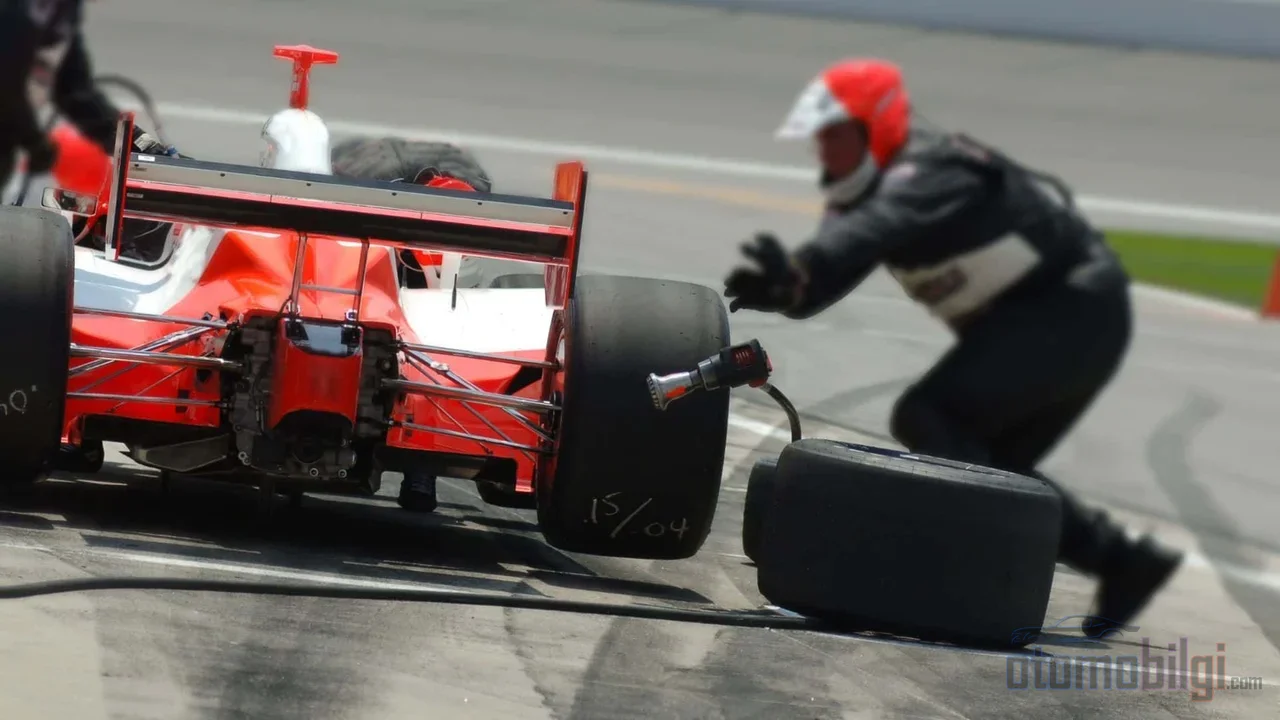
The second big trump card is pit strategy. In a standard pit stop, all four tires are changed, fuel is added, and if needed, a "wedge" adjustment, meaning rear spring adjustment, is made for chassis balance. Other adjustment tools teams have at their disposal: tire pressure, track bar, spring rubber, and body tape. Pit timing is planned based on tire wear, fuel level, and yellow flag conditions; today, analytics and AI-supported real-time data are used to calculate which lap to pit on. A race is not a horse race, it's a chess match - and on the pit wall, seconds slip by like a countdown.
Legends and the Daytona 500: "The Great American Race"
The championship record in NASCAR is currently shared among three names: Richard Petty, Dale Earnhardt, and Jimmie Johnson - each with 7 Cup championships. Petty became the first to reach seven in 1979 at the age of 41, and truly earned the nickname "The King." Earnhardt went down in history as "The Intimidator," the frightening man. When Johnson joined this pair with his seventh championship, the announcement "MAKE ROOM, RICHARD PETTY AND DALE EARNHARDT!" rang out on screens and entered the history books; he has 79 wins in his career. The interesting thing is this: Johnson always refused to compare himself to those two, saying "I could never be them." Humility, it seems, is also passed down from generation to generation like a record.
The season's opening keystone is the Daytona 500. The most prestigious race on the NASCAR calendar carries by far the biggest prize purse and is known by the nickname "The Great American Race" - The Great American Race. The story behind this expression is told by famous broadcaster Ken Squier: The race is a symbol of endurance, determination, and the pursuit of excellence, and is part of American culture. The track itself is a work of vision; Bill France Sr., who saw in 1953 that the beach races were coming to an end, had this massive facility built. The 68th Daytona 500 was run on February 15, 2026. The pre-season Cook Out Clash was postponed three times due to a snowstorm and was run on February 4 at Bowman Gray Stadium; Ryan Preece won the record 17 yellow flag race. This season also brought a sad loss: Two-time Cup champion Kyle Busch passed away in May due to pneumonia-induced sepsis, becoming the first active full-time driver to die during a season since 2001. Richard Childress Racing announced that the number 8 will not be used until his son Brexton Busch starts in NASCAR.
Frequently Asked Questions
Who participates in the Chase and is there an elimination?
The top 16 drivers in the regular season points standings make the Chase. There is no elimination; the driver with the most points at the end of the season finale is declared the champion.
Why is a win worth 55 points?
To encourage winning. As compensation for removing the "win-and-in" rule, the value of a win was raised from 40 to 55 points; this rewards both consistency and winning.
What is changed during a pit stop?
Four tires, fuel, and if needed chassis adjustments like wedge, track bar, tire pressure, or spring rubbers. Teams choose their pit moment based on tire condition, fuel, and caution flags.
Closing: Why Should You Give It a Chance?
I admit I got carried away by my own excitement while trying to explain the NASCAR Cup Series. Giant V8 engines, side-by-side driving at 300 km/h, the hunt for milliseconds at the pit wall, and a legendary legacy of championships spanning seven decades... The Chase format in 2026 has made things even simpler and even sweeter to watch. On the next race day, grab a coffee, turn on the screen, and wait for the moment the draft pack breaks apart. I promise you: Stick with one race, and you'll be hooked.
Sources
- The Chase 101: How new championship format works
- NASCAR returns to Chase championship format for 2026
- 2026 NASCAR Cup Series
- 2026 NASCAR Cup Series Standings & Stats
- How NASCAR Points Work: A Complete Breakdown
- Next Gen (NASCAR)
- Next Gen rules for 2022: 670 target horsepower, 4-inch spoiler
- List of NASCAR Tracks
- Daytona 500
- About Daytona International Speedway
- How NASCAR Drafting Works
- The Science Behind Pit Stops
- How Johnson stacks up to Earnhardt and Petty