Hydrogen and Synthetic Fuels: Which Promise Will Become Reality by 2030?
Share This Page
Looking toward 2030, hydrogen cars will probably have no chance left against battery electric vehicles; synthetic fuels, on the other hand, may not play a real role in cars but could in trucks, ships, and planes. Why? Because behind both lies a harsh reality of physics and economics: hydrogen converts only 40-60% of the input energy into usable power, while e-fuel, when used in a car, requires roughly 5 times more energy than a battery-powered vehicle. But don't worry, the story doesn't end here - let's sort the promises from the realities together.
Highlights
- Fuel cell vehicle efficiency 40-60%, while lithium-ion batteries are above 90%
- Porsche's Haru Oni facility in Chile is still producing about 34,000 gallons per year instead of the promised 55 million liters
- In California, in the third quarter of 2023, 66 refueling stations were serving 34,800
- fuel cell vehicles The U.S. Department of Energy's heavy commercial fuel cell target for 2030 is $80/kW and 25,000 hours
- of lifespan
According to the MIT CEEPR model, the most promising areas are long-distance trucking, short-distance maritime transport, and aviation
Energy Efficiency: We Lose a Little at Every Step
Now let me tell you the heart of the matter. The so-called well-to-wheel method measures how much energy survives the entire journey from the source to the vehicle's wheels. Think of it like a bag of sand: every time you switch hands, a little sand spills. This is exactly where the problems of hydrogen and e-fuel begin. In a fuel cell vehicle, you first convert electricity into hydrogen, then compress that hydrogen into pressurized tanks and transport it, and then convert it back into electricity in the fuel cell. There is loss at every step. The result? At best, 60% of the input energy reaches the wheels; in the total calculation at bus scale, this rate drops to between 60-70%. In a battery electric vehicle, the electricity already goes directly to the motor: total efficiency at bus scale is 85-90%, and at cell level lithium-ion batteries exceed
| 90% | . | Technology |
|---|---|---|
| Efficiency | Notes | Fuel cell (FCEV) |
| 40-60% | Portion of input energy converted into usable power | Lithium-ion battery |
| 90%+ | Energy conversion at cell level | Electric bus (well-to-wheel) |
| 85-90% | Across the entire energy chain | Hydrogen bus (well-to-wheel) |
| 60-70% | Across the entire energy chain | E-fuel (in cars) |
Up to ~1/5 5 times you're wasting electricity. A simple analogy: it's like dividing a cake among five people and then throwing two-thirds of the tray in the trash.
Why Didn't Hydrogen Cars Take Off?
Isn't that the question on all our minds? The technology is genuinely cool: only water comes out of the exhaust, and refueling takes a few minutes. So why do we see them on the roads as exceptions rather than in numbers?
Price Tag: 2.5-3x
Fuel cell vehicles are 2.5-3 times more expensive than their diesel equivalents. We can point to platinum group metals as the main culprit: these catalyst metals are both expensive and volatile in price. To bring costs down, a production threshold of 200,000 units needs to be reached; yet today's production volumes are far below that threshold. In other words, low costs require high production, high production requires demand - and demand requires low costs. The classic chicken-and-egg cycle.
Infrastructure: Where Is Anything Like a Gas Station?
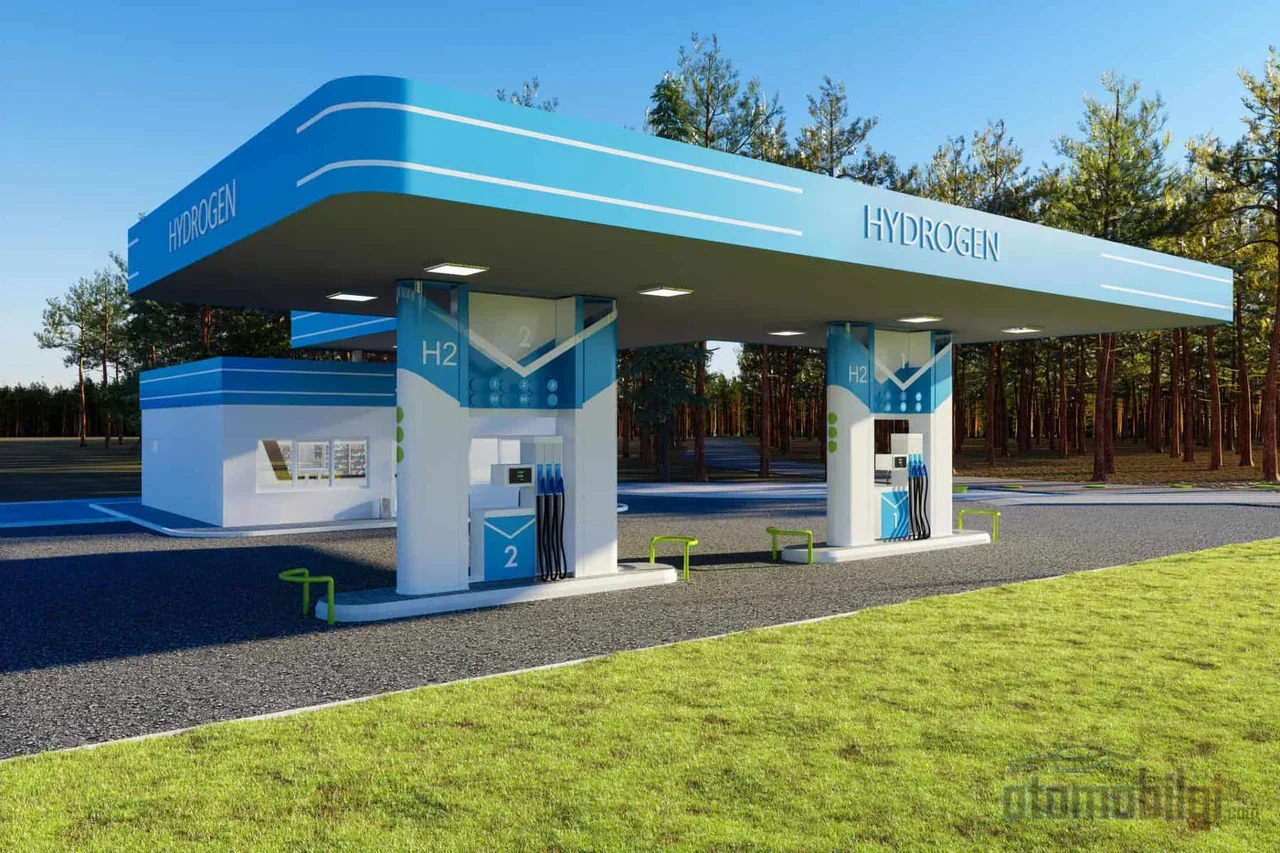
California is considered one of the world's most mature hydrogen markets. Yet in the third quarter of 2023, the state had 66 retail filling stations, and of these, 54 were operating at only 60% capacity; this network served 34,800 vehicles. Now think of the battery side: the charging network starts with outlets that can be installed at home. Hydrogen infrastructure, compared to battery charging networks, is expanding both more slowly and more expensively. As long as infrastructure remains limited, cars don't sell, and as long as cars don't sell, stations don't open - the cycle feeds itself.
So why are the market forecasts so vast? There is a tenfold difference between different institutions' projections: one takes a market worth $3.6 billion in 2026 to $133.93 billion by 2035, while the other starts the same year at $0.45 billion and ends in 2034 at $10.78 billion. The annual growth rates of the two projections are almost identical (above 48%), but from the starting point they don't see each other at all. Such a scattered picture says something about the technology's future as much as the technology itself: no one is sure.
And a clear answer to that famous question: today's battery-powered vehicles are cheaper than hydrogen ones and require less new infrastructure. Some quarters even go further, saying: hydrogen has failed in passenger cars, and it doesn't look like it will succeed in trucks either. Is that last sentence too harsh? Maybe. But hydrogen's score in the automobile race speaks for itself.
E-Fuel: A Lifeline for Classic Engines
The e-fuel side is a drama of its own. The idea is emotionally very appealing - preserving the internal combustion engine, its sound, that vroom. The opposing calculations aren't empty either: e-fuels can have a carbon footprint over their production cycle at least 70% smaller than petroleum, and e-fuel can be transported and stored using existing infrastructure, just like petroleum products. So you don't need to touch gas stations, pipelines, or tankers.
But when it comes down to the automobile scale, three serious obstacles confront us:
- Energy waste: The 5x problem I described above - the electricity spent for every liter of e-fuel is worth only a fifth of the distance an electric vehicle could travel.
- Air pollution persists: Although e-fuel is carbon-neutral in a cycle sense, vehicles running on e-fuel emit just as much toxic nitrogen oxide (NOx) as fossil-fuel engines. So in terms of urban air quality, the gain is close to zero.
- The path to lower costs is unclear: Production is expensive and energy-intensive; there is no clear route by which economies of scale would bring it down to automotive fuel prices.
Let me also give an interesting technical detail: the synthesis stage of the chain is actually relatively cheap. Synthesizing fuel within the plant consumes roughly 0.50 kWh of energy per kilogram. So the bottleneck is not synthesis, but the cheap and abundant green electricity needed to feed that synthesis. And this is exactly where the "there is not enough idle electricity" objection comes in - the amount of extra electricity that would have to be generated to run a car fleet on e-fuel is beyond comprehension.
Porsche and Haru Oni: The Gap Between Promise and Production
Let's set aside the abstract figures and look at a concrete example. The Haru Oni facility in Punta Arenas, Chile, which opened in December 2022, was announced as the world's first integrated commercial carbon-neutral e-fuel facility. Led by Siemens Energy and Porsche with HIF, and with the partnership of Enel, ExxonMobil, Gasco and ENAP, this project was converting the winds of Patagonia into fuel. The announcement was grand: Porsche, 55 million liters by 2026, and two years later 10 times that production expectation, was openly stated.
The reality is this: the facility is still a pilot plant producing at the same scale as on its opening day, around 34,000 US gallons (130,000 liters) per year. The gap between the 55-million-liter target and the 130,000-liter daily reality lays bare the distance between the stated promise and physical production. There is nothing wrong with it being a pilot facility - every technology starts small - but the numbers should not be presented in an exaggerated way.
Still, there are positive developments around the facility: HIF holds the ISCC EU RFNBO certification for 2025 and 2026; the e-fuels produced by the facility have been for three years used in the Porsche Mobil 1 Supercup in Europe; a supply agreement was signed with Porsche and Shell. There is also a noteworthy detail: Porsche envisions e-fuels for keeping its classic cars on the road, not as an EV rival. In other words, even Porsche positions this not as a solution for the car fleet, but as a niche transition fuel - and it is no coincidence that the sole buyer is itself.
Why Are Toyota and Hyundai Still Stubborn?
Toyota continues on the road with fuel cells with the 2026 Mirai and positions hydrogen as an important fuel for carbon neutrality. In February 2025 it introduced its third-generation fuel cell system and shared its roadmap for the PEM stack (the module you could call the heart of the fuel cell). Hyundai, meanwhile, is accelerating its heavy-vehicle-focused fuel cell system with the HTwo program; the NEXO has reached its third generation in 2026, and the infrastructure in Korea is emphasized as functioning. Indeed, in March 2026 BMW, Hyundai and Honda called on Australia to include hydrogen in its EV strategy.
But this question needs to be asked: don't these brands know that the automobile side cannot scale? I think they do. If you look at the real focus of their strategies, the answer is there: heavy commercial applications. Toyota's definition of hydrogen as 'an important fuel for carbon neutrality' is not the same thing as saying 'the future of cars is hydrogen.' A passenger car may be the showcase for hydrogen, but the real business will revolve around truck garages.
Who Will Survive in 2030: Cars, Trucks, or Ships?
Here is the very heart of the article. MIT CEEPR's dynamic cost model scans energy-intensive transport branches one by one and says this: the most promising routes are, for long-distance trucking, eHydrogen and eFuels, for short sea shipping eHydrogen, eFuels, and eAmmonia, and for aviation eHydrogen. The logic is simple: almost all of a passenger car's trips are under 100 km, and the battery is sufficient for that. But for an aircraft flying between continents or a 40-ton truck, the battery's weight and charging time would be a disaster. Carrying energy in a liquid, dense form becomes an advantage there.
The door is open in the long term too: a potential cost reduction of 41-68% in renewable fuels by 2050 is calculated, and it is stated that carbon neutrality by 2050 in trucks, ships, and aviation appears possible with fossil fuel substitution. In shipping, synthetic fuels are positioned as the 'technology solution' for reaching zero-emission targets; the real potential of green hydrogen lies in the hardest sectors to decarbonize - with long-distance aviation leading the way.
Is It Enough or Not? What the Numbers Say
Of course, not everything is rosy. There are doubts even on the heavy-duty side - the view that 'hydrogen will fail in trucks too' is seriously defended in certain circles. And the durability targets are wild: The US Department of Energy expects, from the 2023 point of $170/kW and 10,000 hours to drop by 2030 to $80/kW and 25,000 hours, and ultimately $60/kW and 30,000 hours . Trucks demand 25,000 hours and ships 100,000 hours of durability, and current stacks fall short of these targets. For fuel cost parity, in a typical cell with 45% efficiency, hydrogen needs to drop to $7.50/kg- which isn't expected to happen by 2030 (there are some new cells with 60% efficiency that have achieved parity, but this is still the exception, not the rule). On the other hand, the US has a strategy in place to raise clean hydrogen production to 10 million metric tons per year by 2030 and 50 million metric tons by 2050, and to bring the cost down to $1/kg; under the 2022 IRA, a tax credit of up to $3 per kg also comes into play. So governments are taking the stakes seriously.
According to my exam paper, the conclusion is this: In 2030, the winner for cars is the battery. The promise of hydrogen and e-fuels in cars largely hits the wall of physics and economics. But in trucks, ships, and planes, these two technologies have a real chance - because the alternatives there are weak too. The question is: can these niche markets grow big enough to compensate for the disappointment seen in the car world? I think 2030 will tell us. What do you think - are you ready to see hydrogen trucks?
Sources
- Why have electric vehicles won out over hydrogen cars - MIT Climate
- Hydrogen Fuel Cell Efficiency vs Lithium-Ion - Flux Power
- Battery Electric vs. Hydrogen Fuel Cell Buses - Transfinder
- Explainer: What are e-fuels - Reuters
- E-fuels won't save the internal combustion engine - ICCT
- Why e-fuels are not the solution for cars - T&E
- The future of the European car: why are synthetic fuels not… - Carbone4
- Priming the E-Pump: Explaining E-Fuels - Bipartisan Policy Center
- Fuel Cell Commercialization 2025-2030 - Enki
- Hydrogen Fuel Cell Vehicle Market - Research Nester
- Hydrogen Fuel Cell Vehicle Market - Fortune Business Insights
- New Hydrogen Fuel Cell Achieves Fuel Cost Parity in Europe - ACT News
- Hydrogen Has Failed In Cars. It Won't Be Powering Trucks Either - Forbes
- eFuels pilot plant in Chile officially opened - Porsche Newsroom 2022
- eFuel for thought - Porsche Newsroom 2023
- HIF Haru Oni - HIF Global
- Porsche's Chilean Plant - Autonocion
- 2026 Toyota Mirai - Toyota.com
- Toyota Technology Roadmap, 2025 Hydrogen Seminar - Toyota Pressroom
- Hyundai, Daimler, Toyota Hydrogen Initiatives - Trucking Info
- BMW, Hyundai and Honda Urge Australia - FuelCellsWorks
- Sustainable Hydrogen Fuels versus Fossil Fuels - MIT CEEPR
- Renewable hydrogen and synthetic fuels versus fossil fuels - Martin 2023, ScienceDirect
- Mobilize Green Hydrogen for Aviation and Trucking - Drawdown
- Synthetic fuels and shipping's net-zero goals - ING