Vehicle-to-Grid Energy: Can an Electric Car Really Turn Into a Home Appliance?
Share This Page
Yes, an electric car can turn into a home appliance - even today there are models that power your home during an outage and even sell energy back to the grid. However, the revolution promised by Vehicle-to-Grid (V2G) energy remains a pipe dream in most countries, due more to software, legislation and economics than to hardware. So where do we really stand?
Highlights
- An electric car spends 90-95% of its life parked; the Kia EV9's 100 kWh battery is roughly equivalent to 7 home batteries.
- Commercial V2G, as of fall 2026, is live only in the United Kingdom, Germany, France and Australia. live.
- GM states that there are more than 250,000 bidirectional-capable vehicles on the road.
- The upfront cost of the bidirectional package at GM is around $7,000; a full V2G setup can reach $8,000-10,000.
- The additional annual battery wear effect of V2G is calculated to be around 0.31% on average.
What Exactly Do V2G and V2H Promise?
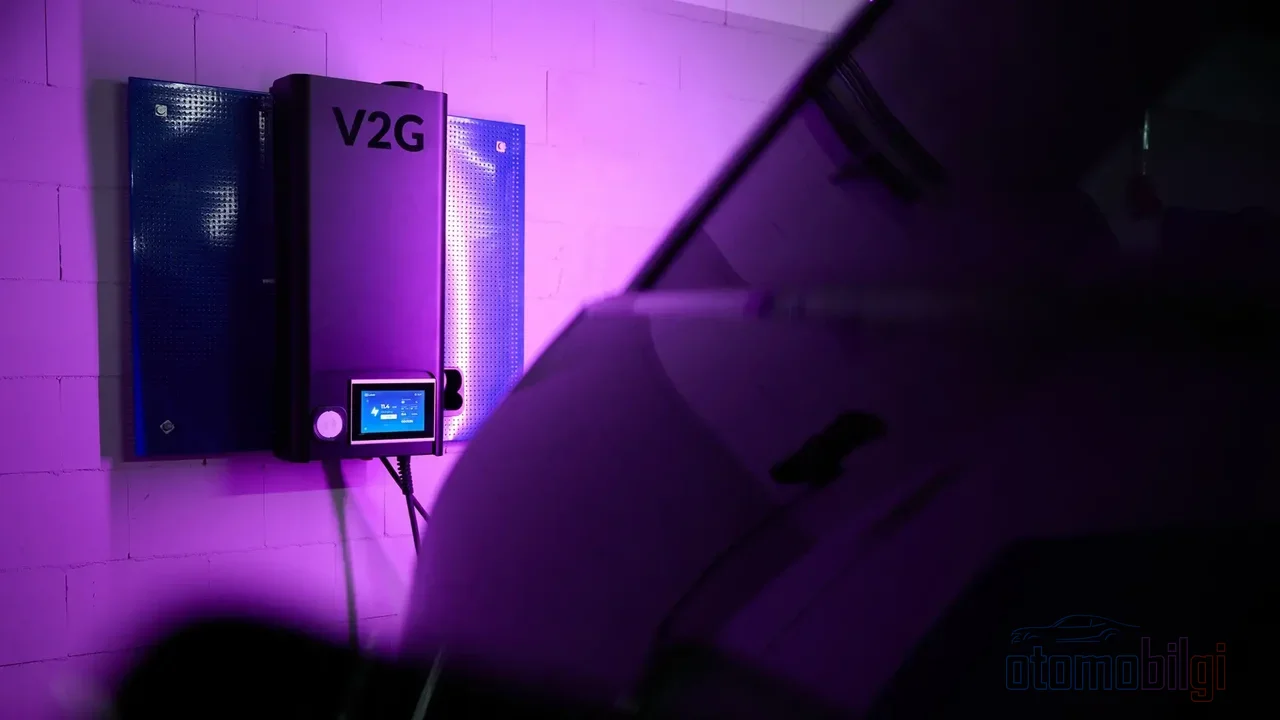
Let me explain briefly: V2G (Vehicle-to-Grid) is the ability to push the energy in your car's battery back to the grid. V2H (Vehicle-to-Home) directs the same bidirectional energy flow to your home; when the power goes out, your car turns into a massive backup power source, and during peak hours it covers your home's expensive electricity consumption. Think of it this way: you have a giant power bank, but this power bank is parked in your garage and mostly sits idle.
And it really does sit idle a lot. An electric car spends 90-95% of its life parked. In other words, the average vehicle lets society's most expensive and most advanced battery sleep in an office parking lot during the day and in a garage at night. A vehicle like the Kia EV9 with a 100 kWh battery carries capacity roughly equivalent to about 7 common home battery units. Faced with this picture, it's hard not to ask: "If that's the case, why don't we rent it out to the grid?"
Three Players That Need to Take the Stage
For V2G to work, a suitable car alone is not enough. Three components need to be ready at the same time: a vehicle that supports bidirectional energy transfer, a bidirectional charger, and a software platform that manages and optimizes the power flow. You'll like the computer analogy: the car is the hardware, the charger is the driver, and the software is the operating system. If one is missing, the system won't boot.
On the architecture side, there are two different paths, and this distinction explains the cost:
- DC architecture: Energy conversion happens outside the vehicle, in the charger. The Ford F-150 Lightning and GM's electric vehicles use this structure; it is also the dominant approach for heavy vehicles with large batteries like school buses. The downside: since the converter is embedded in the charging station, that device is expensive and produced in low volumes.
- AC architecture: The vehicle's own inverter handles the conversion. The Tesla Cybertruck uses this structure; the cost is added to the vehicle, but a much cheaper AC charger can be used. The Rivian R2 was announced with the same logic.
Which Electric Cars Can Really Do V2G?
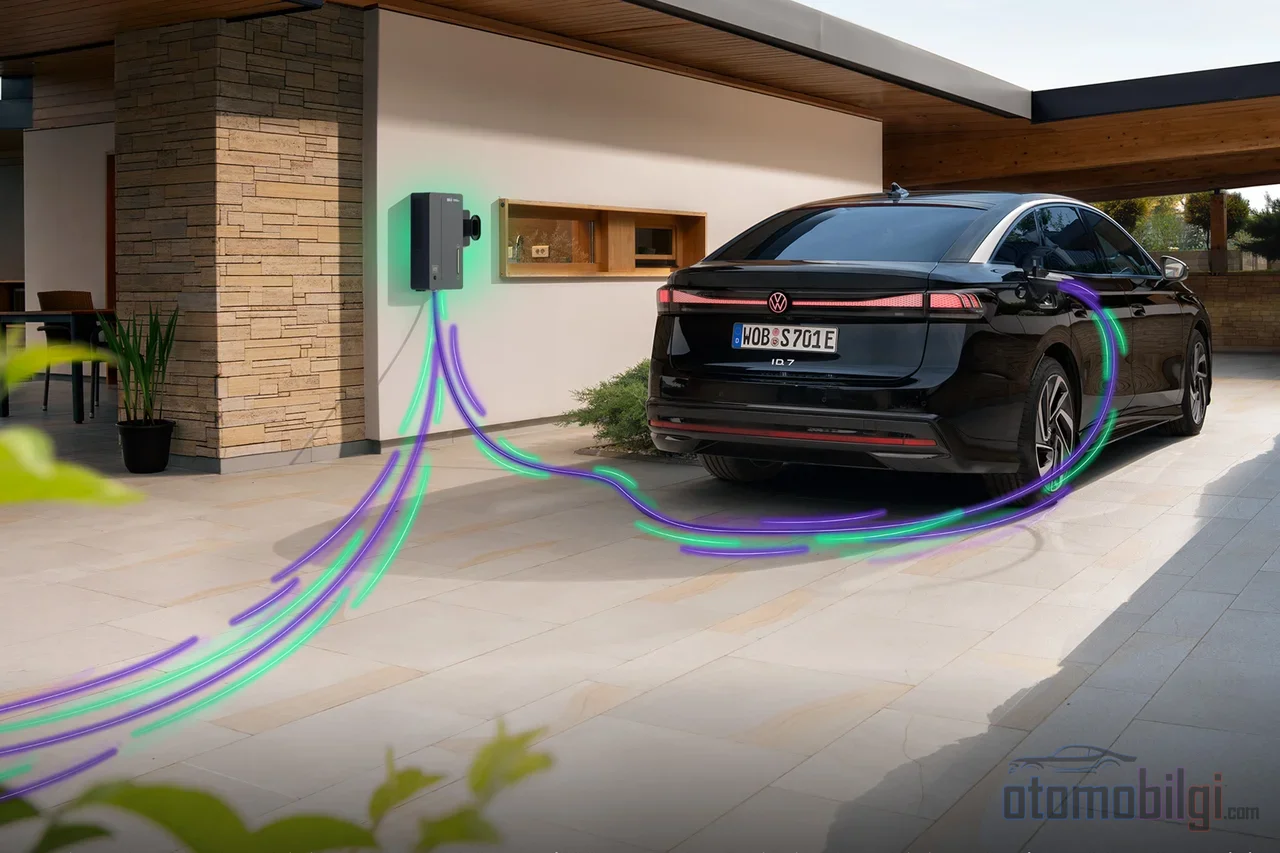
The enviable part of this is that hardware is no longer the bottleneck. Almost every major manufacturer has either launched or announced bidirectional models. GM announced it would make bidirectional charging standard across its entire electric lineup by 2026, and today it states that on its own there are more than 250,000 bidirectional-capable vehicles on the road; at 10 kW accepted per vehicle, that means a nominal ~2,500 MW of capacity. On the Tesla front, at the moment only the Cybertruck can export energy via its Powershare technology; each Cybertruck can deliver over 11 kW. Tesla said all of its vehicles would be bidirectional in 2025, so it's reasonable to expect this list to expand.
But there's a classic marketing blur at play here: "bidirectional" brings to mind three different capabilities, and not everyone means the same thing. The tiers of V2L (vehicle to device via an outlet), V2H (vehicle to home) and V2G (vehicle to grid) differ greatly from one another. While it's said today that more than 75 models globally support bidirectional charging in some form, a stricter definition shows 54 models offering only V2L, and the number of models with official V2G/V2H capability is stated to be just 2 . So the "bidirectional charging" phrase in the brochure often just means you can charge your laptop while camping - not trading with the grid.
| Model | Capability | Notable detail |
|---|---|---|
| Ford F-150 Lightning | V2H | 9.6 kW home backup; explicitly stated that the warranty is not voided |
| Nissan Leaf | V2G | Via CHAdeMO; first manufacturer with warranty clarity |
| Tesla Cybertruck | V2H/V2L | Powershare, over 11 kW export, AC architecture |
| Rivian R2 | At announcement stage | AC architecture with onboard inverter |
There's also the standards front: in the US market, CHAdeMO has fallen out of favor, and new offerings are being built on CCS or NACS. In addition, the UL 1741 SC safety standard for V2G was only approved in summer 2026. So you could say the rulebook for this business only just woke up.
If Hardware Is Ready, Where's the Real Bottleneck?
In my view, this is the article's vital question. If hundreds of thousands of bidirectional vehicles are on the road but this capacity doesn't show up in the grid, the hardware isn't to blame. The three remaining problems - warranty uncertainty, protocol incompatibility and economics - are far more tangled.
On the software side, the ISO 15118 standard defines vehicle-to-charging-station communication; the -20 release supports bidirectional power transfer along with Plug & Charge. In fact, an interoperability guide offering a minimum implementation scope for DC bidirectional transfer was published in 2026. But the existence of a standard isn't enough: adoption remains limited due to regulatory barriers, lack of incentives and the small number of bidirectional vehicles. The classic scenario is this: Ford and GM systems were first sold as V2H, and grid export (V2G) was only enabled via software updates in certain utility territories. The vehicle has the potential, but the key that opens the door is camouflaged.
The process we call "interconnection" to the grid is also a bottleneck: it is explicitly stated that connection rules and definitions for residential-type bidirectional charging need to be updated. California has published a roadmap for bidirectional charging; Brazil's national energy agency, meanwhile, approved a pilot allowing V2G billing in 2026. On a global scale, the situation is more painful: the IEA emphasizes that the lack of grid capacity has turned into a critical bottleneck in many regions. A recent modeling study published in Joule summarizes this nicely: V2G can significantly reduce transformer overload and emissions, but it cannot replace the required grid investments.
Does V2G Really Damage the Battery?
This is the concern I hear most often, and let me be frank: the numbers are far below the fear. A peer-reviewed study examined 33 different charge/discharge scenarios; V2G's average contribution to total annual battery degradation turned out to be only 0.31% . The same study also has scenarios showing a 9-14% increase over a 10-year horizon, meaning the impact can grow in poorly managed programs - but the critical point is this: 85% of battery wear comes from what we call calendar aging. Even if you do nothing, the battery ages; V2G only adds a small increment to this picture. 85% takvim placeholder
You should also hear the discharge rate argument, because it makes a lot of sense: while driving, the vehicle suddenly draws 125-150 kW, while selling power to the grid is done at a gentle rate of around ~10 kW through the charger. It's like the difference between running a marathon and walking down the stairs - the latter puts far less strain on the muscles. In fact, a 2017 University of Warwick study went even further: it showed that smartly configured V2G use can reduce capacity loss in the battery pack to 9.1% and power loss to 12.1% , meaning V2G can actually extend battery life. A recent study paper also confirms that the effect of bidirectional charging on total battery aging is minimal, and that additional cycles have a limited share.
Two honest footnotes: first, most studies calculating V2G's economic benefit do not include battery degradation in the equation at all - this is the weak link of the economics analyses. Second, the warranty issue. Nissan became the first manufacturer to explicitly declare that using the Fermata Energy platform would not affect the warranty; Ford also states that home backup in the F-150 does not void the warranty. Beyond that, there is no official clarity among most brands and consumers need to be reassured.
Does the Economics Really Hold Up?
Now lean back, because this is where promise and reality diverge most sharply. In a GM vehicle, before installing a bidirectional package, roughly $7,000; a full V2G DC system can cost 8,000-10,000 dollars. The revenue side is regional and uncertain: some US states have programs offering seasonal compensation of 200-300 dollars per kilowatt for shaving peak load, which means a theoretical 3,000 dollars per year with a 10 kW system. Programs or pilots are available in California, Massachusetts, New York, Maryland, Colorado, and Connecticut. The problem is this: so far, grid programs have paid drivers far less than this installation cost. In other words, on the other side of the coin lies the reality that "the math doesn't add up."
We pay for V2H; there is still a question mark over V2G.
In my view, this sentence sums up the whole balance sheet. V2H's value proposition is concrete: a system that powers the home during an outage can compete directly with the home generator alternative, and the price calculation can work there. V2G, on the other hand, is entirely dependent on the grid market and regulation. On top of that, there is a mobility constraint: programs must preserve the vehicle's primary job, which is going places; the user can set a battery floor limit, but there is still little data on how consumers will use this.
The proposed solution is interesting: what grew the solar industry was a similar combination of regulation plus financing - it leaped forward with the rooftop solar leasing model. For V2G too, it is thought that without a "bankable," that is, predictable revenue stream, a model that finances mass adoption will not hold. This is why I mention policy leadership.
Should We Believe the "Finally Real" Claim?
This also needs to be questioned, because V2G has been limited to small-scale pilots for about 30 years . As of 2026, verifiable commercial V2G is live in only four countries: the United Kingdom, Germany, France, and Australia. Many countries are still at the pilot stage. "V2G is finally becoming real" headlines come out every year; this year's should also be read with caution.
As for market projections: there are circulating estimates that the V2G technology market was $8.0 billion in 2025 and will reach $123.5 billion by 2033 with 28% annual growth. In my view, figures like these should be treated as decoration; their methodologies are often blog-level and their verifiability is weak. Still, the emphasis of university research is real: your car in the garage turning into a huge, flexible home battery during an outage is a reality today. But that reality does not, on its own, solve the problem of the car generating regular income for the grid.
So What Is the Bottom Line? Promise or Reality?
My reading is this: the car turning into a home appliance - that is, V2H - is real and offers meaningful value today. For someone who wants backup power against outages, Ford or GM systems are a serious alternative. Vehicle-to-grid energy - that is, V2G in the full sense - is technically ready but commercially possible in only four countries so far; elsewhere, standards, warranty texts, and revenue models are still waiting to settle. Blaming the hardware would mean hiding the three problems that are the real challenge.
If it were you, how much would you be willing to pay to rent out that massive 100 kWh battery in your garage to the grid? Whatever your answer, one thing is clear: the most exciting part of this discussion is only just beginning.
Sources
- The multi-billion dollar promise of vehicle-to-grid integration
- Vehicle-to-Grid (V2G): Everything you need to know
- Vehicle-to-grid technology
- Vehicle-to-Home (V2H) | GM Energy
- Bidirectional Charging 101: Vehicle-to-Home
- Vehicle-to-grid impact on battery degradation (Sagaria et al., 2025)
- On the possibility of extending the lifetime of lithium-ion batteries (Uddin, 2017)
- Economic Viability of V2G Reassessed (Zhang, 2025)
- Optimizing Battery Lifespan - RWTH working paper
- Vehicle-to-Grid is Here, Finally: Where V2G Stands in 2026
- Proactive grid investment enables V2G for 100% adoption (Joule, 2026)
- Barriers to V2G in the United States (Soderman, 2026)
- Which Electric Cars Have Bidirectional Charging
- Interconnection Guidance for Residential Bidirectional EV Charging
- A roadmap to unlocking the benefits of bidirectional charging
- Grids - Electricity 2026
- The car in your garage can power your house
- What is V2H (Vehicle-to-Home)?