Are Autonomous Vehicles Really Safe? What Do the Accident Statistics Say?
Share This Page
Should the answer be clear-cut? For driverless robotaxis like Waymo, the independent evidence is genuinely positive: they have significantly fewer crashes per mile than human drivers. But this result does not yet apply to all autonomous vehicles - how the data is collected, what counts as a "crash," and how companies present the numbers determine the conditions under which the "safer than humans" claim appears entirely true. So the answer to the question is not a single "yes" or "no"; it is a question of "where, how, and for whom."
Highlights
- Driverless robotaxis, per mile, compared to human drivers, 68% fewer crashes recorded
- A drop in serious injury or fatal crashes at the 95% level
- By June 2026, Waymo 271.3 million driverless miles logged
- Tesla's safety report methodology received serious criticism; an investigation was opened into FSD
- Human drivers play the leading role in approximately 93% of crashes
Are Autonomous Vehicles Really Safer Than Human Drivers?
The strongest independent evidence comes from driverless vehicles operating in four cities. Scanning roughly 50 million driverless miles in San Francisco, Phoenix, Los Angeles, and Austin was compared with the 222 billion miles driven by humans in the same areas. The result: per mile, 68% fewer crashes. Single-vehicle crashes are 85% lower, and injury crashes 81% lower. That is not a difference to be dismissed.
But pause for a second before moving on: this picture is scattered at the city level. In Phoenix the gap goes up to 76%, and in Los Angeles 71%. In San Francisco, however, it drops to 35%. In Austin, due to the small sample, crashes are 4% higher. So the statement "autonomous vehicles are safer" should, for now, be read as "driverless robotaxis in the cities where Waymo operates appear to be safer." For other companies, we do not have data of this quality.
There is also the scale behind the numbers: by June 2026, Waymo publicly shared 271.3 million driverless miles - 92.1 million in Phoenix, 82.4 million in San Francisco, 67.1 million in Los Angeles, 21.1 million in Austin, and 8.6 million in Atlanta. Compared to human benchmarks, it reports a 95% reduction in serious injury or fatal crashes, 93% in pedestrian crashes, 86% in cyclist crashes, and 82% in motorcyclist crashes. These are impressive figures; but the primary source is itself an interested party. That is why independent verification is valuable.
Why Can't Crash Numbers Be Compared Directly?
This is where the really interesting part begins. Figures like "9.1 autonomous vehicle crashes per million miles versus 4.1 crashes for humans" circulate online - implying that autonomous vehicles are worse . So how do both "68% fewer crashes" and "twice as many crashes" come out of the same dataset we have?
Answer: the definition of a crash. Autonomous vehicle companies are required to report even contact-level incidents with the slightest property damage. For human drivers, most states have either a damage threshold or an injury requirement; moreover, people never report a significant portion of crashes to the police. Of property-damage-only crashes, 69.7% and 31.9% of injury accidents go unreported. Roughly half of all accidents go unrecorded. In other words, the human-side yardstick does not measure with the same measure.
To make this concrete: in 41% of reported collisions involving driverless vehicles, 41% the speed change was below 1 mile per second - meaning essentially parking-lot-contact level, touches that cause no major damage. Such incidents never enter human statistics. Independent researchers had to filter out roughly 25% of the autonomous side's records in order to make a fair comparison. If you compare with a vast net like a lymph, everything looks like an accident; if you filter it through a funnel, the picture changes.
Another problem lies on the mileage side. Companies are required to report crashes but not the miles they drive. Waymo does this voluntarily; others do not. Without mileage data, the accident rate cannot be calculated - just as you cannot perform division without two numbers on a typewriter. That is why independent safety researchers speak plainly: the results show safety at a limited scale, but the current data collection system is not sufficient for continuous monitoring of a large-scale expansion.
The mirrors Waymo itself looks into
Waymo's methodology is of course not flawless, and the company itself acknowledges this. Comparisons are made not against national averages but against the own accident profile of the cities where the vehicle operates; adjustment by time of day cannot yet be made. And there is one striking detail: it does not snow in the cities where Waymo provides service. In other words, all these brilliant safety figures contain no experience at all of snowy, icy roads. How would they perform in winter conditions? There is no answer to that question yet.
Why Is Tesla's "X Times Safer" Claim Controversial?
In the safety report it published for Full Self-Driving (Supervised), Tesla makes a striking claim: vehicles with active safety features travel many times farther between collisions than human drivers. Sounds great, doesn't it? The problem is this: Tesla itself defines what counts as an "accident," and the report is based on in-house data. When independent researchers examined the methodology, they concluded that results like "10 times safer" stem from measurement choices. The old Autopilot metric also covered mostly highway driving, which is inherently safer - so it was not an apples-to-apples comparison, but an apples-to-pears one.
On top of all this, two serious developments were added. First, in a letter a senator wrote to the safety regulator, the view was expressed that Tesla uses "misleading and incomplete safety statistics." Second, in June 2026 an official investigation into FSD was launched: it was documented that the system failed to detect reduced-visibility conditions - scenarios resembling fog, glare, and rain - and did not warn the driver.
The structural risk of Level 2 systems is another separate topic. A study showed that drivers using Autopilot-like systems are caught off guard over time, stop monitoring the system, and engage in safety-critical behaviors. We can call this "guard fatigue": in the world of night watchmen too, the most dangerous moments are the shifts where nothing happens for hours. If the system performs flawlessly for 10 minutes, the human brain says "I can relax now too." But the law still requires the driver to remain supervised. The person in the seat is both pilot, backup, and safety officer - and when they cannot do all of them at once, things fall apart.
Mercedes Drive Pilot: The Level 3 That Runs a Red Light
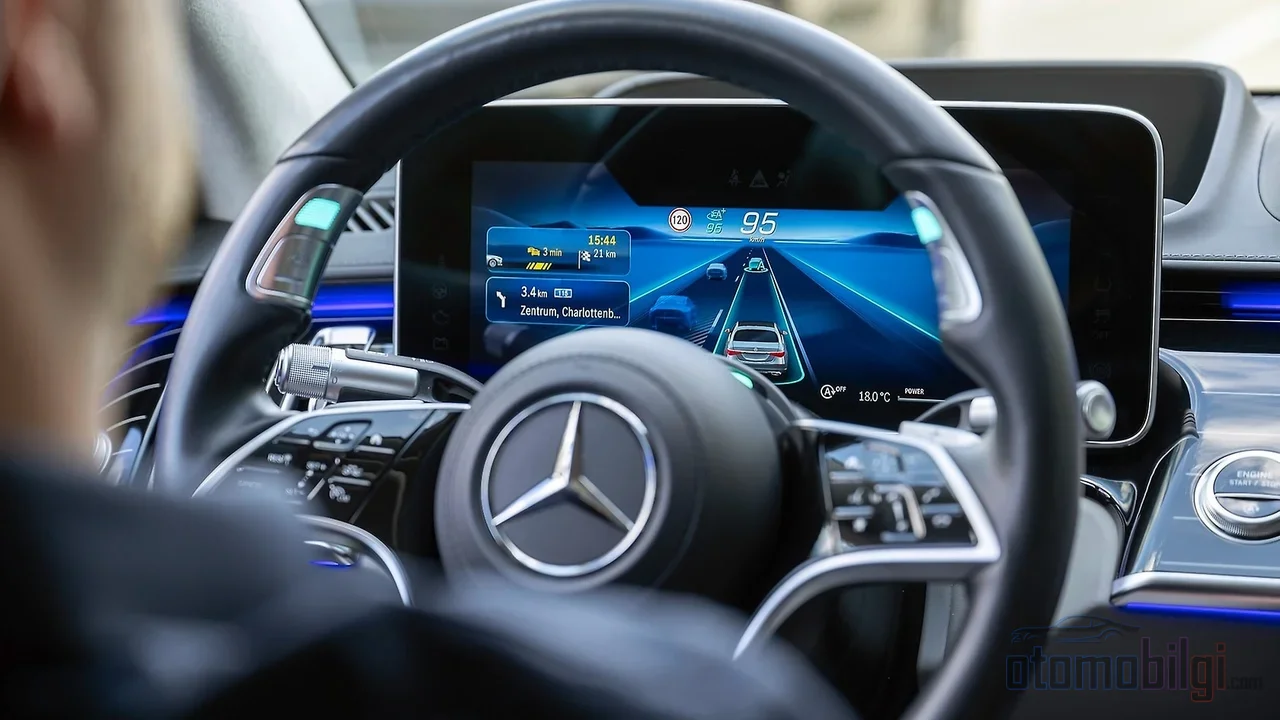
Unlike Tesla, Mercedes-Benz followed a slightly humbler but much more solid line in regulatory terms. The German brand, SAE Level 3 is the first company in the world to receive an internationally valid type approval for conditional automated driving. Drive Pilot is, as of today, the only Level 3 system with international approval. In Germany, initially 13,191 km of highway is approved for this conditional automated driving; it has been introduced to the US market and is expanding.
The SAE definition of Level 3 is important: the system takes over driving under certain conditions, but the driver remains in the seat and must be ready to take over when the system requests it. In other words, the car is not saying "you are free to sleep"; it says "traffic is congested, speed is low, I am driving - but you stay awake." In the blog world, exaggerated claims circulate such as "Mercedes always takes the blame in an accident"; this is a slightly diluted version of reality. The human will still be in the seat, still on duty. On the other hand, one advantage of Level 3 lies on the transparency side: in some states, a "black box" type technical recording device in the vehicle is mandatory - so when an accident occurs, whatever the system was doing at that moment stands in the records. Data instead of speculation.
What Do Disengagement Data Tell Us (and What Do They Not Tell Us)?
The most beloved yet most misunderstood metric of the autonomous driving world: disengagement, meaning the moments during test drives when the driver had to take back control. California's official definition is as follows: the deactivation of autonomous mode when a malfunction is detected in the autonomous technology or when safe continuation is required. At first glance a logical idea - the more often a car says "I can't do it," the less mature it is, right?
The reality is more complicated. In California, permit-holder companies recorded more than 9 million test miles between December 2024 and November 2025; but under deployment (i.e. real passenger carrying) permits, disengagement reporting is not required at all The regulator plans to update the rules in 2026. Moreover, the academic side also views the metric with suspicion: the ambiguity of the disengagement definition can make comparisons between companies misleading, and the reports reflect only testing activity. So saying "Company X had 3 disengagements per year" doesn't mean it is safer than Waymo - perhaps it is simply testing on much easier roads and much less often. If you want to use the metric like a clock, first everyone needs to be looking at the same clock model.
What Are Regulators Doing, and Which Questions Remain Unanswered?
In the US, there has been a rule in effect since 2021: vehicles with ADS or Level 2 systems are required to report their crashes to a central system. The April 2026 update showed 100 collision reports in the past year - 80 of them from Waymo, 12 from Avride, and 3 from Motional. It would be wrong to say these figures are inherently "bad" or "good"; the reported fleet size and kilometers traveled are very different. But there is one sign: regulators opened an investigation into Avride's self-driving vehicles following the incidents in Dallas. So the camera part of the system is working too.
In contrast, some gaps are disturbingly large. There is no mandatory kilometer reporting; the reporting threshold for human crashes varies from city to city; there are not yet comparisons adjusted for conditions such as snow and night. The regulator's 2026 report to Congress points to the same shortcomings: work continues on characterizing subsystem performance, identifying failure modes, and risk assessment methods. So even the official side is saying "we cannot yet measure everything."
So what should we make of the human error rate?
The favorite statistic of autonomous vehicle advocates is this: 93% of crash causes are human error. Recognition errors account for 41%, decision errors 34%, and performance errors 10%. This figure is real - as human drivers, we really are far from perfect. But a careful caveat must be added: a 2024 matched case analysis showed that in 79% of rear-end collisions, the vehicle hitting the driverless car was a human-driven one. So the autonomous vehicle is often the innocent party, but this doesn't mean the system's own failure modes (perception, prediction, unexpected scenarios) are problem-free. Vehicles learn differently from one another; human error has become a classic, while machine error is still unmapped.
Conclusion: The Answer Is Partly Yes, Partly a Question Mark
To summarize today's picture: Waymo's publicly available, independently verifiable data really does show fewer crashes than human drivers, especially far fewer serious crashes. This is a signal suggesting that for the first time in history, a machine is measurably causing less harm than humans in everyday traffic - exciting.
But there are three big open questions in the same picture: measurement standards are not yet suited to honestly comparing humans and autonomous systems; the "orders of magnitude safer" self-reported claims of major players like Tesla have run into serious criticism and investigations; and all this safety evidence comes from a small and sunny subset of the world's cities. Snow, night, rural roads, different companies - for none of these do we have evidence at the Waymo level. In a legislative session in Oregon, even experts unconvinced that today's self-driving vehicles actually cause fewer crashes took the floor; institutions like Brookings also emphasize that "it is not clear they will be safer." So the most honest answer is this: the evidence is almost there, but not yet everywhere. The technology is not waiting for us; the data infrastructure is running to catch up.
Sources
- Waymo's driverless cars crash less often than people
- Waymo Safety Impact
- Full Self-Driving (Supervised) Vehicle Safety Report - Tesla
- Why Tesla's AI trainers don't trust its self-driving tech - Reuters
- Tesla Data NHTSA Letter - Edward Markey
- A note on Tesla's revised safety report crash rates
- New Tesla FSD safety data
- Mercedes-Benz DRIVE PILOT
- Mercedes-Benz: world's first internationally valid system approval
- Mercedes-Benz Automated Driving Legal Framework
- Cal. Code Regs. Tit. 13, § 227.50 - Disengagement Reporting
- California DMV: AV permit holders logged 9M+ test miles
- NHTSA Standing General Order on Crash Reporting
- NHTSA Report to Congress on Automated Driving Systems (2026)
- A matched case-control analysis of autonomous vs human-driven vehicles
- Autonomous vehicles' disengagements: Trends, triggers and limitations (Favarò 2018)
- Could Disengagement Reports Indicate Evolution of AV Readiness? (MDPI 2025)
- New insights into factors affecting crash severity (Fu 2025)
- The Emerging Risks of Level 3 Autonomous Vehicles (Verisk)
- The evolving safety and policy challenges of self-driving cars (Brookings)
- Are Autonomous Vehicles Safer Than Human Drivers? Oregon Legislature testimony
- (Mis-)use of Autopilot and FSD Beta (PMC)