Why Can Autonomous Cars Go Blind in Snow and Rain?
Share This Page
Autonomous vehicles can go blind in snow, fog, and heavy rain, because lidar, radar, and camera sensors seriously lose detection performance in these conditions, and the AI doesn't know which data to trust. That's why robotaxi companies are suspending their services, and manufacturers are taking systems out of operation. So why does the promise of "driving in all conditions" still remain just a promise? Come, let's take a look together.
Highlights
- In heavy rain or snow, lidar detection performance can drop by more than 50%.
- Fog can disrupt lidar's object classification by up to 13.43%.
- Mercedes Drive Pilot (Level 3) cannot operate in snow, rain, and night conditions.
- Waymo suspended its driverless service in Atlanta and Texas in May 2026 after heavy rain.
- Approximately 70% of the US population lives in snowy regions.
Let's be honest: autonomous vehicles work incredibly well on a sunny California day. But look out the window and see that it's snowing. That's the moment things suddenly change. Vehicles that describe themselves as "I can drive in all conditions" either stop service in the first serious winter storm or tell you "you take the wheel." Why? Because all three main sensors that enable an autonomous vehicle to see the world (camera, lidar, and radar) are in trouble in bad weather. In this article, we'll look at exactly which sensor struggles and why, why robotaxis stop in the rain, and why this promise still hasn't caught up with us.
Autonomous driving levels: Why is Level 5 still far away?
First, a quick foundation: the SAE J3016 standard defines driving automation in six steps, from Level 0(no automation at all) to Level 5(the level where the system is entirely responsible for steering under all conditions). Level 2, where most of the "semi-autonomous" systems we see on the roads today sit, is actually just an assistant: it can take over the throttle, brakes, and steering, but you can't take your eyes off the road. When you move up to Level 3, responsibility shifts to the system under certain conditions - note the word "conditions," we'll come back to that shortly.
Level 5 is the holy grail shining in all this picture. That is, whether it snows, fog rolls in, or night falls - it makes no difference, the vehicle drives everywhere, in every condition. The problem is this: even in 2026, this level still stands as a very distant point on the horizon. And the biggest obstacle isn't engine power or software speed; it's exactly the subject of this article: the inability to see in bad weather.
Camera: if the sun glares or the snow falls, vision goes
The camera is the sensor closest to the human eye, but precisely because of that, it also inherits all the weaknesses of the human eye. When fog settles in, snow falls, or the sun hits directly ahead, you can't see the end of the road either, can you? The camera does the same: viewing distance shrinks, contrast drops. In low light and direct sunlight, it genuinely struggles.
The interesting part is that it's impossible for manufacturers to hide this. Tesla's official owner's manuals state it clearly: low-visibility conditions such as dim light, rain, snow, direct sunlight, and fog can seriously degrade the system's performance. On top of that, add dirty cameras and lane markings that are hard for the camera to read because they've faded. Considering that in winter even white lane markings can disappear under snow, this picture is hardly reassuring for the camera.
Lidar: snowflakes turn into false obstacles for the laser
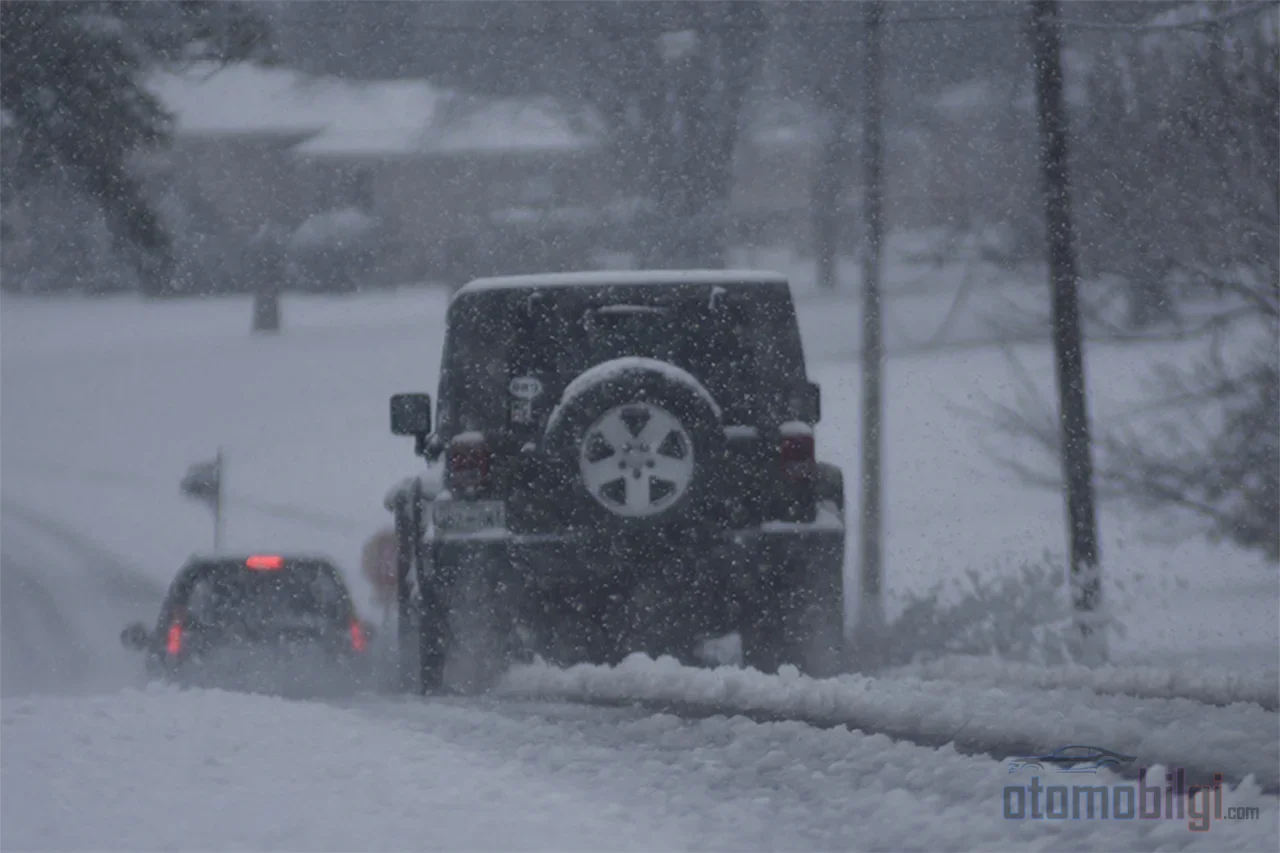
So what does lidar do? Let me explain briefly: lidar is a sensor that sweeps laser beams around it, waits for them to bounce back off objects, and draws a 3D point cloud around the vehicle. Great in sunny weather. But when snow starts falling, millions of snowflakes from the sky enter the laser beam's path, and each one turns into a tiny reflector. Lidar either sees these flakes as shadow areas scattered along the road or generates objects that don't exist. Signal scattering, absorption, and low-quality data problems come as a bonus. Imagine a ghost obstacle cutting you off in traffic - that's lidar's nightmare.
The numbers confirm this: different studies show that lidar performance drops in heavy rain or snow by rates ranging from 25% to over 50%. Fog, meanwhile, can disrupt object classification by up to 13.43%. The reason for the difference between the rates is simple: each study uses different conditions, different sensors, and different measurement methods. But the common conclusion is one and clear: bad weather seriously hammers lidar's superpower. Since rain also affects cameras more than lidar, the weaknesses of both sensors can be triggered at the same time - which is the real vulnerability of sensor fusion, and we'll get there shortly.
Radar: the secret hero of bad weather, but not enough on its own
Now for the calmest, most hidden hero at the table: radar. Radar works with radio waves, and thanks to its long wavelength it is far less affected by small water droplets compared to visible light or laser pulses. So even in fog, in darkness, in conditions that leave the camera completely blind, it keeps measuring distance and approach speed reliably. Millimeter-wave radar can operate normally even in bad weather and on low-reflectivity surfaces. Sounds perfect, doesn't it?
The problem is: radar is not a master detective, more like someone watching its own shadow. It can tell that an object is there and how fast it's approaching, but it can't tell whether that object is a plastic bag, a stroller, or another vehicle. In other words, radar's resolution and classification capability are low. That's why radar alone is not sufficient for any level of autonomy - it's merely the last reliable source keeping the trio alive.
| Sensor | Where It's Strong | Its Weakness in Bad Weather |
|---|---|---|
| Camera | Detail and color perception, sign/lane reading | Visibility range and contrast drop in fog, snow, sun glare and low light |
| Lidar | Precise 3D distance map | 25-50%+ performance loss in heavy rain and snow, false signals from snowflakes |
| Radar | Distance + speed measurement in fog and darkness | Detects objects but cannot classify them accurately, low resolution |
Sensor fusion and artificial intelligence: what happens when all three eyes open at once?
Now a thought may have crossed your mind: "Since each sensor has a different weakness, if they combine all three, the weaknesses will balance each other out!" Yes, this idea is called sensor fusion, and it truly forms the foundation of autonomous vehicles. When the camera is blinded, lidar steps in; when lidar goes haywire because of snow, radar keeps track of the distance. A perfect team play on paper.
But there is a subtle yet important threshold here: the AI models that manage fusion are mostly trained on daytime and clear-weather images. In other words, when faced with contradictory data from three sensors in the middle of a snowstorm, the AI may not know which one to trust. In fog or rain, the camera may say "there is a wall" while the radar says "there is no wall" - and the model gets confused about which side to listen to. Snow causes a kind of confidence shift in the perception algorithm: the vehicle either cannot see an approaching object or "hallucinates" an object that does not exist at all. Both are very close to recipes for disaster on the road.
Why do robotaxis stop in the rain? The Waymo and Cruise examples
Enough theory, let's get to the field. In May 2026, Waymo suspended its driverless services in Atlanta and Texas after one of its vehicles got stuck in floodwaters during heavy rain. The company is also known to be trying to prevent its vehicles from entering flood zones. So one of the world's largest robotaxi operators, unable to roll up its sleeves against the weather, pressed the button and shut down the system. Moreover, Waymo has also paused its highway robotaxi routes in the US due to safety and software concerns - even though it had launched the 45-mile (72 km) highway trip from San Francisco to San Jose Airport via U.S. 101 in November 2025.
Waymo is not just on the defensive either: it plans to expand to Las Vegas, San Diego and Detroit in 2026, and is testing in Boston and New York to prepare for winter conditions. So the company is aware of winter's challenge and preparing against it. The picture was similar on the Cruise side: the company does not carry passengers in heavy rain, operates only in light rain, and stated that when the rain intensifies, the vehicle can autonomously return to the garage. After a storm in March 2023, Cruise robotaxis blocked a road in San Francisco. Following the incident in October 2023, the company recalled its 950 driverless vehicles and halted its operations; the California DMV suspended its driverless permit, and federal investigations began. In short, the robotaxi industry operates in "decide and wait" mode in the face of bad weather.
Tesla FSD and Mercedes Drive Pilot: the quiet confession in the manuals
Robotaxis are at work out there, but what is the state of the systems in our own cars? Tesla's Full Self-Driving (Supervised) The official manual for the system explicitly states that low visibility (rain, snow, direct sunlight, fog) can seriously degrade performance. In other words, even Tesla itself says in its own manual that this system does not work in every condition. If you look at user reports, the picture is a bit more realistic: it is reported that in moderate rain a warning such as "FSD may be degraded due to bad weather" appears, and that on icy roads the system does not impose a speed limit but disengages instantly when the tires slip. Of course, these are user experiences, not official statements - but they are quite consistent with the warning in the manual.
On the Mercedes side, the situation is even clearer: Drive Pilot has SAE Level 3 approval but cannot operate in snow, rain, or nighttime conditions. In other words, the moment Mercedes transfers responsibility to the system (at Level 3, legal responsibility lies with the manufacturer), it subjects weather conditions to a strict filter and returns control to you in every questionable situation. Mercedes also uses simulations to convert variables like rain and snow into hundreds of thousands of miles of test driving - so the effort to solve bad weather with technology will continue, but it is not yet a solution.
Why is the promise of "driving in all conditions" not yet possible?
Here is the real question. The promise is beautiful: in winter, in the fog, in a storm, the vehicle takes you anywhere. But the technical reality is this: all three sensor types each carry their own weakness against this promise, and AI's ability to safely blend them is not yet complete. On the safety side, the picture is still debatable: the safety advantage of self-driving cars currently sits in more of a labor-intensive/aspirational position, not proven. Early data shows that driverless vehicles could reduce serious accidents, but experts say far more data is needed before wider use. There is also a pragmatic voice: even if the technology proves less dangerous, there are much better ways to improve traffic safety.
Let's think in numbers: roughly 70% of the US population lives in areas that get snow. In other words, without solving the snow problem, self-driving cars remain practically irrelevant for a large part of the world. That shows just how critical the issue is. The optimistic side isn't empty either: some argue that sensor fusion could enable next-generation vehicles to work in all weather conditions, and Waymo is preparing for criticisms directed at lidar with its winter testing. But today, looking from 2026, the reality is this: "driving in all conditions" is not yet a product, it's a goal. Let me leave you with a question: as a driver who doesn't put on winter tires on time, how much would you trust a lidar that loses its bearings under snow?
In conclusion, autonomous vehicles going blind in bad weather is not a mistake or a step back - it's an honest snapshot of where the technology stands today. Radar survives bad weather, lidar and camera struggle, artificial intelligence is learning to combine them safely, and robotaxi companies are admitting this and restricting their systems accordingly. A true all-conditions vehicle will come with an AI that reads this trio correctly even in a storm. Until that day, the "service temporarily paused" notification in heavy snow is a sign of a safety decision rather than a failure. And in my view, honesty is far better than boarding a system that promises something it will never be able to do.
Sources
- SAE Levels of Driving Automation Refined
- Levels of Automation (NHTSA)
- SAE Updates Autonomous Driving Level Definitions (LiDAR News)
- Empirical Analysis of Autonomous Vehicle's LiDAR Detection (MDPI Sensors)
- Impact of the Different Weather Conditions on Lidar Performance (ResearchGate)
- A Review of Research on Vehicle Detection in Adverse Weather (ScienceDirect)
- Object Detection in Degraded LiDAR Signals by Synthetic Snowfall Noise (SPIE)
- How Do Self-Driving Car Sensors Work in Snow? (Ansys)
- Lidar vs. Camera: Driving in the Rain (Ouster)
- 3D Radar vs Camera vs LiDAR for All-Weather ADAS (ZLY Radar)
- Radar vs LiDAR vs Cameras: Know Your Sensors (Averno)
- 6 Ways Sensor Fusion Fails in Self-Driving Cars (UDHY)
- In Rain and Darkness, How Should Self-Driving Cars Trust Their Sensors? (AsiaResearchNews)
- Waymo Pauses Driverless Car Service in Atlanta and Texas (AP via CityNews)
- Waymo Is Hitting the Highway (AP via CBS17)
- Waymo Speeds Up Safety, Software Updates Ahead of 2026 Expansion (Dealership Guy)
- Cruise Robotaxis Blocked a Road in San Francisco After Storm (CNBC)
- How Cruise Vehicles Return to the Garage Autonomously in Heavy Rain (Kevin Chen)
- Cruise Recalls Driverless Robotaxis After Halting Operations (Smart Cities Dive)
- Full Self-Driving (Supervised) Limitations - Tesla Model 3 Owner's Manual
- Self-Driving Limitations and Warnings - Tesla Model Y Owner's Manual
- Tesla FSD Beta vs Mercedes-Benz DrivePilot Comparison (Teslarati)
- Driving (Mostly) Hands-Free In a 2026 Mercedes-Benz CLA (MotorTrend)
- The Evolving Safety and Policy Challenges of Self-Driving Cars (Brookings)
- The Safety Data on Autonomous Vehicles (Johns Hopkins)
- Are Autonomous Vehicles Safer Than Human Drivers? (Oregon Legislature Testimony)
- Sensor Fusion Next-Gen AVs (Richard van Hooijdonk)