How Do Autonomous Vehicles Learn to Drive? The Shadow School of Simulation
Share This Page
Autonomous vehicles learn to drive largely in simulation, not on real roads: an artificial intelligence that tries and fails millions of times in a virtual world spanning billions of kilometers learns to make decisions in everyday traffic when combined with real road data. But knowing that a driver who shines in the virtual world won't deliver the same performance on asphalt is just as important as learning itself. Here is the full story of that fascinating tension.
Highlights
- Approximately 11 billion miles of real road data are needed for human-level safety evidence; with physical testing, that means hundreds of years.
- Waymo, more than 20 billion miles of simulation driving has been accumulated; real fully autonomous miles, meanwhile, are at the level of approximately 200 million .
- The University of Michigan's McCity team calculated that testing time and cost with virtual "bad drivers" could be reduced by 1000 times .
- An autonomous vehicle generates approximately 4 terabytes of data per hour.
- A behavior that works flawlessly in simulation may not produce the same result in the real world: this is called the sim-to-real gap.
How do autonomous vehicles learn to drive in simulation?
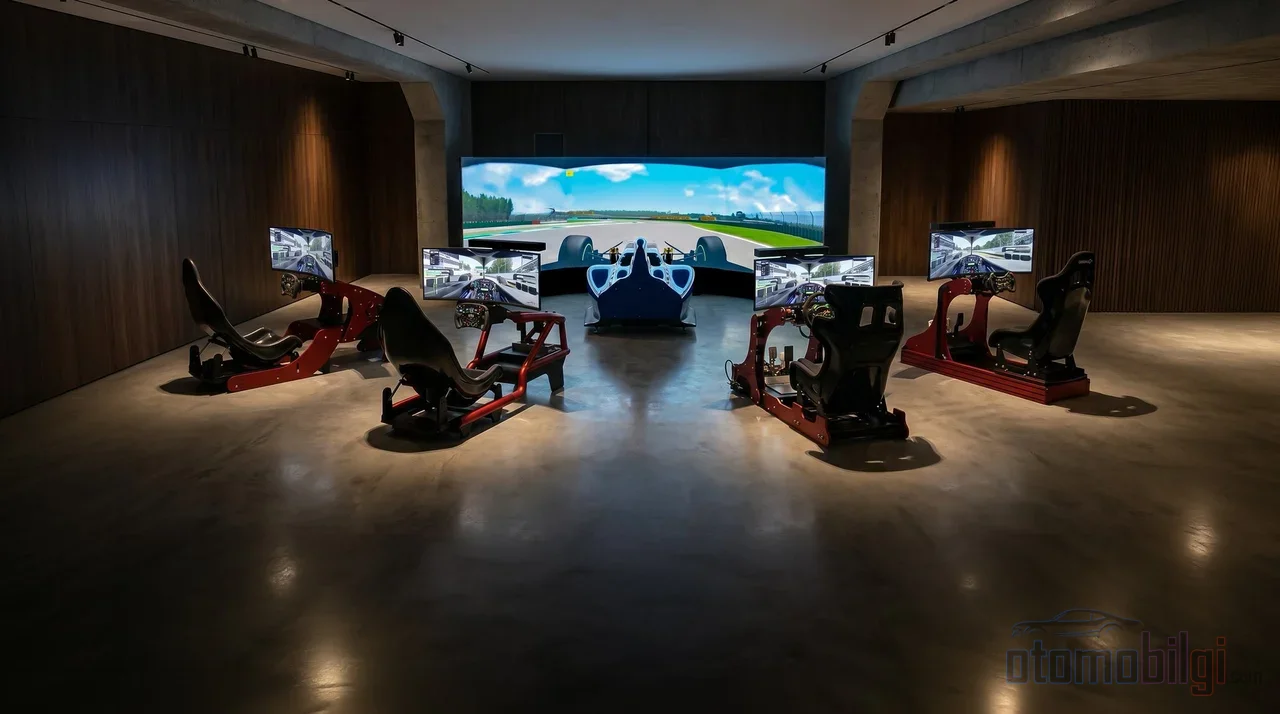
Humans learn to drive on the road; artificial intelligence mostly learns inside a computer. Autonomous driving systems operate not with rule-based approaches, but with probabilistic models that learn from data. In other words, an engineer doesn't write code saying "behave this way at intersections"; the system looks at millions of examples and learns the behavior itself. A significant portion of these examples comes from simulation.
The process roughly works like this:
- Real data is collected: While test vehicles roam the roads, they record camera, radar, and lidar data; moreover, this data, generating ~4 terabytes per hour, reaches petabyte volumes in less than a week.
- The data is transformed into a virtual world: Neural reconstruction techniques convert real multi-sensor driving recordings into high-fidelity 3D environments. Generative world models also add variations in weather, lighting, and rare scenarios.
- The artificial intelligence is trained through trial and error: Thanks to reinforcement learning, the system tries behaviors such as lane changing, overtaking, and yielding in virtual traffic repeatedly; behaviors that achieve good results are rewarded.
- Safety testing is performed: Before policies are used on real roads, they go through staged tests such as software-in-the-loop (SIL), hardware-in-the-loop (HIL), and vehicle-in-the-loop (VIL).
So what is the artificial intelligence actually learning? Convolutional neural networks (CNNs) stand out in object recognition, Transformers in predicting the movement of other vehicles and pedestrians 3-5 seconds ahead, and graph neural networks in intersection interactions. Some systems use end-to-end architectures that learn steering and braking directly from raw sensor data - but these are still considered experimental due to certification issues.
The 11 billion mile problem: Why is simulation necessary?
Here the math is brutal. To reach a human-level error rate, autonomous vehicles need approximately 11 billion miles it needs to do is calculated. Completing this with physical testing would take hundreds of years - meaning no one can wait for that. That is why the industry has no choice but simulation: the greater part of the safety evidence can only be produced in the virtual world. If we add that the driver training simulator market alone was worth 2.2 billion dollars in 2026 and is expected to reach 3.0 billion dollars by 2033, this is not a trend but the industry's fundamental infrastructure.
The superpowers of the virtual world
Simulation's greatest advantage is being able to try things again and again that would be impossible in the real world. A pedestrian suddenly entering the road, a vehicle cutting you off abruptly, headlights off in the dark of night, dense fog, sun glare... All of these are tested in the virtual environment safely and repeatably under identical conditions. Even sensor failures can be simulated: staging a scenario where the front camera malfunctions on a real road is both dangerous and expensive; in the virtual world it takes a few clicks.
McCity's work shows a clever move here: a virtual test environment created with simulated bad drivers breaks the "curse of rarity" for improving emergency decision-making skills. You can experience a scenario you would encounter once a year in real life a thousand times a day in the virtual world. In addition, in some use cases safety validation can only be done through simulation - meaning even the official certification process now depends on the virtual world.
Tesla and Waymo: Two different schools, same classroom?
The industry's two pioneers teach driving in two different ways. Let us summarize the difference in a table:
| Feature | Tesla FSD | Waymo |
|---|---|---|
| Sensor approach | Camera only (vision-only) | Camera + lidar + imaging radar |
| Architecture | End-to-end, all perception in a single architecture | Multi-sensor perception + highly detailed maps |
| Data source | Customer fleet of millions of vehicles | Test fleet + massive simulation |
| Simulation miles | - | 20+ billion virtual miles |
| Current status | FSD (Supervised): under driver supervision | ~200 million fully autonomous miles |
Tesla's strategy is bold: it disables lidar and map infrastructure and entrusts everything to a single architecture that learns from camera data. Its advantage is scale - every Tesla on the road is a teacher. Waymo, on the other hand, works with richer sensor data and emphasizes that no matter how much simulation or test driving it does, this alone is not enough. Interestingly, there is also a strong view that the two approaches are more similar than thought. Because Waymo, too, is learning the best way to represent every object through data-driven training. The difference lies in the richness of the data fed into perception.
Waymo's world model step
In February 2026, Waymo announced a new world model for autonomous driving simulation. The company's approximately 200 million fully autonomous miles and billions of virtual miles are now being used as raw material to produce more realistic virtual worlds. The timeline is also impressive: there were 2.5 billion simulated miles in 2016, over 6 billion by 2018, more than 15 billion in 2020, and today we are above 20 billion. Even a single flashing yellow light can turn into thousands of hours of virtual experience.
The sim-to-real gap: why does a driver who shines in simulation stumble on the road?
This is the heart of the article. Why might a behavior that works perfectly in a simulation fail to deliver the same result in the real world? The name of this difference is sim-to-real gap - the simulation-reality gap. The causes are grouped under four headings:
- Visual domain difference: Virtual graphics cannot exactly replicate real light, texture, and the glare of asphalt in summer heat.
- Physics approximation error: The simulator's physics engine approximates the complex dynamics of the real world.
- Sensor noise mismatch: Real lidar and radar data carry dirty, delayed, and hard-to-predict noise.
- Lack of long-tail scenarios: Not all of the oddities of the real world can be encoded into the virtual library.
Current research from the robotics world examines exactly this: unmodeled effects, sensor delays, and incorrect parameters can turn a laboratory star into a failure in the field. Two techniques stand out as solutions: domain randomization (randomly changing light, color, and physics in the virtual world so the system becomes robust to every variation it encounters) and system identification (calibrating the simulator's parameters with data measured from the real world). Painful examples of this occurred in traffic: In August 2023, Cruise, which received a paid robotaxi permit in California, had two serious accidents in a short time and its fleet was cut in half. A system that looked safe in simulation failed the exam immediately in the real world.
Data imbalance and AI's overconfidence
The second major risk is less visible: imbalance in training data. Counted among the obstacles facing autonomous driving, this problem is based on simple logic - scenarios that are underrepresented in the data pool mean scenarios that are under-learned by the system. Georgia Tech's research showed this can turn into bias: it was argued that, due to algorithmic bias, autonomous vehicles could endanger certain groups, for example pedestrians with dark skin. This is not a technical detail, but an ethical alarm.
The third risk concerns the character of artificial intelligence: AI systems can assign high confidence scores to wrong answers. It cannot say "I'm not sure" like a human; its overconfidence inherits even human cognitive biases through training data, model assumptions, and feedback loops. In edge case detection, false positives lead to unnecessary interventions, while false negatives lead to critical events being missed. Moreover, automatically generated synthetic labels may not always be reliable enough for safety-critical training. According to one expert, reliable autonomous vehicles are still 10 years away - and in a vehicle that mishandles an edge case, the margin for error is effectively zero.
What is the price of trusting simulation too much?
At this point, two camps face off. The advocates are right: because of the 11 billion mile barrier, safety proof without simulation is practically impossible. The skeptics are also right: does simulation-based testing truly include all real-world scenarios? This question has been hanging in the air for years. Even Waymo's own detection implies that simulation volume alone is not sufficient. And Steve Wozniak, one of the field's well-known figures, argues that in unusual situations the steering wheel should be handed over to even the dumbest human - a cynical but thought-provoking point.
Another criticism is that current driving simulation methods cannot scalably produce targeted corner scenarios. In other words, finding "that distinctive dangerous moment" is still partly a human task. Studies shared on OpenReview are seeking solutions to this scaling problem, but it is hard to say it has been completed yet.
Can autonomous vehicles learn entirely in simulation and then hit the road?
The short answer: not on its own. Simulation is an invaluable training ground; but no system hits the road without being fed real-world road data and undergoing gradual real-world testing. Even today's most capable system is not fully autonomous - Tesla's FSD waits for the driver's turn with the "Supervised" label at the start of its name. Simulation is the shadow school; the diploma is earned on the real road. The best driver AI will be the one that blends virtual training with real road experience - and never forgets the difference between the two worlds.
Sources
- Autonomous Vehicle Simulation and Validation
- 6 Reasons to Use Autonomous Vehicle Simulation Software
- Machine Learning in Autonomous Vehicles: Fully Explained
- The Waymo World Model
- Self-Driving Car Technology for a Reliable Ride
- What Is the Sim-to-Real Gap?
- Simulated Terrible Drivers Cut the Time and Cost of AV Testing
- Tesla vs Waymo - Who Is Closer to Level 5 Autonomy?
- Waymo and Tesla's Self-Driving Systems Are More Similar Than You Think
- Edge Cases in Autonomous Driving: Detection and Management
- Research Reveals Possibly Fatal Consequences of Algorithmic Bias
- Full Self-Driving (Supervised)