Asymmetric or Directional? What Happens If Tires Are Fitted with the Wrong Pattern
Share This Page
If a directional tire is mounted backwards, instead of expelling water it channels it toward the center of the tire; grip and braking performance drop on wet surfaces, and the risk of hydroplaning increases. If an asymmetric tire is mounted backwards, the large tread blocks on the outer half end up on the inside; cornering grip and wet-surface performance weaken. On dry surfaces the difference is often not felt, but the real price is paid in the wet.
Highlights
- On a directional tire, there is an arrow on the sidewall; the arrow must point in the direction of forward travel.
- An asymmetric tire has no direction arrow; on the sidewall, the OUTSIDE marking must face outward when mounted.
- Incorrect mounting does not damage the tire but reduces its performance; the greatest risk appears on wet surfaces.
- With directional tires, side-to-side swapping is not possible; only front-to-rear rotation is possible.
What is the difference between symmetric, directional, and asymmetric tires?
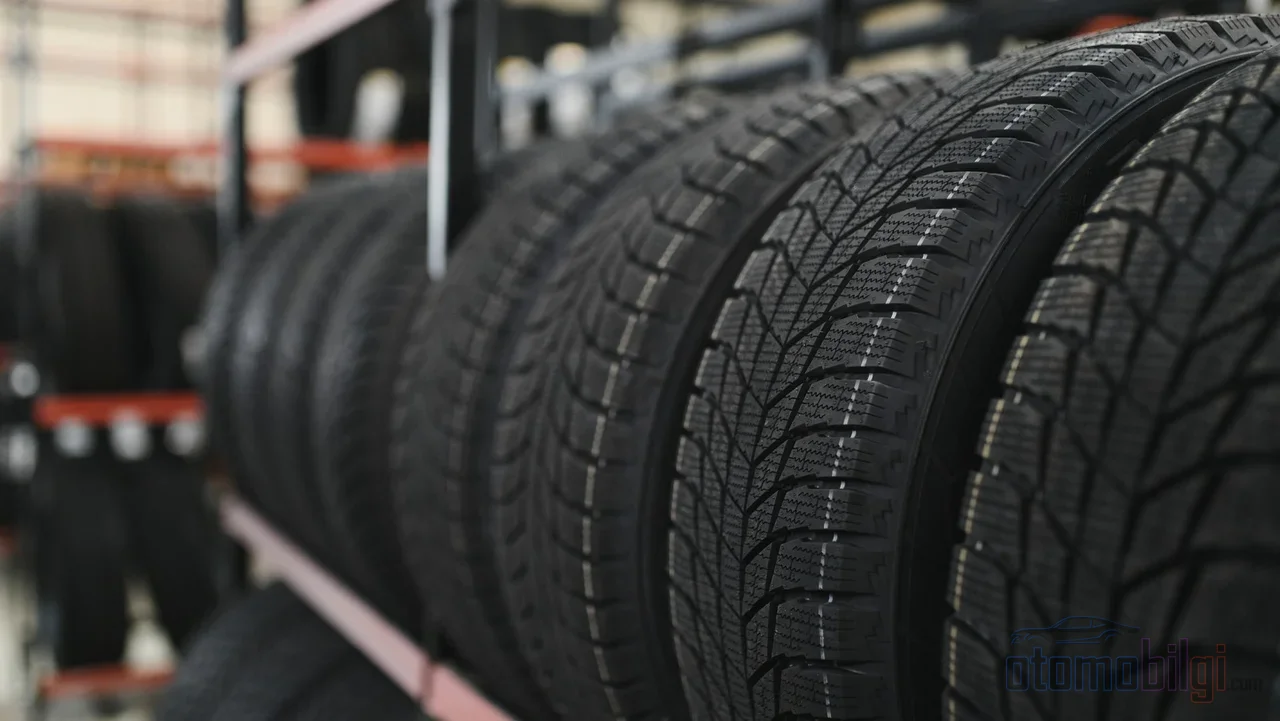
Thinking of the tire tread as one of three families solves most of the puzzle. The design logic of these three families, along with their strengths and weaknesses, differ from one another; which one suits you is determined by your car's character and the surfaces you drive on.
| Tread type | Design logic | Where it excels | Weak point |
|---|---|---|---|
| Symmetric | Same pattern on both sides, can be mounted in any direction and position | Comfort, quietness, economy, even wear | Weak on wet surfaces and against hydroplaning |
| Directional | Arrow/V-shaped pattern working in one direction | Wet surfaces, snow and ice, high speed | More expensive, direction rule mandatory during mounting |
| Asymmetric | Different tread blocks on the inner and outer halves | Balance of dry cornering stability and wet grip | Generally more expensive, inner-outer rule mandatory during mounting |
Symmetric tread: the quietest performer of them all
There is a reason most passenger cars come from the factory with symmetric tread tires: the tread delivers equal performance in every direction, the tire can be rotated to any position, and wear stays even. Road noise is low, rolling resistance is reasonable, and the price is generally the most generous. Because it contains fewer sipes (the thin traction slits on the blocks), it falls behind asymmetric and directional treads on wet surfaces. In daily city and highway use, this shortcoming does not bother most drivers.
Directional tread: the worker that throws out water and snow
The arrow or V-shaped pattern of a directional tire works to evacuate water outward from the center of the tire through circumferential channels. Grip increases on wet surfaces, hydroplaning risk decreases; traction is also good on snow and ice. The trade-off is the mounting and rotation rule: these tires can only be rotated front-to-rear, not swapped side to side. In addition, their prices are higher than symmetric ones, and some sizes may be hard to find.
Asymmetric tread: inside for wet, outside for corners
The outer half of an asymmetric tire features large pattern blocks that provide cornering stability and lateral grip on dry surfaces; the inner half uses small blocks and abundant siping for water drainage and noise dampening. In other words, two different tasks are divided within a single tire. It is common in everyday use and preferred for vehicles that demand handling. Its disadvantages include being more expensive, shorter lifespan in some due to the soft compound, and some models being suitable only for front-to-rear rotation.
There are also patterns that combine the two, being both directional and asymmetric. This is the most expensive category, generally seen in 17-inch and larger sizes, and is aimed at high-performance vehicles. In the past, directional patterns were used as original equipment on most performance models; today, manufacturers have turned more toward high-speed-class asymmetric patterns.
How do you read the direction from the tire sidewall size?
Reading the direction from the sidewall is the skill that will serve you best at the mounting bench, and luckily the marking systems of the two pattern types are completely different from each other.
- On directional tires there is an arrow on the sidewall; when mounted correctly, this arrow should point in the wheel's rotation direction, that is, the vehicle's forward direction. The pattern itself is also arrow-shaped, indicating the rotation direction; some wheels may also have a direction arrow printed on them.
- On asymmetric tires there is no direction arrow; the sidewall has OUTSIDE and INSIDE writings. When the tire is mounted, the OUTSIDE marking must be visible facing outward from the vehicle.
As a practical rule of thumb: if there is an arrow on the sidewall, the tire is directional; if the pattern looks asymmetric but there is no arrow, it is probably an asymmetric pattern and you need to check the inside-outside markings on the sidewall. Differences in markings between the two sidewalls also give clues. For those curious, let us note: on some asymmetric tires, the outside marking may be visible on both sidewalls; in this case, the service performing the mounting by looking at the pattern follows the inside-outside indicators.
What happens if a directional tire is mounted backwards?
The good news is that a tire running backwards typically does not make a big difference on dry surfaces; since the pattern direction provides no noticeable contribution to traction and braking on dry asphalt, it is hard to notice the reversed mounting when you drive the car out of the garage on a straight road. The real effect appears when it rains.
The entire logic of a directional pattern is to drain water outward. When the tire is mounted backwards, the channels direct the same water not outward but toward the center of the tire. The result: grip and braking power drop on wet surfaces, the risk of aquaplaning increases, and road holding becomes unpredictable. Noise is also observed to increase; though, to be honest on this point, the main cause of road rumble is more often the tire's wear condition than the pattern direction. In summary, reversed directional mounting does not ruin the tire, but it does not let it work in the job it was designed for and can be dangerous on wet surfaces.
There is also the rotation side: if you have to run two wheels in the reverse direction, these tires cannot be swapped side-to-side; rotation can only be done front-to-rear.
What happens if an asymmetric tire is mounted inside out?
In an asymmetric pattern, an error means reversing the division of labor. When there are large blocks on the outer half that carry cornering loads, mounting the tire inside out leaves those blocks on the inside; the ability to carry lateral loads decreases, and the tire cannot grip well even on dry ground, let alone deliver the expected performance in the wet. It is known that water evacuation, stability, and fuel economy performance are affected, and in serious cases this turns into a safety risk.
There is also a reassuring fact: if there is no other mechanical problem, an incorrectly mounted asymmetric tire does not harm itself; its wear does not deteriorate, and no structural damage occurs. What is affected is performance. So if the mistake is noticed before it turns into permanent damage, the fix is as simple as turning the wheel in the right direction.
Which pattern is the right choice for which use?
If the summary of thirty years of experience is a single sentence, it is this: choose the tire not according to the vehicle, but according to the surface the vehicle will operate on.
- Symmetric pattern: If daily driving, comfort, low road noise, and long tread life are the priorities, it is the sensible choice for city and highway-heavy use.
- Directional pattern: It stands out in wet and snowy conditions, winter tires, and high-speed use; if your need for water evacuation is high, it is the natural candidate.
- Asymmetric pattern: It is the most balanced choice for mixed-condition use, for those who want high cornering stability and wet grip together in everyday use.
- Directional + asymmetric: For performance-oriented vehicles and large wheels; the budget also has to keep up with this demand.
A small reminder: using different pattern types on the four wheels of a vehicle is also a separate risk. Different patterns can create uneven grip, inconsistent braking, and especially pulling to one side in rain or snow. The pattern type should be taken as seriously as the size.
What should consumers pay attention to during installation?
Although most of the job is done at the service when you take the tire to be changed, checking it is your right and responsibility. A few practical items:
- Before the new tire is mounted, check whether there is an arrow or the word OUTSIDE/INSIDE on the sidewall; this two-second look is enough to read the pattern correctly.
- After installation, confirm that the arrow points forward on directional tires and that the OUTSIDE marking is visible from the outside of the vehicle on asymmetric tires.
- Plan the rotation according to the pattern: on directional and some asymmetric tires, only front-to-back rotation is possible; requesting cross rotation does not mislead the service but violates the pattern.
- Do not mix different pattern types on the same axle or vehicle; all four tires should be from the same pattern family.
Tread depth is a topic as worth discussing as installation: a new tire typically comes with 8-9 mm of tread depth, and the 5-7 mm range is still considered good condition. As depth decreases, the channels' water evacuation capacity drops and the advantage gained by mounting the pattern in the right direction also fades, because a worn pattern has no water left to throw outward.
Conclusion: direction is not a detail, it is the design itself
Modern tire tread patterns aren't the product of such complex engineering for nothing; every component-grooves, blocks, tread ribs, and sipes-is placed for a specific task. The direction on directional tires and the inner-outer distinction on asymmetric tires are the very essence of this engineering; when reversed, the tire isn't ruined, but the design goal is wasted away. Is there an arrow on the sidewall, or an "OUTSIDE" marking-check this first at your next tire change, then leave the rest to the service.
Sources
- Asymmetrical, Symmetrical or Directional Tread?
- Weighing the Pros and Cons of Tread Patterns
- The Differences Between Symmetrical, Asymmetrical, And Directional Tire Treads
- Mounting of Tires with Directional and Asymmetrical Tread Patterns
- Keep 'Em Rollin' in the Right Direction
- Tire Tread
- What are Directional Tires?
- What Are Directional Tires & Their Benefits?
- Asymmetric Tyres
- Understanding Tire Tread Patterns and Installation
- Asymmetrical Tires: Inside/Outside Guide
- Tyre Tread Patterns Explained
- Can you run a Directional Tire Backwards?
- Single-direction, asymmetrical, what happens if the tire is mounted wrong
- Tires with Different Tread Patterns: Is It Worth Experimenting?
- Asymmetric vs Directional Tread
- Tire Tread Depth