Can a Plug-in Hybrid Charge at a Fast Charging Station?
Share This Page
Short answer: The vast majority of plug-in hybrids cannot charge at a DC fast-charging station, because their vehicles lack a DC input and the appropriate charging hardware. Instead, they fill up with standard AC charging, typically at 3.7-7.4 kW in 1.5-3 hours. Only a small number of models are designed to support DC fast charging, and this support varies by model year and equipment.
Highlights
- The battery of most plug-in hybrids is 10-20 kWh; DC fast charging is unnecessary for a size this small.
- Typical AC charging times: with Level 1, 8-12 hours; with Level 2, 1.5-3 hours.
- Mitsubishi Outlander PHEV is one of the few models that supports DC fast charging via a CHAdeMO port.
- Mercedes-Benz GLC 350e fills up in 30 minutes at 60 kW DC charging with its 23.3 kWh battery.
- Frequent DC fast charging can typically cause an extra 5-10% capacity loss over the battery's lifetime.
Why Do Plug-in Hybrids Generally Not Support Fast Charging?
Let's approach the problem from an engineer's perspective. DC fast charging is a solution designed to fill the 60-100 kWh batteries of fully electric vehicles in as little as 30-60 minutes. A plug-in hybrid's battery, however, is generally in the 10-20 kWh range. Filling such a small pack with more than 50 kW of power is technically pointless: the charging time is already short, and sizing the onboard components to withstand that power needlessly increases cost.
The second obstacle is the hardware. If the vehicle's charging input circuit and battery management system are not rated for DC input, the right thing for the manufacturer to do is not to include that input at all. The third obstacle is the most visible one: the charging port of most PHEVs has no physical socket for DC connectors such as CCS or CHAdeMO. The port has only a J1772 AC input.
It is easy to check whether your vehicle supports DC charging. Look at the charging port: if there are two extra DC pins below the J1772 input, the vehicle supports DC fast charging. If there is only the standard AC input, you are limited to Level 2 charging.
AC Charging Power Levels and Expected Charging Times
A plug-in hybrid's onboard charger typically accepts AC power in the 3.3-7.2 kW range. Compared with fully electric vehicles accepting 11-19.2 kW, the difference is clear: for the PHEV's small battery this power is more than sufficient, and it yields fill times measured in fractions of hours rather than whole hours. The key variables that determine charging time are battery capacity, initial state of charge, the power of the onboard charger, the output of the charging station, and ambient temperature; cold weather measurably slows charging.
| Charging Level | Power | Typical PHEV Time | Connector |
|---|---|---|---|
| Level 1 (120V) | ~1.2 kW | 8-12 hours | J1772 |
| Level 2 (240V) | 3.3-7.2 kW | 1.5-3 hours | J1772 |
| DC fast charging | 50+ kW | 30-60 minutes (on supporting models) | CCS / CHAdeMO |
One of their effects can also be read in terms of range: Level 1 charging adds roughly 5 miles of range per hour, while Level 2 adds roughly 25 miles of range per hour. Because the battery is small, a fully charged electric range overnight on Level 2, from midnight to morning, is more than most users' daily needs. If you only have a standard outlet at home, the Level 1 cable also does the job; it is slow, but sufficient for overnight charging. Every PHEV comes with this cable, and buying a special charging unit is not mandatory - Level 2 is merely an upgrade for speed and predictability.
Which Stations Can Be Used on the Road and in an Emergency?
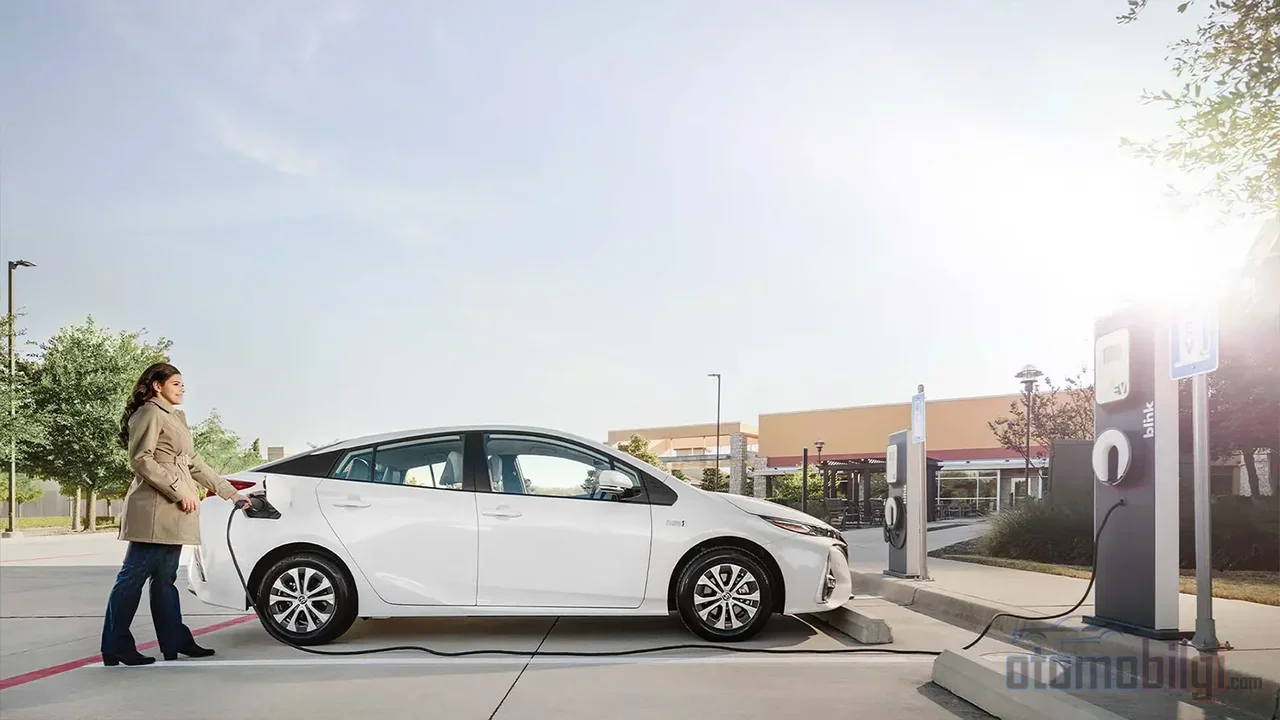
For a PHEV owner, the practical ceiling of public infrastructure is Level 2 stations. Most plug-in hybrids with a J1772 connector are compatible with nearly all public Level 2 stations on the market; the compatibility question comes down to the connector type. DC fast charging stations, on the other hand, are installed along highway routes and in city centers to make long journeys possible for fully electric vehicles - a PHEV with a J1772 port cannot physically charge at these stations.
A critical point needs to be distinguished here: waiting at a station with a PHEV is not as critical as it is with an EV. Even if the electric range runs out, the vehicle continues on its way with the internal combustion engine. For this reason, fast charging for plug-in hybrid owners is not a necessity, but a comfort feature that emerges in new-generation models with larger batteries.
Two different paths are also being discussed in the industry. On one side, the sector is moving to the NACS (SAE J3400) standard, which combines AC and DC charging in a single plug; this may encourage DC charging in more PHEVs in the future. On the other side, one of the charging infrastructure operators argues that for hybrids, 22 kW AC charging could be a "semi-fast" public solution: since hybrids have small batteries, 22 kW AC fills them up quickly and brings a negligible cost to the vehicle manufacturer compared to DC.
Models That Support DC Fast Charging
There are exceptions, and their numbers are growing. Mitsubishi Outlander PHEV is a well-known example that supports DC fast charging via a CHAdeMO port; it is possible to use other chargers with an adapter. Its electric range is at the 38 miles (approximately 61 km) level. Mercedes-Benz GLC 350e came in the 2025 model year with a 23.3 kWh battery, 54 miles of electric range, and 60 kW DC fast charging; a full charge takes 30 minutes. Toyota is offering DC fast charging and a range of about 50 miles in the 2026 RAV4 PHEV: you can go from 10% to 80% in 30 minutes, whereas doing the same with 11 kW AC takes hours.
A more ambitious category is EREVs (extended-range EVs) with 100-200 miles of electric range, according to McKinsey's definition. The 2025 Dodge Ramcharger is an example of this class: 92 kWh battery, 145 miles of range, and 350 kW DC fast charging cuts a fill-up that takes about 8 hours at 11 kW AC down to 45 minutes. Volvo, for its part, announced the new XC70 PHEV with 125 miles of electric range for the Chinese market.
A quite appealing alternative for customers not yet ready to go fully electric.
Does Fast Charging Damage the Battery?
Short answer: with reasonable use, no, though it would be wrong to say no across the board. Data from a large vehicle fleet shows that frequent use of fast chargers can shorten battery life compared to slower Level 2 charging. The amount is measurable too: frequent fast charging typically causes 5-10% additional capacity loss over the battery's lifetime. A peer-reviewed study reveals that charging rates above 4C can alter the battery's chemistry, leading to serious damage and reduced lifespan. On the other hand, when modern battery systems manage heat properly, responsible fast charging does not harm the battery; fast charging does not cause sudden damage, it only slightly increases long-term wear when used alone and routinely.
Let us add a note for plug-in hybrids: some PHEVs used most often in EV mode have been seen to lose more than 30% of their battery capacity at 200,000 kilometers, while some models degrade far more slowly. Also, charging a PHEV battery to 100% every time is a habit that affects its lifespan. So what preserves battery health is not so much a single charging type as the whole of charging behavior.
What to Look for When Choosing a Model?
- Charging port: Are there DC pins under the J1772 inlet? If not, the vehicle is limited to AC charging.
- Onboard charger power: The difference between 3.3 kW and 7.2 kW cuts home charging time in half.
- Electric range: The new RAV4 or Prius Plug-in offers more than 40 miles of EV range per charge; that is longer than the average daily commute.
- Home-side hardware: A 32-amp (7.7 kW) Level 2 unit is sufficient for nearly all PHEVs; 40A/48A units waste money, because the speed is limited by the vehicle's own onboard charger.
One final reminder: full hybrids (non plug-in) are never plugged in; they charge their own batteries through regenerative braking and the engine. The correct answer to the question "Does a hybrid charge at a fast charging station?" lies in this distinction - plug-in hybrids do get plugged in, but mostly through the AC port, while non plug-in hybrids are never plugged in.
Summary: The Practical Picture
Your plug-in hybrid most likely will not charge at a DC fast charging station; this should be read not as a shortcoming of the manufacturer but as a consequence of the small battery's engineering. In daily use, Level 2 charging at home or work is both cheaper and sufficient. In a road-trip scenario, since the engine is already your backup power, you only need to consider highway fast stations if you have a DC-capable model (such as Mitsubishi, Mercedes-Benz, or Toyota's new-generation PHEVs). The only thing you need to do before buying is to check whether DC fast charging is explicitly listed in the model year's equipment list.
Sources
- PHEV Charging at Home: Costs, Times, & Choosing a Charger
- Extended-Range Plug-in Hybrids With DC Fast-Charging Gain Popularity
- Plug-in Electric Vehicle Charging: The Basics
- Hybrid and Electric Vehicle Benefits and Advantages
- Does a plug-in hybrid vehicle require charging?
- Hybrid Battery Health: 7 Pro Tips
- EV Battery Health: Key Findings from 22700 Vehicle Data
- How does fast charging affect EV battery lifespan?
- Does Fast Charging Hurt Your EV Battery?
- Does Fast Charging Damage EV Batteries?
- Some Plug-In Hybrid Batteries Degrade Much More Slowly
- Impact of Charging Rates on Electric Vehicle Battery Life
- Do I Need a Special Charger for a Plug-In Hybrid?