Engineering Electrochromic Glass: Cars with Dimming Windows
Share This Page
Electrochromic glass is a smart glass technology that permanently darkens in color when a small voltage is applied, and becomes clear again when the voltage is reversed. It contains no moving parts whatsoever; the job is done by lithium ions traveling between thin layers within the glass. From the curtainless windows of the Boeing 787 to Mercedes' glass roofs, this principle is at work. So how can tiny sand-like ions darken an entire pane of glass like a pair of sunglasses? Let me tell this story from an engineering perspective.
Highlights
- Electrochromic glass typically operates on 3-5 V DC - less voltage than a USB cable.
- Light transmittance can drop from 60-70% to 1%; in the newest aircraft windows, <%0,1 seviyeleri görülüyor.
- Mercedes MAGIC SKY CONTROL does not use electrochromic but SPD (suspended particle device) technology.
- In its darkened state, the glass blocks approximately 98% of the sunlight falling upon it.
- No power is needed to maintain the state; electricity is consumed only at the moment of transition.
How Does Electrochromic Glass Darken? The Science of Lithium Ions
The concept dates back to 1969: Dr. Satyen K. Deb discovered electrochromism in solid tungsten oxide (WO₃) - that is, the phenomenon of a material's color being able to change reversibly through electrochemical means. From that day to this, the principle has remained the same: when lithium (Li⁺) or proton (H⁺) ions enter the WO₃ lattice, the material turns from transparent to dark blue; when the ions are withdrawn, it becomes clear again.
Think of it for a moment like the adhesive smeared on the back of stickers at home: the substance stays in place, but when something is added inside it, its behavior changes. What is added here are ions, and what changes is the way the material absorbs light. No moving blinds, curtains, or rotating slats - just a tiny migration of ions between layers.
The Five-Layer Sandwich
An electrochromic glass is actually a paper-thin sandwich consisting of five layers: transparent conducting oxide (TCO) electrodes on both sides, with three functional layers in between. The cathodic electrochromic layer is almost always tungsten trioxide (WO₃); next to it is the ion-conducting electrolyte through which the ions pass; on its other side is an anodic ion storage layer such as nickel oxide (NiO) or vanadium pentoxide (V₂O₅).
In the classic structure, lithium ions normally wait in a lithium cobalt oxide (LiCoO₂) inner electrode. When a small voltage is applied, the ions cross the electrolyte and settle into the polycrystalline WO₃ layer - this is called "intercalation," or entering between the layers. The result: the glass reflects light and becomes nearly opaque. And here is the sweetest part: even if the voltage is cut off, the ions stay in place. The glass does not clear until the reverse voltage arrives.
"The easiest way to see an electrochromic device is as a thin battery that optically indicates its charge state."
The analogy is spot on: it is exactly the same principle as the lithium-ion battery in your phone. Indeed, a 1992 patent explicitly describes the device as "usable as an electrochromic window and/or a rechargeable battery." Electricity is only needed to change the state; none is needed to maintain the dark or clear state.
Voltage, Time and Numbers: How Fast in Reality?
Driving voltage is typically 3–5 V DC; some economical designs use 3.5–4 V for forward dimming and −3.0 to −2.5 V for reverse fading. Light transmittance can vary between 10% and 70% in the visible range; some commercial products promise tinting that goes from 60% down to 1%.
The annoying part is speed. Since ions spread by diffusion into the layer, switching in electrochromic systems typically takes 3–20 minutes - in large architectural glass, this is the industry's main commercial bottleneck. While some solutions report times as short as 3 minutes for full darkening, manufacturers are looking for ways to bring the typical 10-minute transition below 1 minute. And let's be honest: the glass never goes pitch black - it lets through a little light even in its dark state - nor does it look completely clear; a slight smoky tint always remains. In its initial state, the window is slightly bluish.
PDLC and SPD: Alternative Ways of Dimming
Electrochromic glass is not alone; it has two popular rivals on its stage. If you are looking for a mystical privacy effect like frosted glass, the technology you need to meet is PDLC: polymer dispersed liquid crystal. When current flows, the crystals align and let light through; when the current is cut, they orient randomly, scatter light, and the glass appears frosted. SPD (suspended particle device) does a similar job by aligning tiny particles with electricity.
| Feature | Electrochromic | PDLC | SPD |
|---|---|---|---|
| Operating voltage | 3–5 V DC | 20–100 V (types: 24/48/65 VAC) | High voltage (capacitor physics) |
| Switching time | Seconds–minutes | 1–3 seconds | Seconds |
| Intermediate tint | Stepless, gradual | None (clear/opaque) | Stepless |
| Main purpose | Sun/heat control | Privacy | Heat and glare control |
| Power to maintain state | Zero (untinted state) | 4–6 W/m² | Transparent when powered |
PDLC blocks 80–90% of UV but modulates NIR only between 12–38%; so privacy is great, heat control is limited. Electrochromic glass is slow and expensive but offers gradual tints and maintains its state for free. In short, one is an instant curtain, the other a slow but smart pair of sunglasses.
Are Cheap "Smart Films" Really Electrochromic?

Most of the cheap adhesive films sold online are not electrochromic; they use LCD-like liquid crystal. A typical example: a film 0.35 mm thick transmits about 98% of light when clear, turns opaque in a third of a second (transmittance drops to a third), and has been tested to switch 3 million times. Impressive numbers, but the technology is from an entirely different family. Also, laminated smart glass is considered clearer and more homogeneous than a film applied afterwards. If you ask the price: a large smart window costs roughly 500–1000 USD per square meter; electrochromic, due to manufacturing complexity, is even more expensive than thermochromic glass.
From Mercedes to Boeing: Real-World Applications
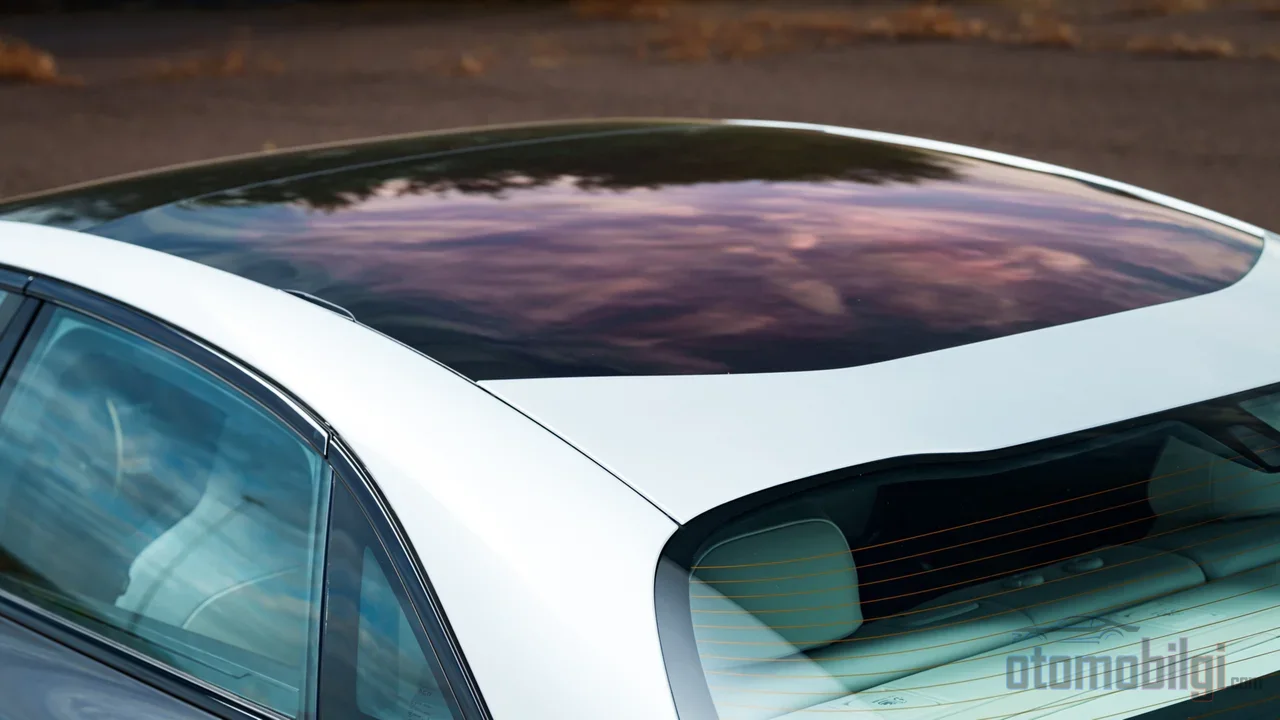
The most famous example in the automotive world is Mercedes's MAGIC SKY CONTROL glass roof. It first appeared in 2012 on the SLK's panoramic roof, then in the 2019 S-Class (W222) and also in the GLC with MBUX connectivity and a segmented roof. The technology is based on SPD-SmartGlass: using the physics of a plate capacitor, tiny particles inside align when voltage is applied and the roof becomes transparent. When the voltage is cut off - for example in the dark or while parked - the roof turns dark. SLK users have repeatedly confirmed on forums its effectiveness in reducing heat transfer.
On the aviation side, the star is the Boeing 787 Dreamliner: Its cabin windows feature gel-based electrochromic windows made by Gentex, relegating the shuttle-like shades to history. Passengers adjust the tint with buttons, and cabin crew lock them according to flight phases. These windows are the largest ever on a passenger jet - about 65% larger than standard. The newest generation of dimming glass achieves light transmittance below 0.001% ; meaning up to four full orders of magnitude darker at the darkest setting.
Thermal Load and Energy: Does Dimming Glass Make Money?
The numbers are striking. In the US, buildings consume 71% of electricity used, and roughly 30% of that is spent compensating for energy escaping through windows. An electrochromic glass in its dimmed state blocks about 98% of incident sunlight; in its opaque state it absorbs or reflects the near-infrared (780-2300 nm) band. On a south facade at the summer solstice, a smart window can reduce the cooling load by 30.8-46.1% ; a reduction of about 20% is projected in peak cooling and lighting energy use.
The system's own consumption is comically low: the switching energy of 100 windows is close to a single incandescent bulb. Moreover, since it operates on 3-5 V DC, it can even be powered by small photovoltaic cells embedded in the frame. This is why electrochromic glass is, in the long run, an energetically more comfortable choice than PDLC, which requires continuous power.
The Hard Side of Engineering: Durability, Manufacturing and Degradation
So why doesn't everyone do this? The answer: the electrolyte. The switching speed is limited by Li+/H+ diffusion, and everything is demanded from the electrolyte at once: high ionic conductivity, electronic insulation, dimensional stability across a wide temperature range, and electrochemical endurance over tens of thousands of cycles. Finding a material that meets all of these mutually contradictory requirements at once is one of engineering's favorite impossible assignments.
Degradation doesn't come from a single cause either; there are at least four interacting mechanisms: the lattice volumetric stress created by ion cycling leads to microcracks and delamination; UV photochemical reactions can create unstable coloration and permanent darkening; moisture seeping into interfaces and thermal cycling stress finish the job. The target lifespan is 20-30 years; today's windows can lose performance after 10-20 years.
On the production side, the job is even more delicate: On panels exceeding one square meter, achieving the film thickness via PVD (magnetron sputtering) is essential; even a difference of a few nanometers creates a visibly different color depth. If the resistance uniformity of the TCO electrode is compromised, the edges of the glass tint more slowly than the center - the "RC delay" effect. Add to that power supplies delivering precise voltage waveforms to each panel, coordination with building management systems in large installations, and the risk of permanent whitening/darkening artifacts from overdriving. Among the major patent holders are giants like View Inc., Saint-Gobain, and AGC; forecasts that the automotive smart glass market will reach a range of 6-9 billion dollars by the early 2030s are also a sign of this seriousness.
Conclusion: A Slow But Patient Technology
Electrochromic glass is an elegant engineering product that behaves like a battery "charged" by electricity: When needed, it blocks light and heat at rates of up to 98%, and once its job is done, it consumes almost no power. It loses to PDLC in speed, and to rapidly changing environmental conditions in patience; but its lifetime low operating costs and gradual comfort put it ahead in buildings and aircraft. One day, don't be surprised when your car's side windows also darken at the touch of a button - the physics is already ready. Now, if it were up to you, would your roof stay always open, or always closed?
Sources
- How do electrochromic and other 'smart' windows work?
- Engineering Challenges in Next-Generation Electrochromic Smart Window Systems
- Performance assessment of SageGlass electrochromic glazing
- Electrically powered active smart windows - Gadgil et al.
- Optimized Physical Properties of Electrochromic Smart Windows - Kim et al.
- Design and Implementation of Electrochromic Smart Windows - Xie et al.
- MAGIC SKY CONTROL function - Mercedes-Benz Owner's Manual (S-Class W222)
- Function of the panoramic roof with SKY CONTROL - MBUSA (GLC)
- Gentex electronically dimmable windows brochure
- Electronically Dimmable Aircraft Windows
- Electrochromic Glass vs. PDLC Smart Glass
- Electrochromic Materials - Lawrence Berkeley National Laboratory
- Automotive Smart Glass Market