Faraday Future Unveils Its FF Nova Robot to the World
Share This Page
Faraday Future unveiled its FF Nova humanoid robot, announced in a joint press release on October 15. While this $2,490 small robot does not replace the volume the company has never quite managed to capture on the electric vehicle side, it stands out as a tangible product of its technology diversification strategy. This announcement, which went largely unnoticed amid the launch buzz of big names like Tesla, Porsche and Maserati, may turn out to be the move that truly determines the company's financial future.
Highlights
- October 15, 2026: FF Nova ($2,490) and FF Nova Mini ($299) were unveiled.
- FF Nova is 49.7 cm tall, weighs 2.8 kg, and has 20 degrees of freedom.
- Initial production is limited to 100 units and invitation-only; delivery of 20 robots is ready.
- The robotics business is part of a share-based merger with a valuation of ~$200 million.
- In Q2 2026, the company's revenue reached the $836 thousand level.
What is FF Nova and who is it designed for?
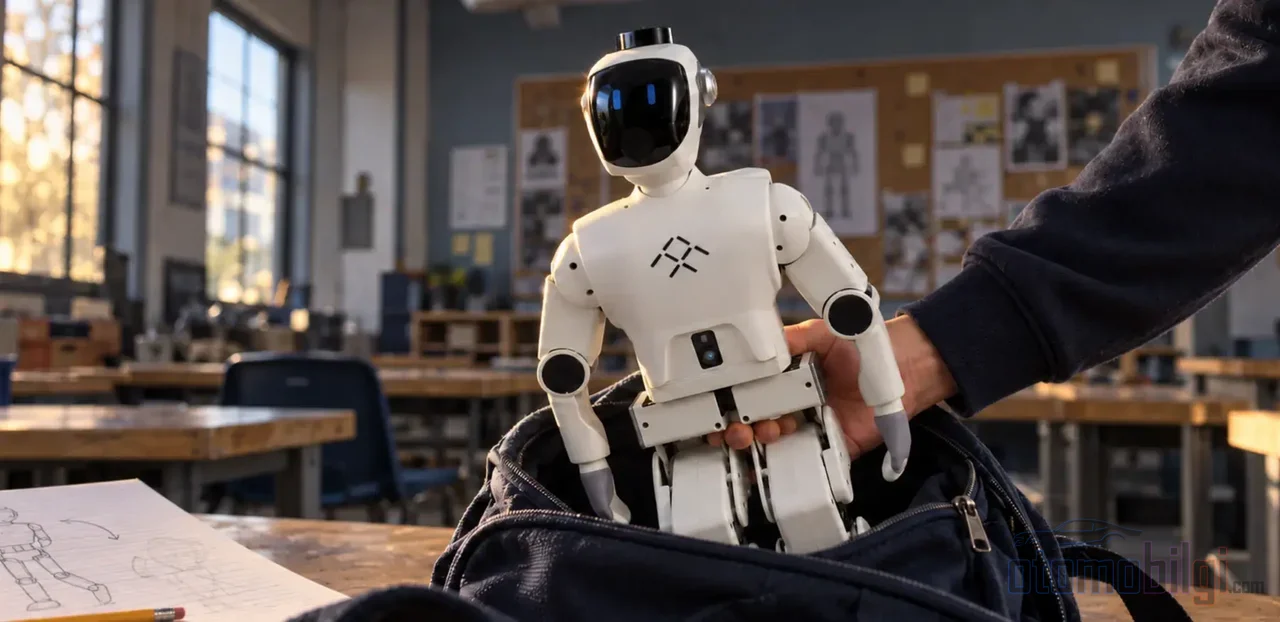
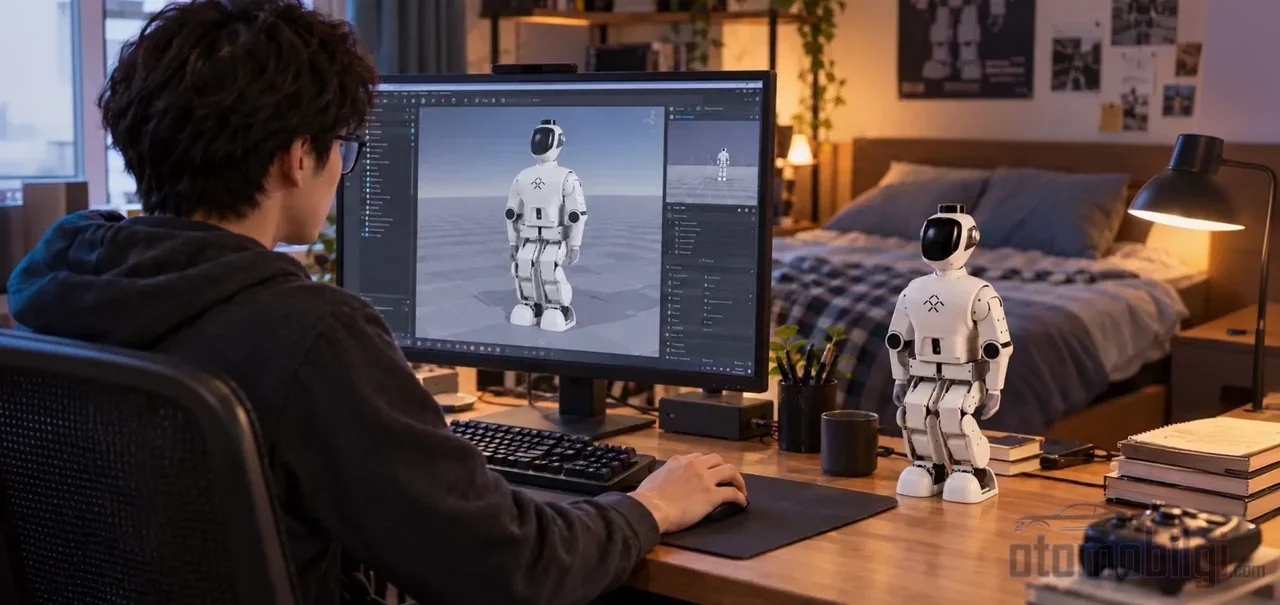
First of all, expectations need to be set correctly: FF Nova is not a full-size industrial humanoid that walks on stage, moves crates, or performs factory operations. At 49.7 cm tall and 2.8 kg in weight, it is a research and education platform that can be placed on a desktop. The target audience has been determined accordingly: developers, universities and schools. The company describes the robot as the first embodied AI humanoid robot priced under $2,500 in the US; however, this claim has not been verified by an independent source.
On the technical side, here is the picture: 20 degrees of freedom (2 in the head, 6 in the arms, 12 in the legs), 10 TOPS of on-device processing power, 8 GB of RAM and 32 GB of storage. On the sensor side, there is a 2D LiDAR on top, an approximately 4 MP wide-angle camera, a 3D time-of-flight sensor and a microphone array with three microphones. In the face area, there is a 2-inch display with a resolution of 240x296 pixels. Wi-Fi 6 and BLE 5.4 are provided for connectivity.
Its mobility capabilities suit this class: walking, turning, waving and getting back up after falling over. Thanks to a detachable wheeled base, a sliding mode is also available. However, one should be careful when looking at the speed figures: the bipedal walking speed is 0.1 m/s; the high speed of 0.8 m/s applies only to the wheeled base, with a maximum obstacle height of 2 cm. In other words, the speed highlighted in the promotions actually belongs to one of two separate mobility modes.
The software side may be the robot's real selling point. ROS 2 support, an open SDK, OTA updates and promises of AI Agent integration with connection to a large voice AI model are being offered. In other words, Faraday Future is opening the door to a development ecosystem here rather than selling hardware.
Four products took the stage at once at the launch event
FF Nova was actually not introduced on its own. On October 14, at an invitation-only event, the companies announced a package consisting of four products: The robot itself is the $299 FF Nova Mini, along with a curriculum called the Physical AI Spark Program and the Nova Reinforcement Learning Developer Program. This integrated approach shows that the company's aim is not merely to sell robots, but to build a community around education and developers.
The FF Nova Mini, on the other hand, is aimed at children aged 8 and up: 34.9 cm tall, 0.94 kg in weight, an aluminum alloy chassis, and 17 servo motors. It stands out with more than 40 voice commands, more than 50 preset motions, block-based programming, teaching poses by hand, and an AI coding tutor feature. This education-market product is one of the rare items capable of selling to families.
| Feature | FF Nova | FF Nova Mini |
|---|---|---|
| Price | $2,490 | $299 |
| Height | 49.7 cm | 34.9 cm |
| Weight | 2.8 kg | 0.94 kg |
| Degrees of freedom | 20 | 17 servos |
| Target audience | Developers, universities, schools | Children aged 8 and up |
| Standout features | ROS 2, open SDK, OTA, LiDAR | Block programming, 40+ voice commands |
A separate revenue stream has also been planned on the add-ons side. A $390 Developer Skills Package is offered for the Nova. On the Nova Mini side, the Physical AI Foundations curriculum, consisting of 16 live online lessons conducted over Zoom in groups of 6-10 people over 8 weeks, is sold for $499; purchasers of the course are given a coupon that provides a discount on the robot's price. The curriculum is built on the NVIDIA Isaac platform: it includes simulation training, reward function tuning, and domain randomization, and concludes with validation on the physical robot.
Who can buy the robot right now, and how?
We are not talking about a consumer product sitting on shelves. Distribution has been planned in three phases: Phase 1 is invitation-only and limited to 100 units; the first 20 robots are said to be ready for immediate delivery. Phase 2 is defined as an opening to all developers and educational institutions, and Phase 3 as the consumer launch - but no timetable has yet been given for these two phases. In the initial stage, applications were accepted for a limited period through the developer portal.
This scaling strategy should be read with caution. An initial production run of 100 units points to a controlled start rather than a large-scale commercial launch. Nor does the company appear to have shared a timetable or sales forecast for additional production phases. In other words, as of today the FF Nova is more of a signal: the product exists, a price has been set, but the market size has not yet been proven.
Where does robotics stand in the company's survival plan?
Those who have followed Faraday Future's story know that the promise of luxury electric vehicles has been stuck on scaling problems for years. The figures draw a clear picture: in the first quarter of 2026 the company's revenue rose 62% to $512 thousand, and in the second quarter it reached $836 thousand; total revenue for the first half of the year stood at around $1.35 million. While the rate of growth is striking - over 1,400% year-on-year in the second quarter - the absolute size is not at a scale sufficient for an automaker to survive. The net loss for the same period was announced as 38.9 million dollars.
The company's response was to reframe the business. The operating model announced in September is based on staying asset-light in capital, assets, marketing and sales. The robotics business, meanwhile, was positioned as a new revenue engine in its first delivery quarter; having shipped 817 units by the end of September and reported to have reached a positive gross margin in the first half, this unit is becoming a revenue line independent of the company's EV business.
In May, founder and global CEO YT Jia announced a total of 70 million dollars in financing over two months and outlined a comprehensive transformation in five areas. In August, the top three robotics targets came up along with a valuation of around 200 million dollars for the robotics business. In short, the introduction of Nova is less a marketing event than the showcase of a strategy that has long been in the works.
What does the 200-million-dollar merger mean?
Days before the launch, on October 12, FFR and Faraday Future Intelligent Electric (FFAI) signed a definitive agreement to acquire FFAI's robotics business at a valuation of approximately 200 million dollars on a stock basis. FFR shares will be issued at 2,246 dollars with a premium of roughly 50% over the closing price on the signing day. Once the transaction is completed, FFAI will own approximately 65.7% of FFR; the new shares will remain locked up for 18 months. FFR also provided PIPE financing of up to 10 million dollars, and the deal is expected to close by the end of October.
Knowing the corporate background here is essential: FFR changed its name from AIxCrypto Holdings on September 30, and its value is at a level of around 60 million dollars on a fully diluted basis. A merger tied to a valuation of 200 million dollars from such a scale in such a short time also shows how risky an arithmetic the market is standing on. FFR's Nasdaq listing ceremony and first Investor Day will be held in New York on Monday, October 26 - this will be the robot story's first major test in front of investors.
The market's initial reaction is cautious: following the agreement, FFAI stock is trading at around 0.81 dollars, down 2.46% according to the latest data. Despite the bet on robotics, it is hard to say that the company's EV-origin challenges are behind it; the market is therefore prudent.
What does the 2,490-dollar price change in the humanoid market?
On the agenda of the humanoid robot market these days are names like Tesla Optimus (not yet on sale, with a target price range of 20,000-30,000 dollars), 1X NEO and Figure 03. FF Nova's 2,490-dollar price tag falls far below this segment; but the product class is also different. While the rivals on its arms promise full-size or general-purpose in-home robots, Nova is clearly positioned as an education and development platform. So a direct price comparison isn't possible, but the fact that an entry-level education robot has come down to this price point is noteworthy in terms of lowering the cost of access to the field of embodied AI.
In the past, a car company's launch calendar was built around engine displacements and the models on showroom floors; now degrees of freedom in robots and reinforcement learning curricula have been added to that list. In Faraday Future's case, this is not a luxury but a necessity. Unable to find the volume it was looking for in the EV market, the company is trying to stay afloat by spreading its technology across multiple revenue streams.
What does this launch say about the company's future?
FF Nova alone won't save the company; an invitation-only sale of 100 units is far too small a step for that. However, what the launch really signifies is that its robotics business is now at the center of the story. A unit that is beginning to replace the EV business on income statements, reportedly reached a positive gross margin, and received an independent valuation through a $200 million spin-off, will be the factor determining the company's financial outlook in the period ahead. That is also Nova's real purpose: to make an investor story about the future of robotics tangible with a sellable product. How much premium the market will place on this story will become clear at the investor day on October 26 and beyond.
Sources
- FF Nova - Embodied AI Humanoid Robot for Developers
- FF Nova Mini - Educational Humanoid Robot for Physical AI
- Faraday Future and FFR Jointly Launch FF Nova (Business Wire)
- FF EAI Robotics Ecosystem Inc. - Investor Relations
- FFR Listing Ceremony and Nasdaq Investor Day (Business Wire)
- "Light on Four, Heavy on Four" press release - SEC EDGAR
- Q1 2026 8-K - Faraday Future Intelligent Electric
- Q2 2026 results - Yahoo Finance
- FF EAI Robotics Launches $2,490 Humanoid Robot - Yahoo Finance
- Faraday Future unveils a $2490 humanoid robot - TNW
- Faraday Future Unveils $2,490 Nova and $299 Nova Mini - Unite.AI
- Faraday Future launches $2490 FF Nova humanoid robot - Humanoid.guide
- YT Jia investor update, May 2026 (Business Wire)
- FFAI stock quote - Yahoo Finance
- Faraday Future - Wikipedia