Heat Pump and Thermal Management for Efficiency Engineering
Share This Page
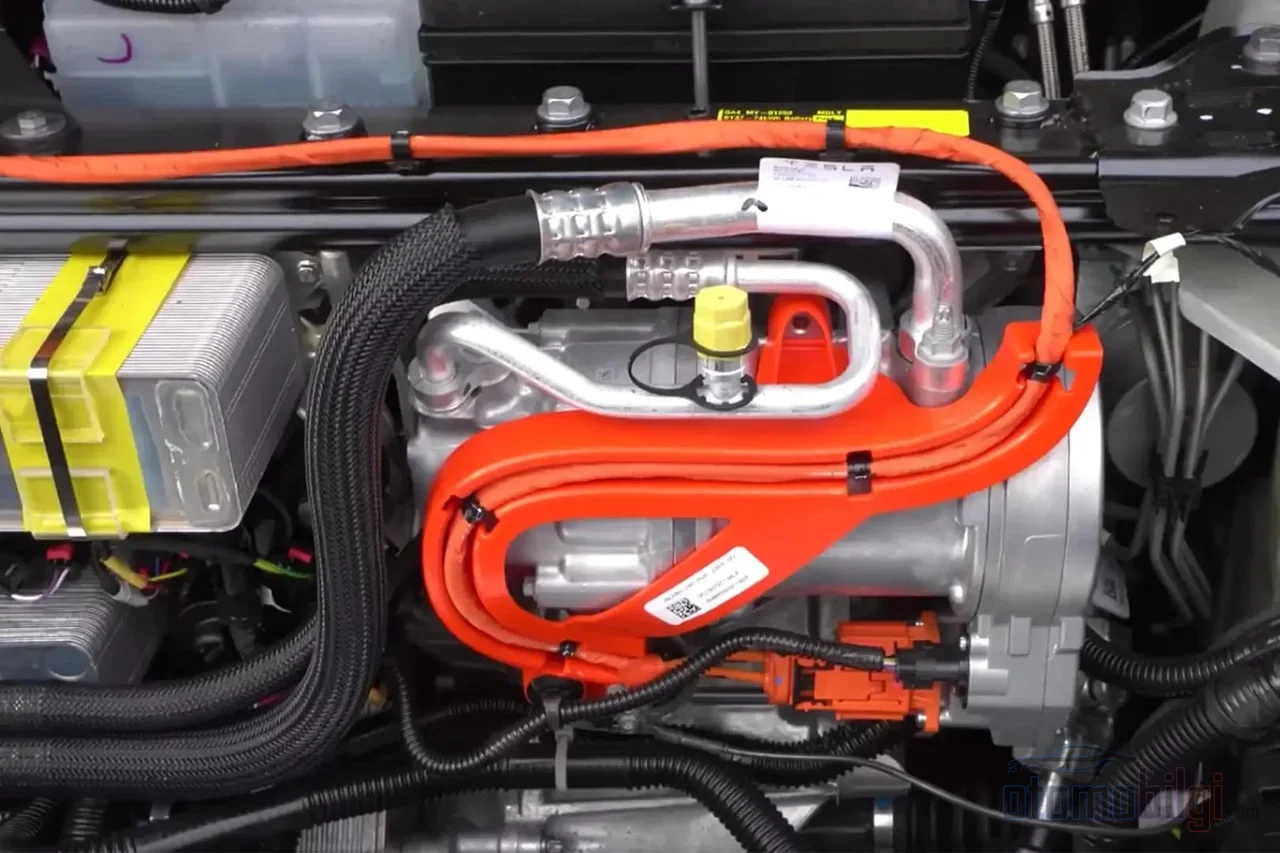
A heat pump is a heat transfer system in an electric vehicle that can produce 2-4 kW of heat from 1 kW of electricity, operating as a reversed air conditioning cycle. Instead of generating heat the way a resistance heater does, it collects heat from the outside environment and the powertrain; this way it recovers winter range by an average of 8-10% and regains a significant portion of the range that resistance-heated vehicles lose in freezing conditions.
Highlights
- A heat pump provides 2-4 kW of heat from 1 kW of electricity; it is 200-400% more efficient than a resistance heater.
- At -7°C with the heating on, EV range loss can reach 41%; only 12% of that comes from the battery.
- Around -1°C, heat pump vehicles show an 8-10% improvement in winter range.
- Below -15°C, resistance assist kicks in; in extreme cold the heat pump's contribution is nearly zeroed out.
- A heat pump cannot be retrofitted; it is a system deeply integrated into the thermal circuit.
Why It Matters So Much: EVs Have No Waste Heat
In a gasoline-powered vehicle, 75-85% of the energy is lost as heat, and this waste heat is a free source of comfort: the cabin is heated by the engine's warmth. An electric vehicle has no such luxury. Motor efficiency is high and there is almost no waste heat; all the heat for the cabin and battery must be generated from the energy in the battery. This is precisely the main cause of winter range loss.
The numbers paint this picture clearly: At -7°C with the heating on, range loss can reach 41%; whereas the loss caused solely by battery temperature is around 12%. Most of the difference is energy spent on cabin heating. Because the EPA test cycle never measures cabin heating, this large gap opens up between official range and winter reality.
Three Jobs in One Loop: How Does the Thermal Management Chain Work?
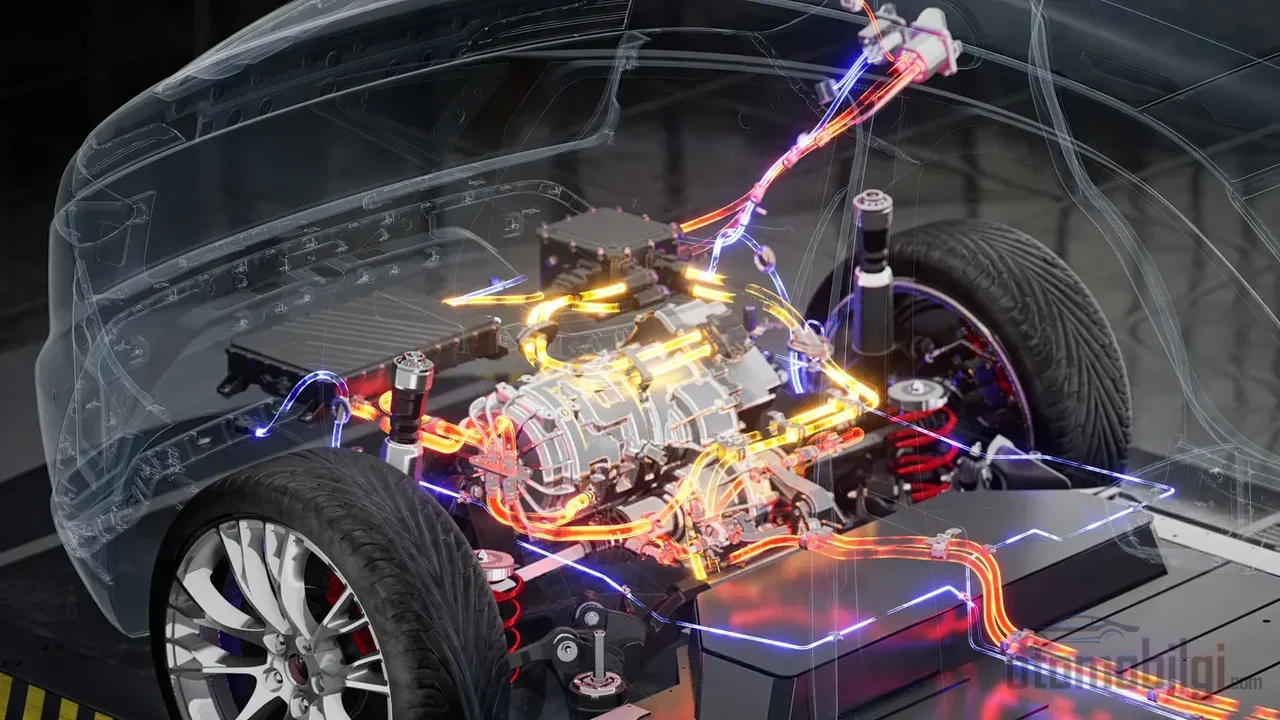
Thermal management in an electric vehicle is not a single task but a chain of jobs circulating in the same circuit: battery, power electronics, electric motor, and cabin. The system's goal is to keep each component within its own safe and target operating range. The battery is the most critical link in this chain; its cells must be kept in a narrow temperature window that directly affects range, charging speed, and lifespan.
In a typical architecture there are two liquid loops: one cools the power electronics via the radiator, the other cools the battery via a chiller. Both loops connect to the refrigerant circuit. For motor cooling, dielectric oil directly wets the rotor and stator, transferring the heat it absorbs to the water/glycol mixture. In some systems, a refrigerant evaporator is placed inside the battery pack to provide direct contact with the cells.
Integrated Valve Example: All Heat Sources in a Single Circuit
The best example of where thermal management has evolved is an eight-port valve architecture that manages a vehicle's cabin condenser and evaporator, the low-voltage electric cabin heater, and all heat sources - motor, battery, power electronics - in one integrated circuit. A peer-reviewed analysis shows that this approach significantly reduces energy consumption and battery load during system warm-up, while the total warm-up time becomes longer: the gain is not free, it comes with a trade-off.
The heat pump sits at the center of this chain because it is not merely a cabin heater. It can also collect the residual heat left after the operation of the motor, inverter, and battery and direct it toward cabin heating - this is the engineering answer to the "no waste heat" rule in an electric vehicle.
How Much Does the Heat Pump Really Contribute to Winter Range?
The short answer: between 8% and 30%, depending on temperature. The long answer involves several layers that vary according to measurement conditions. According to large-scale verified fleet data, vehicles with heat pumps retain an average of 83% of their range in freezing conditions; resistance-heated ones retain 75% - a net advantage of 8 points. Around -1°C, the improvement is measured in the 8-10% band.
At lower temperatures, the difference widens. In an experimental study conducted at -10°C, the heat pump increased range by 25-31% compared to resistance heating. In a comparison made in the same temperature band, the resistance-heated Model 3 increased energy consumption by 26%, while the heat pump-equipped Model Y increased it by only 8%.
| Measurement | Resistance (PTC) | Heat Pump |
|---|---|---|
| Share of range retained in the cold | 75% | 83% |
| Winter range improvement at -1°C | - | 8-10% |
| Consumption increase at ~30°F (comparative test) | +26% | +8% |
| Range increase at -10°C (experimental) | reference | 25-31% |
| Average heating power (at 20°F operation) | 1.6 kW | 1.1 kW |
The speed profile also has an effect. In dynamometer tests at 0°C, the heat pump's range contribution came out as 15% in the city cycle, 10% in the highway cycle, and 7% in the aggressive driving cycle - since the heating load remains constant, the longer you stay on the road, the bigger the absolute gain.
What Happens as Temperature Drops? The Efficiency Limit
The heat pump's efficiency is measured by the coefficient of performance (COP: units of heat produced per unit of electricity consumed). In mild winter conditions (0-10°C), COP is in the 2-3 band; as the temperature drops, the heat that can be drawn from the outside air decreases and COP approaches 1, meaning the same efficiency as resistance heating. NREL data shows this point clearly: while range loss with resistance heating progresses in the 28.3%-53.8% range depending on temperature, the heat pump recovers between 12.8% and 1.1% of range - in extreme cold, the contribution is almost zeroed out.
The practical rule is this: most systems lose efficiency below -10°C, and below -15°C electric resistance assist kicks in automatically. New-generation pumps, using the residual heat of the battery and motor, aim for effective operation down to -25°C. So the heat pump is not an alternative to resistance heating; it is the efficient first stage that engages before it.
A Concrete Scenario: Winter Range in a 65 kWh Vehicle
To put the number into everyday language: An electric vehicle with a 65 kWh battery offers ~264 miles (approximately 425 km) of range at 65 mph (approximately 105 km/h) under optimum conditions. With full cabin heating active, this figure drops to around 176 miles (approximately 283 km) - a loss of 33%. With a heat pump, the same car can do around 230 miles (approximately 370 km); the loss drops to a range of only 10-14%. The difference in between means roughly 85-90 km of planning margin, and it can completely change winter charging planning.
The same effect can also be achieved with seat and steering wheel heating - but at a far lower cost. Each seat heater draws only 50-100 W; compared to the 1.5-3 kW load of cabin heating, that is dozens of times more efficient. In short urban trips, the biggest gain comes from heating the passenger directly rather than the cabin.
Preconditioning: Heat from the Grid, Not from the Battery
The biggest item in the winter energy budget is bringing the cold car up to a comfortable temperature. Preconditioning moves this load from the battery to the grid: while the car is plugged in, it is started 20-30 minutes before charging, and the battery and cabin are heated with grid energy. It does not completely eliminate winter range loss, but it reduces it significantly and makes daily use predictable. The general rule is to precondition when the battery drops below 15.5 degrees C.
Combined with a heat pump, the effect is striking: when the journey begins, the battery is already warm and the cabin already heated; the heat pump also maintains cabin temperature up to three times more efficiently than a resistive heater throughout the trip.
Equipment Status, Cost and Frequently Asked Questions
The heat pump is now standard on many models: The Tesla Model Y and post-2021 Model 3, Audi e-tron, BMW iX/i4, Nissan Ariya, Mercedes EQS/EQE. It comes as an option or with a climate package on some models: The VW ID.3/ID.4, Hyundai Ioniq 5, Kia EV6, and the higher-trim Polestar 2. The option price is typically around GBP 1,000; in real-world usage examples in the UK, it pays for itself in 3-4 years with annual charging savings of around GBP 100-150.
Manufacturers' own claims are above independent measurements: While BMW measured up to a 30% reduction in climate energy consumption in internal tests, Audi claims up to a 25% contribution to winter range in the -5 degrees C to +5 degrees C band. When making a decision, it is wise to separate these claims from independent measurements.
- Can it be retrofitted? No - it is a system deeply integrated into the vehicle's thermal circuit, and it should be decided at the point of choosing the car.
- Does it work below freezing? Yes, but its efficiency drops; below -15 degrees C, resistive backup heating kicks in.
- Does it work as air conditioning in summer? Yes, it provides cooling by reversing the cycle.
- Does it require maintenance? No - it is a closed system, checked along with the air conditioning circuit during routine maintenance.
- Does it make a difference on short trips? The advantage is evident on long trips that require continuous heating; on short trips it is more limited but still present.
Conclusion: Don't Ignore Thermal Engineering
A heat pump is not a range booster on its own, but the visible part of a well-designed thermal management chain. Systems that manage battery, power electronics and cabin temperature in a single loop; when pumps that collect residual heat and grid-powered preconditioning come together, winter range loss can drop from the 40% band to the low double digits. When choosing an electric vehicle, look at how this loop is built as much as motor torque or fast-charging power - perhaps even more so if you live in a cold region: because range is won not in the brochure, but in the engineering of the thermal circuit.
Sources
- Study: How Much Heat Pumps Boost EV Range
- Electric Car Heat Pumps: How They Increase Range in Winter
- Heat Pumps & EVs: The Ultimate Guide
- Octovalve Thermal Management Control for Electric Vehicle (Wray et al., 2022)
- Tesla Octovalve analysis
- Cooling Systems for Electric Vehicle Powertrains
- Electric Vehicle Thermal Management
- Types of EV Battery Thermal Management Systems
- Thermal Management in Electric Vehicles: E-Motor Cooling
- Preconditioning Electric Vehicles in Winter
- Smart Tips for Electric Vehicles in Cold Weather
- EVs in Cold Weather
- EV Heat Pump vs PTC Heater
- Heat Pump Efficiency at Low Temperatures
- Vehicles with Heat Pumps vs Resistive Heaters