How Headrests Prevent Whiplash Injuries?

Share This Page
A head restraint is a safety component that limits the head from snapping backward in rear-end collisions, thereby preventing whiplash injuries. When adjusted to the correct height and distance, it can reduce neck injuries by 24 to 44 percent; active versions move forward and upward on their own at the moment of impact, catching the head even earlier. In other words, the most overlooked part of your car is actually the silent guardian of your neck.
Highlights
- Properly adjusted head restraints can reduce rear-end collision injuries by 24-44% .
- An estimated 4 million rear-end collisions occur each year in the US; neck sprain is the most serious injury in one third of whiplash compensation claims.
- In 60% of cases, whiplash is the only injury resulting from the crash.
- The top of the restraint should be at head level, and the distance between the head and the restraint should be at most about 5 cm .
- Of the 18 small SUVs that were the first victims of the new whiplash prevention test, only 4 managed to earn the top rating.
How Exactly Does a Whiplash Injury Occur?
Let's think about the physiology of a rear-end collision with a simple analogy: You are standing on a bus and the driver suddenly hits the gas; your body presses into the seat but your head lags behind for a moment. The same thing happens in a rear-end collision, only far more violently. As the vehicle and seat push the passenger's torso forward, the unsupported head lags behind due to its inertia. This speed difference between the head and the torso causes the neck to bend forward and then stretch. As the acceleration of the torso increases, the forces acting on the neck and the likelihood of injury also rise.
The neck goes through several phases during this. In the first stage, the cervical spine experiences flexional deformation and loses its natural neck curve. Then the neck practically takes on an S shape - the upper part is forward while the lower part has stayed behind. This S shape is the most critical moment of whiplash biomechanics; it is precisely here that the soft tissues are stretched and strained.
Let's see how significant the problem is with a few figures: In 60 percent of cases, whiplash is the only injury that appears after the crash. Neck sprain and strain is recorded as the most serious injury in one third of injury compensation claims across all types of crashes, and its annual cost exceeds 8 billion dollars. The risk is not the same for everyone: women suffer neck injuries more often than men in rear-end collisions; those in the front seats, especially drivers, are at greater risk than those sitting in the back.
Why Is a Head Restraint Not Just a "Cushion"?
In engineering language, the name of this part is head restraint - deliberately distinguished from the "headrest" we use in everyday speech. Because its job is not to comfort the head but to limit its backward movement in a collision. The basic goal is very clear: to move the head and torso at the same time, together. When this relative movement decreases, neck injuries also decrease.
What makes this possible is geometry. The higher the restraint and the closer it is to the head, the higher the likelihood of preventing a neck injury. The reverse situation is genuinely dangerous: A head restraint set too low passes behind the head and acts like a fulcrum, putting even more strain on the neck. In other words, a wrongly adjusted head restraint can be more harmful than having none at all.
Once the geometry is sufficient, the seat itself comes into play. The structure and stiffness of the seatback must work in harmony with the restraint to support the neck. In addition, the recline angle of the seatback is an important engineering balance: reclining the seatback more reduces the peak value of head acceleration but can increase the risk of injury by extending the duration of its effect. The practical advice is clear - keep the seatback as upright as you can tolerate; don't recline it more than 20 degrees.
The legal side is also serious: In the USA, FMVSS No. 202 regulates head restraints and requires the restraint to withstand an increasing rearward load until the seat or seatback fails or a load of 890 newtons (200 pound-force) is applied. From the 2009 model year onward, the standard made it mandatory for restraints to extend higher and sit closer to the head.
What Does an Active Head Restraint Do at the Moment of a Collision?
This is where the real engineering show begins. A passive restraint has to be in the right place before the collision. An active restraint moves closer to the right place as the collision develops - meaning even if you forget the adjustment, the system fills in for you. The active head restraint is defined as a device that automatically improves the position and geometry of the restraint during a collision and, unlike fixed restraints, is designed to move forward and upward in a rear impact.
How does the system trigger itself?
The most common mechanism is based on acceleration, that is, inertial force: when a rear impact pushes the body into the seat, the system responds to this motion. In the Active Head Restraint (AHR) system in Chrysler, Jeep and Dodge models, for example, the front half of the restraint extends forward in a collision to catch the head. The Self-Aligning Head Restraint (SAHR), on the other hand, moves up and forward with the occupant's motion of sinking into the seat, providing neck support earlier - even if the restraint is poorly positioned. In other words, the energy source is the collision itself; no battery, no sensor, no waiting.
In newer-generation systems, rear-facing sensors detect the collision in advance and adjust the restraint accordingly. There is also synchronization on the seat side: the hinge at the base of the seatback moves rearward, reducing the forward acceleration of the body. In addition, the controlled "breakaway" torque in the internal structure of the seatback softens the effect by allowing the body to sink into the seatback without excessively pivoting on impact. When the rearward motion of the head and the body's sinking into the seat occur at the same tempo, the neck is not crushed in between.
Whiplash Tests: How Do IIHS and Euro NCAP Put Seats to the Test?
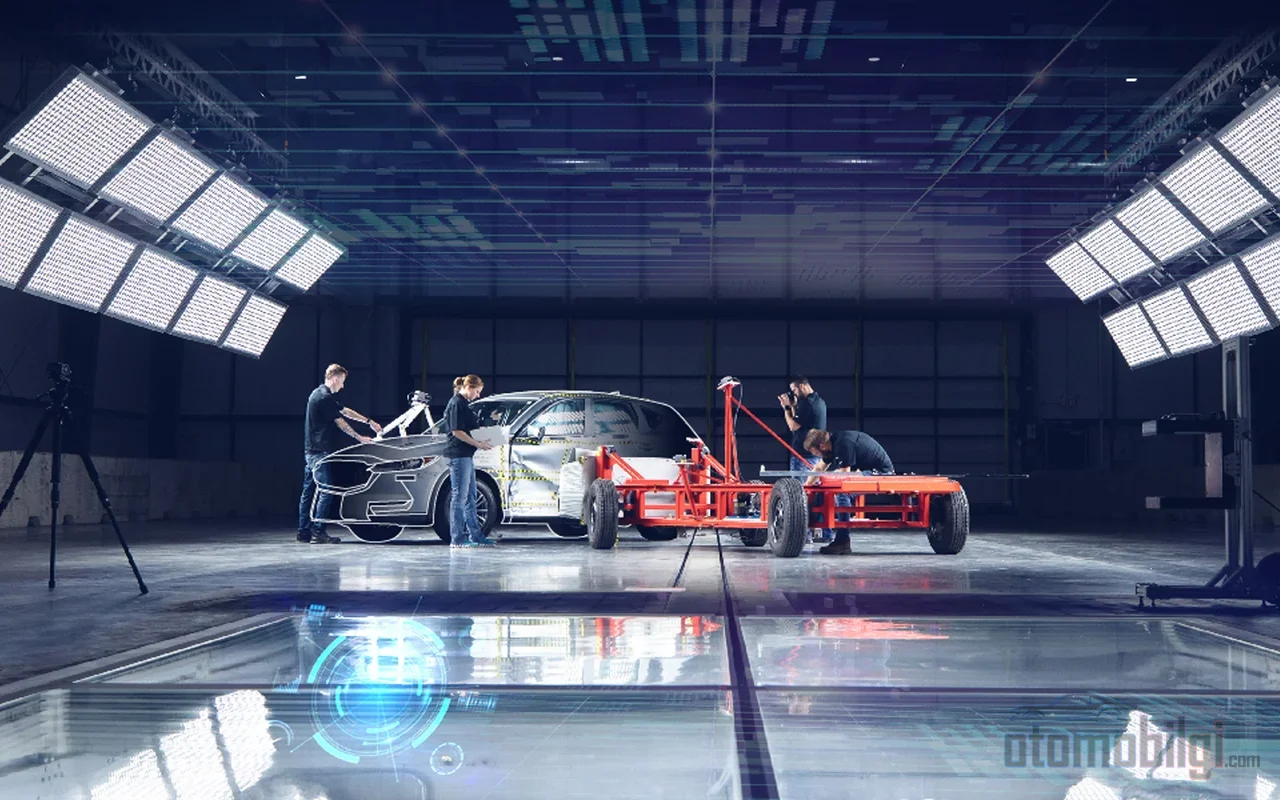
Do head restraints actually work? We don't guess by sitting in the seat - we measure with dynamic tests. IIHS has been measuring geometry since 1995; in 2004 it added a dynamic test simulating a rear-end collision. The rating scale has four tiers: good, acceptable, marginal and poor, and the same system is used internationally by the International Whiplash Prevention Group. The protocol is two-stage: designs whose geometric rating is acceptable or good are subjected to a dynamic rating in a simulated rear-end collision at 16 km/s; the test measures how the seat manages the bending and tension forces on the occupant's neck.
In January 2026 the task got even tougher: IIHS rolled out a new, more demanding whiplash prevention test. The old test had lost its meaning as almost all models started earning good ratings. The first victims of the new test were 18 small SUVs, of which only 4 managed to earn the top rating - among them the 2025 Audi Q3, the 2025-26 Hyundai Ioniq 5 and 2025-26 Subaru models. The logic of the new assessment is also interesting: An effective head restraint must hold the head in its natural upright position; if the restraint pushes beneath or above the head, it counts as ineffective.
So do these ratings translate into real life? A comprehensive 2008 assessment showed that neck injury complaints were 15 percent lower with good-rated seat and head restraint combinations compared to poor-rated ones, while claims for neck injuries lasting longer than three months were 35 percent lower. The rate of neck complaints in traffic accident claims was 16.2 percent for good-rated seats versus 19.2 percent for poor-rated ones; for long-term injuries the figures were 3.8 percent versus 5.8 percent. There is also an interesting nuance: acceptable and marginal seats showed no clear reduction in initial neck complaints compared to poor ones, improvement appearing mainly in long-term injuries. In other words, a "not bad" rating doesn't inspire as much confidence as a "good" one.
On the European side, Euro NCAP takes the stage. Euro NCAP simulates low-severity rear-end collisions to evaluate the whiplash neck protection of seats, and this score is part of the overall vehicle rating. The assessment measures how well the seat and head restraint assembly reflects best practice against the risk of whiplash-related neck disorders in low-severity collisions. The current protocol includes three sled tests with different measurements - meaning the seat, together with a test device placed in place of a passenger, is subjected to a collision on a sled. The goal is clear: to improve seat design and reduce neck injuries in low-speed collisions.
Two Systems, One Goal: The Difference Between Passive and Active Restraints
| Feature | Passive head restraint | Active head restraint |
|---|---|---|
| Operating timing | Must be in the right place before the collision | Moves into the right place as the collision develops |
| Movement | Fixed, user-adjusted | Moves forward and upward on its own |
| Triggering | None | Inertial force or rearward-facing sensors |
| Tolerance to incorrect adjustment | Lower; a low setting increases risk | Higher; SAHR provides support even in a bad position |
| Synchronized with the backrest | Dependent on geometry | Works together with the hinged backrest and breakaway torque |
The real-world benefit of active systems isn't an empty promise either. A retrospective evaluation based on Scandinavian real-world data revealed that whiplash-reducing head restraints are effective in reducing the risk of whiplash in drivers and front-seat passengers. In other words, head restraints that adjust automatically in a collision and energy-absorbing seats are among the modern features that genuinely reduce insurance claims.
Proper Adjustment: Reducing Whiplash Risk in 30 Seconds
Now for the other side of the coin: How much are you benefiting from this system? Because even the best head restraint is useless if adjusted incorrectly - and it can even backfire. The good news: Getting it right takes 30 seconds and is completely free.
- Height: The top of the head restraint should be at or above the level of the top of your head. Never let it drop below ear level.
- Distance: The back of your head should be as close to the head restraint as possible; the gap between them should be at most about 5 cm. As this distance widens, the room for your head to whip back grows.
- Backrest angle: Keep the backrest upright; take care not to recline it more than 20 degrees.
- The low-setting trap: If you set the head restraint too low, your head pivots over the top of it and the risk of injury increases.
This adjustment also has a concrete payoff: Farmer and his team's 1999 study showed that drivers of vehicles with well-rated head restraints were 24 percent less likely to suffer neck injuries in rear-end collisions. A broader estimate says that if all adjustable head restraints were in the topmost position, the relative risk would drop to 2.4 and whiplash injuries would decrease by 28 to 42 percent. Let me also remind you of the most common mistakes: setting the head restraint too low, leaving too much distance between the head and the restraint, and reclining the backrest too much. All three are mistakes that can be fixed in 30 seconds.
Frequently Asked Questions
What exactly does a head restraint do?
In a rear-end collision, it limits the rearward movement of the head and reduces strain on the soft tissues of the neck. It is estimated that, when properly adjusted, it can reduce neck injuries by 24 to 44 percent.
How does an active system differ from a passive one?
Passive head restraints must be in the right place before a collision; active head restraints move to the right place as the collision develops. Some manufacturers refer to these systems with names like WHIPS.
What happens if I set the head restraint too low?
The head pivots over the head restraint; the restraint acts like a wedge, straining the neck further and increasing the risk of injury. That is why a low setting is even worse than no adjustment at all.
Final Word: Give That Little Piece a Chance
In the trunk, the glovebox, and the door pockets we think of dozens of things, but most of us never look at the head restraint. Yet what keeps you out of the hospital in a rear-end collision is most likely the engineering inside that cold, hard plastic. The next time you change vehicles, when you sit in the seat, first check the height of the head restraint and the distance behind your head. This 30-second habit might one day save your neck.
Sources
- Neck injury risk is lower if seats and head restraints are rated good
- IIHS launches new whiplash prevention test
- Whiplash prevention - IIHS
- Head restraints - IIHS
- Only 4 Small SUVs Get Top Marks in New Whiplash Test
- Euro NCAP Whiplash test protocol v4.1.2
- FMVSS No. 202 Head Restraints for Passenger Vehicles
- Biomechanics of whiplash injury
- The effectiveness of active head restraint (SAHR)
- Relationship of head restraint positioning to driver neck injuries
- Retrospective evaluation of vehicle whiplash-reducing systems
- Adjusting head restraints
- Active Head Restraints - SEAT
- Active car headrests – what are they and how do they work?
- How Do Headrests Prevent Injury?