How Is Safety Ensured in Rallying? Safety Measures from the Cage to the Halo
Share This Page
Rally safety is achieved through the combination of in-car measures such as the roll cage, racing seats, HANS device and fire suppression system, together with organizational measures like stage closure, the zero car and safety delegates. In rallying, one of the most dangerous motorsports in the world, these two layers have become a life-saving system over the last forty years. So how exactly does this system work?
Highlights
- Group B 1982-1986 raced for only four seasons and 1987 was banned for
- Engine power in WRC cars 34 mm is limited to around 300 horsepower by the intake restrictor of that diameter
- Rally cars have no airbags; instead there is a roll cage, six-point harness and HANS
- Halo arrived in Formula 1 in 2018; the three-armed titanium structure wraps around the cockpit
- 30 minutes before every stage, a safety delegate makes a final inspection run through the stage
How Is Rally Safety Ensured?
Imagine this: a gravel road, trees alongside, a cliff on the corner, and you have your foot flat on the gas. In a normal car this picture is terrifying; in rallying, what makes it all work is the coming together of measures inside and outside the car. In other words, there is no single miracle part; the cage, seat, harness, HANS, fire extinguisher and the organization's per-stage plan all interlock like the links of a chain.
And in my view the most interesting part of this chain is this: rally cars have no airbags at all. When you first hear this, you say "are you serious?", but the logic is this; the cabin is wrapped up in such a way that in a crash, what protects the driver is not a big cushion but a steel skeleton surrounding them and the straps that lock them into that skeleton.
What Is Inside the Car? From the Roll Cage to HANS
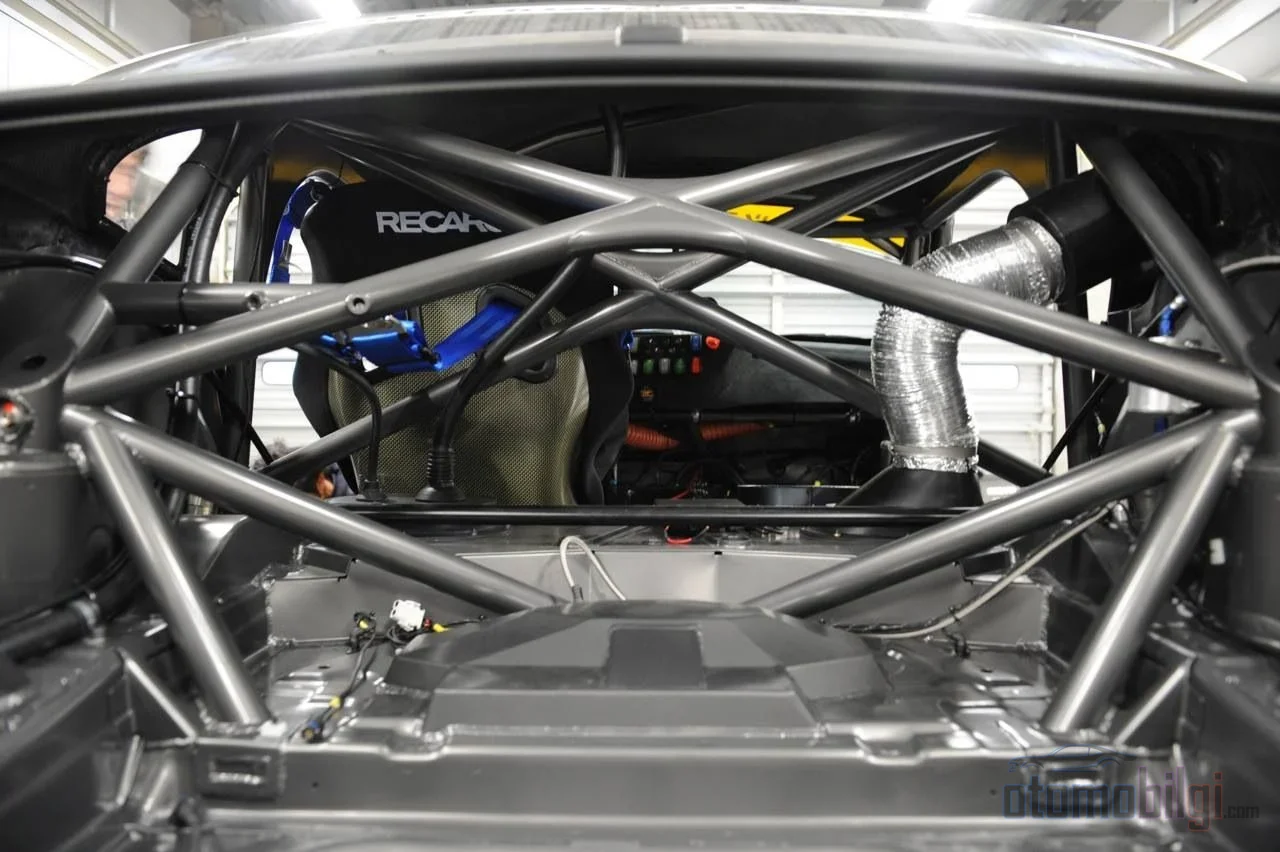
Roll cage: the hidden skeleton of the cabin
The roll cage is a structure made of high-carbon steel tubes welded inside the passenger cabin. When the car rolls over or takes a major impact, this tube skeleton preserves its shape instead of crumpling along with the body, creating a "life pod" for the driver and co-driver. Think of it like a soft package placed inside a cage; impacts from outside hit the tubes first, the energy is distributed across the tubes, and the crew survives in the end.
One important detail is this: the cage is not a part that protects the driver on its own. The entire structure fixed to the car's body works together with the body as a system. That is why welding a tube into our ordinary family car and saying "I'm safe now" does not work; even in a minor collision there is a risk of your head hitting metal. A rally cage makes sense only when considered together with the seat, harness and helmet.
Seat, harness and HANS
Inside the cage, the crew sits in racing seats that are completely different from ordinary seats. These seats wrap around the body, and six-point harnesses with wide straps secure the body to the seat. In this cockpit without airbags, the protection trio works like this: the cage takes external impacts, the seat holds the body in place, and the harness locks the crew into the car.
HANS, on the other hand, is one of the most critical pieces of recent years. It stands for Head and Neck Support. It is a device fitted over the shoulders and resting behind the neck; it is used together with the harnesses. In a crash, the head does not fly forward independently of the torso and sudden movements are restricted; this greatly reduces head and neck injuries. A simple analogy: think of it as a flexible but limited arm sling worn around your neck, always moving the head together with the torso.
Fire and power limitation
The cockpit also has an automatic fire suppression system; if flames appear, the system kicks in and the crew is additionally prepared with flameproof suits, balaclava, helmet and HANS. The safety list also includes reinforced fuel tanks, crash protection, and the ability to exit quickly after an accident.
There is also an interesting safety detail that most people don't notice: speed itself is a safety issue. In WRC cars, to limit engine power, a 34 mm diameter intake restrictor must be placed in the air intake. Without the restrictor, these engines can exceed 500 horsepower; with the restrictor, power stays at around 300 horsepower. In other words, the rulebook physically narrows the engine's airway to keep speed under control as well. Safety is designed not only for after a crash, but also to prevent crashes from happening.
Group B: The Turning Point That Changed Safety History
To understand the current state of rally safety, you need to look at Group B. Introduced by the FIA in 1982, this category lived only four seasons, between 1982 and 1986; but for many, it is considered the "golden age" of rallying. Why? Because the definition practically explained itself: "cars faster than the sport could safely manage." Machines faster than supercars on gravel roads, weak crowd control, and a low margin of safety. All of them together.
Unfortunately, the price was paid with lives. In 1986, spectator deaths occurred in Portugal and most manufacturers abandoned their Group B programs. The same year, immediately after the deaths of Henri Toivonen and co-driver Sergio Cresto at the Tour de Corse, the FIA banned Group B from competing in the WRC; the ban took effect for the 1987 season. So 2026 is exactly 40 years after that ban. The death of one category paved the way for the birth of rallying's safety culture; the harshest example of the lesson in motorsport that "speed isn't everything."
The Halo Reality: Where Is That Protective Arch Actually Used?
In the title we said "from the cage to the Halo," but I have to be honest here: the Halo is not used in rally cars, but in open-cockpit series - that is, series where the wheels and the driver's head are exposed. It entered in 2018, and its purpose is to reduce the risk of debris or objects striking the head area. It is a three-pronged, tunnel-shaped titanium structure; it deflects incoming objects or absorbs their energy by wrapping around the cockpit. So you don't see a Halo in rallying, because a rally car is already a closed-cockpit car; its "Halo" is the roll cage itself, together with the roof pipes.
Halo was designed as additional front-end protection from the start; the design goal was to manage the energy of the impacting object.
This energy management idea aligns perfectly with the philosophy of rallying. The cage does the same job: it doesn't reject the impact, it absorbs and dissipates the energy. In an open-cockpit sport, a welded network of tubes takes the place of the protective shell - that's all there is to it. The two worlds use different vehicles, but the safety math is the same.
The Organizational Side: How Are Stages Made Safe?
Even if everything inside the car is perfect, the situation is a problem if the spectator crowd on the stage is uncontrolled. That's why half of rally safety lies hidden in the pre-race organization. At modern WRC events, the scenario roughly proceeds as follows:
- Pre-event inspection run: Thirty minutes before the first competitor, a safety delegate drives through each stage one last time; the stage is only approved after this final inspection.
- Zero car: A course car that passes through the stage before the competitors, letting spectators know the area is now "live." The wheeled version of the message "the race is starting, step aside."
- Safety vehicles: Except for the Zero Car, all safety vehicles are equipped with a roof light bar, siren, and PA system; at every event, one spectator safety vehicle and one Zero Car are on duty.
- Spectator rules: Spectators must stay within designated fan zones; standing on the outside of corners or at the end of long straights is forbidden, because that's exactly where cars can lose control.
- Time restriction: At some events, spectators are even banned from entering and walking along stage roads 30 minutes before the first competitor's start.
- Marshals and signage: Spectators are asked to follow the instructions of officials, follow the red-and-white color-coded barriers, and use natural terrain as protection.
At the international level, safety directors are also on duty; for example, a deputy chief safety officer is responsible for flagging spectator safety concerns regarding course sections that cannot be sufficiently controlled. So if something goes wrong within a stage, there is a hierarchy of names who report it upward and intervene. Spectator campaigns are also part of this system; a direct "stand in the right place" message is delivered to spectators.
Surviving Crashes: Proof the System Works
All this equipment and procedure looks good on paper, but the real test is done in real crashes. Robert Kubica's story is one of the best-known examples. On February 6, 2011, he had a severe crash in a Skoda Fabia at the Ronde di Andora rally, suffering a partial amputation and fractures in his forearm. The crash occurred before the 2011 Formula 1 season and radically changed his career. The interesting thing is: he had previously also survived a rally crash, breaking through barriers in a lucky escape from a cliff drop. On the F1 side, at the 2007 Canadian GP, 300 km/h he had launched into the air and hit three barriers, yet walked away from the crash.
The common message of these examples is this: much of what we call "luck" in motorsport is actually engineering put in place in advance. The cage's tubes, the seat's wrapping, HANS holding the neck, and the stage having been inspected beforehand may not prevent a crash, but they can radically change the outcome. In the Group B era, many links of this chain were missing; today every link is in place and connected to one another.
Cage, HANS, Halo: Same Goal, Different Tools
| Item | Where | What does it do? |
|---|---|---|
| Roll cage | Rally cars, inside the cabin | Cabin protection with a steel tube skeleton against crashes and rollovers |
| Six-point harness | Rally cars, seat | Securing the driver to the seat and the car |
| HANS | Together with helmet and harness | Reducing neck injury by restricting head movement |
| Intake restrictor | Engine air intake | Reducing power to roughly 300 horsepower with a 34 mm diameter |
| Halo | Open-cockpit series, F1 (since 2018) | A titanium arc above the head; deflecting objects, absorbing energy |
| Zero car and safety delegate | Stage organization | Stage approval and warning spectators that "the race is starting" |
Looking at the table, the pattern is clear: protection or prevention; they all complement one another. The safety cage protects the car, the organization protects its surroundings. When one is missing, the chain weakens; Group B's story is the most expensive proof of this.
Final Word: Where We Started and Where We Are After 40 Years
It has been 40 years since Group B was banned, and rally appears to have truly learned the lessons of that dark era. Today, when you get into a rally car, the steel cage that surrounds you, the HANS device on your neck, the fire suppression system above your head, and the fact that the stage was inspected one last time half an hour before the race; all of these are the paid-off invoice of 1986. Although the Halo is not a part we see on rally cars, the "manage the energy" philosophy it represents lives on inside every rally cage. What do you think will be the next leap in safety over these forty years? My guess is that the next revolution will be sparked not by another tragedy, but by engineering itself.
Sources
- Glossary - Rally Türkiye | WRC
- WRC A-Z
- FIA Rally Safety Guidelines 2025
- Škoda Motorsport: Promoting spectator safety at the FIA World Rally Championship
- WRC launches new spectator safety campaign
- Group B - Wikipedia
- All 22 Group B rally cars, 40 years since they were banned - Classic & Sports Car
- Halo (safety device) - Wikipedia
- Tech Explained: Formula 1 Halo - Racecar Engineering
- Halo: guardian angel of the race track - FIA Foundation
- Robert Kubica - Wikipedia
- Surgeons fight to save the hand of Formula One star - The Guardian
- National Historic Rally Regulations - TOSFED
- Stage Rally Safety Car Guidelines - Motorsport UK
- Safety rules - Automobile Club de Monaco
- Spectators Safety - Croatia Rally 2026
- How Does a WRC Safety Cage Protect the Driver? - arabakirala.com.tr