How Much Does Battery Repair on an Electric Car Actually Cost?
Share This Page
Electric car battery repair varies across a wide range, from a few thousand dollars for module replacement depending on the scope of the fault, to full pack replacement reaching 7,000-50,000 dollars; within the warranty period, capacity loss is generally covered free of charge, while outside the warranty the bill goes directly to the owner. The good news: the battery is not a single block, it is made up of modules, and in most faults there is no need to replace the entire pack. This guide will help you set realistic expectations for costs with concrete figures.
Highlights
- Full pack replacement in most models is 7,000-25,000 dollars; in electric pickup trucks it can exceed 50,000 dollars .
- Single module replacement at an independent shop can stay around 1,000-3,000 dollars .
- The industry average pack price has fallen to $108/kWh , but labor, BMS, and logistics are added to the customer's bill.
- The standard battery warranty is 8 years/160,000 km, valid in case of capacity loss below 70%.
- In Türkiye, the material damage limit of traffic insurance is 400,000 TL per vehicle; this may be insufficient for high-value batteries.
The Battery Is Not a Single Block: Module vs. Pack Difference
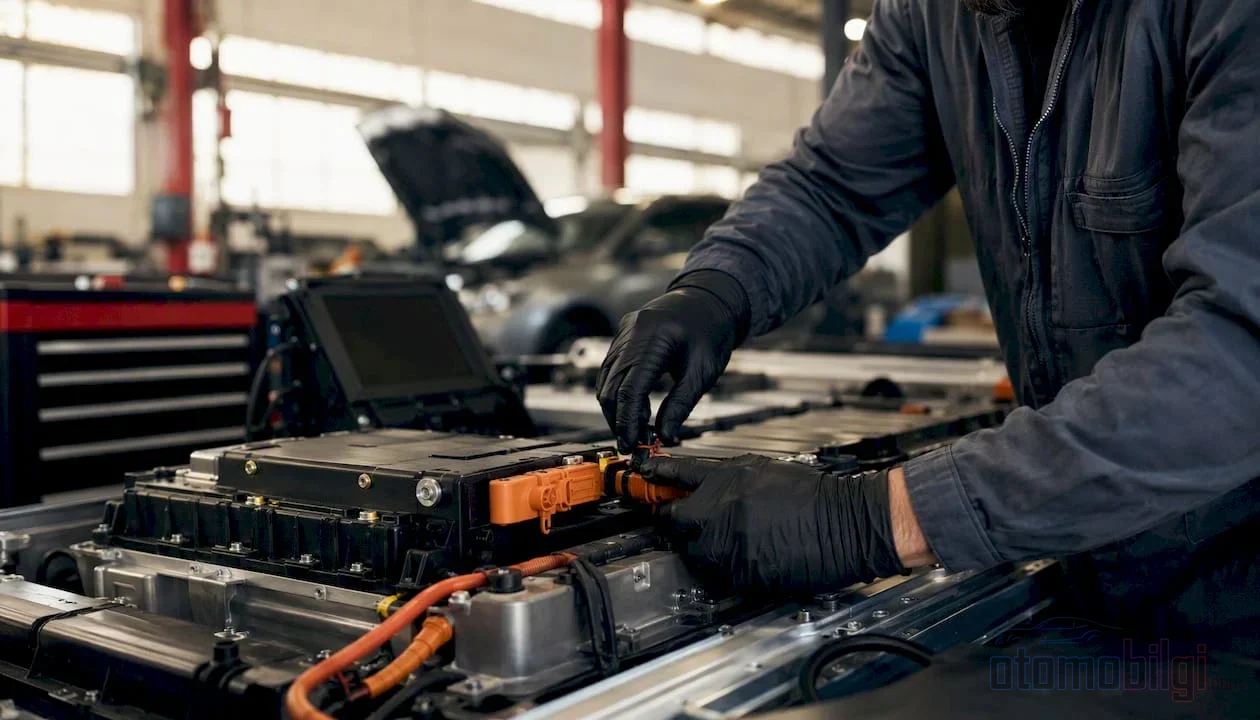
To understand the cost of battery repair, you first need to know the internal structure of the pack. An electric car's battery is built from modules assembled together, each consisting of hundreds of cells. For example, a 77 kWh VW ID.4 pack consists of 12 modules of approximately 6.5 kWh each, while the BMW i3 consists of 8 modules. This architecture offers a significant cost advantage when the fault affects only a few modules rather than the entire pack.
Replacing one or two faulty modules can stay around 1,000-3,000 dollars at an independent shop. The price of a single module varies by model: approximately 1,450 dollars for VW, approximately 1,800 dollars for BMW, and in the range of 1,500-5,000 dollars for Renault. Installation time also varies from model to model, ranging from 2.5 hours to 12 hours. So if the fault is correctly diagnosed, the repair bill can be a small fraction of a pack replacement.
However, in practice it is not always that simple. Many manufacturers do not officially support module-level service; some packs have a sealed structure, and full assembly replacement through the dealership channel remains the default path. Modules also have to be matched in terms of age, voltage, and chemistry - installing a new module into an old pack can cause imbalance. Working on a high-voltage system is also dangerous work that requires qualified equipment and training.
How Much Does an Electric Car Battery Replacement Actually Cost?
When module repair is not possible or not economical, full pack replacement comes into play - and this is where the real cost emerges. As of 2026, most full replacements are between approximately 7,000-25,000 dollars; while small and older packs stay in the 3,500-8,000 dollar band, common sedan and crossover models are in the 10,000-20,000 dollar range, and the luxury segment exceeds 15,000-30,000 dollars. For electric pickups and large SUVs, the figure can exceed 50,000 dollars.
Labor is another line item on the invoice that cannot be ignored. At a dealership service center, the hourly rate starts above $175 in 2026; the labor cost of a battery replacement falls in the $750-3,500 range in total. Although the physical replacement takes one or two days, the entire process involving diagnostics, parts procurement, and software work can stretch from a few days to several months.
| Model | Full Pack Replacement (USA, 2026) |
|---|---|
| Tesla Model 3 / Model Y | $12,000-16,000 |
| Tesla Model S | $13,000-20,000+ |
| Nissan LEAF (24 kWh) | $3,500-6,000 |
| Nissan LEAF (62 kWh) | $10,000-15,000+ |
| Hyundai KONA Electric | $12,000-20,000+ |
| VW ID.4 | $18,000-30,000+ |
| Hyundai IONIQ 5 | $15,000-25,000+ |
| Ford F-150 Lightning | $30,000-50,000+ |
The picture in Europe is similar: list prices in Germany as of March 2026 Nissan Leaf are around 10,300 euros for the 40 kWh and 15,500 euros for the 62 kWh; BMW i3 up to 12,000 euros at most; for the Tesla Model 3/Y it ranges between 9,400 and 18,000 euros. The Renault Zoe falls in the 9,000-12,000 euro band.
Why Doesn't the Invoice Reflect the $108/kWh Average?
The "batteries are getting cheaper" headlines you hear often are true, but they are not directly reflected in the repair invoice. At the production level, the average lithium-ion pack price fell to $108/kWh in 2025; the raw material cost of a 60 kWh LFP pack is roughly 3,200-3,500 euros. The price the customer pays, however, multiplies when the enclosure, cooling system, BMS (battery management system), logistics, and labor are added on top of this cost. For comparison: an automatic transmission replacement costs 5,000-10,000 euros, and a turbo replacement 3,000-6,000 euros - the battery is in the same league as the most expensive repairs on internal combustion vehicles.
Battery Repair Cost in Türkiye: Why Are the Figures So Different?
It is difficult to give a definitive price list for the Türkiye market, because the service is provided through a limited number of channels and the circulating figures fall into a wide range. For example, Togg T10X battery renewal packages are reported to be in the 350,000-550,000 TL band; on the Tesla side, there are claims that a full replacement has reached around 500,000 TL. If pack prices continue to fall, these figures are expected to decline significantly toward 2030, but for now, owners of high-value electric vehicles need to treat the battery line item as a serious investment and plan insurance and warranty accordingly.
A critical detail concerns insurance: as of 2026, the property damage limit of mandatory traffic insurance is 400,000 TL per vehicle and 800,000 TL per accident. In a vehicle where the battery alone can approach these limits, it may not be possible to cover the entire damage from mandatory insurance in the event of an accident. For owners of high-value electric vehicles, considering a comprehensive casco (own damage) policy is a practical necessity. Moreover, in an accident caused by your own fault, all repairs including the battery come directly out of your budget; in covered events such as collisions, fire, or flood, however, casco insurance kicks in.
When Does the Warranty Protect You, and When Doesn't It?
Most manufacturers' battery warranty is at the 8 years/160,000 km standard, and since this warranty is tied to the vehicle, it transfers to the second-hand owner as well. The scenario in which the warranty kicks in is most often the capacity dropping below the 70% threshold or manufacturing/workmanship-related defects. Some manufacturers go beyond this standard: Hyundai 8 years/200,000 km, Tesla Model S/X 8 years/240,000 km, Mercedes EQS/EQE 10 years/250,000 km, BYD 250,000 km, and the Lexus UX 300e stands out with 10 years/1 million km.
The warranty weakens in the face of misuse. Common exclusions include:
- Use of unauthorized or incompatible charging equipment
- Exposure to floods, physical damage, and extreme environmental conditions
- Unauthorized modifications to the BMS or software
- Neglected charging habits that damage the battery
Practical takeaway: in a vehicle with an active warranty, instead of worrying about capacity loss, you should avoid uses that could cause defects. After the warranty ends, however, you should know that your only protection on the other side of the table is a healthy diagnosis and choosing the right repair channel.
Authorized Service or Independent Workshop?

While the dealer channel recommends a full pack replacement for most battery problems, the independent repair ecosystem is growing rapidly and positioning module-level repair as both a more economical and more sustainable solution. The examples are striking: Autocraft's REVIVE EV workshops restore the packs they repair to levels above 90% of original capacity, and this approach won the Automechanika Green Award. EV Clinic, based in Zagreb, offers independent diagnosis and repair for Tesla, BMW, Mercedes, and Kia vehicles. Bosch, meanwhile, is releasing a repair kit based on module replacement for select hybrid models, mainstreaming high-voltage service. Mercedes, Opel, and Tesla have also adopted the factory remanufactured battery approach; Opel does this at its central facility in Rüsselsheim.
A repaired or remanufactured pack can recover 70-90% of capacity by replacing weak modules and rebalancing the system. The difference compared to a full pack replacement is significant - but when making your decision, clarify the answers to these questions:
- Is the pack new, factory remanufactured, or repaired?
- Is there a core (old pack) return fee?
- How long is the new pack's own warranty valid?
- Does the repair affect the vehicle's existing battery warranty?
How Should You Read the Battery Health Report When Buying Second-Hand?
In the second-hand electric vehicle market, the most critical document is the battery's SoH report - that is, the State of Health capacity percentage (SoH). You can read this value yourself with an OBD adapter and an app compatible with your vehicle; the report also shows details such as cell voltage differences and the number of fast charges. A detailed check by an independent expert costs around 100 euros and allows you to set your negotiating power accordingly.
Looking at the SoH percentage alone is not enough. The estimated value on the range display may be inflated by the manufacturer's optimization; the most reliable way to test the real range is to charge to 100% and take measurements on a realistic route. A low voltage difference between cells indicates a balanced pack; high differences suggest a recent module repair. Remember: since the warranty is tied to the vehicle, a car with remaining 8 years/160,000 km standard warranty also benefits from the same protection on the second-hand market - make sure to document how much warranty time and mileage limit remain.
The picture is also reassuring on battery lifespan: modern lithium-ion packs can complete over 1,000 full charge cycles before capacity drops below 80% - theoretically equivalent to 400,000 km. Real-world data confirms this: a 2014 BMW i3 retained 86% of its capacity after 100,000 km; the oldest i3s are still above the 70% warranty threshold after 11 years.
Summary: Cost Expectations Based on Your Ownership Scenario
If you are within the warranty period, capacity loss is mostly not your problem; what you need to do is avoid practices that would void the warranty. If you are out of warranty, the first step is an accurate diagnosis: if the fault is limited to a few modules and your vehicle supports modular service (for example, the F-150 Lightning and Mach-E were produced with this design), the bill can stay in the four-to-five figure dollar range. If a full pack replacement is needed, look into the factory-remanufactured pack option instead of new, as well as the growing capacity of independent workshops in Türkiye. In case of accident-related damage, know your comprehensive insurance's battery coverage and traffic insurance limits in advance - be prepared not for the worst moment, but for the best negotiating moment.
Sources
- Electric Car Battery Replacement Cost Explained
- How much does a battery for an electric car cost?
- Electric vehicle batteries – Global EV Outlook 2026
- EV Battery Replacement Cost in 2026
- EV Battery Replacement Cost 2026: Real Prices by Brand
- EV Battery Replacement Cost
- EV Battery Replacement in the UK 2025
- Autocraft REVIVE EV workshops win Automechanika Green Award
- Bosch high voltage battery repair kit
- EV battery & charging equipment: What insurance covers
- Electric vehicle insurability – Swiss Re Institute
- Electric Vehicle Accident Insurance Claims in Türkiye
- What Warranty Does An EV Battery Cover
- The Best EV Battery Warranties
- EV Clinic
- 2026 Electric Vehicle Battery Replacement Prices
- SoH Check When Buying a Used Electric Vehicle