How to Check Battery Health When Buying a Used Electric Car?
Share This Page
The battery health of a used electric car is determined by the ratio of the vehicle's current usable capacity to its factory capacity, i.e. its SoH (State of Health) value; this value is queried via an authorized service report, by reading BMS data with an OBD-II adapter, or through the health test in the vehicle's own menu. The range figure on the dashboard, on the other hand, is the output of an algorithm that produces an estimate and is not a health criterion on its own. Below you will find the steps for reading this value correctly, checking the charging history, and verifying the warranty transfer.
Highlights
- In large-scale measurements, the average annual capacity loss is 2.3%; after eight years, the average SoH is 81.6%.
- With use focused on fast charging above 100 kW, the annual loss is 3.0%; with low-power charging, 1.5%.
- In Türkiye, most brands offer a 8-year/160,000 km warranty on the battery; the SoH threshold is mostly 70% or 80%.
- Manipulations are known where a battery that has dropped to around 60% is shown as 95% on the screen; a cell-level test is essential.
What Is SoH, and Is It Confused with the Charge Indicator?
SoH is the percentage ratio of the capacity the battery can deliver today to its factory capacity. 100% represents the capacity of a zero-km vehicle; 85% indicates a loss of roughly one-sixth. The formula is simple: currently measured capacity divided by the original factory capacity, times one hundred. For example, if a 75 kWh pack shows 63 kWh, the SoH is 84%.
This value is not the same as SoC (State of Charge), with which it is often confused. SoC is the battery's current state of charge; it is the equivalent of the fuel gauge in a gasoline-powered car. SoH, on the other hand, describes the tank shrinking over time; it declines over the years and never rises again. That is why the seller's claim that "it shows full on a full charge" says nothing about battery health; that figure is merely the state of charge.
The range estimate on the dashboard likewise does not count as a measurement. The vehicle's software generates an estimate based on the average consumption of past drives; air temperature and driving style constantly make this estimate fluctuate. Basing the purchase decision on that figure is a fallacy akin to looking at the gauge rather than the size of the fuel tank when buying a gasoline-powered car.
How Much Loss Is Normal?
Large-scale data draw the general picture. In an assessment covering 22,700 vehicles, the average annual capacity loss came out at 2.3%; after eight years, the average SoH drops to 81.6%. In earlier-period measurements, this average was 1.8%; behind the increase lies the spread of high-power DC charging. A hot climate also causes an additional average loss of 0.4% per year.
The distribution of loss over time is not uniform, either. In measurements of more than 7,000 vehicles, taken up to 300,000 km, the most pronounced drop is seen around the first 30,000 km; afterwards, the loss progresses almost linearly and much more slowly. It is reasonable to regard the few points of loss in the first year as the battery "settling in"; but sudden drops from 100% to 90% should raise suspicion of cell imbalance in a vehicle.
Charging habits are more decisive than mileage
In the group that primarily uses DC fast charging above 100 kW, the annual loss is 3.0%; among those who prioritize low-power charging, it is 1.5%. In other words, degradation nearly doubles. After eight years, SoH in DC-heavy vehicles drops to 76%, while those using low-power charging can reach up to 88%. Mileage, on the other hand, is not as strong an indicator as one might think: long-distance use wears the battery less, and it is quite common to see SoH close to 90% in high-mileage vehicles. A vehicle that has spent 120,000 km on low-power charging may be healthier than one that has consumed 60,000 km on fast charging.
How Is Battery Health Measured? Reliability Ranking
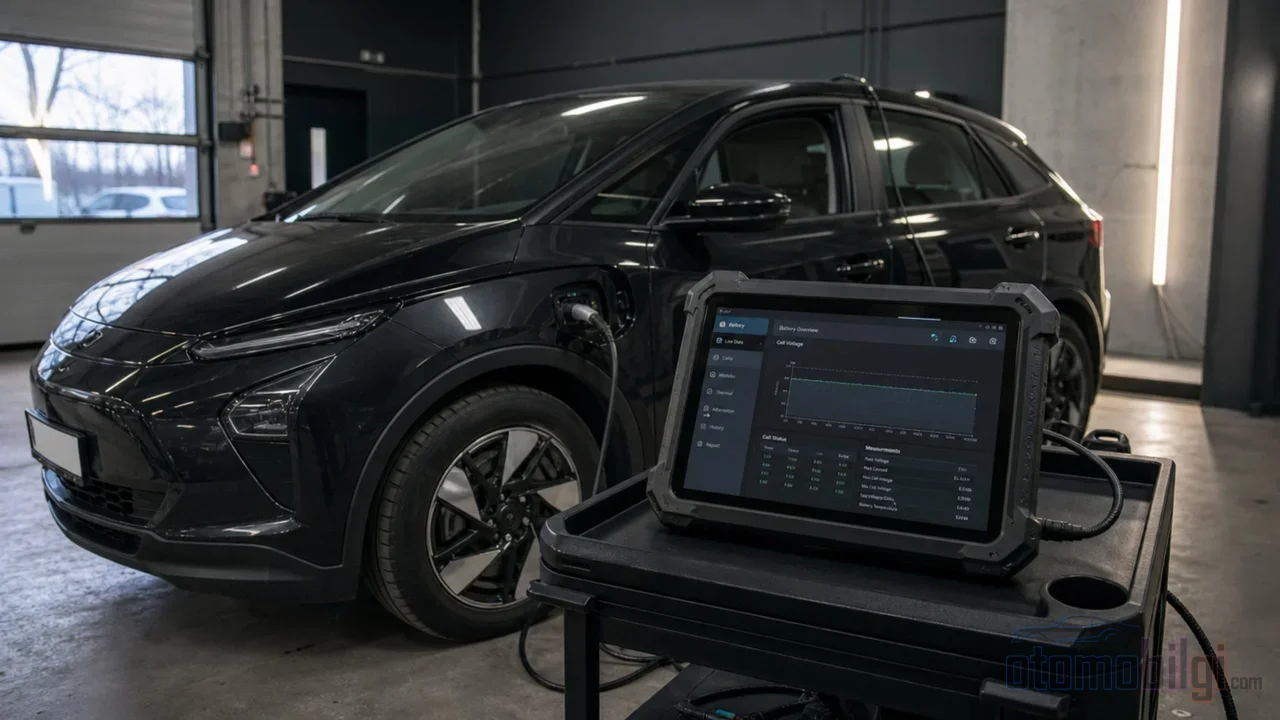
Measurement methods can be ranked by reliability, and following this order makes your job easier at the negotiation table.
- Authorized service report: The most reliable method. The brand's diagnostic device reads the battery at the cell group level. Ask the seller for a current report; a seller who dodges instead of providing one is already a red flag.
- OBD-II adapter + app: With apps like Car Scanner, SoH, cell voltage differences, and DC charge count can be read from BMS data. It is important that the adapter is compatible with your vehicle's model; cheap general-purpose adapters may not provide meaningful data on electric vehicles.
- Vehicle menu or manufacturer app: Tesla offers a Battery Health Test requiring a 24-hour AC charging connection, while Togg has an Energy/Maintenance tab. This option is not available on every brand, and the calculation method is generally not disclosed.
- Controlled charge-discharge (capacity) test: Since it measures the actual energy flow, it gives the most precise result; but it takes time and requires professional equipment.
There is also a rough field test: charge from 10% to 80% at a DC station. A healthy battery gradually reduces power toward the end of charging; sudden cutoffs indicate cell imbalance. As for cell voltage differences, a deviation exceeding 0.05V is considered the warning threshold; differences between 0.02-0.05V are regarded as a harbinger of cell fatigue.
What to Ask During Inspection, and Which Pitfalls to Watch Out For?
Classic inspection centers focus on bodywork, paint, and mechanics; they often do not cover battery health. For an electric vehicle inspection, request that the AC and DC charging systems, the charging port, and charging speed also be examined. If possible, have a cell-level test done at a TSE-certified center equipped specifically for electric vehicles; because malicious sellers can use diagnostic devices to make a battery that has dropped to 60% appear as 95% on screen. A standard inspection that relies on screen data cannot catch this manipulation - having the BMS data read at the cell level is the only method and the most solid insurance against manipulation.
Other items that should be added to the checklist:
- If there is underbody damage, ask for the repair records; If the battery pack has been removed before, ask why.
- Some older Renault Zoes come with a rented battery that belongs not to the vehicle but to the leasing company. As someone who has spent years with this model, let me note: this detail adds a monthly rental cost on top of the purchase price.
- Base your decision not on mileage, but on SoH and DC charging rates.
- A car with a replaced battery can even be an advantage if it is documented with authorized service records; do not rely on undocumented claims.
Four battery checks during the test drive
- Do not take delivery of the car with a low charge (for example, 20%); test it at a high state of charge.
- Try the regenerative braking; weak or irregular regeneration may be a sign of a battery or software problem.
- If possible, do a short charging test at a DC station; power far below what is expected may indicate a temperature management or pack problem.
- Check the battery and drive system warning lights.
Is the Battery Warranty Transferred to the Second Owner?
In Türkiye, most brands, including Togg, offer an 8-year/160,000 km warranty on the battery. BYD announced in April 2026 that it extended this period for its vehicles in Türkiye to 8 years/150,000 km. Tesla offers an 8-year/192,000 km warranty with a commitment to a minimum 70% capacity throughout the warranty period. When choosing among these figures, keep in mind that the general vehicle warranty period may not be the same as the battery warranty period; both must be verified in a written document.
Five points to address before asking:
- How much of the warranty's year/kilometer conditions remain? Whichever is exhausted first ends the warranty.
- Is the warranty transferred to the second owner? Transfer conditions vary by brand and model; look at the clause in the warranty certificate instead of a verbal confirmation.
- What is the warranty's SoH threshold value? It is 80% for most manufacturers, 70% for some.
- Have the periodic maintenance services been performed at an authorized service center? Maintenance gaps can create warranty disputes.
- A vehicle of the same age and mileage with an active warranty is significantly more valuable than one without a warranty; evaluate the price difference with this awareness.
There is one more layer: The Special Consumption Tax (ÖTV) regulation, effective as of April 2026, lowered the tax to 10% for vehicles with batteries of 60 kWh and above. This is a parameter that also affects the market position of second-hand vehicles with large batteries; it is worth considering in the purchase decision along with age and battery size.
Below What SoH Should a Car Not Be Bought?
Giving a single threshold would be easy but misleading. 80% circulates as the generally accepted "good" threshold, and an SoH above 90% is expected in a 3-5-year-old vehicle; in a vehicle younger than 5 years, a loss exceeding 20% must definitely be investigated. On the other hand, keep in mind as a separate concept that the threshold in manufacturer warranties is mostly 70%: a vehicle below 80% may still be within the warranty limits. The right approach is to read the SoH value together with comparables of the same model and similar mileage, along with the price and warranty status.
As for the lifespan question: manufacturers cite their own data showing a high efficiency band of 10-15 years, even up to 20 years, under proper use. An average annual loss of 2.3% translates, in simple terms, to a usable lifespan exceeding 13 years. So a 3-5 year old electric vehicle on the market today, if its battery is sound, is still at the beginning of its life - what you are buying is the battery pack, and you buy it based on measurement, not on the dashboard.
Sources
- How to Check Battery Health (SoH) When Buying a Used Electric Vehicle?
- Battery (SoH) Test When Buying a Used Electric Vehicle
- Electric Vehicle Battery Health (SoH): How to Measure It, How to Preserve It?
- Battery Health in a Used Electric Vehicle
- How to Check Battery Health in a Used Electric Vehicle?
- How Is an Electric Vehicle's Battery Measured?
- Electric Vehicle Warranty Periods: Brand Table
- Vehicle Warranty - Tesla Support
- High Voltage Battery Health - Model Y Owner's Manual
- What Is the Lifespan of an Electric Car Battery?
- Electric Vehicle Battery Lifespan
- BYD Türkiye Battery Warranty 8 Years/150,000 km
- New Regulations That Will Affect Electric Vehicle Sales in Türkiye in 2026
- How Is an Electric Vehicle Inspection Performed?
- What Should You Pay Attention to When Buying a Used Electric Vehicle?
- Should You Buy a Used Electric Vehicle? 7 Critical Points