How to Balance Down Payment and Loan Term in a Vehicle Loan?

Share This Page
The down payment, term, and loan balance equation in vehicle loans is the triple formula that determines how much of the vehicle's price tier you will cover with a loan, how many months you will repay it over, and how much you will pay in monthly installments. The basic logic is simple: as the vehicle price increases, the term shortens, the loan ratio drops, and the down payment ratio rises. These three factors cannot be considered independently of one another; which one is prioritized directly changes both your monthly budget and the total cost of the loan.
Highlights
- Loan ratio by price tier for internal combustion vehicles between 20% and 70% varies, and loans are not issued for the top tiers.
- For electric vehicles, the tiers were improved with the March 6, 2025 regulation; 7.5 million TL no loans for vehicles above.
- In the used car market, the sum of loan term and vehicle age can be at most 10 years ; many banks reduce this limit to 8 years.
- As of October 2026, the average vehicle loan interest rate is around 3.60% monthly.
- The formula installment × term = total repayment reveals the real interest cost of the loan in a few minutes.
How Does the BDDK Tiering System Determine the Down Payment and Term?
In Türkiye, the term and loan ratio for vehicle loans are not determined by us, but according to the regulator's tiered table. The basis amount is the vehicle's final invoice value including VAT and SCT. The table in effect for internal combustion vehicles since the February 21, 2022 regulation is as follows: vehicles up to 400,000 TL allow a 48-month term and up to 70% loan; vehicles between 400,001 and 800,000 TL allow 36 months and 50%; vehicles between 800,001 and 1,200,000 TL allow 24 months and 30%; vehicles between 1,200,001 and 2,000,000 TL allow a 12-month term and 20% loan. For vehicles above 2,000,000 TL, the loan door is completely closed - full payment upfront.
Electric vehicles are financed according to a separate table. With the March 6, 2025 regulation, the thresholds in this segment were raised: vehicles under 2.5 million TL allow a 48-month term and 70% loan; between 2.5 and 5 million TL, 36 months and 50%; between 5 and 6.5 million TL, 24 months and 30%; between 6.5 and 7.5 million TL, 12 months and 20%. Loans are not available for vehicles above 7.5 million TL. This regulation increased the share of cash sales in the premium electric segment; as of 2026, no new change has been made to the internal combustion table.
Let's give a concrete example. For a 2 million TL electric vehicle, a maximum loan of 1,400,000 TL and a down payment of 600,000 TL are projected, with a term of 48 months. For a 900,000 TL internal combustion vehicle, the ceiling is 270,000 TL loan with a term of 24 months. As for a 300,000 TL vehicle, a 210,000 TL loan can be spread over 48 months. In other words, the logic of the table can be summarized in one sentence: as cars become more expensive, the bank's risk is reduced, and a larger down payment and shorter term are required from you.
How Does Total Repayment Change as the Term Lengthens?
Here's the classic trap we all fall into: assuming that a low monthly installment means a cheap loan. In reality, interest accrues on the remaining principal with every installment; as the term gets longer, the principal erodes more slowly, so the total interest paid grows. The installment drops, but the total debt increases. This is a fact clearly visible in banks' calculation tools, and the most honest calculation you can do yourself without asking anyone is to work out the total repayment.
The formula is child's play: multiply the monthly installment by the term to find the total repayment; subtract the loan amount from that, and what remains is your total interest cost. As of October 2026, the average interest rate hovers around 3.60% per month; over the past year it has ranged from a low of 2.31% to a high of 3.54%. Let's look at a table to see what the difference in interest does at the same loan amount:
| Interest (Monthly) | Monthly Installment | Total Repayment |
|---|---|---|
| 3.14% | 9,566 TL | 460,447 TL |
| 3.29% | 9,877 TL | 475,386 TL |
| 4.29% | 12,044 TL | 579,405 TL |
| 4.72% | 13,019 TL | 626,186 TL |
All of these examples are for a 200,000 TL loan with a 48-month term. Moving from the lowest rate to the highest means paying roughly 165,000 TL more to finance the same car. Another measure: paying off a 100,000 TL loan in 36 months at 2.89% interest means a monthly installment of 4,510 TL and a total repayment of 162,360 TL. The amount paid on top of the principal is the true price of the loan; you should look at the total payment, not the interest rate advertised at the door.
Factor in the Fees Too
Interest is not the only cost of a loan. The legal cap on the loan origination fee is 0.5% of the loan amount plus 15% VAT; on a 500,000 TL loan, that means 2,500 TL plus VAT. There is also a fee for establishing a lien (mortgage) on the vehicle in the bank's favor. The annual cost rate condenses all of these items into a single percentage; in the market, this rate for vehicle loans is measured between 62.19% and 185.94%. Don't be surprised that it appears to be double the interest rate; that's where the fees and the compounding effect make the difference.
Why Does the Vehicle Age Limit in the Used Car Market Come Up When Getting a Loan?
Used car loans are subject to a strict rule tied to the vehicle's age: the sum of the loan term and the vehicle's age can be at most 10 years. In other words, a 6-year-old car cannot get more than 48 months of financing at most logically, and that's where the age limit in this table comes into play. While some banks apply the 10-year limit, many banks lower this cap to 8, and at some banks even to 5-7 years; this figure varies from bank to bank and is one of the first questions you should ask before applying.
In practice, this limit means the following: if a 2016 model car has reached 10 years of age as of 2026, your chances of getting a loan have narrowed considerably depending on the bank. That's why used car financing is based on the vehicle's comprehensive insurance (kasko) value; this value is determined from the insurance industry's kasko value list. Additionally, banks generally offer loans in the range of 1,000 TL to 400,000-500,000 TL; the loan amount limit is set at most banks. The commonly expected conditions are as follows:
- Documented income (SGK statement or tax certificate) and a regular income sufficient to cover the installments.
- The vehicle's age must not exceed the bank's upper limit.
- There must be no previously registered lien on the vehicle.
- The credit score must not be in the risky category.
Inspection, Tramer and Lien Checks in Used Car Loans
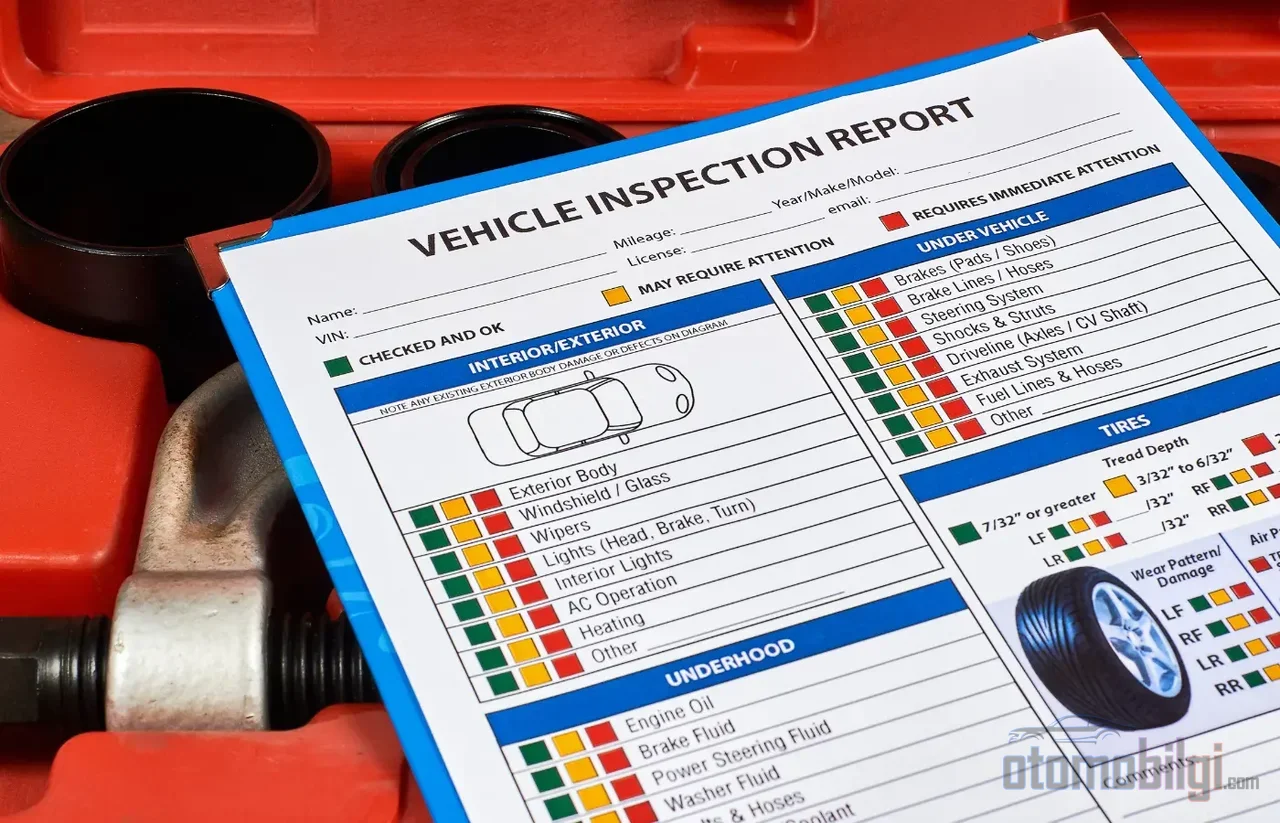
The loan process does not ignore the vehicle's history. A TSE-certified inspection report is requested during the application; relying on a report of uncertain reliability is one of the biggest risks of a purchase. The inspection reveals the vehicle's paint-free/original panel condition, overall mechanical condition, and damage history within a standard framework. The bank also conducts its own damage inquiry; if the loan is approved, the vehicle is registered in the name of the person taking the loan and a lien is placed in favor of the bank.
To learn a vehicle's accident history, a Tramer (SBM) inquiry can be used; this query shows past damage records, their amounts, the first registration date, and whether the vehicle has comprehensive insurance or not. The inquiry can be made via SMS, e-Devlet, or the chassis number. Checking for seizure and lien records is also possible through e-Devlet and a notary. Do these three checks before collecting the down payment; there is no need to reach a point of no return afterwards.
What Is the Difference Between Buying a Car with a Promissory Note and a Loan?
Buying with a promissory note has always been on the roadmap of those who cannot get a bank loan. Although this model appears to have no bank interest or file fee, a medium-to-high maturity difference can arise on the dealer's side. With a loan, there are file fees and mandatory comprehensive insurance; with a promissory note, these costs are invisible but embedded in the payment plan as a maturity difference. In other words, both have a price; one is hidden on the label, the other in the promissory note.
Today, second-hand sales with promissory notes have become widespread at dealerships with 20% down payment and terms of up to 48 months. However, transactions with promissory notes often involve maturity differences, uncertain costs, and delivery risks; therefore, buying with a promissory note should be considered an alternative for those who cannot obtain a bank loan, and the decision should be made by calculating the cost of this alternative. Let us also remind you: with a loan, the vehicle immediately passes to the buyer but is registered with a lien as bank collateral; in leasing, ownership remains with the company throughout the contract. Both structures operate on a different plane from the uncertainty above.
How to Do a Simple Budget Test to Measure the Installment Burden?
Before applying for a loan, draw up a budget plan: vehicle price, down payment, term, interest, and monthly installment should be the columns of this plan. Then add the expense items; mandatory comprehensive insurance, inspection, insurance, and the loan's allocation fee should not be left out of this table. Failing to pay installments regularly directly lowers your credit score; an installment that strains you today deals a blow to every future loan application.
Let's suggest a practical test: put on paper how much of your monthly income you can set aside for insurance, maintenance, and fuel after the installment. If these items, together with the installment, swallow a large portion of your income, then instead of extending the term you should consider a lower loan amount, meaning a higher down payment. Extending the term eases the monthly burden but makes you pay more in total; increasing the down payment creates a short-term gap in your pocket but pulls down the real cost of the loan. Banks' own calculation tools generate a complete payment plan once you enter the loan amount, term, and interest; running the same amount through several banks and comparing the total repayment is a method as simple as it is sobering.
Conclusion: The Balance Itself Is the Answer You Are Looking For
Establishing the balance between down payment, term, and installment is not about fitting three numbers into a table; it is about honestly asking yourself a question: how much will I pay in total by the time this car is paid off, and will that payment leave me breathless? The regulator's tiers draw a framework for you; fill the space within it with a calculation that takes the total cost into account. Do not skip the second-hand car's age, the expert inspection, and the lien check. Buying with a promissory note opens a door, but do not walk through it without reading the sign on that door. From my thirty years of observing buying and selling, only one principle has become clear: the price of the loan is money that is understandable and paid; what will hurt you are the items that are forgotten and whose bill arrives later.
Sources
- Vehicle Loan Term Limits and Down Payment Rates 2026 | Hesap Defteri
- Vehicle Loan Calculation Tool - Garanti BBVA
- Car Loan Calculation 2026 - Toyota Türkiye
- Vehicle Loan Calculation and Application - HesapKurdu
- Most Affordable Vehicle Loan 2026 & Car Loan Conditions - DenizBank
- Used Car Loan Calculation, 2026 Current Interest Rates
- Second-Hand Vehicle Loan Calculation Tool
- Inquiry with Tramer - SBM
- Second-Hand Vehicle Loan - Koç Finans
- Promissory Note or Loan? Vehicle Financing Comparison
- Vehicle Loan Conditions 2026 - Araclo
- Car Loan Calculation 2026 - ihtiyackredisi.com
- Loan Comparison Calculator - KOBİ Pratik
- Vehicle Inspection Report - otokredibul
- Leasing or Loan - Autoline