The Little Rocket Inside the Airbag: How Does the Gas Generator Work?
Share This Page
There is actually a tiny rocket motor inside an airbag: the gas generator, or inflator. At the moment of impact, the solid propellant burns within milliseconds, producing a large volume of nitrogen gas that fills the bag; the secret of this inflation process, typically completed within 15–30 milliseconds of the impact, lies entirely in this chemistry.
Highlights
- Front airbags inflate within 15–30 ms, side airbags within 10–20 ms
- Early systems used sodium azide (NaN3), while today guanidine nitrate is used
- The combustion temperature of azide-free formulations can reach up to 2,800 °C
- The Takata recall is the most concrete example of why inflator design is so critical
How Does an Airbag Gas Generator Work?
Think of it this way: the total duration of a collision is about 60 milliseconds. You would not even have time to blink, but in that time the car has to complete three tasks: detecting the crash, making the decision and inflating the bag. At the heart of this entire chain is the inflator - hidden beneath that soft cushion that looks so friendly is actually a pyrotechnic device.
The chain works like this: at the moment of impact, the crash sensor, or accelerometer, detects the sudden deceleration and sends a signal to the airbag control unit. If the control unit decides the threshold has been exceeded, it triggers the inflator. The bridgewire inside (the squib) ignites the pyrotechnic composition, this initial flame leaps to the booster composition and ignites the gas generator pellets that do the main job. The pellets burn very quickly, an enormous volume of gas is produced, and this gas passes through filters to fill the bag. All of this happens in less than half the time of a blink reflex.
How fast, how hard?
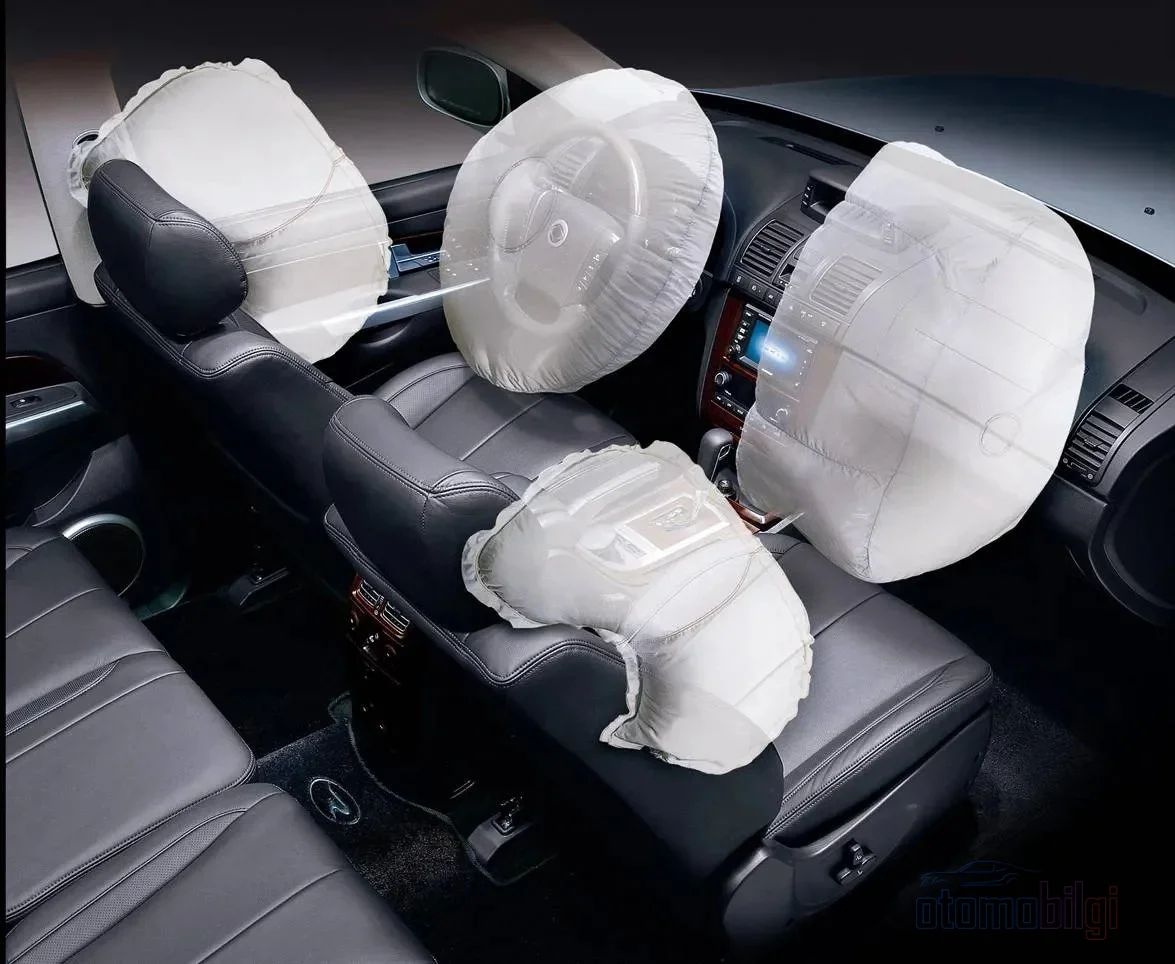
Front airbags are usually fully inflated within 15–30 milliseconds after the start of a collision. For side airbags, the situation is even tougher: in a side impact, the distance to the occupant is so small that inflation must be completed within the first 10–20 milliseconds.
So does the bag deploy in every crash? No. Front airbags typically deploy at a deceleration equivalent to a belted occupant in a snug-fitting seatbelt striking a rigid barrier at about 13–22 km/h; some systems can do this at lower speeds. The bag does not deploy in light braking or minor impacts below this threshold - the seatbelt's job is already done there.
The Coolest Part of the Chemistry Lesson: From Sodium Azide to Guanidine Nitrate
The star of the first-generation airbags was sodium azide (NaN3). When the sensor triggered, this compound decomposed and released plenty of nitrogen gas - exactly what we wanted. Potassium nitrate (KNO3) was used alongside it; because metallic sodium formed as a byproduct of the reaction, and since this substance is extremely reactive, it had to be bound with other chemicals to neutralize it.
The biggest problem with sodium azide, however, was its toxicity. This substance is so poisonous that its manufacture, transport, and the disposal of airbags from decommissioned vehicles posed serious safety and cost problems. That's why manufacturers have been searching for alternatives over the years: back in 2006 azide-based systems were still the most common, but today the stage belongs to guanidine nitrate.
When guanidine nitrate is ignited, it produces nitrogen gas, water and carbon, and it has become the preferred chemical in today's airbags. But not everything is rosy: early non-azide formulas produced far more nitrogen oxides and carbon monoxide than their successors, and their combustion temperatures climbed as high as 2,800 °C. Azide compositions, on the other hand, burned in a range of roughly 1,200-1,900 °C. Modern multi-fuel systems are built precisely on this balance: high gas output, low toxicity and a reasonable temperature are targeted all at once.
Two Generations Side by Side
| Property | Sodium azide (old) | Guanidine nitrate (current) |
|---|---|---|
| Product gas | Nitrogen + metallic sodium | Nitrogen, water, carbon |
| Toxicity | Extremely toxic | Relatively low |
| Combustion temperature | ~1,200-1,900 °C | Approximately 2,100 K (modern formula) |
| Main problem | Toxicity and disposal | N2O/CO emissions, high temperature |
A modern Autoliv-type generator formula shows just how fine-tuned everything needs to be: 45-55% guanidine nitrate by weight as the primary fuel, 2-10% 5-amino tetrazole as the secondary fuel, up to 40-50% strontium nitrate as an oxidizer, plus potassium nitrate, copper oxide, and around 1-5% process additives such as mica and boron nitride. Even that tiny mica portion is critical: if it isn't used in the right proportion, toxic gas limits can be exceeded. In these types of formulations, the burn rate is measured at approximately 2.59 cm/s (at 1000 psi pressure) and the gas conversion stays above 73% by weight.
From Pellets to Filters: The Inner Architecture of the Inflator
The inside of the inflator is designed like a furnace. The gas-generating pellets are tiny tablets about 5 mm in diameter, 1.2 mm in height, and weighing 51-53 mg. During production, they are dried in explosion-proof ovens at 120 °C and their moisture content is kept between 0.5-1% - because moisture is a sneaky detail that disrupts combustion behavior.
The generated gas also travels a path before setting off on its journey: first it passes through a ring filter made of woven stainless steel wire. This mesh prevents hot pellet particles from flying into the bag - in other words, it lets the gas through while holding the solid particles back. The gas then travels through a perforated ring pipe to the apertures in the metal housing and finally fills the bag. The quality target is clear: high gas output, non-toxic, low-temperature gas, and combustion that leaves minimal liquid/residue.
And there's a safety detail that I think is the cleverest part of the design: the auto-ignition material placed near the booster. If the ambient temperature exceeds a predetermined threshold, this material ignites spontaneously and fires the generator early in a controlled manner. The aim is to prevent the heat that builds up inside your car while it sits in the sun from pushing the inflator into a more violent and uncontrolled reaction. In other words, the system has even calculated its own potential to become a bomb.
The test side is also interesting: the new inflators are tested in a 2.83 m³ steel tank with the help of a steering wheel simulator. This volume simulates the interior of a standard car, and the composition of the gases released is measured one by one with FTIR gas analysis.
Two-Stage Inflators: The Airbag's Gas Pedal
We don't all punch with the same force; and airbags don't have to inflate with the same force either. Dual-stage inflators solve exactly this: the system has two inflator modules, and sensors that detect the severity of the crash decide whether to deploy both of them, just one, or engage them with a time delay in between. A single small firing in a minor crash, full power in a severe one.
There are adaptive systems that go one step further: they can adjust bag pressure according to seat position, passenger size, crash severity, and seatbelt use. Why is this so important? Because as the pressure inside the bag increases, so does the force applied to the occupant. Biomechanics scientists have long shown that overly stiff inflation is itself an injury risk: a higher inflator charge increases the pressure on the head and the extension loads on the neck. In other words, the airbag's job is to catch the occupant softly, not to slam into them like a wall - which is exactly why tuning the inflation pressure is so critical from an engineering standpoint.
Lessons from Takata: Why Is the Gas Generator a Matter of Life and Death?
To understand why all this chemistry and engineering detail matters so much, it's enough to look at the Takata case. Takata had chosen a cheap alternative to avoid the toxicity of sodium azide: phase-stabilized ammonium nitrate (PSAN). The problem is that this compound is cheap but unstable - and Takata's inflators had no desiccant. Over the years, the propellant fuel exposed to high heat and moisture degraded, becoming far more prone to burning faster.
The result? The degraded fuel produced pressure far higher than the design anticipated, and the metal inflator housing, unable to withstand that pressure, ruptured. So while the airbag protects you, the inflator itself can turn into shrapnel spraying metal fragments. Because of this defect, it was reported that 19 people lost their lives and hundreds were seriously injured; the incident turned into the largest and most complex automotive recall in U.S. history. Takata was the only airbag manufacturer using ammonium nitrate, and as part of the recall, it announced it would stop using this chemical. But the hard part was this: some replacement inflators still contained ammonium nitrate, which made the solution considerably more complicated.
The one-sentence lesson this story teaches us is: a single chemical choice in a gas generator can have fatal consequences decades later. Moreover, the disposal of azide-filled airbags remains a separate ongoing problem - sodium azide leaking from scrapped azide airbags poses a threat to the environment, and the challenge of safely disposing of large quantities of azide will take years to resolve.
Not Pyrotechnics Alone: Hybrid and Stored-Gas Systems
Each inflator does not produce gas by burning its own chemical. Hybrid inflators combine a chemical gas generator with stored gas (argon or nitrogen). This yields more reliable inflation both in very hot and very cold environments - because stored gas partly sidesteps the problem of outside temperature affecting the chemical reaction rate. Inflators with stored gas, for example those inflated with helium, are also being marketed as an alternative to pyrotechnics.
Frequently Asked Questions: What Is Inside the Airbag, and Is It Harmful?
Question 1: What gas inflates the airbag? Nitrogen. It is produced either by the decomposition of sodium azide or the combustion of guanidine nitrate, and nitrogen has effectively become the standard answer for airbags.
Question 2: Is that gas harmful? Since the gas produced is mainly nitrogen, it is relatively harmless. The real risk comes from the residual chemicals in the product - such as sodium azide and metallic sodium in older systems. That is why there are special disposal rules for airbags in dismantled vehicles; being someone who dissects a broken inflator in their garage to take a closer look is about as disastrous an idea as doubling one's centimeter count.
Question 3: How fast does an airbag deploy? Typically 15-30 ms; side airbags 10-20 ms. And a reminder: the airbag does not deploy in every crash - the system kicks in once the deceleration exceeds a threshold roughly equivalent to hitting a rigid barrier at about 13-22 km/h.
Final Word: Behind the Scenes of 60 Milliseconds
Airbag stories usually get stuck on that magical 60-millisecond crash tale. But the layer I truly admire lies behind it: a bridge wire that receives the signal from the sensor, precisely dosed pellets that ignite within milliseconds, self-protecting steel meshes, safety chemicals that self-ignite as temperature rises, and two-stage generators that breathe according to the severity of the crash. Each one is an engineering epic of its own. Next time you look at your car's steering wheel, remember how many years of chemical experimentation lie beneath that calm-looking plastic cover - in my view, the airbag is the quietest rocket ever fitted to an automobile.
Sources
- What chemicals make airbags inflate, and how have they changed over time? - C&EN
- Gas generating compositions and airbag inflators - EP2164823A1
- Airbag Inflators - Clemson Vehicular Electronics Laboratory
- Takata Recall Expansion: What Consumers Need to Know - NHTSA
- Airbags - IIHS
- Airbag Inflators & Initiators - Autoliv
- Airbag Systems - Honda Technology
- Sodium Azide | Chemical Emergencies - CDC
- Airbag Waste Management - California DTSC
- What Caused Takata's Airbag Problems? - Knowledge@Wharton
- Dual-Stage Airbag Systems - Firehouse Magazine
- A study on the benefits of dual-stage inflators - IRCOBI 1998
- How Airbags Work - HowStuffWorks
- Gas Generant Systems - Petersen Research Group, Texas A&M