What Changed With Ferrari's Return to Hypercar After Half a Century?
Share This Page
58 years. That is exactly the span of time: Ferrari won the overall classification of the 24 Hours of Le Mans for the first time since 1965 in 2023, with the Ferrari 499P and this victory changed not just a trophy but the entire balance of endurance racing. It ended Toyota's five-year streak, pushed the factories toward Hypercar, and turned the WEC into today's multipolar battlefield. So what exactly changed? Let's take a look.
Highlights
- By winning the 2023 Le Mans, the 499P brought Ferrari its first overall victory after 58 years
- Ferrari won Le Mans for the 3rd consecutive time in 2025 and took the Manufacturers + Drivers championships
- The 499P: 2,992 cc V6 twin-turbo + 200 kW front electric motor, 1,030 kg
- In 2026, Ferrari could neither win nor reach the podium at Le Mans - best result was 5th place
- The FIA and ACO began hiding BoP data from 2026 onward
Why Couldn't Ferrari Win Le Mans for 58 Years?
First, let's understand the magnitude of the event. Ferrari's Le Mans history progressed like a tram line: a first victory in 1949, followed by six consecutive wins from 1960 to 1965. Then silence. Nearly half a century passed without a factory entry in the top class - the last one was in 1973.
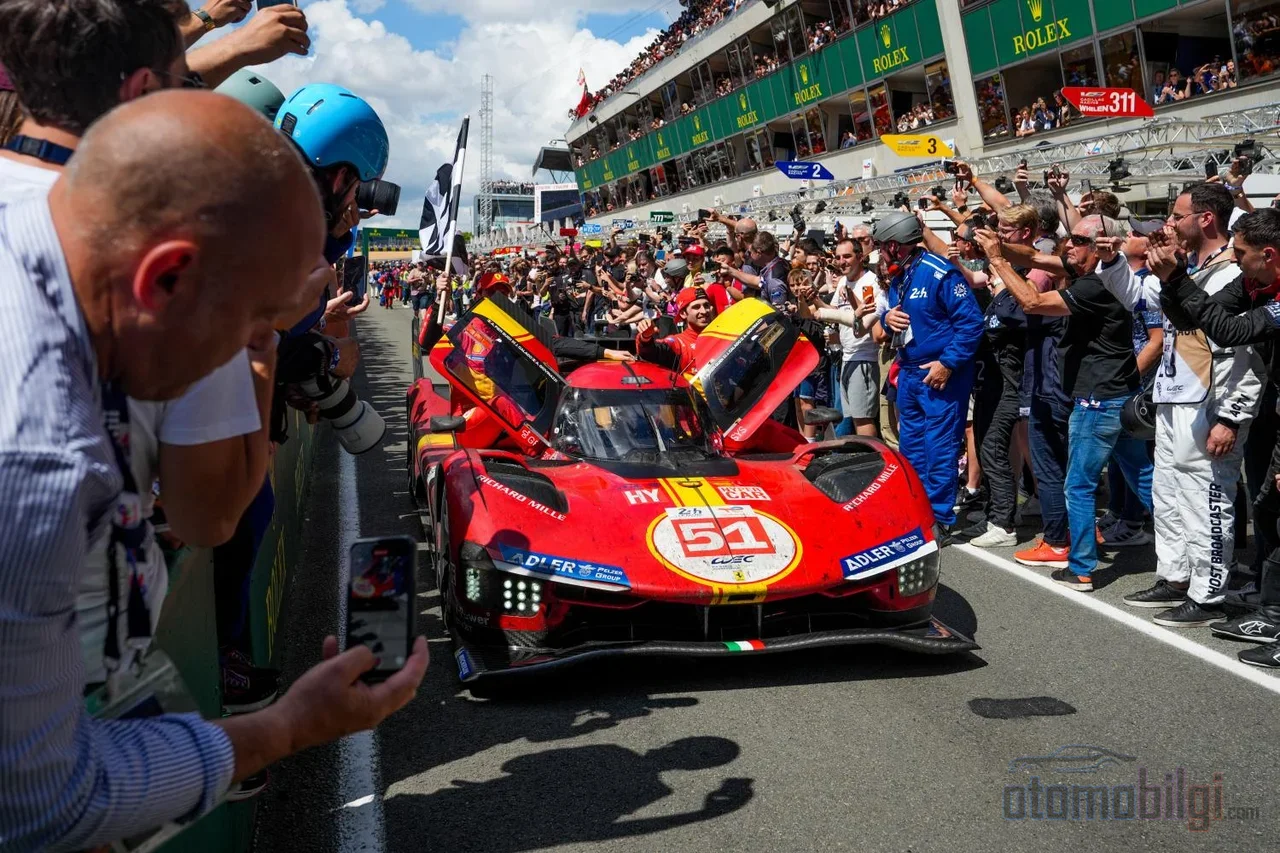
Meanwhile, Toyota took the stage and, from 2018 onward, took over Le Mans like a family dinner: five consecutive victories. In endurance racing, it had become nearly impossible for a brand without a factory or a serious budget to win the overall classification. And it was precisely at this juncture that Ferrari returned, with the 499P. And it returned and won - what's more, 2023 was the race's centenary edition. Even a screenwriter couldn't have written it better.
The #51 car (the trio of Calado, Giovinazzi, and Pier Guidi) claimed the historic victory. So what lies beneath this car? Here's a brief spec sheet:
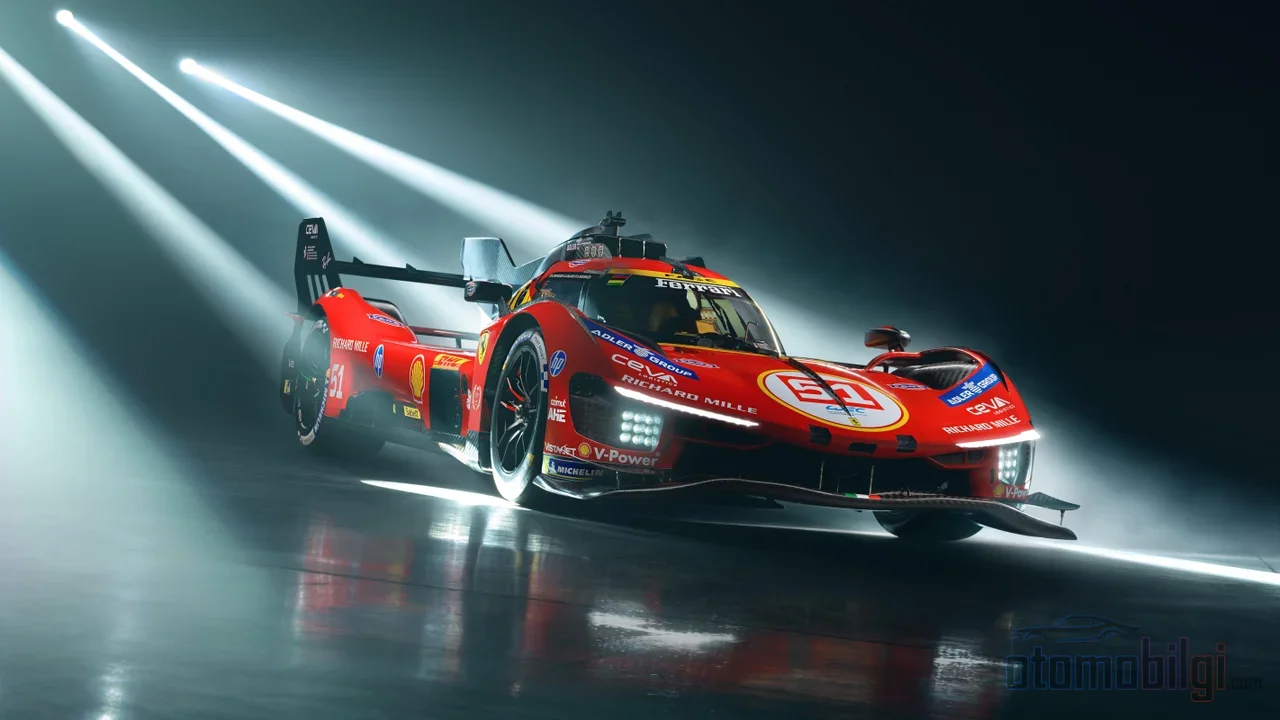
| Feature | 499P |
|---|---|
| Engine | 2,992 cc 120-degree V6 twin-turbo, 671 bhp |
| Electric motor | 200 kW on the front axle, active above 190 km/h |
| Weight | 1,030 kg |
| Gearbox | Xtrac 7-speed |
| Chassis | Built by Dallara |
| WEC record | 25 races, 8 wins, 25 podiums, 10 poles |
Even the car's name tells a story: the #50 number was chosen to commemorate the 50th anniversary of Ferrari's return to factory prototype racing. This project, designed under the leadership of Flavio Manzoni and Ferdinando Cannizzo, is the tangible embodiment of Maranello's longing for racing. The engine is a V6 that shares its architecture with the road-going 296 - meaning the kinship between a road car and a racing prototype is still alive. Think of it this way: the stove in your kitchen and the giant range in a restaurant work on the same principle, it's just that one cooks at a much higher heat.
How Did the Toyota and Ferrari Balance Turn Into a Multipolar War?
In 2023, Ferrari had finished second to Toyota in the manufacturers' championship; Toyota led with 161 points. We thought they would do a lap and be gone, but in 2024 things got complicated. The #50 499P (Fuoco, Molina, Nielsen) won Le Mans - Ferrari's second consecutive victory and its 11th overall class win. That same season, the customer AF Corse car #83 (Kubica, Shwartzman, Ye) took Lone Star Le Mans. Just be careful: in both victories, there was an almost wheel-to-wheel battle with Toyota's #7 car. The speed difference was negligible; the difference came down to strategy and endurance.
That year, with the rise of the Porsche 963, Ferrari dropped to third among the manufacturers. So the picture was clear: there is no longer a single-pole empire, but an arena with many contenders for the crown.
2025, however, was Ferrari's year. A historic triple podium at the Qatar 1812 km was followed by victories for the #51 at Imola and Spa. The 11th win at Spa moved Ferrari ahead of Porsche in that circuit's endurance record. Then came Le Mans 2025: this time the #83 AF Corse car (Kubica, Ye, Hanson) won, and Ferrari became Le Mans champion for the third consecutive time. With this victory, Kubica and Ye became the first Le Mans winners from Poland and China - meaning history in this arena is not written by Italy alone. At the season finale, after a three-way battle at the 8 Hours of Bahrain, Ferrari clinched the Manufacturers', Drivers' and Teams' championships; the top three spots in the points standings were also claimed by the red cars.
The lesson here is actually a beautiful one: Toyota had gone 1-2 at Bahrain, but Ferrari, playing the points game well, took the championship. Endurance racing is a siege game - it's not the king of a single race, but the one who thinks about the entire season who wins. Isn't that the cleverest aspect of motorsport?
Why Are the Hypercar Rules So Attractive to Manufacturers?
Ferrari's return was no coincidence; the flexibility the rulebook offered played a major role. In the Le Mans Hypercar (LMH) category, a manufacturer can build its car from scratch - there are no standardized chassis packages like on the LMDh side. If you choose hybrid, a fixed 200 kW electric motor on the front axle is mandatory; total engine power is limited to 500 kW. The 499P chose this path, with the electric motor kicking in above 190 km/h to send power to the front wheels. The battery is charged by Ferrari's own ERS system.
Thanks to this flexibility, completely different philosophies race side by side on the grid: the Ferrari 499P and Toyota's LMH car on one side; LMDh cars like the Porsche 963, Cadillac V-Series.R, Peugeot 9X8, BMW M Hybrid V8 and Aston Martin Valkyrie on the other. Even Cadillac's naturally aspirated V8 finds a place on this stage - once you hear the sound difference, you'll understand why this category is so beloved. The 2026 grid features 14 manufacturers, 35 cars and 8 races spread across 5 continents; 18 Hypercar entries are being discussed for Le Mans alone.
The future is not locked in either; it is open: according to the new technical platform announced for 2030, all cars will be rear-wheel drive and hybrid, with chassis updated to comply with revised FIA safety standards. Moreover, from 2026 onward, ERS becomes mandatory for every car undergoing new homologation. In short, the rulebook is gradually closing toward a hybrid future.
Why Did the BoP Debate Grow, and Why Was It Hidden in 2026?
How do you make completely different cars from different brands race at the same speed? The answer: BoP, or Balance of Performance. Assuming that every car is using its full performance potential, the system creates balance through adjustments such as weight and power. The regulations set a maximum of 500 kW of power and a minimum of 1,030 kg weight for Hypercar; the fine-tuning beyond that is BoP's job. Picture this in your mind: it is like equalizing the different abilities of all the students in a class by adjusting the difficulty of exam questions separately for each one.
But in 2026 things got strange: the FIA and ACO stopped publishing BoP values before each event, banned the media from publishing this data, and imposed heavy penalties on manufacturers. The rationale, in summary, was "we are protecting ourselves"; the criticism was this - far too much time was spent on BoP, whereas hiding it magnified the transparency debate. The new process is based on each car's homologation parameters and dynamic BoP data. There is also a practical question: if most cars made aerodynamic updates this winter, how valid is the balance established with last year's data?
Why Is the 499P Struggling in 2026?
The slowdown following the championship is striking. After the WEC subjected all Hypercars to re-homologation, comprehensive updates were made to the 499P: dive planes 60-70% smaller, a redesigned engine cover, a revised floor, and gurney flaps. The three updated cars were tested at Imola ahead of the season opener. In other words, Maranello is working hard to maintain its advantage on a field where everyone has caught up.
At the start of the season the picture was mixed: pole was taken at the 6 Hours of Imola, but victory went to Toyota, with Ferrari second. At Le Mans 2026, however, the 499P for the first time neither won nor made the podium - the best result was 5th place. Toyota, meanwhile, updated and renamed its car, and let us not forget that the 499P is now cited as the benchmark in terms of "raw speed": the rivals' yardstick is Ferrari. That, too, is a status as valuable as victory itself.
On the other hand, Ferrari confirmed its plan to keep the 499P in the field until 2026/2027, and it is said to be evaluating options such as transferring cars to customer teams. There is even a non-racing, free version, the 499P Modificata - it first took the stage at Mugello in 2024 under the Sport Prototipi Clienti program. It seems like a gift designed for wealthy customers who want not just to watch the race but to get behind the wheel themselves.
So What Is the Situation on the LMGT3 Side?
While the Hypercar scene shines, we shouldn't forget the sub-category. LMGT3 is the endurance test for GT models derived from road cars, and the 2026 grid has a crowded field of 18 cars. The standout name at the start of the season was Iron Lynx's #79 Mercedes. In other words, the red hegemony in Hypercar is far more scattered and harder to predict on the GT side. If you love endurance racing, this two-tier structure is perfect for you: prototype battles at the top, and GT teams working like caves below.
Is Ferrari's Return a Permanent Shift in the Balance?
I think yes. The 2023 Le Mans victory didn't remain a nostalgic celebration; it transformed the WEC from a series carried single-handedly by Toyota into a platform where 14 manufacturers compete across five continents. The very reason Porsche, Peugeot, Cadillac, BMW and Aston Martin are on the grid is this: the Hypercar rules are attractive, the competition is real, and the championship is winnable. Ferrari finishing 5th at Le Mans in 2026 proves it - nobody wins easily anymore, and nobody loses easily. Who the next 24-hour marathon will favor, I leave the interpretation to you.
Sources
- Ferrari 499P
- Ferrari 499P Le Mans Hypercar | Ferrari.com
- A look back at the Centenary: Ferrari's tour de force with the 499P Hypercar
- Ferrari wins 2025 FIA WEC Constructors' and Drivers' titles
- Ferrari Reveals Revised Look For 2026 499Ps
- Single technical platform announced for Hypercar class from 2030 - FIA WEC
- What is "Balance of Performance"?
- Le Mans' BoP secrecy
- 2026 standings - FIA WEC