Why Do Fog Lights Glow Yellow? The Wavelength of Light and the Engineering of Visibility
Share This Page
The yellow glow of fog lights is an engineering choice related to how light interacts with fog: the yellow filter filters out the short-wavelength blue-violet light, trimming the wall of glare scattered back into the driver's eyes. The real aim is not to physically "pierce" the fog, but to reduce veiling glare and increase contrast; the cutoff line and low mounting height are part of the same goal.
Highlights
- Blue light 400-495 nm, while yellow light is at approximately 570-750 nm wavelength
- The selective yellow filter absorbs approximately 15% of the light (the blue-violet portion)
- In light fog, 3000K yellow light can provide up to 34.8% better contrast on white targets
- According to the SAE rule, the upper cutoff line of the fog light is set approximately 7.6 cm below the mounting height
- Fog light mounting height: between 30-76 cm from the ground
So Why Do Fog Lights Glow Yellow? First, Let's Debunk the Urban Legend
You've probably heard this sentence too: "Yellow light pierces the fog." I'll admit, I believed it for years. But when physics enters the picture, the situation changes. Fog consists of water droplets roughly the same size as visible light, and particles of this size scatter light according to the rule known as Mie scattering. The interesting thing about Mie scattering is this: it affects all visible colors relatively equally. In other words, the droplets treat blue and yellow the same way; the idea that yellow light is "reflected less" by the droplets is not confirmed as pure physics.
For comparison, look at Rayleigh scattering: it applies to particles much smaller than the light's wavelength (like atmospheric gases) and scatters short wavelengths much more strongly - this is exactly why the sky appears blue. Fog droplets, however, are enormous by comparison, so this lambda-to-the-minus-fourth effect does not come into play. That's why fog appears grayish-white, and the tale of "yellow photons slicing through the droplets" rests on a weak foundation. In fact, this belief had already been questioned back in 1929 by W.S. Styles' experiments.
The Real Mechanism: Backscatter and the White Wall Effect
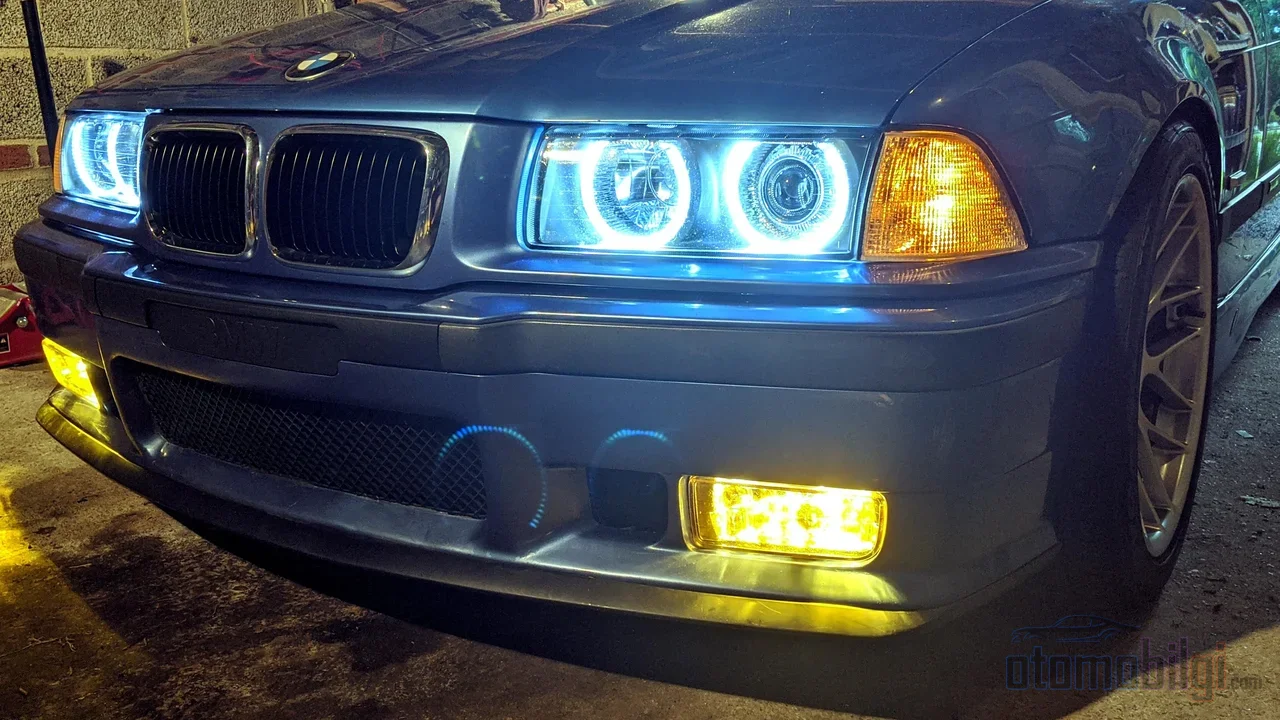
So if physics doesn't pierce the fog, why does yellow light still make things more comfortable in foggy conditions? The answer lies in our eyes. Part of the fog light's light bounces off the droplets and returns to the driver's eyes; we call this backscatter. Short wavelengths - that is, blue and violet - create more glare in the eye on this return trip. That bright "wall" that suddenly rises in front of you, from which you can't pick anything out, is exactly this.
This is precisely where the selective yellow filter comes in: it filters out the blue-violet portion of the light coming out of the projector, sacrificing approximately %15'ini for this reason. But in return, glare is reduced, edge perception of objects improves, and eye fatigue decreases. So the yellow light doesn't pierce the fog; it prevents your eyes from drowning in the glare created by the fog. This difference is subtle, but it changes everything.
Contrast in Numbers: Which Color Wins When?
The table compiled from adaptive headlight research shows that this is genuinely a gray area. On clear nights, 6000K white gives higher contrast, while in light fog (200 m visibility) 3000K yellow on white targets up to 34.8% performs better. In thick fog (100 m visibility), the figure climbs to up to 106% - but note: this applies at very long distances; approaching 40 m, the advantage of yellow diminishes. In very dense fog (40 m visibility), both sides struggle and the difference drops to only 3.7%. In heavy rain, 3000K light has an advantage of up to about 15% .
| Condition | Advantage of 3000K Yellow | Note |
|---|---|---|
| Clear night | None | 6000K white has higher contrast |
| Light fog (200 m) | Up to 34.8% | White on targets |
| Thick fog (100 m) | Up to 106% | At long distances; effect diminishes at 40 m |
| Very dense fog (40 m) | 3.7% | Both colors struggle |
| Heavy rain | Up to 15% | 3000K ahead |
The Sides in the Wavelength Battle: Kelvins and Nanometers
Let's clarify the terms, because the "yellow" labels in stores can be confusing. The wavelength of yellow light is approximately 570-750 nm, while blue falls in the 400-495 nm band. On the color temperature side, selective yellow is 2500K-3000K, deeper and more orange-toned amber is 2000K-2500K, and white LED is around 5000-6000K . Amber is claimed to be superior in thick fog and snow, while selective yellow offers a balanced solution by filtering out blue-violet.
A small warning here: many "yellow" products sold on the market are not actually a true selective yellow filter, just a lens that looks yellowish. A lens that doesn't filter does not provide the wavelength advantage because it doesn't filter out blue waves. So you need to look at the light's spectrum, not the word on the box - a similar situation applies in the LED era: putting a yellow coating on a white LED is not the same thing as true selective yellow projection.
Cut-Off Line and Mounting Height: An Issue More Important Than Color
An academic study published in 2023 showed that the optical transmittance of halogen, LED, and xenon headlights in fog differs by only a few percentage points. But the interesting part is this: in human subjects, yellowish halogen headlights were significantly better at detecting yellow and red targets in dense fog. The main lesson of the study is striking: more important than the color of the headlight is where it is aimed and how it focuses the light.
That's why the heart of fog light design is the cut-off line. A sharp upper boundary, as in normal headlights, prevents light from escaping toward the sky and the upper layers of fog. According to the SAE aiming rule, the upper cut-off line of the fog light is set approximately 3 inches (7.6 cm) below the mounting height. In practice, the vehicle is pulled 7.6 meters in front of a wall, a target line is marked 4 inches below the headlight center, and the upper cut-off is aligned to this line. The exact location of the cut-off line varies depending on mounting height, lamp design, suspension condition, and local regulations; the downward tilt is a deliberate design element.
Why Are They Mounted So Low?
Regulations require fog lights to be 12-30 inches (30-76 cm) above the ground requires them to be mounted between. The reason is simple: a layer of fog covers the top of the car like a blanket. The lower the headlight is, the more the light beam passes under this blanket and the less affected it is by the wall effect caused by droplets reflecting back into your eyes. A headlight mounted high sends most of its light right into the densest layer of fog - the worst possible scenario. By the way, a gentle reminder: fog lights should not be used in weather without fog; these are lamps designed for low-visibility conditions such as dense fog, rain, and snow.
High Beam or Low Beam in the Fog?
There is a one-sentence answer to this heading: high beam, no. The light of the high beam enters the fog from above and at a flat angle, bounces off the droplets and returns directly to your eyes, turning your field of vision into a pitch-white curtain. The right move in the fog is to use low beam or fog lights. There is also a psychological truth that most drivers skip: in dense fog, the main goal is sometimes not to see, but to be seen. While you can barely make out what is ahead, the vehicle behind you being able to notice you saves lives.
There is also an interesting detail on the night side of the eye: as light decreases, the retina's color sensitivity shifts toward blue - this is called the Purkinje effect. So there is no single answer to the question "which is the best wavelength"; whether you are looking for target detection, reading a sign, or whether visibility should increase, whether the weather is clear or dark, all change the result. Moreover, experimental results are also inconsistent for this reason: artificial fog, natural fog, and smoke mixtures exhibit different scattering behavior. For example, there is a study measuring the increase in perceived sharpness as correlated color temperature rises, but that experiment used much denser artificial fog and measured fine-detail perception.
Is a Yellow Filter Still Necessary in the LED Age?
Technically no, it is not mandatory. So why do manufacturers still favor white LED? I can give three reasons: a modern and sharp design language, much brighter illumination outdoors, and the lumen advantage. LED lifespan up to 50,000 hours while halogen generally stays below 2,000 hours; halogen is less efficient but produces a naturally warmer light, which itself slightly reduces the white wall effect. So part of the reason halogen feels comfortable in fog is not physics, but that its spectrum is already close to yellow-red.
There are two ways to get a yellow feel on a vehicle with LEDs: either a true selective yellow lens/filter (one that really filters out blue-violet), or a factory fog light set with amber lenses. So, amber or classic yellow? Amber, 2000-2500K, is a deeper, orange-leaning tone; its superiority in thick fog and snow is defended. Selective yellow, on the other hand, filters out blue-violet and preserves the rest of the yellow, leaving a more balanced light. On the regulatory side, the limit is clear: fog lights can be white or yellow/amber; blue, red, and green are banned in most places.
Short Answer: What Is the Reason for the Yellow Glow?
To sum it up: Yellow fog lights don't physically pierce fog - the water droplets in fog scatter all colors roughly equally. Yellow's job is to filter out the short-wavelength blue-violet light that dazzles your eyes, thereby breaking down the wall of back-scattered glare and strengthening contrast and edge perception. Just as important as the color, or even more so, is the cut-off line design, proper aiming, and low mounting position. The next time you're driving on a foggy morning and see that oncoming yellow beam, you'll know what it is - that driver's lights aren't piercing the fog, they're protecting their own eyes. So, do you use yellow or white lights on your car? If you have questions, I'd be happy to write more - this topic never ends.
Sources
- Penetration of Light through Fog
- Performance investigation of different headlights used in vehicles under foggy conditions
- Selective yellow - Wikipedia
- Yellow vs. White Fog Light: Which is the Best Fog Light Color?
- How to Aim Fog Lights
- Fog Lights Explained: White or Yellow?
- Headlight Cutoff Line: Why Does It Matter?
- Weather and Accidents: Rain & Fog
- Can You Use Fog Lights When It's Not Foggy?
- Amber vs. Yellow Fog Lights: Enhancing Visibility and Safety