Thermal Engineering in LED Headlights: How Heat Kills an LED
Share This Page
The heat in LED headlights is wasted energy trapped inside the chip that must absolutely be carried out; if left unmanaged, brightness drops first, then the LED permanently ages and dies. While a halogen bulb comfortably expels its heat within the light beam, an LED has no such luxury - all its waste heat is a guest that must be driven out with heat sinks and fans. This is exactly why serious cooling engineering lies behind LED headlights.
Highlights
- Only ~20-35% of the electricity entering an LED converts into light; the rest is heat.
- Every 10°C increase in junction temperature shortens the LED's usable lifespan by 30-50%.
- An LED headlight must dissipate between 25-70 W of heat depending on its light function.
- Quality fan motors have an MTBF of 200,000 hours, lasting longer than the chip itself.
- Fan-based (active) cooling can improve heat transfer by ~40% compared to passive solutions.
"Aren't LEDs Cool Anyway?" Here's the Biggest Misconception
I smile every time I hear this, but the question is quite reasonable: LEDs are efficient, and efficient things don't heat up, right? Unfortunately, no. An LED is roughly 90% more efficient than an incandescent bulb - but "efficient" is a relative word. Looking at the sources, roughly 80% of the input power still turns into heat; even in the most efficient commercial LEDs, the share going to light only stays around 50-60%, and in most applications it's just 20-35%.
So why doesn't a halogen bulb explode while converting far more of the same electricity into heat? Because halogen and xenon expel their waste heat directly with the light beam as infrared radiation. It's as if they wrap their heat in a package and launch it through the headlight lens. LEDs, however, do not emit thermal infrared - the heat is trapped at the core of the semiconductor. Just like a computer processor without a fan on top of it. That heat has to be carried somewhere, and that "somewhere" means heat sink design.
What's more, heat is not generated at a single point. Heat builds up separately in the chip itself (injection and photon extraction losses), in the phosphor layer, and in the driver circuit. The phosphor layer converts about 15-40% of its own power into heat while transforming blue light to produce white light, and it often becomes the hottest region of the package. Linear power supplies also blatantly waste 15-30% of the voltage drop as pure heat. In short, an LED headlight is a heat factory - just one that does its job well.
Junction Temperature (Tj): The LED's Measured Like a Fever Point
The junction temperature, which engineers call Tj, is the temperature of the active layer inside the LED chip and the single most critical number determining the LED's entire performance. It depends on three things: driver current, the thermal path (the resistance chain through which heat travels from the chip outward), and ambient temperature. The calculation is surprisingly simple: Tj = Rthja × P + Ta. In other words, thermal resistance times power, plus ambient temperature.
When Tj rises, two separate disasters line up. The first is thermal droop: short-term and reversible. Operating above the maximum allowed Tj can reduce optical power by up to 25% in InGaN LEDs and up to 70% in AlGaInP LEDs. A concrete example: An LED delivering full lumens at 25°C typically drops to 85–90% at 85°C. Some LEDs experience light loss of up to 30% as temperature rises, and a temperature climb from 25°C to 75°C can nearly halve the luminous flux. An LED headlight rated near 6,000 lumens visibly dimming after half an hour is no coincidence - it is a law of nature.
The second one is far crueler: lumen depression. It never comes back. It can roughly be summarized as follows: Every 10°C increase in Tj shortens the LED's lifespan by 30–50% (under the 70% lumen maintenance definition). The industry calls it the "10-degree rule," and it really works. The color also shifts: the dominant wavelength increases by about 1 nm for every 10°C - meaning a heated LED dims and yellows at the same time. The golden rule is this: if you want high lumen maintenance, keep Tj below 80% of the maximum value in the datasheet.
Passive Cooling: Silent, Simple, and a Compromised Copper Backbone
Fanless LED bulbs entrust heat transfer entirely to physical conduction. A copper-cored body or a copper braid radiator picks up heat from the chip and spreads it across the large surface behind the bulb; in aluminum-cored PCBs, heat is transferred to the heat sink through thermal vias or copper "thermal coins." An LED headlight can dissipate a total of 25–70 W of heat depending on its lighting function and vehicle class - a serious burden on the shoulders of a passive copper body.
The appeal of the passive solution is undeniable: no moving parts, silence, and no mechanical point of failure. It is the favorite of designs demanding long-term reliability. But its weak point is also clear: if heat transfer between the LED and the heat sink is poor - for example, if the thermal paste or lamination bond is low quality - the chip's temperature can climb to destructive levels. Moreover, powerful bulbs running above 30–40 W produce more heat than a passive system can safely dissipate in continuous use; and that is where the fan comes in.
Active Cooling: A Small Fan, A Big Difference
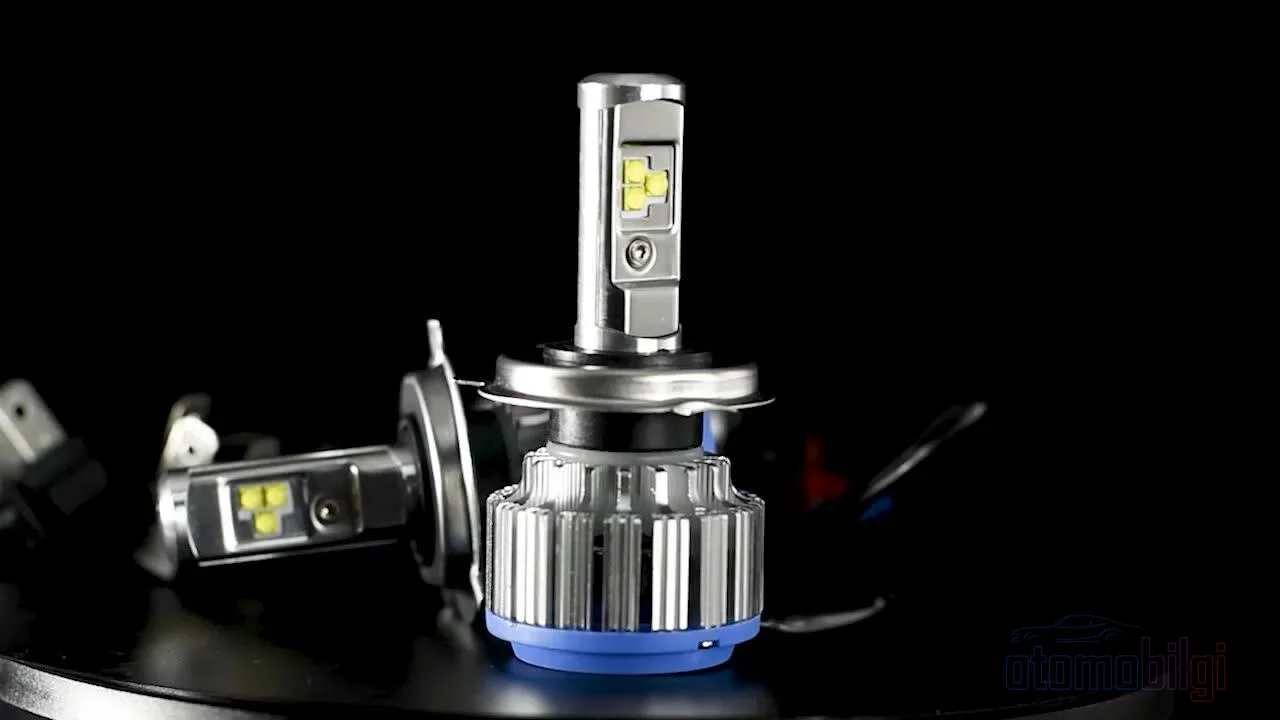
Fanned bulbs remove heat from the chip much faster than passive cooling via forced airflow - heat dissipation can improve by about 40% over passive application. In functions that run at full load continuously, such as high lumen high beams, this difference turns into a lifespan difference: an actively cooled LED can live noticeably longer than a passively cooled one.
The opposing side's defense is also strong. A fan means a new point of failure and extra mechanical volume: fanned bulbs are not compact and can be difficult to fit into narrow headlight housings. Noise can also be disturbing in some cases. But quality fan motors live longer than the chip's expected lifespan, with 200,000 hours MTBF; they can be controlled via PWM and vibration can be reduced with rubber suspension. There is also an interesting diagnostic tip in practice: when the fan noise of an actively cooled LED cuts out, it's usually not the fan that has failed but the LED - because a blocked fan traps heat and kills the chip quickly.
| Feature | Passive (Fanless) | Active (Fanned) |
|---|---|---|
| Heat transfer rate | Conduction-dependent, slow | ~40% better |
| Reliability | No moving parts | The fan is a new failure point |
| Silence | Completely silent | May have fan noise |
| Packaging | Compact | Bulky, difficult in tight spaces |
| Suitable use | Low-medium power, where long life is the priority | High power above 30-40 W |
Marginal but existing exotic methods
Peltier (thermoelectric) coolers and microchannel liquid cooling also exist; but because they are complex and expensive, their automotive use remains marginal. More exciting things are happening on the research side: heat pipe assisted compact active coolers have been proposed to reduce junction temperature, and in recent years generative design has come into play - software experiments with hundreds of cooler geometries through CFD simulations, targeting thermal performance that conventional designs cannot achieve in both natural and forced convection. This approach opens the door to more compact, lighter, and potentially fanless cooling solutions.
The design's heartbreak: efficiency droop
The engineer's nightmare is this: increase the drive current → lumens increase. But high current also triggers the efficiency drop known as "efficiency droop," and the heat flux density skyrockets. In other words, wanting more light comes at the cost of producing more heat and carrying a more powerful cooler. The drive current must either stay within thermal limits, or additional thermal capacity must be added to the design. There is no free lunch.
Why Do LED Headlights Fail in 2-3 Years? The Failure Chain Step by Step
Marketing says the chip itself can last up to 100,000 hours when driven correctly - and that's true. So why do automotive LED bulbs usually give up in 2-3 years? The answer lies in the triple of heat, driver, and assembly quality. High temperature is the most significant failure accelerator in LED systems, and the damage progresses like a chain:
- Package degradation: The phosphor, encapsulant, and plastic lens carbonize and discolor; permanent color shift occurs.
- Bond wire breakage: Because the materials have different coefficients of thermal expansion, the epoxy encapsulant constantly expands and contracts, breaking the thin wires inside - a sudden, catastrophic failure.
- Solder fatigue: Thermal stress causes open circuits at solder joints.
- Driver death: The liquid electrolyte of the electrolytic capacitor in the driver dries out; it's not the LED that dies, but the electronics.
- Vehicle-side factors: Charging system fluctuations, poor grounding, loose wiring, and assembly errors accelerate the process.
Add to this classic chip killers like ESD and overcurrent, plus UV-induced encapsulant aging, and the picture becomes clear: the chip isn't weak; the system around it is harsh. Actually, the most crucial point is this: What kills an LED is rarely the LED itself; what kills it is a design that cannot carry its heat away.
Matrix and Laser Headlights: Superstars That Multiply the Heat Load
The headlights of the future shine pixel by pixel - and heat up pixel by pixel. Matrix LED headlights produce glare-free high beam through pixel-level digital control via individually addressable LEDs; adaptive light distribution, improved night vision, and a significant reduction in glare for oncoming drivers are the official promises of this technology. An impressive feature - but from an engineering standpoint it should be thought of as a processor array.
A densely packed array of LEDs, each controlled separately, creates a cooling problem that is markedly larger than a simple single-chip design. The heat-generating surfaces are no longer expanding, they are concentrating; and the focus geometry has to be more precise. In other words, behind those eye-pleasing pixel segments lies a thermal design that works far more meticulously than a single bulb's radiator. Laser headlights are the next level of the same picture: in comparative tests, the LED's low operating temperature and long lifespan stand out, but the more light functions you add, the more heat management problems you buy along with them.
Which LED Headlight Lives Longer? The Engineer's Short Answer
It is not super simple, but it can be summed up in these three sentences: If your power stays below 30-40 W and silence plus maximum reliability are your priorities, a quality thermally bonded passive solution will carry you for many years. If you are building a high-lumen function that runs continuously at full load, a fan is indispensable - and the fan's health means exactly the same thing as the LED's health. And whichever system you choose, the real issue is not the chip itself: it is the thermal path that keeps the junction temperature under control, driver quality, and proper installation. A design that welcomes heat with respect gives the LED back its promised lifespan.
Sources
- LED – Cooling and Thermal Management
- Thermal Management Technologies for LED Lighting Systems
- Thermal management of high-power LEDs
- Understanding LED Thermal Resistance and Junction Temperature
- Cooling of LED headlamp in automotive by heat pipes
- Experimental investigation on active heat sink with heat pipes
- Thermal management system of LED headlights
- Rethinking LED heat sink design with generative design
- LED Headlight Cooling Systems Explained: Why Heat Dissipation Matters
- LED Headlight Cooling Systems Explained
- LED Car Bulbs Lifespan: Why They Fail After 2-3 Years
- LED Lights Lifespan, Why It's So Short
- Why a 10°C Drop in Temperature Can Double Your LED Lifespan
- Adaptive Lighting with Digital Matrix LED headlights
- Halogen v LED v matrix LED v laser: Headlights compared
- A Critical Review on the Junction Temperature Measurement
- The Causes of LED Chip Failure and Package Failure