Why Is the 24 Hours of Le Mans in a Separate Universe on the WEC Calendar?
Share This Page
The 24 Hours of Le Mans is a special race on the WEC calendar that awards double the points of other races, rewards the team that covers the longest distance with the car, and can single-handedly turn an entire season's fate around. So how does this race go from being an ordinary championship round to becoming a universe of its own? The answer lies in points, wear and tear, strategy, and a bit of passion.
Highlights
- The team that wins Le Mans takes 50 points; in a 6-hour race that figure is 25.
- A car takes on fuel roughly 30 times over the 24 hours.
- In 2025, Ferrari brought its third consecutive Le Mans victory and a double championship in the same season.
- In 2026, 14 manufacturers are racing in the WEC.
- The 2026 Le Mans was run on June 10-14 at the Circuit de la Sarthe.
Why is the 24 Hours of Le Mans different from other WEC races?
Most of the WEC's other races are measured in hours: 6 hours, sometimes 8-10 hours. At Le Mans, however, it is distance, not the stopwatch, that speaks. The winner is the team that completes the most laps within 24 hours. On its own, this may sound like a small detail, but it changes the entire racing philosophy. In a 6-hour race, the fastest car usually wins; at Le Mans, the one that is both the fastest and the most durable wins - and the two are rarely on the same team at the same time.
Moreover, the roots of this race go all the way back to 1923. In other words, one of the world's oldest endurance races was already a legend long before the WEC was founded. When the championship was established in 2012, it had to incorporate Le Mans into its structure; never the other way around. That is why the race stands less like a round of the series and more like its crown.
How does the double points rule work?
The points table tells us everything. In a 6-hour race, the winner takes 25 points, second takes 18, third 15... In 8-10 hour races this figure rises to 38; that is, a multiplier of roughly 1.5 times. At Le Mans, however, the winner takes a full 50 points . In a way, you are fitting two normal races into a single weekend. Second is rewarded with 36, third with 30 points; everyone in the top ten scores points. In addition, an extra championship point is given to the team that takes pole position in Hyperpole.
The interesting part is: this weighting has not always been the same. Until 2018, Le Mans awarded double points, that season it was reduced to 38 points (1.5x), and afterwards it returned to double points. So the series' administrators constantly debate how heavily this race should weigh. A team finishing second at Le Mans and taking 36 points is worth more than a race win in a normal race. This balance completely changes championship strategy.
There is also a small but critical detail: teams from series outside the WEC also enter Le Mans. But only official WEC entries score points. In 2017, Corvette finished third in LMGTE Pro, but because it was not racing in the championship, the points went to the fourth-place finisher. A tragicomic situation, but rules are rules.
How much wear and tear does a car suffer in 24 hours?
Let me draw an analogy for you: Have you ever tried to drive your car flat out for a full day, non-stop, without a break? Let's count you in, and the car too... The engine, transmission, brakes, suspension - they're all running not a marathon but an ultramarathon. At Le Mans, a car makes about 30 pit stops in 24 hours to refuel. Every pit stop is measured in seconds, and every second can drop you all the way down the overall classification.
The 2026 Le Mans was a textbook example of this battle against wear and tear. In the Hypercar class there were mechanical failures and a significant number of DNFs; a BMW M Team WRT car had to pit after colliding with an LMP2. A damaged car loses seconds every lap, and this can permanently upend the overall classification. The ACO even has a little-known rule: a regulation preventing a badly damaged car from spending a disproportionate amount of time just to finish the race. In other words, 24 hours is both a physical and a psychological torture for the car.
How do the drivers share this distance?
24 hours with a single driver is of course impossible; every car rotates in stints with 2-4 drivers, and the rules limit the maximum time a driver can spend in the car. Fuel, tires, and driver changes are all managed at the same time; synchronization of all three jobs is required to gain seconds in the pits. It really is like the Olympics of time management.
How does strategy change over 24 hours?
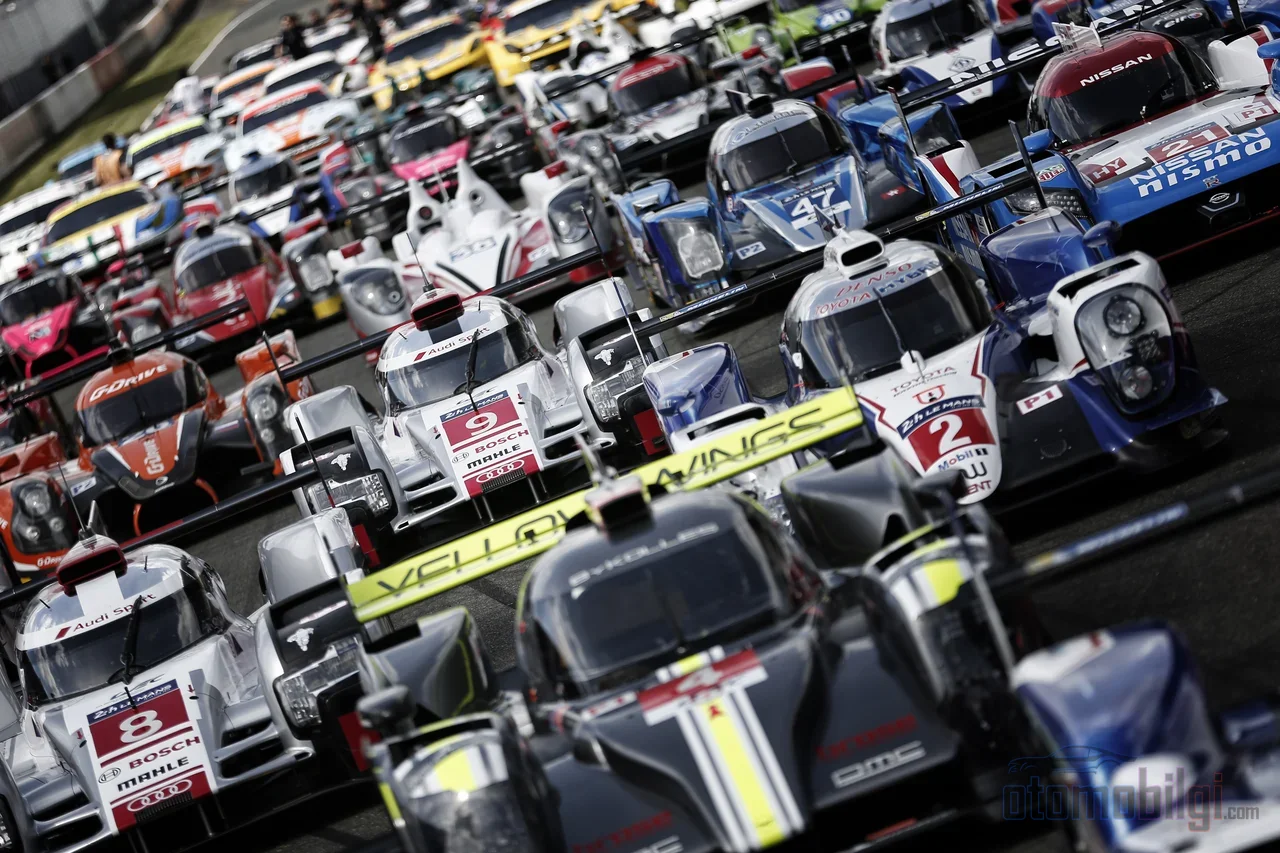
In short races, strategy is simple: be the fastest, stop the least. At Le Mans, this equation is reversed. Speed still matters, but the bigger question is: will the car survive 24 hours? Engineers have to leave a margin for reliability instead of pure speed. Fuel tactics are planned according to pit stop windows, and a safety car or a repair break can rewrite the entire race plan.
And there is the multi-class racing factor - in my opinion the coolest feature of WEC. In a single race there are Hypercars, LMGT3s, and at Le Mans also LMP2s racing under a quota. Classes with different speeds constantly overtake each other, creating a layered race: while a Hypercar catches you within a lap, an LMGT3 pilot manages their own race using the mirror view. An exam in traffic management you would never experience in classic single-class races.
Hypercar and LMGT3: two different worlds in the same race
| Feature | Hypercar | LMGT3 |
|---|---|---|
| Basis | Purpose-built prototype (LMH or LMDh) | GT3 platform based on a road car |
| Drivers | Fully professional | Pro-Am lineups, mandatory Bronze driver |
| Goal | Realistic contender for overall victory | Victory in their own class |
| Tires | Balanced with BOP | Goodyear tires |
In the Hypercar class, two different philosophies coexist: in LMH the manufacturer designs the chassis itself (as with Ferrari, Toyota, Peugeot, Aston Martin), while LMDh uses chassis from Dallara, Multimatic or Oreca. LMGT3, on the other hand, is the stage for GT3 cars based on road vehicles. It replaced LMGTE in 2024 and provided a stage for private teams and mixed amateur-professional lineups. For overall victory, only the Hypercars are realistic contenders; LMGT3 fights its own separate battle for a cup within its class.
A little smile: in 2026 the WEC has a record number of manufacturers - exactly 14 brands. Alpine, Aston Martin, BMW, Cadillac, Corvette, Ferrari, Ford, Genesis, Lexus, McLaren, Mercedes-AMG, Peugeot, Porsche and Toyota. The competition in the Hypercar category is so balanced that in 2025, 8 races produced 7 different winners. Trying to predict the championship is like winning the lottery.
How can a single race turn a season upside down?
Here is the heart of this article. Look at Ferrari's 2025 season: in addition to winning its third consecutive Le Mans victory, it also embraced both the Manufacturers' and Drivers' championships. The 499P was the reference car for most of the season; in the #51 car were reigning champions Giovinazzi, Pier Guidi and Calado, while Molina, Fuoco and Nielsen sat in the #50. Winning Le Mans is like starting the championship with a half-lead on victory.
Now let's look at the counterexample. Porsche collected four championships in three years with the 963, but its Le Mans victory count is zero. Moreover, Toyota won its fourth consecutive Hypercar Manufacturers' championship in 2024; 2025 was very difficult, and at the end of the season it had to settle for a single victory in Bahrain, bringing the TR010 Hybrid with a technical 'Evo' joker for 2026. What I mean is: Winning Le Mans is not a championship guarantee, but most of those who win the championship have won Le Mans.
This debate is still alive in the WEC community: which is more prestigious, the victory of a single race or the seasonal world championship? In my view, they are two different prizes - but in no other championship does winning a single race get talked about this much. In the WEC, however, it becomes the main topic of endless conversations on Le Mans night.
How will Le Mans shape the future of the WEC?
The 2026 WEC calendar was almost identical to 2025; there were races at Imola, Monza and Barcelona, and Le Mans, run at the Circuit de la Sarthe on June 10-14, was the crown of the season. The opening races of the 2026 season had no repeat winners; even in the final six rounds, three new winners emerged, with Cadillac Hertz Team JOTA reaching victory in São Paulo, while Alpine celebrated its first win with the A424. In the final hour of the 2026 Le Mans, a breathtaking duel unfolded between Toyota and BMW for second place - what a competitive field it was, I simply have to say.
It also looks promising for the period ahead: an expanding nine-round calendar has been announced for 2027. But there remains a lingering question: what happens if the status of the agreement between the FIA and the ACO after 2027 remains unclear and Le Mans one day breaks away from the series? For now, this possibility remains at the level of conversation; there is no official statement. Still, it is worth keeping in a corner of your mind - because Le Mans breaking away from the WEC would mean redefining the championship's identity from scratch.
Conclusion: how does a race become a universe?
What sets the 24 Hours of Le Mans apart from the other WEC races is not a single item; the point weighting, the distance format, the multi-class structure, the war of attrition, and prestige dating back decades - when all of these come together, they reveal a true sub-universe of the WEC. The other races on the calendar build the championship; Le Mans puts the championship to the test. My question to you: if it were up to you, would it be a regular season worth 25 points, or that one night, those single 50 points? Whatever your answer, Le Mans still holds a special place in my heart.
Sources
- Points System - FIAWEC
- What is the WEC? - FIAWEC
- Focus on the 24 Hours of Le Mans regulations: points allocation
- 24 Hours of Le Mans 2026 - FIAWEC
- FIA WEC reveals nine-round 2027 calendar
- FIA World Endurance Championship - Wikipedia
- 24 Hours of Le Mans - Wikipedia
- Pit stop tactics: a major factor at the 24 Hours of Le Mans
- What is a Le Mans Hypercar? - Motorsport Magazine
- The different classes - European Le Mans Series
- 2026 Le Mans 24h retirements: DNF tracker
- 2026 FIA World Endurance Championship - Wikipedia