Why Do They All Look the Same? The Growing Sameness of Car Front Ends
Share This Page
Look at your parking lot: if there are thirty cars, twenty-five of them are staring back at you with the same sloped hood, the same slim LED light strip and the same wide lower grille. The reason modern cars look alike is this: they all have to be designed according to the same safety regulations, similar aerodynamic targets and the same market research data. So this is no coincidence, it is the natural outcome of the system.
Highlights
- In the 1970s, the drag coefficient of vehicles was around 0.45 and above; in modern vehicles this value is mostly in the 0.25-0.30 range.
- Reducing aerodynamic drag by 10% improves highway fuel economy by roughly 5% .
- Since pedestrian safety rules require a gap between the hood and the engine, high hoods and high beltlines have become the standard.
- BMW rewrote its design language with the Neue Klasse in early 2026; Hyundai, meanwhile, is making its models harmonious in a "matching without being identical" way.
Why do modern cars increasingly look alike?
Let's first catch the biggest culprit: the rules. Designing a car today is a game played within a much narrower framework than in the past. Pedestrian safety legislation demands a gap between the hard engine components under the hood and the hood itself, plus a "soft" hood surface. The goal is simple: to prevent the head from hitting the hard parts of the metal in the event of a crash. A noble goal, but the design price is heavy: high hoods, bulky front ends, and the disappearance of low, sharp wedge shapes. The beltline is rising, the front end is rounding out, and every car is left with a serious expression rather than a smile.
If you want to see how things used to be, look at pop-up headlights. Those mechanical eyes that opened when the lights came on inspired hundreds of cartoon scenes. Today they are gone; they effectively vanished into history because they were not safe in terms of pedestrian collision regulations. There is an even older example: the reason all old American cars had the same headlights was regulations that forced all vehicles sold in the US to use the same headlight type. So the complaint that "everyone looks the same" is not that new after all.
The headlight story stands in a similar place today. The spread of white LED headlights is not just a style choice; the wide field of view they offer and the savings they provide over the vehicle's lifetime have made them standard equipment. But when everyone chooses the same solution, the light, color and signature of the headlights also become shared. LEDs make headlights look slimmer, which leads to the optical units being integrated seamlessly into the front end; the result is more and more cars with almost the same "gaze." This is also why split headlights have proliferated in recent years: with so little room left, teams trying to divide the light blocks to highlight the design's identity have very little space to work with.
The wind tunnel pushes everyone in the same direction
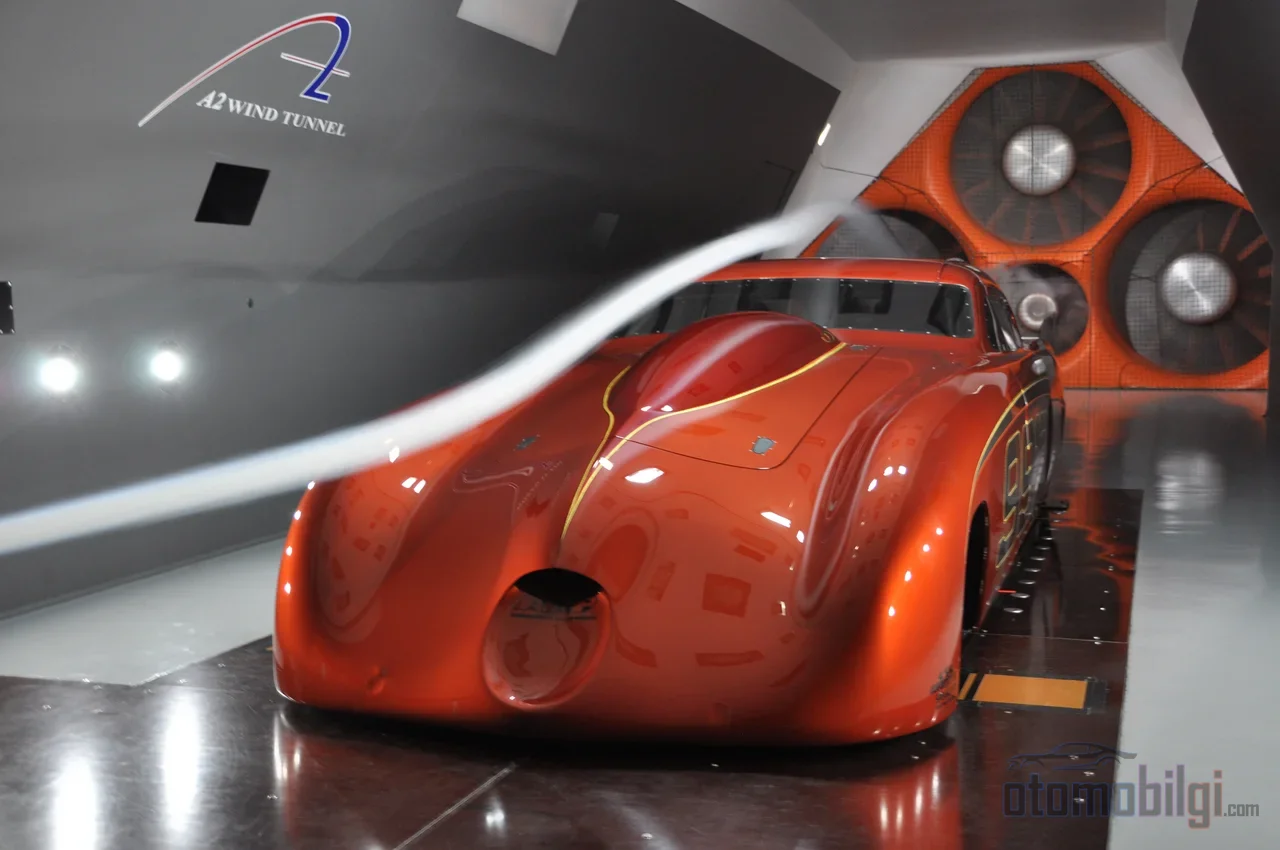
The second culprit is the air. Wind tunnels have been used in automotive design for about a century; even strange but far-sighted vehicles like the Rumpler, created in 1924, were early steps down this path. Today the situation is very clear: the drag coefficient (Cd) of 1970s vehicles was around 0.45 or above; modern vehicles are mostly 0.25-0.30 or so. Engineers estimate that reducing aerodynamic drag by 10% improves highway fuel economy by roughly 5%. The numbers may seem small, but for a manufacturer selling millions of vehicles, this difference means reaching or missing emissions targets.
Scientists continue to examine the aerodynamic effects of grilles through wind tunnel tests and computational solution methods. Some academic studies have focused directly on this question: how can we combine the aesthetic quality of a grille with engineering functionality while preserving brand identity? The answer to this question has still not been fully found; most brands take the easier route and proceed with the same type of approaches.
This is also where the paradox of electric vehicles lies. Electric skateboard platforms were supposed to offer design freedom in theory: motors underneath, batteries in the floor, meaning no mechanical hardware that needs to be hidden under the hood. But in practice, since efficiency determines everything, most electric vehicles still suspiciously resemble one another. The most aerodynamically super shape is already known: rounded nose, high hood, smooth front face and flowing body. When everyone takes the same exam, they all give the same answer.
The algorithm designs, the data decides
The third and perhaps most interesting culprit: market research. According to automotive analyst Lauren Fix, manufacturers now design "according to the algorithm." Market research and predictive analytics determine how a vehicle should look before the designer puts the first line on paper. Intuition, emotion and risk-taking are being replaced by data-driven conservative formulas. Leaving aside safety rules, pedestrian-collision laws, emissions standards and platform sharing, on the other side sits trend-focused styling chasing "global appeal"; the result is indistinguishable mid-size SUVs.
Before the designer makes the first sketch, how the vehicle should look has already been determined by market research and predictive analytics.
But wait, the main culprits are not just rules and algorithms. There is also a fact that makes us guilty: us buyers. Neutral colors like gray, white and silver dominate global sales; people mostly choose familiar and practical forms. So if manufacturers produce cookie-cutter vehicles, part of that is fed by our demand. The debate about vehicles designed with a "neutralization" logic instead of building emotional bonds is also fed from here: a common design language that offends no one and leaves no one behind.
How does uniformity look in the Türkiye market?
If we bring this abstract discussion down to Türkiye, the picture becomes clearer. The C segment, meaning compact-class cars like the Golf, Civic and Focus, is evaluated within the same segment, with similar dimensions and similar usage purposes. Looking at the C-segment sedans popular in our country, the picture becomes even more concrete: Toyota Corolla, Honda Civic, Fiat Egea Sedan, Renault Megane. All of them are marketed with similar lengths, similar hood heights, and similar aerodynamic solutions. Since the rules of the class are the same, the designs are also squeezed into a common zone.
A similar picture emerges when we look at the B segment; small city cars are also shaped within the same framework of safety and efficiency. In Türkiye's own production story, there is an interesting counter-example: following a history stretching from Devrim to Anadol, TOGG opened up to the world with the C-segment fastback sedan introduced at CES 2022. The domestic car is still being tested on whether it can carry its own design identity within the stream of global homogenization; but in the current picture, it is within an approach consistent with global standards.
Are signature elements a point of resistance to homogenization?
Amid all this homogenization, brands are left with a few trump cards: signature elements. BMW's kidney grille is the best example of this; it has an almost century-long relationship with the brand identity and has continuously evolved from 1933 to today. The illuminated Iconic Glow kidney grille is offered on the 7 Series, and this element is also at the center of the 1 Series introduction. But beware: the same signature can also bring criticism of homogenization when excessively enlarged. That is why BMW's reset of its design language, from the kidney grille to lighting, with the Neue Klasse in early 2026 is meaningful; it shows that the days of very large grilles are partly over. The new X5 also brings the Neue Klasse-inspired language with the illuminated kidney grille and the dual-X headlight signature. BMW says it has no regrets about design, but a change of direction is evident.
On the Hyundai front, the picture is different. The brand is aware that its models do not resemble each other; a more consistent style is planned for future models, and the approach is this: "let designs match without being identical." In other words, the goal is not for everyone to look alike, but for intra-family resemblance to be readable. Hyundai will also bring a bulkier style to crossovers and SUVs in its electric models, while keeping sleek hatchback options. The brand is not idle on the awards front either; it won 21 awards in eight categories at the 2026 iF Design Award. At Auto China 2026, it introduced concepts reflecting the design language evolving for the Chinese market.
So, was characterful design dead? No. Ferrari, Porsche and Lamborghini prove that creativity is possible even within the rules. The Mazda MX-5 is still in production, Toyota promises enthusiast cars, and Ford says the V8 Mustang will stay as long as regulations allow. Renault 5 and 4 models were revived with a retro-inspired approach, and MG also brought the Cyberster model into series production. In other words, it can be achieved when there is courage.
How do we escape this homogenization?
At both global and local scales, the answer has several layers. As enthusiast communities and consumers keep providing feedback, companies that produce bold and distinctive vehicles are rewarded with interest and loyalty. In other words, the market is sending a signal; however, a change is also needed on the buyer's side. Unless the dominance of neutral colors and familiar shapes is broken, it becomes harder for manufacturers to take risks either. There are no shortage of those who argue that the future may belong not to the most aerodynamic "blob" but to vehicles that dare to look different; exceptions like Ferrari and Porsche also show this is not an empty hope.
While you are standing in that parking lot, look again at those cars that make it hard to tell them apart. Then this question comes to mind: if it were you, which brand's signature would you recognize? If you are struggling to find the answer, you have already understood why the issue of sameness needs to be taken so seriously.
Sources
- Why Do All New Cars Look the Same? - Brown Car Guy
- Why Modern Cars Look Worse Than Ever: Lauren Fix Analysis - CBT News
- Hyundai Realizes Its Models Don't Look Related - Carscoops
- Hyundai Motor Triumphs at iF Design Award 2026 - Hyundai Newsroom
- BMW Neue Klasse Design: What It Means and Why It Matters - BMWBlog
- The BMW Kidney Grille Through Time 1933-2025 - BimmerLife
- July focus: Aerodynamics - Car Design News
- Investigation of effect of vehicle grilles on aerodynamic performance - Dergipark
- Why Do So Many Cars Have Split Headlights? - Motor1
- The Evolution of Car Headlights: From Oil to LED - Hyundai Newsroom
- Türkiye's Domestic Car Journey - Arabam.com
- C-Segment Vehicles - Cetas