Wings and Ride-Height Devices in MotoGP
Share This Page
Winglets and ride-height devices in MotoGP are aviation-derived technologies that press the front wheel of prototype motorcycles to the ground and maximize traction on acceleration; at 350 km/h they generate roughly 35-50 kg of downforce. These solutions first changed racing dynamics, then became subject to FIM's strict restrictions amid safety and cost debates. So how can an airplane wing be mounted on the front of a bicycle and change the fate of a race? Let me tell you, because this story is truly great!
Highlights
- Winglets produce roughly 35-50 kg of downforce at 350 km/h - think of it as strapping a huge dog weight to the front wheel!
- The modern winglet era began in 2015 with Ducati's GP15.
- Protruding winglets were banned in 2017 on safety grounds; integrated winglets remained.
- Front holeshot devices are banned from June 24, 2026, and all lowering devices from 2027 onward.
- The 2027 rules reduce engine capacity from 1000cc to 850cc and significantly narrow the aero area.
How Does a Winglet Work? The Secret of the Inverted Airplane Wing
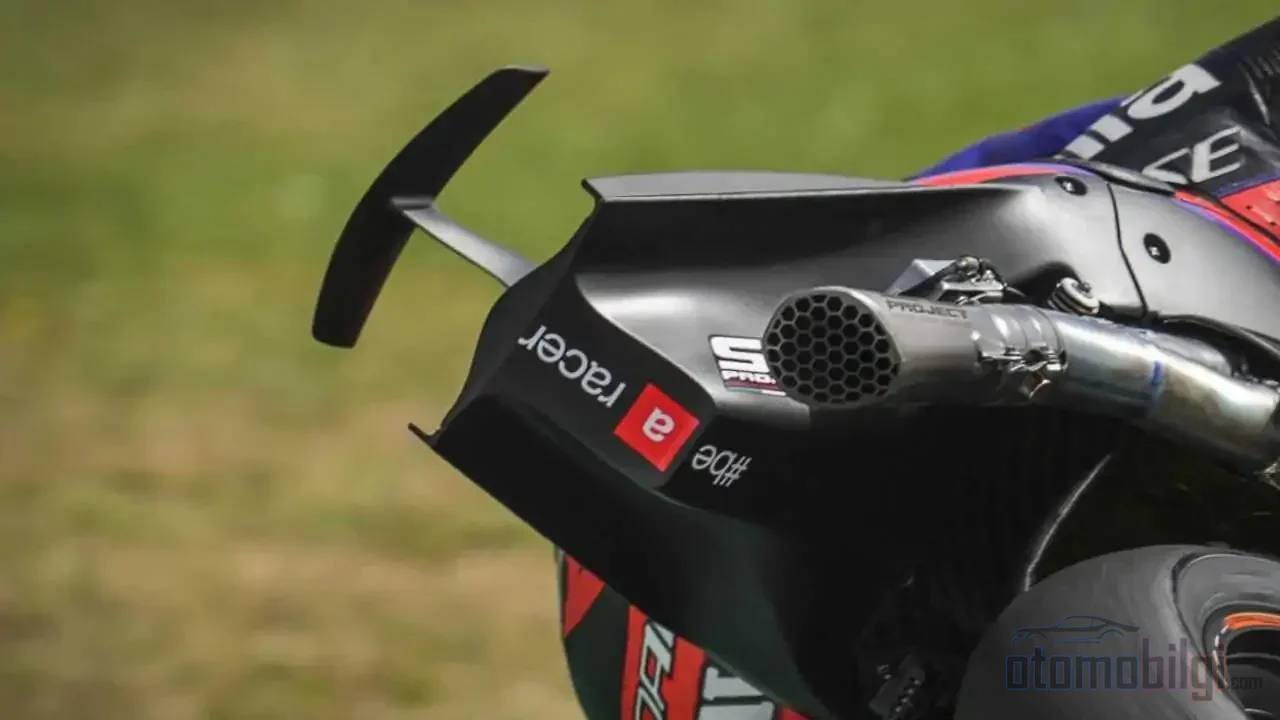
An airplane's wing splits the air to lift the machine, right? The MotoGP winglet does the exact opposite: it creates high pressure on the upper surface and low pressure on the lower surface, pushing the front of the motorcycle toward the ground. Romano Albesiano, former Aprilia technical director, summarizes it like this:
If we reverse this principle, we get a force that pushes the motorcycle down and increases the tire's grip on the asphalt.
Now let's look at the numbers: at 350 km/h, modern winglets produce roughly 35-50 kg of equivalent downforce. In other words, a load presses on the front wheel as if you had strapped one of those giant dog weights sold for animals to it. For a motorcycle exceeding 360 km/h, this means tremendous stability on the straights.
So Why Doesn't It Work the Same as in F1?
In a Formula 1 car, the front wing primarily increases cornering grip. On a motorcycle, the picture is completely different, because the bike has a short wheelbase of about 1.5 meters, a weight of only about 210 kg, and a much higher center of gravity. The result? Under 0.5g acceleration, the motorcycle transfers more than half of its static axle load to the rear, while an F1 car stays below even a tenth of that. So the winglet's real job on a motorcycle is anti-wheelie: preventing the front wheel from lifting when you nail the throttle, and reducing electronic power cuts. As a bonus, at around 65 degrees of lean in corners, it generates lateral pressure that presses the tire to the ground and provides front load under hard braking. Not for free, of course: the winglet adds air resistance and slightly reduces speed on the straights. Everything has a price!
The Winglet's Half-Century Journey: From 1972 to the Ducati Revolution
You'll be surprised, but this idea isn't very new. MV Agusta tried small front wings on Phil Read's 500cc GP bike at the 1972 Dutch TT;' tried small front winglets; 1978 Mike Hailwood's Suzuki RG500 also used a front wing. But back then, nobody followed suit and the idea was shelved. Even more interesting: those famous "dustbin" fairings used in the 1950s to reduce drag had been banned on safety grounds, largely due to wind stability problems at the Isle of Man TT. So the kinship with aviation had existed since the early days.
The first chapter of the modern story, however, opened in 2010. Ducati, suffering from a pronounced understeer problem with the Desmosedici, fitted two small wings to the side fairing during Filippo Preziosi's era. Ducati engineer Marco Palmerini's admission today is another matter: "Looking back now, it seems almost ridiculous. Those little wings produced very little downforce." That solution was abandoned in 2011-2012 - but the seed had been planted.
2015: The Year Everything Changed
The modern winglet era began in 2015, when Ducati introduced aerodynamic winglets with the GP15. The real explosion came with the unified Dorna electronics system in 2016: with manufacturers stripped of their old custom anti-wheelie software, winglets became the mechanical answer to the problem electronics could not solve. Within a single season, every other manufacturer began developing their own winglets! According to Ducati's official chronology, the "biplane" dual-wing configuration peaked in 2016; only the top-wing layout was being used depending on the circuit. with introducing aerodynamic winglets. The real explosion came with the unified Dorna electronics system in 2016: with manufacturers stripped of their old custom anti-wheelie software, winglets became the mechanical answer to the problem electronics could not solve. Within a single season, every other manufacturer began developing their own winglets! According to Ducati's official chronology, the "biplane" dual-wing configuration peaked in 2016; only the top-wing layout was being used depending on the circuit.
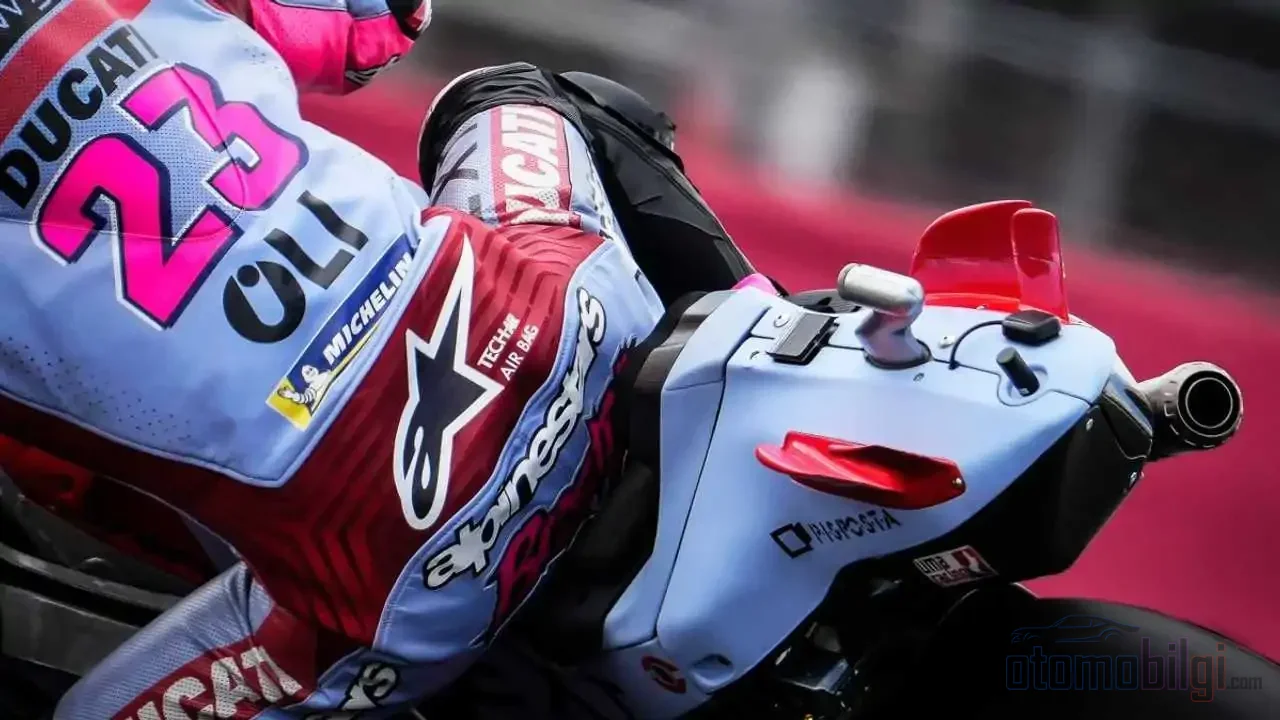
Then the classic motorsport scenario kicked in: a ban, followed by engineers stretching the rules. In 2017, the FIM banned protruding winglets over concerns they could catch on other bikes in a collision. What did the engineers do? Since the rules were written to allow "integrated" winglets, they buried them into the fairing! Ducati moved to side-pod layouts in 2017, and in 2018 its first approved fairing became the "triplane," and in 2019 it introduced the "spoon"-type appendage mounted on the swingarm - and despite rivals' objections, the MotoGP Court of Appeal ruled it legal.
From 2022 onward, the aero race gained momentum, and entering the 2023 season, all five manufacturers on the grid (Aprilia, Ducati, Honda, KTM, Yamaha) arrived with highly multi-element, F1-style aero packages. With engine, electronics, suspension... all tightly regulated, aero had become one of the last areas where manufacturers could gain a real performance advantage.
Ride-Height and Holeshot Devices: The Hidden Weapon at Launch
Winglets work on the straights, but what about the start? This is where two mechanical wizards come into play. The holeshot device is a mechanical solution activated by the rider just before the race begins: by lowering the front of the bike, it prevents wheelies and maximizes traction. Think about it: a 260-horsepower monster on two wheels - locking the front down to the ground so it doesn't lift at the start is simple but genius!
Ride-height device takes it one step further: the rider presses a button to collapse the rear suspension, the center of gravity drops, and this device can be used throughout the race. By rule, it must be entirely mechanical; electronic control is forbidden. So no matter how high-tech the race is, this job still relies on springs, hydraulics, and mechanical ingenuity.
The Bans Have Knocked on the Door: What Changed in 2026?
Here's the most current part of the matter. Following consecutive first-corner crashes, MotoGP, without waiting, banned the front ride-height devices in 2026 putting it into effect. In addition, rule changes brought the removal of front holeshot devices from all MotoGP bikes starting from the Dutch Grand Prix (June 24, 2026), and the grid format changed from Germany onwards. All lowering devices, including rear ride-height devices, will be banned at the end of the season; completely banned from 2027 onwards.
| Rule / Technology | Status | Effective |
|---|---|---|
| Protruding winglets | Banned | Since 2017 |
| Seat winglets | Ban postponed | Legal in 2026, banned from 2027 |
| Front holeshot devices | Banned | From June 24, 2026 |
| Front ride-height device | Banned | In 2026, immediately |
| All lowering devices | Banned | From 2027 onwards |
The story of the seat winglets is also interesting: In the second half of the 2025 season, Aprilia introduced them, and Honda adopted them right after. But a safety debate began on the grounds that they were too close to the rider's legs and could crush and injure them in a crash. In December 2025, the FIM postponed the ban to 2027 - meaning the two manufacturers who had invested in this technology went through 2026 using them for a full season. The FIM's failure to identify a clear safety risk and the lack of unanimous agreement also played a role in postponing the "leg wing" ban.
The 2027 Reset: Why Is MotoGP Rebuilding Itself?
One of the biggest technical resets in MotoGP history is at the door. With the 2027 rules, engine capacity drops from 1000cc to 850cc, the nose fairing is moved back so the winglets shrink, and the front fairing width goes down from 600mm to 550mm. All aero components behind the rider will be homologated under the aero body scope, and manufacturers will be granted only one update per season. Even in the current system, all aerodynamic components must be approved by the Championship Technical Director before the season; the winglets must not be excessively rigid either - there is a maximum 10mm flex limit under a 50N load. In-season updates are also limited by a concession system: Manufacturers in categories A/B/C can make one aero update per rider, and those in category D can make two.
So what's the goal? Three things: breaking the dependence on expensive aero development, bringing back the look of close racing, and rebalancing the championship toward rider skill. And there's a nice detail: from 2027 onwards, all teams will be considered independent, and every team will receive the same financial support. In other words, the wall between factory and satellite teams is also coming down.
Dirty Air, Braking Distances, and the Woes of the Smaller Teams
How did these technologies change racing? First of all, downforce shortened braking distances - riders could now brake harder. But a problem emerged: "dirty air". The turbulence created by the bike ahead makes it difficult for the rider behind to follow closely, and causes instability in the front tire of the rider attempting an overtake. In other words, get close to your rival on the straights, pull back before entering the corner... that is not exactly a spectacle anyone wants to watch, we have to admit. The seat and rear aero, meanwhile, increase rear load during braking, making more aggressive rear braking possible. Don't forget that the rider is also considered an aerodynamic vehicle: position on the straights, opening the leg during braking, using yaw moment through asymmetric movement in corners... the rider's own body works like a wing too!
And there's that famous copycat game: every innovation since Ducati's 2019 swingarm appendix was copied by its rivals. Ducati's brain, Gigi Dall'Igna, openly said that his ideas were copied, from the swingarm scoop to the holeshot device, from the moving ride-height device to aero downforce. Today, Aprilia's aero work is seen as at least on par with Ducati's - that's the beautiful side of competition!
The Cost Reality: Who Pays the Price for the Aero Arms Race?
Here's the part that really saddens me. A single engine in MotoGP 200,000-250,000 €; tires, brakes, suspension, fuel and consumables add roughly 6 million € in extra costs per season. Renting out a complete bike on behalf of a rider for a satellite team can reach 2 million € per season. In this picture, aero packages instantly become an obligation for everyone else when one team develops - you can't just stand by and say "we won't develop" because you fall behind. Small teams on tight budgets are the most crushed victims of this winglet arms race. The fact that cost concerns are explicitly cited in the rationale for the 2027 rules is no coincidence: aero reduction is directly trying to end this expensive nightmare.
The Last Season of Winglets: So What Comes Next?
2026 is the last season winglets and seat ailerons will be seen in their current form. But engineers aren't sitting idle, of course: Ducati is accelerating the development of the 2027 Desmosedici GP in cooperation with Lenovo and introduced a noticeably updated aero package at the Sepang shakedown; at the US GP it fitted new rear aero and "leg wings" to the machines of Marc Márquez and Pecco Bagnaia. So while the rules narrow, creativity isn't running out - it just requires working smarter within new boundaries.
In my opinion, the sweetest lesson of this story is this: when MotoGP leaves technology unrestricted, you get magnificent engineering but somewhat diminished racing; when it bans it all, the rider's talent comes to the fore. Until 2027, at every start and every braking zone, you'll now look with different eyes at how seriously those tiny winglets work. Which do you think is better to watch: winged monsters, or pure rider combat? I'm expecting something in between!
Sources
- What Are MotoGP™ Winglets? How They Work, Their History and the Rules Explained
- The Anatomy of Speed - Ducati Museum
- Ducati's first MotoGP winglets: 'Almost laughable today'
- The secrets behind MotoGP aerodynamics
- What Is a MotoGP Holeshot Device?
- What Is a MotoGP Ride Height Device?
- Holeshot devices banned from Assen, grid layout to change from Germany
- Device ban, aero reined in: MotoGP's 2027 rules unveiled
- MotoGP makes ride height device ban immediate after crashes
- MotoGP 2027 Regulations: Engine Reduction and More
- MotoGP to treat factory and satellite teams equally from 2027
- MotoGP updates 2027 technical regulations
- How much does it really cost to run a MotoGP team?
- How much does a MotoGP cost?
- Lenovo accelerates Ducati Corse's development of the new 2027 Desmosedici GP bike
- Ducati debuts aerodynamic package at Sepang MotoGP shakedown