DTM's Legendary Cars: From the E30 M3 to the Audi V8 Quattro
Share This Page
DTM's legendary cars are the racing machines that adorned the peak of German touring car racing between 1984 and 1996, and still feature in collectors' dreams today: BMW E30 M3, Mercedes-Benz 190E 2.5-16 Evo, Audi V8 Quattro, Opel Calibra and Alfa Romeo 155 V6 TI. These five names not only won on the track; they were models that truly put into practice the "race on Sunday, sell on Monday" philosophy that also carried over to street sales.
Highlights
- DTM was founded in 1984 under Group A rules and continued until 1996.
- The BMW E30 M3 racing version produced 300 hp with its 2,332 cc engine.
- The Audi V8 Quattro won back-to-back championships in 1990 and 1991. won back-to-back championships in a row.
- The Alfa Romeo 155 V6 TI took the 1993 championship with its 420 hp V6.
- The Class 1 regulations transformed DTM from a production car series into a prototype silhouette series.
How Was DTM Born and Why Did It Become So Legendary?
The short answer: A series where the cars people could buy on the street devoured each other on the track, and the brands turned this into a serious prestige war. DTM (Deutsche Tourenwagen Meisterschaft), was founded in 1984, replacing the old Deutsche Rennsport Meisterschaft (DRM). Its original name was actually "Deutschen Produktionswagen Meisterschaft," meaning the German Production Car Championship, and everything started under Group A regulations. In its first season, 12 events were held across Germany, and later the series expanded to tours outside Germany as well.
What makes the series so special is its philosophy: "Race on Sunday, sell on Monday." In other words, the road version of the car that wins on Sunday awaits you in the showroom on Monday. In 1995, the series became part of the International Touring Car Series, came to a complete stop at the end of 1996, and was reborn in 2000 under the name "Deutsche Tourenwagen Masters." But the golden age we will talk about in this article is that first era.
BMW E30 M3: The Most Successful Touring Car of All Time?
I think yes, and I don't think I'm alone. The E30 M3, developed by BMW Motorsport based on the E30 3 Series, was the most prestigious weapon of the Group A era. More than 18,000 units were produced; three evolutions were made, and the Sport Evolution (Evo 3) variants are still among the most sought-after BMWs today.
On the technical side: The S14 engine in the racing version has a 4-cylinder inline layout with a capacity of 2,332 cc and delivers 300 hp at 8,000 rpm (220 kW). The howling sound of the engine as it revs beyond 8,000 rpm is like a guitar wailing on its final fret; anyone who hears it knows which car is behind the barrier even without guessing. Some 2.5-liter DTM-spec engines reached up to~350 hp. The race car weighed around 1,020 kg - it didn't even fill out a ton.
The track record? It entered DTM in 1987 and with Eric van de Poele became champion with 127 points on the first attempt; the other E30 M3s finished 3rd, 4th, and 5th in the standings. The second championship came in 1989 with Roberto Ravaglia. The 1990 season featured 11 double-race weekends, a total of 22 races and BMW was filling the grid with four factory teams each running three cars. That wasn't a team, it was an army.
Mercedes-Benz 190E Evo: From the Race Senna Won to Ludwig's Crown
The other face of the competition. The 190E 2.3-16, was introduced as a homologation car in 1983; its engine was a 2.3-liter 16-valve unit tuned by Cosworth and it produced 182 hp . Interestingly, the car was originally designed for rallying, but Audi's turbo + all-wheel-drive innovation threw that plan in the trash, and Mercedes turned the road toward racing.
Ayrton Senna at the Opening of the Nürburgring
The opening race of the Nürburgring GP circuit in 1984 was run with 20 identical 2.3-16s, and the grid featured F1 legends like Hunt, Lauda, and Prost. The winner? Ayrton Senna. So the first great victory of this car was won by one of the most talented drivers in history. The 190E's DTM debut came in 1986. The production numbers were also ambitious: approximately 20,000 units of the 2.3, 5,000 units of the 2.5-16 and from each Evo model 502 units.
Evo II: The Peak of Aggressive Looks
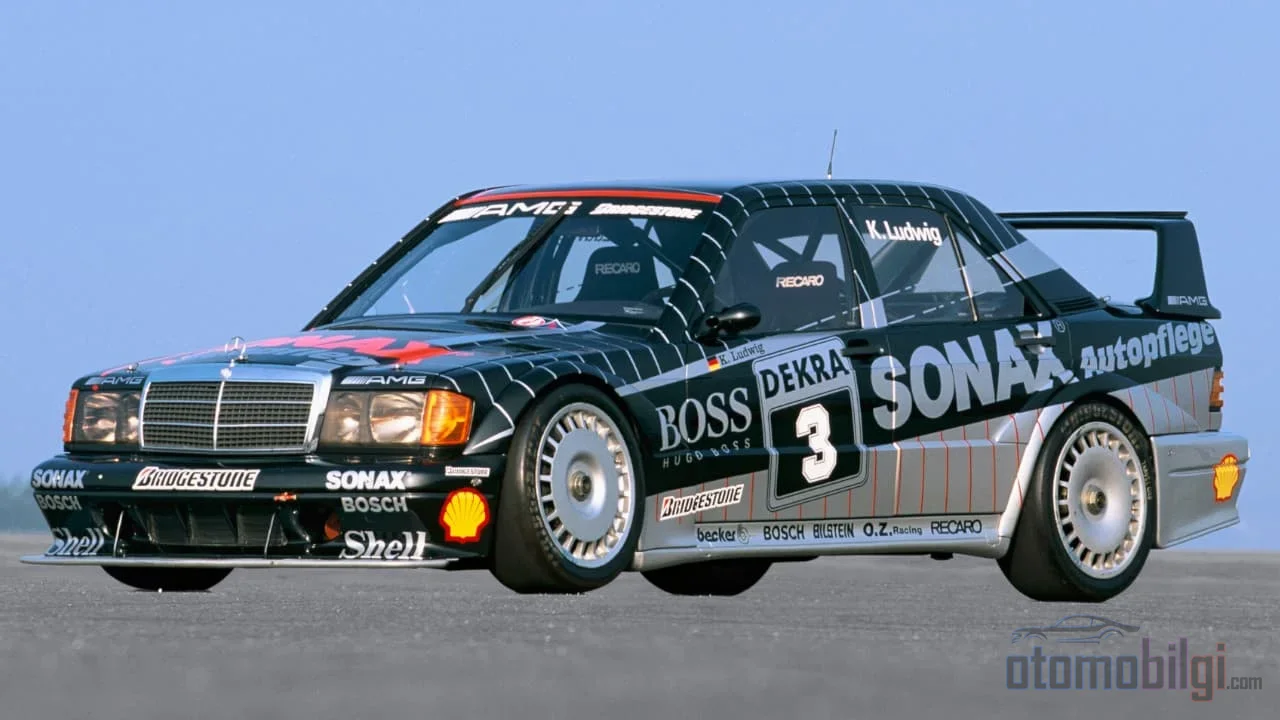
In August 1988, the more competitive 190 E 2.5-16 was introduced; the Evolution I came as the 1989 homologation special production. Then the Evo II exploded: the 2.5-liter engine was raised to 232-235 hp, with wide wheel arches, a roof spoiler, and an adjustable massive rear wing added. The racing version produced 274 kW (373 hp), used lightweight plastic body panels, weighed 980 kg, had a 6-speed transmission and a 55:45 weight distribution. There are still those who consider that body kit the most aggressive look of DTM's golden age; in my opinion, they're right.
The Conclusion came in 1992: Klaus Ludwig made Mercedes-Benz champion, and it was his second DTM title. That same year, Bernd Schneider, Kurt Thiim, and Keke Rosberg finished 2nd, 3rd, and 5th with other 190Es. Ludwig and Schneider won almost all the races that season. Mercedes' answer to BMW was complete.
Audi V8 Quattro: The All-Wheel-Drive Giant (Grid) Killer
In 1990, after Ford's withdrawal, Audi didn't enter the DTM with a half-baked idea: unlike their rivals' 4-cylinder cars, they brought a car using a V8 engine and quattro all-wheel drive . The production car it was based on, the Audi V8, was the brand's first V8-engined car and the first model to combine quattro with an automatic transmission; the first engines were 3.6 liters.
Yes, it was heavier than its rivals. But with extra power and fine chassis tuning, it became a hard beast to beat. It took its first victories in the fourth round of the season, with two consecutive races at Avus; the car used a 6-speed transmission and AWD. If you have no idea how all-wheel drive works, think of it like a shoe gripping all four corners on a bad road - while two wheels slip, it's still pushing forward. The result: in 1990 with Hans-Joachim Stuck, in 1991 with Frank Biela two consecutive championships.
The bitter part of the story: Audi fell into a disagreement with management over a controversial crankshaft design and withdrew from the DTM in the 1992 season In other words, the V8 Quattro's successful era ended early, before the crown was even secured. Still, quattro's impact endured: the system had left a deep mark in the WRC in 1980, and in 1996 the A4 quattro won championships in seven countries.
How Did Class 1 Rules Change Everything?
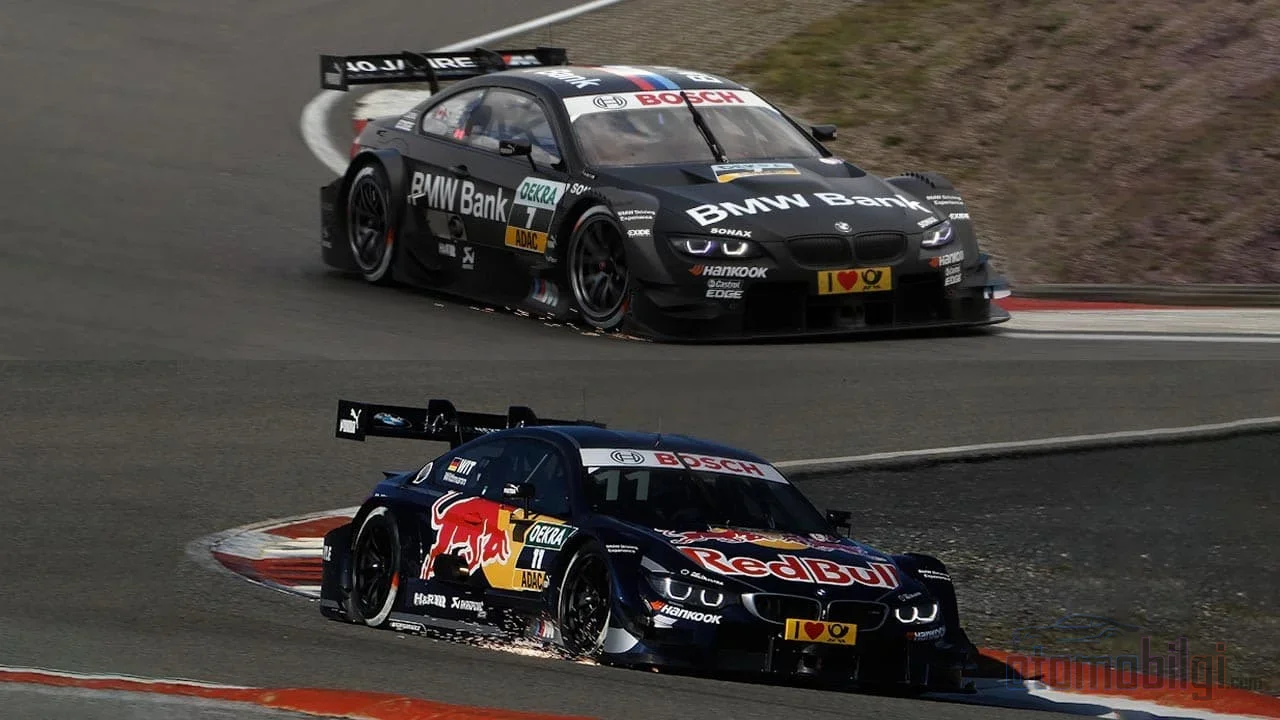
1993, DTM switched from Group A to FIA Class 1 rules, and the series never returned to its old form. The new rules limited engines to 2.5 liters and a maximum of six cylinders , allowing four valves per cylinder. But the real difference was this: Class 1 brought a shift from production-based cars to prototype-level "silhouette" style vehicles and granted great technical freedom. Now the outside was a car, but the inside was like a spacecraft. To make a comparison: in Group A, the car truly was the racing version of the car on sale; in Class 1, only a silhouette resemblance remained with the showroom car.
Alfa Romeo 155 V6 TI: The Italian Snake in the Germans' Home
With the transition to the Class 1 era, Alfa Romeo became the only non-German brand to end German manufacturers' dominance. At the heart of the 155 V6 TI was the "Busso" V6 delivering 420 hp at 11,500-11,800 rpm- I cannot describe the sound a V6 makes at those revs, you have to hear it. The engine weighed only 110 kg, and the carbon-fiber-bodied car weighed 1,040 kg in total. The regulations required the engine to be based on a production engine; Alfa solved this by using the Busso as the reference. As for the road car requirement, things got funny: Alfa produced only a single 155 GTA Stradale in 1992 . Just one car!
On the track, the math was clear: the 1993 championship with Nicola Larini, 12 wins out of 20 races. He won his first race on his very debut, beating an AMG Mercedes 190E. The total number of wins in its class reached 38. The Italians arrived at Germany's doorstep in its own backyard.
Opel Calibra and the Beginning of the End
Opel entered in 1993 with the Calibra DTM 4x4; in the early 90s the grid was dominated by the Mercedes 190E, BMW M3 and Calibra. After Audi and BMW withdrew, Opel, Mercedes-Benz and Alfa Romeo remained as factory teams - then Opel and Alfa Romeo also departed, and the end of classic DTM drew near. Meanwhile, another surprise of the era should not be forgotten: the Ford Sierra RS500 Cosworth entered at the end of 1987 and won the driver and team championships in 1988 with Klaus Ludwig ; it was the first turbocharged car to win both titles, with its turbo inline-four producing ~500 hp in full race trim.
Classic DTM and the Next Generation: How Much Did Technical Evolution Change?
When you put the legendary cars side by side, the picture of evolution emerges on its own:
| Model | Engine | Power | Best Achievement |
|---|---|---|---|
| BMW E30 M3 | 2,332 cc inline-4 | 300 hp | 1987 and 1989 championships |
| Mercedes 190E 2.5-16 Evo II | 2.5 L inline-4 | 373 hp (race) | 1992 championship, Ludwig |
| Audi V8 Quattro | 3.6 L V8, quattro | - | 1990 and 1991 championships |
| Alfa Romeo 155 V6 TI | 2.5 L V6 | 420 hp | 1993 championship, Larini |
| Ford Sierra RS500 Cosworth | Turbo inline-4 | ~500 hp | 1988 double championship |
After the original DTM ended, the series returned in 2000 under the name "Masters" and the Class One concept survived: the regulations were re-adopted in 2019 with turbocharged engines. The manufacturers didn't forget the split either - Bernd Schneider, with the CLK in the re-established series, won in 2000, 2001 and 2003; BMW, on the other hand, had to wait until 2012 to claim its next DTM championship with the E92 M3 and Bruno Spengler, followed by championships with the M4 in 2014 and 2016. The BMW-Mercedes rivalry continues today on the M Division-AMG axis; in other words, that 90s feud never ended, it just changed costumes.
Which Legend Would You Choose?
Let's be honest: the E30 M3's rev heaven S14, the Evo II's winged audacity, the V8 Quattro's stubbornness on all four wheels, and the 155 V6 TI's Italian scream at 11,800 rpm... Each one is a distinct character. But I ask you: an inline-four whose sound carves into your heart as you accelerate, or an Italian V6 crowned in the Germans' home? Whichever your answer, these five cars of classic DTM are proof of an era when touring car racing best bridged the street and the track. And in my opinion, it's precisely because of these cars that that bridge is still missed.
Sources
- 5 Legendary Cars From the Glory Days of the DTM
- Best DTM Cars
- Which is better, BMW E30 M3 or Mercedes 190E?
- BMW M3 Gruppe A DTM 2,3 – BMW Group Classic
- The BMW M3 E30 – BMW M Magazine
- The Mercedes-Benz 190E Evo 2 DTM [TECH TOUR]
- Mercedes-Benz 190 E 2.5-16 DTM
- Audi V8 – Wikipedia
- Giant Slayer: The 1990 Audi V8 Quattro DTM
- Audi motorsport history: From quattro to e-tron
- Alfa Romeo 155 2.5 V6 TI – Stellantis Heritage
- Alfa Romeo 155 V6 TI DTM – Revs Automedia
- Class 1 Touring Cars – Wikipedia
- Deutsche Tourenwagen Meisterschaft – Wikipedia
- The Original DTM Championship (1984-1996)
- The real DTM – A look into Class One (Part 1)
- Guide: BMW E30 M3 2.5 Sport Evolution
- An AMG-Mercedes 190 E 2.5-16 Evolution II DTM Gruppe A