Does the Head-Up Display Really Help the Driver?
Share This Page
A head-up display (HUD) is a display system that projects speed and navigation information onto the windshield or a small panel, allowing the driver to read information without taking their eyes off the road. Seeing your speed directly on the glass instead of the gauges sounds like science fiction, but the physics is very simple. Does it actually work? Let's find out.
Highlights
- In systems with AR-HUD, response times 43.1%, and success rates 26.2% improvement was measured
- Glances at the instrument panel typically last 1-3 seconds lasts
- Bright sunlight, polarized glasses, and glass quality are the HUD's biggest enemies
- Windshield-type HUDs are expensive when replacing glass, panel types are cheaper
How exactly does a head-up display work?
Remember the law of reflection from physics class: light hitting a surface reflects at the same angle it arrived. That's all the magic of a HUD. Hold a phone flashlight against a window; you see both the reflected light and the world beyond the glass, right? A car's HUD works on the same principle, projecting a digital image onto a transparent surface. You perceive that image as if it were layered over the road scenery.
The system has three main components: a light source that generates the image (usually a LED-based unit), a reflective surface (windshield, a separate combiner glass, or a lens), and a magnification system that enlarges the image and makes it appear distant to your eyes. In windshield-type systems, there is a small projector mounted on the instrument panel, a combiner glass positioned at a precise angle, and a control module that processes the information. Inside the projector are also a light source, a lens that focuses the image, and a mirror that reflects it.
Meanwhile, don't underestimate the magnification system: the HUD image is designed as if it were floating several meters ahead of the vehicle. That's exactly why even drivers who wear glasses to see the instrument panel due to near-vision problems can often read the HUD without glasses. Your eyes focus not on the screen but almost on the road.
Windshield type or panel type: What's the difference between the two HUD types?
HUDs fall into two camps, and the pros and cons of both are clear.
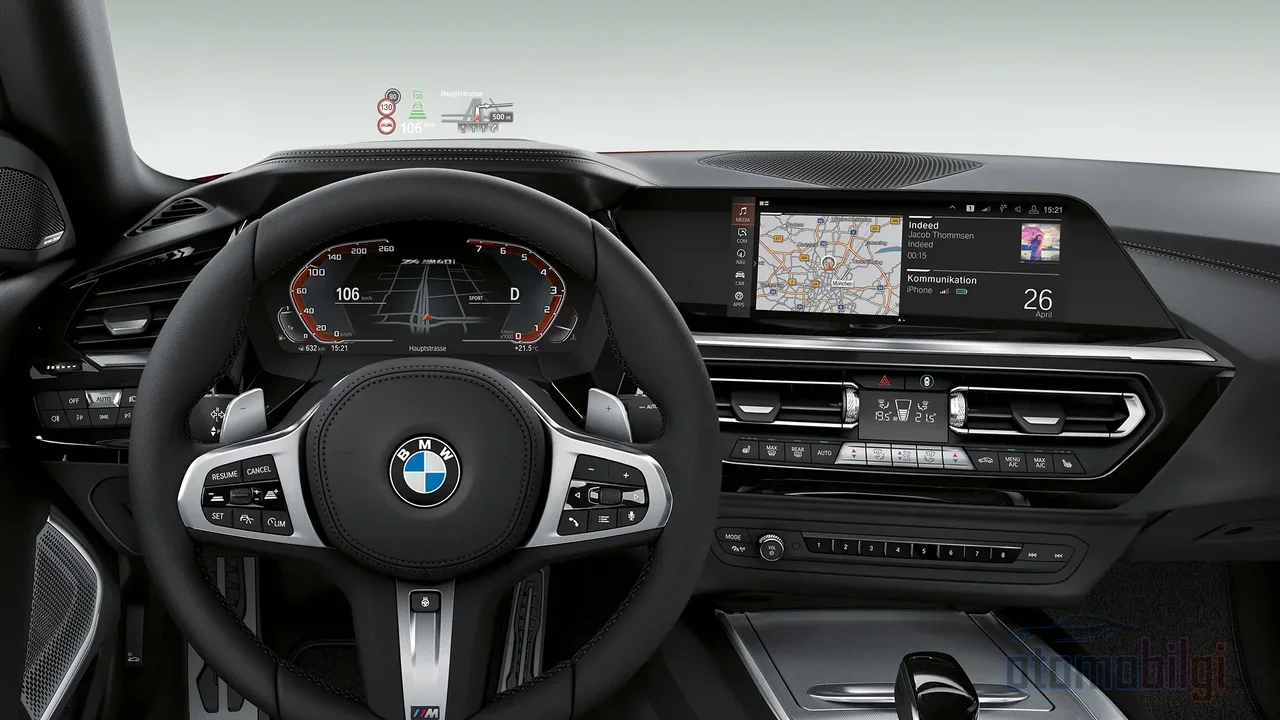
In windshield-reflected systems, the information sits higher up, right in the line of sight. Since the reflecting surface is wide, more data can be displayed. But this luxury comes at a price: to reflect the image properly, the windshield needs to be a special laminated type, which is reflected both in the vehicle's price and in your wallet when replacing the glass later. Moreover, some systems are hard to read with polarized sunglasses.
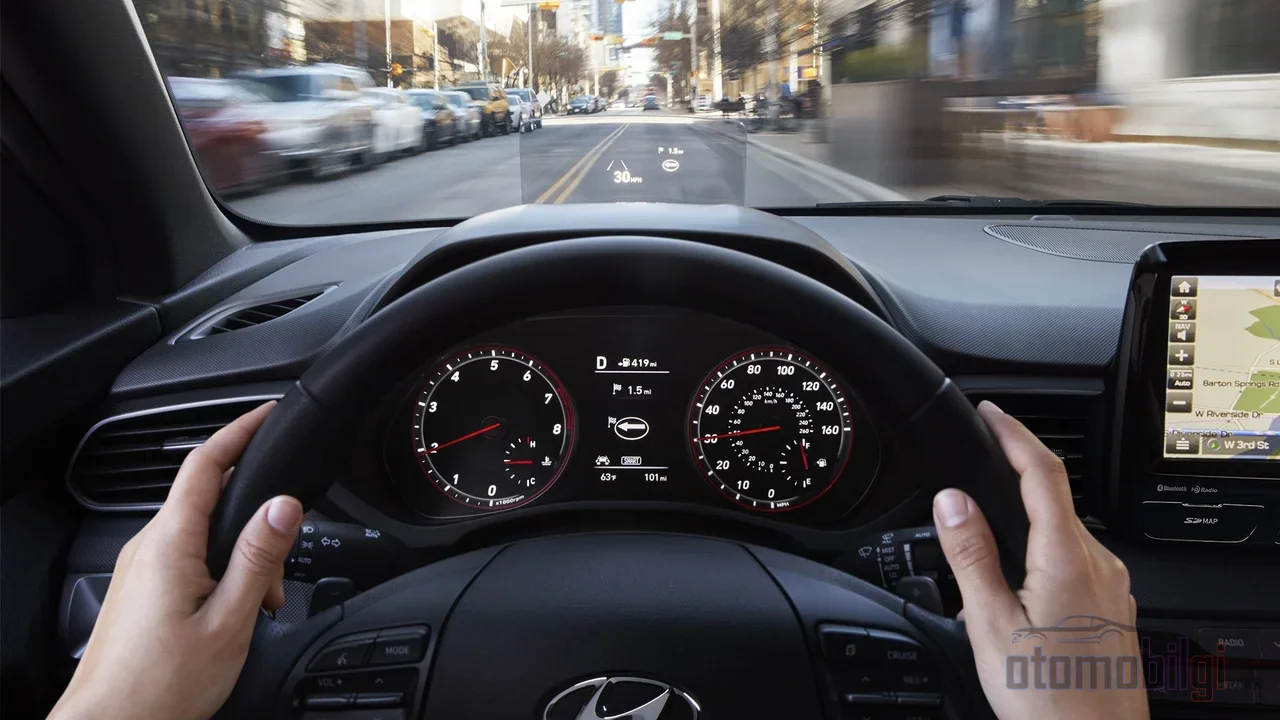
In panel (combiner) type HUDs, the image falls not onto the windshield but onto a small transparent plate that flips up from the panel. This is the cheaper solution; Hyundai, Kia, Mazda, Ford, and Mini prefer this route. The third-generation Mazda3, Hyundai Kona, Kia Soul you had seen these pop-up panels in the top trims of models like that. And the advantage is a big one: since a regular windshield is used, glass replacement isn't expensive. The downside? The reflecting surface is small, adjustment options are limited, and your eyes may have to look slightly downward.
| Feature | Windshield-type HUD | Panel (combiner) type HUD |
|---|---|---|
| Image position | High, directly in the line of sight | Lower, eyes drop slightly downward |
| Data that can be displayed | More, thanks to the large surface | Limited, small surface |
| Glass replacement | Requires special glass, expensive | Regular glass, cheaper |
| Brands using it | Usually the premium segment | Hyundai, Kia, Mazda, Ford, Mini |
There is also a distinction between projection-based and reflection-based systems: Laser/LED-based projection provides a very sharp image and little light bleed, but it is expensive and difficult to install. Reflection-based systems are somewhat less sharp and leak more light, but they can be installed in most vehicles on a plug-and-play basis.
How does it differ from the digital cluster, and does it really contribute to safety?
A digital instrument cluster is exactly those colorful screens that show you speed, rpm, fuel and temperature. The HUD, on the other hand, takes part of this data and moves it onto the view of the road. So the HUD is not a rival to the digital cluster; it is its assistant, carrying its most important information to a less dangerous place. Why does this matter? Because glances at the instrument panel typically last 1-3 seconds and at 65 km/h city speed, three seconds means a serious distance covered while your eyes are off the road.
So does this transfer produce a measurable benefit? Yes, a conditional yes, but it does. A 2023 study using eye tracking showed that an augmented reality-based HUD significantly increased the driver's attention to risky areas and shortened perception times in dangerous scenarios. A 2025 AR-HUD compilation, meanwhile, mentions improvements of 43.1%in response times and 26.2% in success rates, along with reduced cognitive load and reduced inattentional blindness.
But there is another side to the coin: a careful evaluation from the same period warns that the HUD itself can be a source of distraction. Another study on warning displays produced an interesting result: warnings on the HUD elicit faster responses than warnings on the screen looked at downward, but there is no enormous advantage. So the HUD is not a magic button for fast reactions; used well, it is a smart arrangement that keeps your eyes on the road. Indeed, researchers also say that HUD information does not automatically make the driver a faster driver.
Augmented reality navigation: How useful are those arrows dancing on the road?
AR-HUD is HUD taken to the next level. It doesn't just show speed; it overlays turn arrows, lane guidance, and hazard warnings on top of the real road view. A red warning layer on lane violation, blue animated arrows for an upcoming intersection... This visual alignment matters, because the arrow sits exactly on the road you're seeing. Think of it this way: instead of reading a text saying "turn left now", it's like "turn left right there".
We see systems doing genuinely good work here: Audi's AR system has been evaluated as the best augmented reality design on the road thanks to its skillful use of animation and audio cues. The 2026 LYRIQ-Vfeatures an AR HUD where you can adjust height, rotation, brightness, and display modes. It has also been announced that a HUD spanning nearly the full width of the windshield is coming with BMW's future iDrive X system. The field is growing; estimates for the AR navigation market vary between sources, but they all point in the same direction: up.
Let me offer just one caution: AR-HUD doesn't make a difference in every situation. A 2025 study found that the spatial position of navigation graphics has no significant effect on inattentional blindness behavior or reaction time. So where the arrow sits on the road alone doesn't change the game; the type of scenario matters too.
Real-world problems: Sun, polarized glasses, humidity, and glass
Everything is perfect in the brochure, but get in the car with me on a sunny day, and then we'll talk. Bright sun can completely wash out the HUD image. There are drivers who report the image partially or fully disappearing, especially when the sun is directly overhead or at certain angles; this varies from vehicle to vehicle. Running it at maximum brightness in daytime use is almost a must. Plug-and-play accessory HUDs have also been observed to struggle in direct sunlight.
The second classic problem: polarized sunglasses. With some systems, reading the HUD through glasses can be genuinely difficult, and this varies from one glasses-and-vehicle combination to another. It wouldn't be wrong to say sit down and test it before switching to glasses-free driving.
The glass itself is also a critical factor. Windshields dedicated to HUD duty can suffer from distortion, ghosting, and magnification issues; that's why inspection of these glasses is very important. Since laminated glass has two reflective surfaces, the HUD can become blurry or degraded after a glass replacement. In vehicles with HUD, special wedge-shaped films and solar control layers protect the unit from the sun and provide a clear image. So when getting glass fitted on a HUD-equipped vehicle, insist on "HUD-compatible glass" - I'm serious.
And the final dirty detail: humidity. Some Land Rover Discovery owners have reported condensation and fogging on the inner surface of the projector cover. When the weather cools down and the inside heats up, the HUD image can end up behind the fog. A rare problem, but it exists.
What should you expect when buying or activating a vehicle with HUD?
Let me give you a clear set of expectations, because HUD users are polarized: some say "I can't imagine a car without a HUD," while others question its usefulness. The right answer lies between the two. Here's what you need to know:
- There is a safety benefit, but it's conditional. It shortens detection time and keeps your eyes on the road; but there's no promise like "I'll drive faster and safer with a HUD-equipped car."
- Be prepared for disappointment on sunny days. The image may fade depending on lighting conditions and seating position; learn how to adjust the brightness.
- Bring your polarized sunglasses along. Before buying the car, test the HUD with your own glasses.
- Question windshield replacement. On a car with a windshield-type HUD, the glass price and the windshield's HUD compatibility are critical; this is less of an issue with panel-type systems.
- The content varies by brand. Some manufacturers offer only a minimal display showing speed and the speed limit; brands like BMW, Mercedes-Benz, Toyota and Volvo let you customize the image.
As for the aftermarket side: yes, they make speed monitoring easier and keep your eyes on the road. But they are known to struggle in bright sunlight, and they can hardly match the visual quality of windshield-reflected factory systems. Factory equipment always offers a more refined experience.
In conclusion, the HUD is a smart idea in the age of distracting screens: it puts information not in front of your eyes but in their path. With the right type, the right windshield, and realistic expectations, it genuinely contributes to your driving. If it were you, would you prefer a windshield-type system, or a panel type with no windshield replacement hassle? I'm waiting in the comments!
Sources
- What Are Head-Up Displays? How Do They Work? And Are They Worth It? - MotorTrend
- What is a Heads-Up Display (HUD) & How Does it Work? - Ansys
- Heads-Up-Display (HUD) Windshield in Car - Effectual Services
- Does the AR-HUD system affect driving behaviour? An eye tracking study - Cheng, 2023
- A Review of Augmented Reality Heads Up Display - Winkler, 2025
- Head-Up Displays and Distraction Potential - Russell, 2023
- Are Warnings Suitable for Presentation in Head-Up Display? - Niu, 2024
- Spatial Plane Positioning of AR-HUD Graphics - Ye, 2025
- How HUD Head-Up Displays Work and Their Advantages - AllPCB
- Eye on Electronics: Augmented Reality HUDs - Motor.com
- Heads Up Display Pros and Cons for Cars - Edmond Industries
- CES 2018 Part 2 (Aftermarket HUD) - Karl Guttag
- Characterizing the Effects of Windshields on Head-Up Displays - Radiant Vision Systems
- Why Inspection is Crucial for Windshield HUD Clarity - Design News
- Windshield Features - Heads Up Display - Glassmasters Auto Glass
- Solutions for Head-Up Displays by solar control function - S-LEC Film
- Best Tech 2026: Audi's Augmented Reality - MotorTrend
- Available Augmented Reality HUD | 2026 LYRIQ-V - Cadillac
- Future Cars 2026-2029 - U.S. News
- Which Cars Have Head-Up Displays? - Cars.com
- Head-up Display: Why You Need It in Your Next Car - KBB
- Is a head-up display worth it? - Kia
- Best Aftermarket Heads Up Displays (HUD) - 2026 Guide - CarAudioNow
- Best Aftermarket Heads-Up Display - CarTalk
- Condensation at head up display - LandRoverForums
- HUD slightly blurry after windscreen replaced - Bimmerpost
- Do you use a Heads Up Display? - Reddit r/cars
- When HUD display can't be seen - ClubLexus