From Long Beach to Milwaukee: IndyCar's Classic Stops
Share This Page
Classic stops on the IndyCar calendar are the places where the series' heart beats: the palm-lined streets of Long Beach, the rolling hills of Mid-Ohio, Gateway's egg-shaped oval, Milwaukee's century-old circle, and Laguna Seca's legendary Corkscrew corner. Each produces its own history, its own character, and its own style of racing; and it is precisely this variety that sets the series apart from the others. IndyCar is the only major series whose calendar includes ovals, permanent road courses, and temporary street circuits within the same season.
Highlights
- Long Beach, held since 1975, is the longest-running major street race in North America.
- The 2026 calendar consists of 17 races; the season finale is at Laguna Seca in September.
- Gateway is an 1.25-mile egg-shaped oval with two opposite corners of differing radius and banking.
- Milwaukee Mile has been in operation since 1903, making it the oldest motor racing circuit in the world.
- Laguna Seca's Corkscrew corner features a drop of six stories.
Why Are IndyCar's Tracks So Different?
As you know, Formula 1 races almost exclusively on road courses, while NASCAR sticks mostly to ovals. IndyCar, however, embraces all three worlds: long superspeedway ovals, short and demanding short ovals, twisty permanent road courses, and temporary circuits laid out on city streets. Since 1996, the series has raced on exactly 50 different tracks: 24 ovals, 11 permanent road courses, and 14 street circuits. Since the car uses the same basic Dallara chassis everywhere, the team must reconfigure it from track to track and the driver must adapt. Each classic stop on the calendar tests a different facet of this adaptation game.
Long Beach: The Crown Jewel of Street Racing
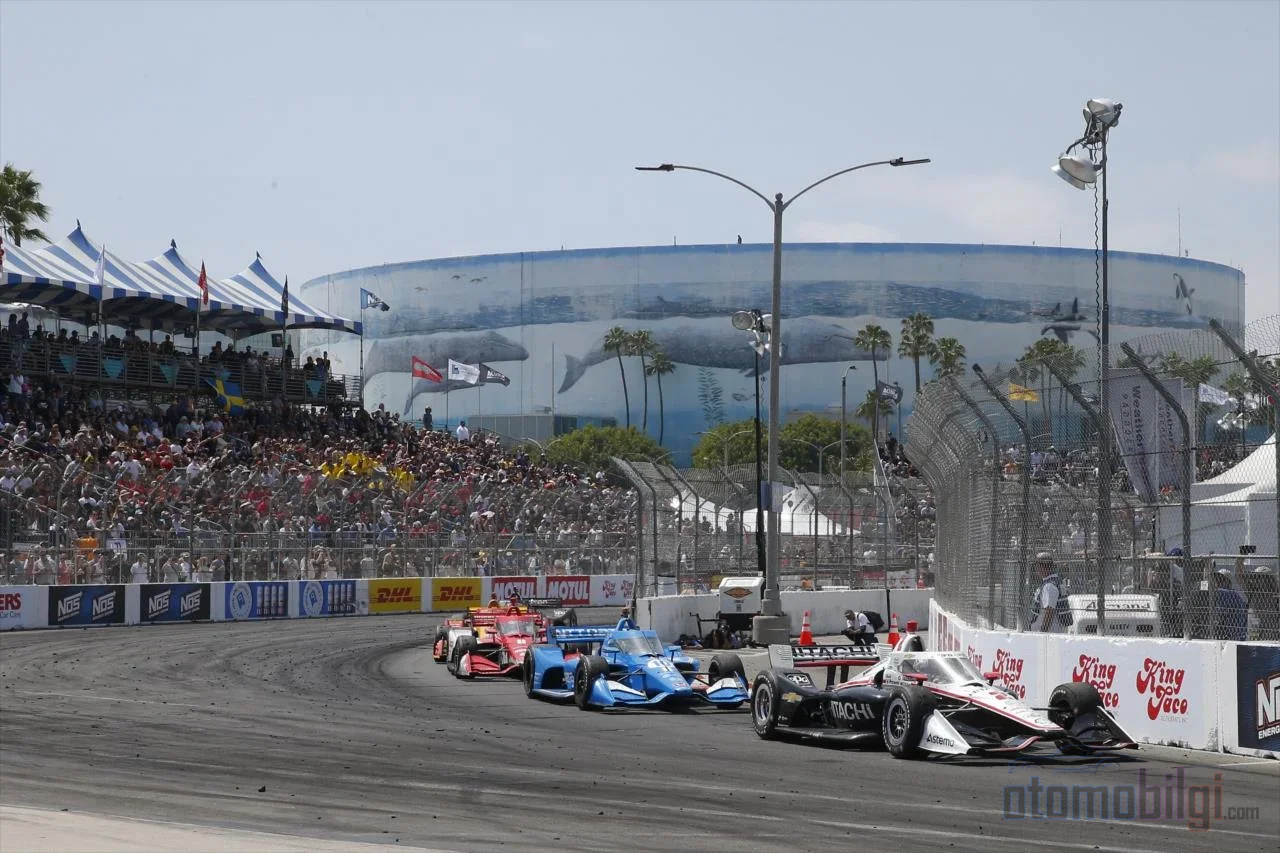
Long Beach, California, is the most iconic address on the IndyCar calendar. A temporary street circuit built around the Long Beach Convention Center, 1.968 miles (3.167 km) long with 11 corners; it stretches along Shoreline Drive in the shadow of palm trees. The festival atmosphere is truly something else: the beach, music, grandstands, and open-wheel cars squeezed between concrete walls. With almost zero margin for error in a place like this, every lap is like walking a tightrope.
An Event Born from a Monaco Dream
The story of the circuit begins in 1975. British former travel agent Chris Pook carried the idea of establishing a street race in America, inspired by the Monaco Grand Prix. The first event was held that same year in September as part of the Formula 5000 series, with Brian Redman taking the win. Then, from 1976 to 1983, the circuit hosted Formula 1's United States Grand Prix West. In 1977, Mario Andretti overtook Jody Scheckter to become the first American to win an F1 race on home soil; that victory also solidified the race's financial foundations. But the F1 event was not profitable: against a budget of millions of dollars, the profit margin was only $100,000. Pook found the solution on the IndyCar side, and from 1984 on from that point on the race moved to the CART open-wheel series. It has been on the IndyCar Series calendar since 2009 as well. The race, which was cancelled in 2020 due to COVID-19, was moved to September as the season finale in 2021, then returned to its traditional April date in 2022.
Track Character: The Hairpin and the Long Straight
Long Beach's formula for producing races is simple: a long front straight that immediately follows the sharp hairpin in the final corner. The driver who gains a position before the hairpin gets the chance to defend it on the straight, and the braking into that corner is one of the most exciting moments of the weekend. Turn 1 is also a critical spot for overtaking. If you look at the list of winners, you'll see how prestigious the track is: alongside IndyCar legends like Unser, Zanardi, Montoya, Franchitti, Power, Conway and Dixon, on the F1 side Regazzoni, Andretti, Villeneuve, Piquet and Lauda have also won here. The lap record is Álex Palou's official race lap of 1:07.2359 from 2022; in qualifying, Colton Herta pushed the limits that same year with 1:05.3095 . The 2026 Acura Grand Prix of Long Beach was run on April 17-19 and featured a tremendous battle between Palou, Felix Rosenqvist and Scott Dixon.
Mid-Ohio: The Test of Technical Corners
Mid-Ohio Sports Car Course in Lexington, Ohio, unlike Long Beach, is a permanent road course, built on 330-380 acres of land. The main configuration is 2.4 miles with 15 corners; for IndyCar's Honda Indy 200 event, the track length is measured as 2.258 miles and the race runs 90 laps, i.e. 203.22 miles . What makes the track special? Swallow hills and constantly changing elevation differences. Launching the car over a hill and turning in on the descent gives you such a feeling in your stomach that if you were sitting in it, you would definitely scream. That's why setup engineering is everything at Mid-Ohio: a car that can't find its balance pays the price in all 15 corners. The facility offers a 12,000-seat grandstand and three viewing mounds; on the 2026 calendar, the IndyCar race is run on September 22.
Gateway: The Feisty World of the Short Oval
World Wide Technology Raceway in Madison, Illinois is one of the liveliest representatives of IndyCar's short oval traditions. 1.25 miles (2.012 km) long, this oval's most interesting feature is its shape: egg-shaped. That means the two opposite corners are not the same; they have different radii and banking, with 11 degrees of banking at both ends. This is a real setup nightmare for teams: a setting that suits one end makes the car restless at the other. It's as if you're running two different tracks in one circle.
After new asphalt was laid in 2017, tests showed drivers found the track to have a lot of grip and to be faster, saying we could watch the best short oval race of the year here. Why do short ovals produce such intense racing? Think about it: each lap takes only a few seconds, the cars are constantly close together, you lunge forward using the airflow (drafting), and the long straights produce explosive acceleration thanks to low drag. The 2026 race runs 260 laps / 325 miles is run and hybrid energy systems are allowed unlimited activation, with a maximum of 150 uses per lap. In other words, the strategy is just as brutal as the track.
Milwaukee Mile: The Oldest Surviving Track in the World
Now let me tell you the history: Milwaukee Mile opened in 1903 as a dirt track and is the world's oldest motor racing track still in operation. Car races were held here before parking lots had even been invented! The site goes back much further; it was reportedly used as a horse racing track since at least 1876. For the first 49 years it was run on a dirt surface, and since 1954 it has been asphalt. The first IndyCar race was held in 1937, which goes back well before the series' modern era.
The track is a 1 mile flat oval; the infield also features a road course layout 1.8 miles (2.9 km) in length. The type of racing Milwaukee produces? Intense, packed, and never boring. In the doubleheader weekend format, Race 1 saw 333 position passes, and in Race 2 that number rose to as many as 372. That many passes within one mile means there is no stalling on this track, just overtaking. The 2025 event carried the name Snap-on Milwaukee Mile 250 and continued its tradition on the calendar.
Laguna Seca: The Corkscrew and the Season Finale
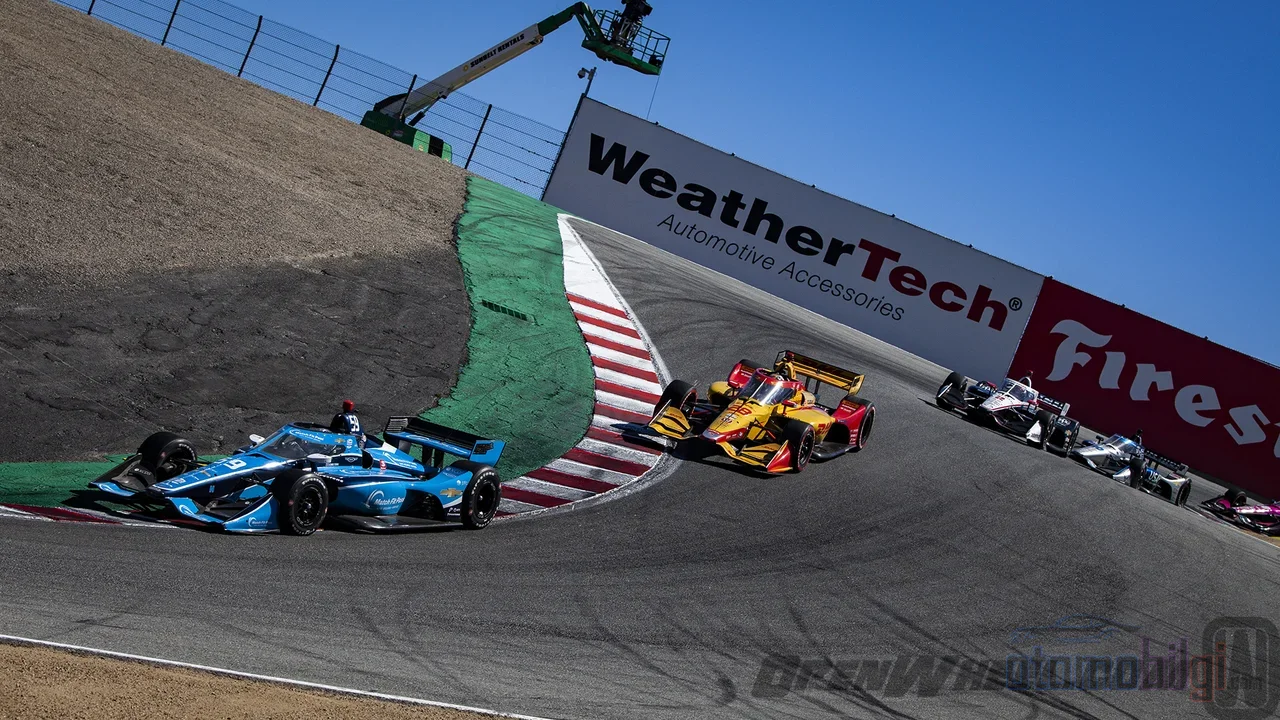
WeatherTech Raceway Laguna Seca, on the Monterey coast of California, was built in 1957: a 2.238-mile (3.602 km), 11-turn road course. But this track has a star: the Corkscrew. To explain it with a wine metaphor, the Corkscrew is a pair of back-to-back corners that twist like a corkscrew, containing a six-story drop. You climb toward the crest, then at an almost blind point the car drops into the void and changes direction. For drivers it is a test of courage and timing; for spectators, a visual feast.
The first race of the CART IndyCar World Series at the track was run on October 23, 1983; the track hosted IndyCar championship weekends between 1989-96, in 2019, in 2022-23, and now once again. The season finale of the 2026 NTT IndyCar Series runs here on September 4-6, and the 17-race season closes with the Mission Foods Grand Prix of Monterey. In 2026, a historic IndyCar exhibition featuring legendary drivers and cars was also organized; so Laguna Seca is not just closing out the season, it is also showcasing the series' memory.
Five Tracks, One Calendar: Seeing the Classic Stops Side by Side
Each stop represents a different kind of test. If you want to compare them, here is a brief summary:
| Track | Type | Length | Notable Feature |
|---|---|---|---|
| Long Beach | Street circuit | 1.968 miles, 11 turns | Hairpin + long straight, festival atmosphere |
| Mid-Ohio | Permanent road course | 2.258-2.4 miles | Rolling hills, technical 15 turns |
| Gateway | Short oval | 1.25 miles | Egg shape, 11-degree banking at both ends |
| Milwaukee Mile | Short oval | 1 mile | In operation since 1903, high number of passes |
| Laguna Seca | Permanent road course | 2.238 miles, 11 turns | The Corkscrew turn, season finale |
When you look at this picture, you see IndyCar's identity more clearly: the same car, the same weekend, but completely different challenges. Braking discipline on a street circuit, setup precision at Mid-Ohio, courage and air management on short ovals, and at Laguna Seca, that split-second decision taken entering the Corkscrew. The champion is the driver who powers through these five worlds within a single season. In my opinion, next time you glance at the calendar, pay attention to these details; once you see which track carries which exam, you'll start watching the races in a whole different way.
Sources
- Long Beach Street Circuit
- Acura Grand Prix of Long Beach
- Acura Grand Prix of Long Beach
- Long Beach | F1 Circuits - F1 History
- Mid-Ohio Sports Car Course
- Mid Ohio Sports Car Course - History
- Honda Indy 200 at Mid-Ohio
- Gateway Motorsports Park
- Gateway's oval character
- Milwaukee Mile
- Everything To Know About The Milwaukee Mile
- Laguna Seca 2026 finale announcement
- Laguna Seca
- List of IndyCar Series racetracks
- 2026 schedule announcement