How Does Matrix Night Protect Other Drivers' Eyes?
Share This Page
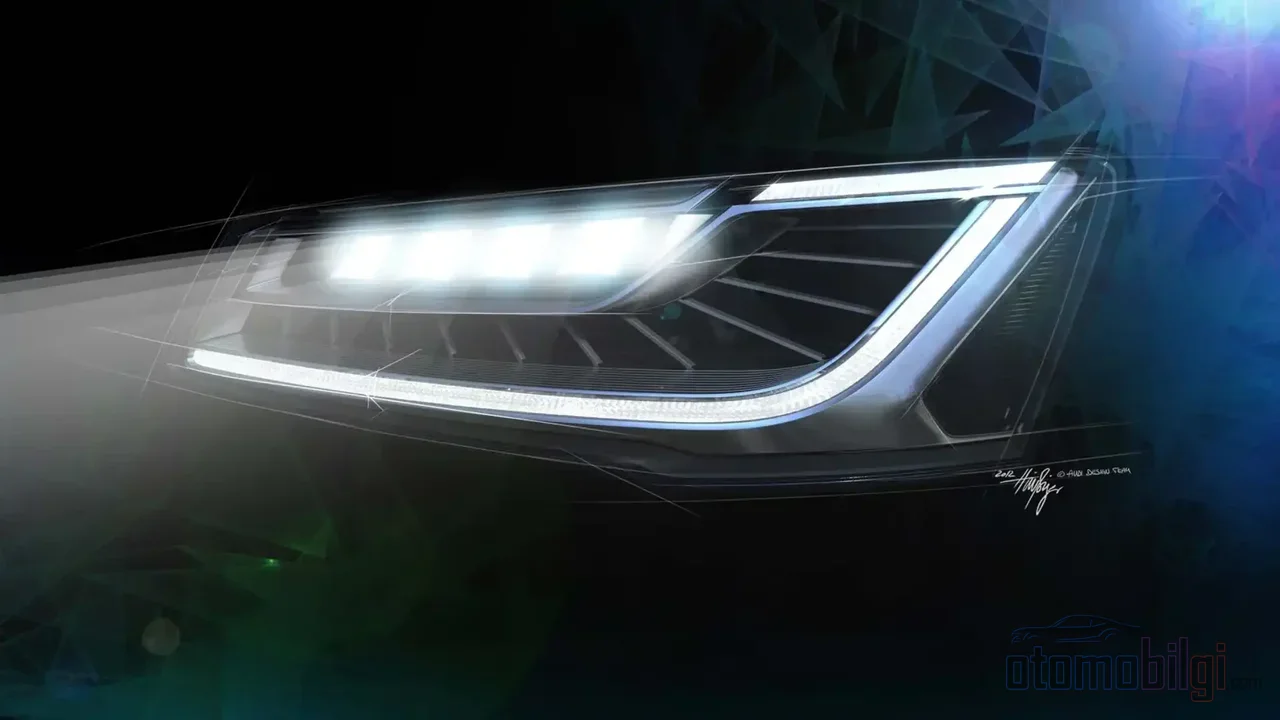
Matrix headlights are an adaptive driving beam (ADB) system that divides the high beam into dozens or even thousands of independently controllable LED segments. It dims or completely shuts off the LEDs that fall on oncoming or preceding vehicles detected by the front camera, while the rest of the road remains illuminated by the high beam. This way, visibility stays at high-beam level without dazzling other drivers.
Highlights
- Porsche's HD Matrix headlights have, per headlight, 32,768 pixels each controlled individually.
- The system's eye is the front camera, sensitive to visible and near-infrared light.
- In the US, ADB headlights only received certification approval in February 2022 while in Europe they have been approved under ECE R123 since 2012 .
- In Audi vehicles, the adaptive mode engages above 30 km/h while Hyundai's headlight assistant turns on the high beams above 30 km/h .
- According to ECE R123, if ambient illumination exceeds 7,000 lux the adaptive beam shuts off.
When driving at night, doesn't this thought cross your mind: "I wish the high beams could stay on without bothering anyone." Seriously, one of the engineers who thought exactly this made playing with light their profession, and the matrix headlight was born. This system, which treats the high beam not as a single spot of light but as a giant pixel wall, turns off only that slice of the beam when it sees an oncoming vehicle. The rest of the road stays brightly lit by the high beam. In this article, we dive into this system: how does the camera see, how does the computer decide, how do the LEDs dim? Ready? Let's begin.
How Do Matrix Headlights Work? The Chain from Sensor to Pixel
At the heart of it all is a single question: where is the oncoming vehicle? No matter how smart your light is, it doesn't matter without this information. This is why the matrix headlight is conceived as a chain of three parts: a sensing camera, a deciding computer, and an acting LED array.
The Eye: Front Camera and Traffic Reading
The system's eye is the front camera mounted on the inner part of the windshield. This camera is sensitive not only to normal visible light but also to near-infrared light. In other words, even in darkness where the human eye struggles, it can capture almost all traffic within its detection range. It distinguishes the headlights of oncoming vehicles, the taillights of vehicles ahead, and in some systems even reflective road signs.
This image from the camera is raw data; on its own it's not enough. The image processing software extracts the objects in the scene and classifies them as "there's an oncoming vehicle here, there's a vehicle ahead there." In more advanced applications, computer vision can even extract the lane information of the road, and when combined with GPS data, headlight control becomes predictive: just before entering a curve, the light focus can be shifted along the curve. The system always plans the light one step ahead - just like a good driver preparing the steering the moment they see a curve.
The Brain: ECU and Pixel Dimming Logic
When the camera says "oncoming vehicle detected," the electronic control unit, or ECU, comes into play. The ECU interprets the data it receives from the camera and directs the output of each individual LED. Here's the key point: the high beam doesn't shine as a single spot; it is divided into multiple independently controllable sub-beams. When an oncoming vehicle is detected, only the LEDs illuminating that zone are dimmed or switched off completely; the rest of the beam keeps shining.
Think of it like a bright flashlight beam projected onto a wall: if there are people on the wall, you cover with your hand only the part of the beam falling on them, and the rest stays lit. Matrix headlights do exactly this - but multiple times per second, with millimeter precision, and without the driver taking a hand off the wheel. Each LED motor has its own driver circuit, and brightness is dynamically controlled via current or PWM (pulse-width modulation). In other words, the LED doesn't simply turn on or off; it provides brightness in hundreds of steps in between.
Muscle: Why Are LEDs a Must?
Why did this system explode precisely in the LED era? Because LED is a champion when it comes to dimming: it turns on instantly, requires no warm-up time, withstands tens of thousands of on-off cycles, and offers a white color temperature of around 6,000 Kelvin. Halogen or HID (xenon) lamps don't allow for smart light control; managing them pixel by pixel is virtually impossible. The classic AFS systems used in the past relied on mechanical shutter-rotation mechanisms; these worked with a delay and degraded over time with vibration and wear. Matrix's solution completely defeated the mechanics: there is no shutter anymore, only light managed by software.
Why Does Pixel Count Matter So Much? HD Matrix Architecture
"Matrix" is not a single technology, but a scale series. The greater the number of independent light points in the system, the more precise the dimming becomes, and the smaller the slices that escape glare.
At the cheap end, there are solutions with 32 small LEDs arranged in two rows; these can with 64-step dimming produce millions of different light patterns. At the top sits Porsche's HD Matrix headlight: a total of 32,768 individually controllable pixels per headlight. That number means being able to "draw" light at nearly image resolution. Honda's approach is also interesting: its ADB splits the high beam into upper and lower sections; the lower section illuminates at a lower height, reducing glare for pedestrians and brightness reflecting off road signs.
The electronic infrastructure enabling all this control is itself an engineering feat. Microcontrollers called the Lighting Matrix Manager (LMM) feed each LED motor's MOSFET driver via PWM through the SPI interface, and the LED voltages 65 V can be managed up to. DLP-based alternative solutions, instead of switching each LED on and off, direct light with micro mirrors to deliver higher-resolution adaptive headlights. The price isn't negligible either: increased circuit complexity, growing PCB area, rising EMI, and a serious thermal management problem. That's why aluminum heat sinks began to appear inside headlights, and over time fans started to be seen in some high-power designs.
When Does the High Beam Assistant Kick In, and When Does It Back Off?
Before the matrix headlight's expensive sibling, there is a simpler but far more widespread assistant: the high beam assistant (HBA or AHB). This system either switches the high beam on or off - it knows nothing of the shades in between. It looks at brightness data from the front camera or light sensor; when it detects an oncoming vehicle's headlights or the taillights of a vehicle ahead, it automatically switches to low beam. So the assistant should be thought of as a switch, while ADB is like a dimmer. The switch turns the light off completely; the dimmer keeps the light on but dims only a portion of it. That is precisely ADB's main purpose: to keep the main beams on for as long as possible, with part of the beam acting like high beam and part like low beam.
Speed Thresholds and System Rules
High beam assistants have their own set of rules, and they vary from manufacturer to manufacturer:
- According to Hyundai's manual, when HBA is activated, if the speed is 30 km/h or above, the high beams turn on.
- In Audi's HD Matrix system, the adaptive mode engages outside the city and above 30 km/h ; the laser module, in turn, switches on automatically at 70 km/h and dims when the camera spots another vehicle.
- In BMW's automatic high beam, the driver can set separate activation and deactivation speeds (let's note this as a detail shared by forum users).
- The Kia EV9 manual warns: the assistant may not switch off the high beams every time, and after the vehicle is started, it may not work for the first 15 seconds until the front camera is ready.
These thresholds are not superstitious details; the system's decision quality depends entirely on the camera's view. Fog, heavy rain, spray, and snow reduce visibility, and when the sensors are dirty, detection is limited. Ford and Mercedes manuals say exactly this. There is even an interesting reversed situation: fog can actually cause some systems to keep the high beams on, because the camera cannot clearly see the oncoming light. That's why managing the high beams manually in bad weather is still the safest course. Among users, the recommendation to switch manually in rain and snow is also widespread - pressing a button is easier than wrestling with the system.
There is also a nice detail about the indicators: in Polestar, when partial beam dimming is applied - that is, when the light is stronger than low beam but not full high beam - a special symbol lights up on the driver's display. In other words, the car is telling you "look, I'm doing it right now."
Instead of Glare, Visibility: What Does the System Actually Deliver?
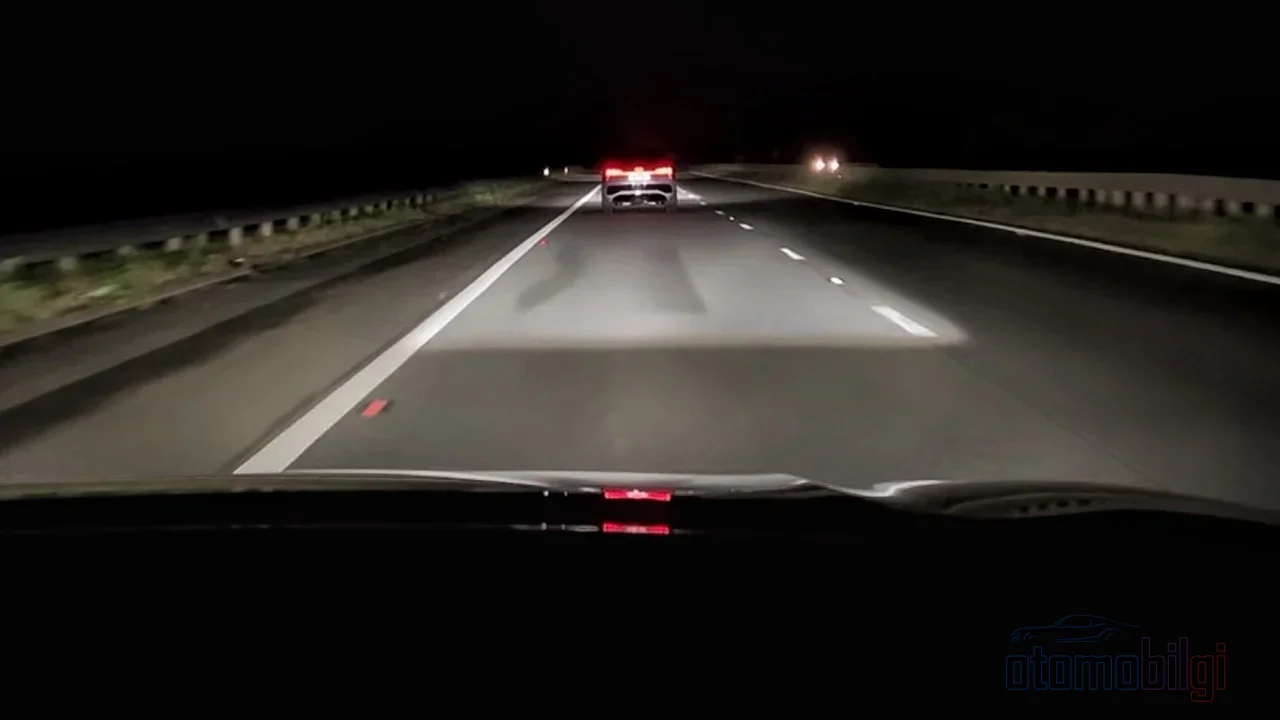
When looking at a Matrix high-beam from the outside, oncoming drivers see a strange sight: the road is illuminated by the high beam, but a "hole" within the beam passes over your vehicle. The logic explained by the IIHS is exactly this: ADB provides normal high-beam visibility except for the segments dimmed to limit glare for oncoming or preceding vehicles. This is called glare-free high beam logic, and in essence it frees the driver from the burden of switching the high beam on and off - the high beam stays permanently on, and the system handles the rest.
To give a numerical idea, in user experience shares (that is, not an official measurement but a forum-based claim) the useful lighting range is said to be around 50 m on low beam, and around 100 m on high beam. This is exactly where ADB's value emerges: illuminating the scene ahead at high-beam level while reducing glare for oncoming drivers - it is defined for this purpose in SAE literature as well. Of course, it is not a technology beyond debate: the opposing view voiced in community discussions related to the IIHS is that ADB, by increasing high-beam usage, could increase the total light on the road and limit glare only in some situations. So the technology is not perfect; but its principle is sound: where it is light and where it is dark is determined not by the driver but by software and sensors together.
Regulations: Why Did the US and Europe Take Different Roads?
The interesting part of this is: the delay in this technology reaching US roads was not an engineering matter, but a regulatory one. In Europe, ADB headlights since 2012 had been homologated under ECE R123; but on the US side, legislation did not allow this, and this gap lasted for years. The turning point was February 22, 2022: NHTSA changed the lighting standard to allow the certification of ADB headlights, and the US market was opened up. NHTSA also published a technical report evaluating the glare performance of European ADB systems. As Bullough's 2015 study pointed out, if adaptive control is shown to provide acceptable glare management, even the necessity of the existing upper-limit rules may become debatable.
On the ECE side, too, the system has a "shut-off" rule: according to ECE R123, if ambient lighting 7,000 lx is exceeded - that is, if the system decides on its own that there is sufficient light - the adaptive driving beam must switch OFF. In short, matrix mode does not work in daylight.
Power Through Software: OTA Updates and the Future
Perhaps the most exciting aspect of matrix headlights is that the headlight can behave like a software product. A current example: in February 2026, it was reported, based on code reviews, that Tesla was preparing a wireless (OTA) update bringing pixel-level dimming improvements. Thanks to its two-stage dimming system, it is expected to apply graduated brightness adjustment instead of instant on-off on reflective objects such as road signs and traffic lights, reducing reflected glare. Since the hardware is already present in Model 3/Y/S/X, the update is expected to be distributed as software. The thought that light, just like autopilot, improves the night via OTA makes me smile every time.
In short, matrix headlights split night driving into two layers: you provide direction and speed, the system draws the map of light. The camera sees, the ECU decides, thousands of LED pixels shine knowing there is no one in which region. Protecting the oncoming driver's eyes while keeping your own viewing distance at high beam level - that is exactly the technology's "promise of night vision". But when you are alone on that road, would you notice that your high beam never goes out again? That is precisely the sign of the best matrix headlights: going unnoticed.
Sources
- Matrix LED Headlights: Redefine Adaptive Front-lighting With Smart High Beam Technology
- Performance leap in light technology – Porsche Newsroom
- Adaptive Driving Beam|Honda Technology
- Headlights – IIHS
- High-beam assist – basic principles – Hella Tech World
- High Beam Assist Operation – Hyundai
- Limitations of High Beam Assist – Kia EV9 Manual
- ADB Final Rule – NHTSA (Feb 2022)
- FMVSS; Lamps – Adaptive Driving Beam – Federal Register (22 Feb 2022)
- ECE-TRANS-WP29-GRE-2020-13e – UNECE
- Adaptive Driving Beam - Visibility Improvement versus Glare – SAE 2014-01-0436
- Adaptive Driving Beam Headlighting System Glare – NHTSA 812174
- Create high-resolution adaptive headlights Using DLP – Texas Instruments
- LED Matrix Manager – Analog Devices
- High-Beam Intensity, Visual Performance and Safety – Bullough 2015 (ROSAP)
- Ryan Shaw – Tesla adaptive matrix headlights update (Instagram, 27 Feb 2026)
- Adaptive Driving Beam : r/NewDefender (Reddit)
- Pixel led in Action : r/Polestar (Reddit)
- High-Beam Assistant Activate/Deactivate Speeds – Bimmerfest
- Do Automatic High Beam Systems Recognize Fog? – Jalopnik
- minimum distance headlights illuminate – CrashForum.info
- How do automatic high beams work on my Ford vehicle? – Ford
- IIHS community discussions (Reddit)