Night Vision and Thermal Camera Systems in Cars
Share This Page
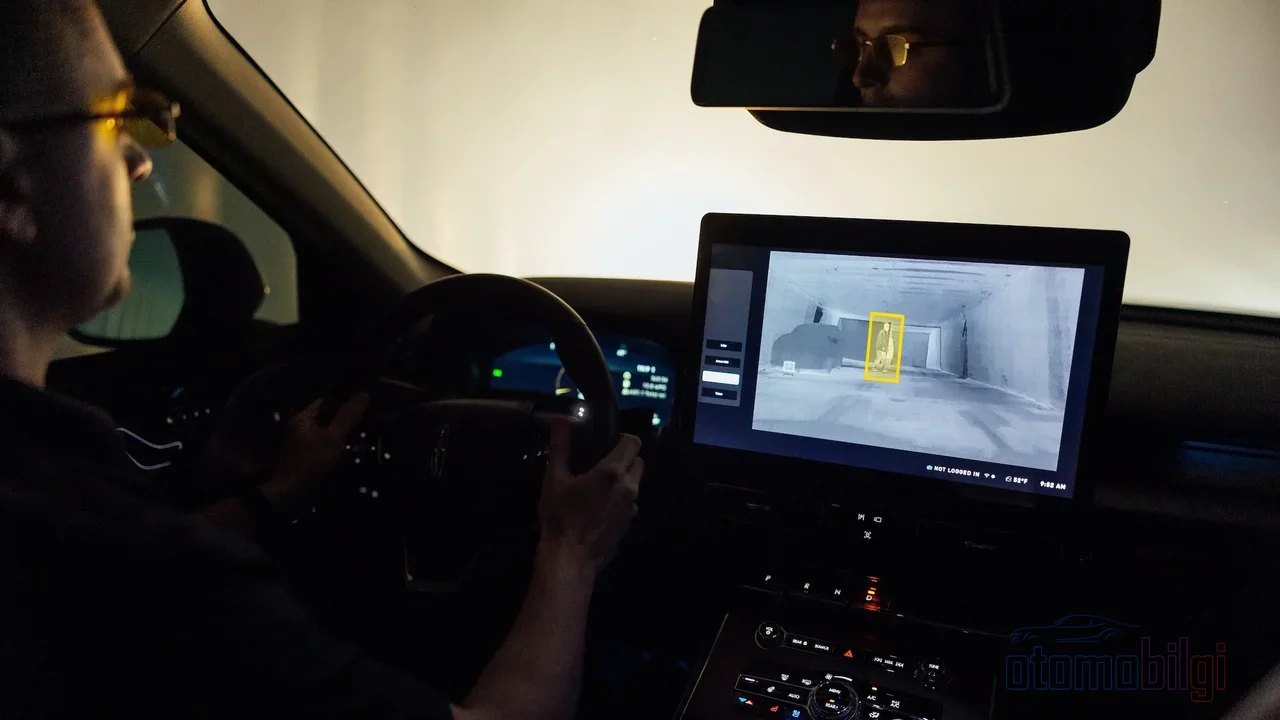
A night vision system is a thermal camera setup that, in the darkness beyond what the vehicle's headlights can see, detects the heat emitted by pedestrians, animals, and vehicles and displays it as an image on a screen. Working with long-wave infrared (LWIR) sensors, these systems produce images even in total darkness and are increasingly becoming a critical safety layer, especially in preventing nighttime pedestrian accidents.
Highlights
- LWIR thermal cameras operate in the 8–14 µm band and produce images even in total darkness. Mercedes-Benz illuminates the road with near-infrared, while BMW passively scans for heat.
- Gated active systems
- offer a range of 250 m and perform well in rain and snow.
- The thermal fusion AEB test vehicle passed all test conditions, including nighttime scenarios; three 2024 model AEB systems, however, failed in at least one nighttime scenario.
- Roughly three quarters of pedestrian deaths occur in darkness.
I will be honest: among automotive technologies, night vision still looks a bit like a superhero. In that dark void beyond the reach of your headlights, it "sees" the body heat of a pedestrian or a deer that has dashed into the middle of the road. So how does this happen? Heat is not light, after all... And that is exactly the point: a thermal camera reads heat, not light. Let's take a look at the engineering side.
How Does the Thermal Camera Work Inside the Vehicle?
Every object - you, me, a cow, that restless cat painting a car, the road itself - emits infrared radiation depending on its temperature. The thermal camera captures exactly this: not reflected visible light, but emitted heat differences. It converts this heat data into a visible image. So no flashlight is needed in the dark; the object itself is already "glowing". The idea is this: everything in the world, as long as its temperature can be measured, is an invisible map, and the thermal camera draws that map onto its screen.
On the automotive side, the star of the show is LWIR, or long-wave infrared. These sensors typically operate in the 8–14 µm band (some sources give a range of 7.5–12 µm), which corresponds exactly to the heat wavelength emitted by the human body. That is why it works in total darkness, is unaffected by glare from oncoming headlights, withstands sun glare, and keeps working in fog and smoke. There is also an MWIR (3–5 µm) band for very hot objects like a truck's exhaust or engine block, but this is hardly ever used in production vehicles.
The second path is active systems: those using near-infrared (NIR). These are not passive; they work "like a flashlight" - they illuminate the road with their own infrared light sources and read the light reflected from objects. NIR stays in the 0.75–1.4 µm band and requires an illuminator (projector). That is why it is more sensitive to brightness and has a more limited range. The classic "holding a flashlight in the dark" analogy works perfectly here: the more powerful the flashlight, the farther you see, but a bright oncoming light can blind you.
Gated Systems: A Weapon Against Rain and Snow
There is a special type of active NIR system: gated systems. Here, the light source does not burn continuously; it sends light in pulses, and the camera works in sync with these pulses. In other words, the camera opens the "gate" by waiting for the exact time it takes the light to travel to and return from a certain distance - it reads only the reflections within that range, ignoring early reflections from a raindrop or snowflake in front of it. The result: approximately 250 m of range and high performance in rain and snow. This mechanism reduces the backscatter problem that distorts the image in fog and rain.
BMW, Mercedes-Benz and Audi: Three Different Philosophies
Manufacturers' approaches to night vision differ considerably from one another. And this difference stems precisely from the NIR/LWIR distinction we described above. BMW uses a passive system: with far-infrared technology, it scans the heat on the road without illuminating anything. Mercedes-Benz does exactly the opposite: it uses projectors that illuminate the road with near-infrared, with a system featuring flashing and steerable headlamps. Audi, on the other hand, offers pedestrian and animal recognition with an FLIR-based thermal camera; the image is overlaid on the driver's display. In independent tests comparing these three, Audi's first place even surprised the testers.
These systems are generally found in the premium segment: BMW's Night Vision is available on the 7 Series, 5 Series, X5 and X6; Mercedes' Night View Assist on the S-Class and E-Class; and Audi's Night Vision Assistant on models such as the A6 and A7 . An interesting detail: Rolls-Royce's night vision components are the same as those in the Audi, BMW and Cadillac systems. Premium night vision systems are priced in the range of approximately $2,000-2,500 .
| Brand | System | Technology | Approach |
|---|---|---|---|
| BMW | Night Vision | Far infrared (LWIR) | Passive heat scanning, no illumination |
| Mercedes-Benz | Night View Assist | Near infrared (NIR) | Illuminating the road with projectors |
| Audi | Night Vision Assistant | FLIR-based thermal camera | Pedestrian/animal recognition, display overlay |
The Software Side: The Threshold of Pedestrian, Animal and Vehicle Detection
The camera produces a nice heat image, but the driver cannot be expected to interpret it instantly. The real work is done by software: it classifies the heat signatures in the thermal image, labeling them "this is a pedestrian," "this is an animal," "this is a vehicle." On the modern side, deep learning object detectors are in play; the outputs of uncooled microbolometer-based sensors can be processed with models like Fast R-CNN. One of the industry's biggest players offers software packages performing detection/trajectory tracking/sensor fusion, along with a free dataset consisting of more than 26,000 labeled thermal and visible-light images.
The detection threshold issue is an interesting balance problem: the more sensitive the software, the more things it flags as "threats," but then false alarms increase. Audi's system not detecting objects smaller than a deer is a result of this balance - smaller targets have weak heat signatures and are hard to detect at long range. The hardware side is also maturing: shutterless LWIR cameras resistant to automotive conditions (-40 °C to +85 °C) have been developed. And the final step, functional safety certification: ASIL-B level, 640×512 resolution, IP6K9K protected first LWIR ADAS camera was announced. This means the thermal camera is no longer a "luxury extra" but becoming an official link in the safety chain. The fact that thermal sensors have been supplied to more than a million vehicles in the past also shows the scale.
Does Thermal Imaging Really Improve Safety?
Short answer: yes, but you need to understand why. Darkness is the biggest enemy of pedestrian safety. Approximately 18% of walking deaths are pedestrians, and deaths occur mostly in darkness; roughly three-quarters of pedestrian fatalities happen at night. This is exactly where the thermal camera comes into play, because it can identify pedestrian and animal heat signatures in every light condition.
The numbers support this too. An automatic emergency braking (AEB) test vehicle with thermal fusion passed all day and night conditions of the new federal rule (FMVSS No. 127), including night scenarios; three 2024 model AEB systems tested in the same program failed in one or more night scenarios. In the same thermal fusion tests, the vehicle stopped before the Euro NCAP pedestrian target in all six scenarios, in every one of the 35 conditions in total. IIHS data is also striking: pedestrian AEB provides a 27% reduction in pedestrian accidents at all severity levels, and 30% in the dark category. But here's the problem - these systems can become ineffective in darkness. There is also positive study data showing that automatically activated night vision systems improve pedestrian safety.
The regulatory side is also moving in this direction: the federal rule finalized in 2024 mandates automatic emergency braking, including pedestrian AEB that works in daylight and darkness; estimated annual benefit is at least 360 lives. The rule faces legal challenges and the final timeline is uncertain, but the direction is clear: detection that works in darkness will increasingly become mandatory. The thermal camera is precisely the technology filling this gap.
The Limits: Where Does the Thermal Camera Struggle?
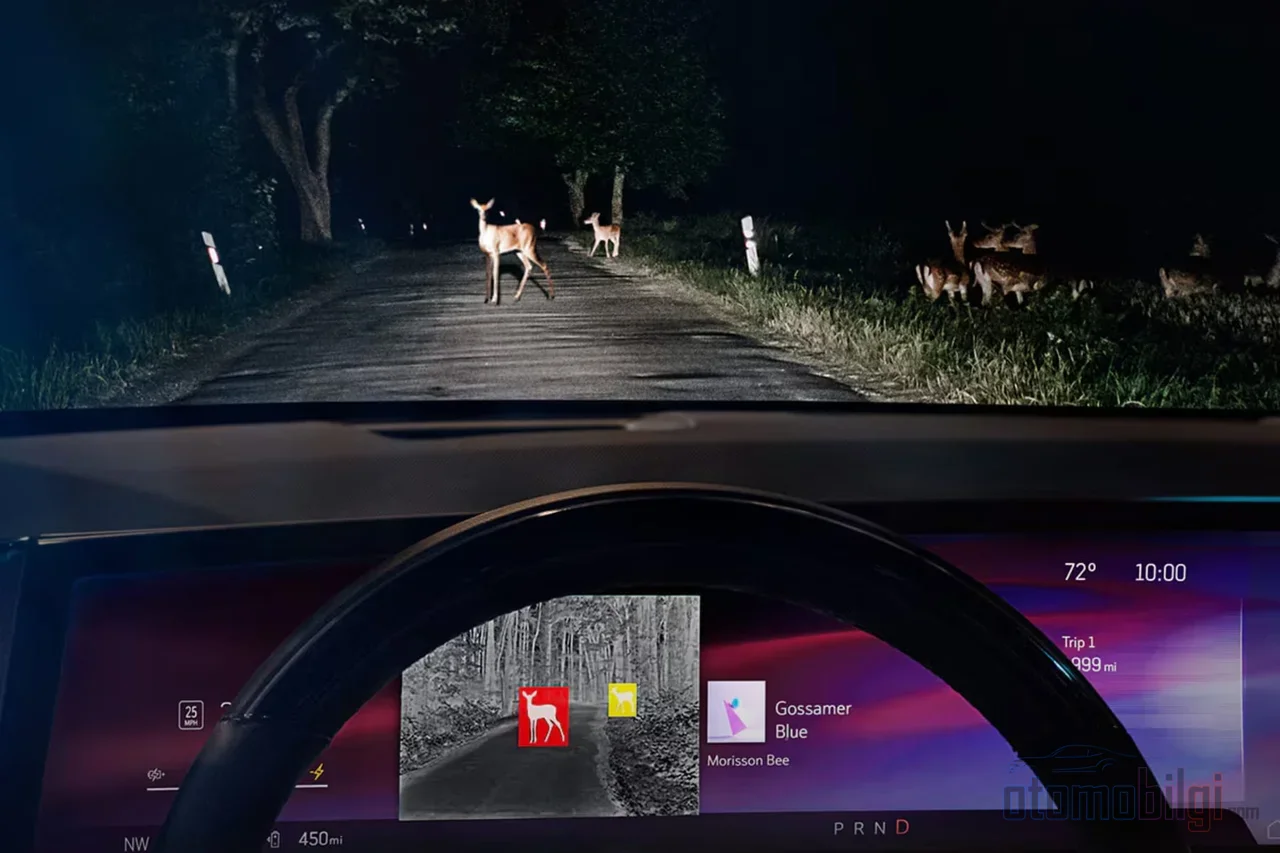
We shouldn't assume thermal imaging is "perfect in every condition." LWIR is strong in total darkness, strong against headlight glare, and moderately good in fog and smoke. But heavy rain, dense spray, and very high-radiance sources can degrade thermal imagery. It cannot see clearly through glass or reflective surfaces - which is why it looks not through the windshield, but usually through its own glass in the grille. Small or low-heat targets are hard to detect at long distances. And of course, cost is still high; real scale will come when this technology reaches economy models.
On the other hand, fog is not as big an obstacle as it's thought to be: in heavy fog conditions (visibility range 15±4 m), LWIR cameras have been reported to perform better in pedestrian detection than NIR and SWIR. The headlights of oncoming vehicles also do not affect LWIR cameras. LiDAR, however, can lose performance in rain, fog, and dust; radar is strong at night, but the thermal camera's real contribution is classification and detecting warm living beings - that is, when radar says "something is there," the thermal camera clarifies "it's a human."
The Future of Night Vision: Toward Autonomous Sensor Packages
Night vision first appeared in series-production cars with thermal sensors about 20 years ago. Since then, the technology has gone beyond driver displays; it now takes its place in the sensor packages of autonomous vehicles. One of the most recent examples: Zeekr, 9X partnered with a thermal imaging company to enhance night vision in the model (August 2025). The trends for 2026, meanwhile, focus on AI-powered analytics and multi-band thermal systems.
The market is also growing, but the figures from market research vary considerably; for the night vision system market, there are estimates for 2026 ranging from about $3.7-5 billion and it is expected to reach the $10 billion range by the early 2030s. The difference in such estimates depends on how the market is defined - it's not clear which systems count as "night vision." The infrared detector market presents a broader picture, valued at $6.34 billion in 2025 and projected to reach $10.50 billion by 2032.
Let's also answer a frequently asked question: does the thermal camera replace the other sensors in ADAS? No. It is a complementary layer to radar, lidar, and the visible-light camera - the conditions where each sensor is strong are different. And it's not just for autonomous vehicles either; in human-driven cars it strengthens pedestrian AEB, which is precisely the focus of near-term regulatory pressure. Do you think the next step is for the thermal camera to move out of the premium segment and become standard equipment in every car? In my view, that day is not far off.
Sources
- Automotive Thermal Cameras for Safer ADAS and AEB
- Thermal Imaging for Automotive & ADAS | LWIR Cameras
- How Thermal Night Vision Works?
- Automotive Night Vision and Thermal Sensing
- Night Vision Systems
- Night-Vision Systems Compared: BMW vs. Mercedes-Benz vs. Audi
- Go to the Dark Side with BMW Night Vision
- Automotive night vision
- Thermal Imaging Solutions Mitigate Risks to Pedestrian
- LWIR sensor parameters for deep learning object detectors
- Example of video records by LWIR
- Range gated active night vision system for automobiles
- Thermal Imaging for Safer Autonomous Vehicles
- Is More Better? Night Vision Enhancement System's Impact
- Pedestrian crash avoidance systems cut crashes - but not in the dark
- Comprehensive Guide to LWIR Imaging Systems
- The Incredible Infrared Science Behind Night Vision Displays
- Long Range 3D with Quadocular Thermal (LWIR) Camera
- What Automotive Thermal Cameras Add to ADAS
- Which Cars Have Used Thermal Cameras?
- 10 Vehicles with Night Vision
- Car Night Vision Systems Compared: BMW, Mercedes, Audi
- Automotive Night Vision System Market
- Automotive Night Vision System Market
- Global Automotive Night Vision Systems Market
- Infrared Detector Market Report 2026
- Why Zeekr's New 9X Partners with Raytron's Thermal Imaging
- Top Thermal Imaging Trends Shaping 2026 and Beyond
- Driving Technology: Improving our Night Vision