How Does the Adaptive Headlight System Illuminate the Road in Corners?
Share This Page
The adaptive front-lighting system (AFS) is a lighting system that reads steering angle and vehicle speed data to physically rotate the headlight modules on the horizontal axis. The goal is simple: to make the light beam point in the direction of the road's turn before the vehicle has fully entered the corner. In other words, while you are still turning the steering wheel, your headlights have already begun illuminating the inside of the curve.
Highlights
- Each headlight unit generally has two stepper motors one for horizontal rotation, one for vertical leveling.
- Curve-adaptive headlights make hard-to-see objects in dark corners visible about one-third of a second faster than standard headlights.
- Across seven manufacturers, curve-adaptive headlights reduced property damage claims by 5.8% and collision claims by 1.1% .
- The first vehicle with AFS was the 1948 Tucker which earned the nickname "Cyclops" because of its center third headlight that turned with the steering wheel; only 51 units could ever be produced.
Now let's dive into this system. Because from the outside you'd say "the headlights turn sideways, nice," but what's going on under the hood is far more fun: sensors, control units, stepper motors, calibration targets... Each one is worth explaining in detail.
How Does AFS Illuminate the Road in Corners?
The system's working logic progresses like a chain. First, the sensors collect data, then a control unit processes this data in real time, and finally the motor that physically rotates the headlight module comes into play. The headlights never turn "by guesswork"; behind every movement there is a calculated command.
Which sensors say what?
The basic inputs that feed the AFS are: the steering angle sensor, the vehicle speed sensor, and the wheel speeds. In some vehicles, yaw (deviation angle) and lateral acceleration sensors are added as well. From the steering angle, the system reads how much you have currently turned; from the speed, how sharp the turn is; and from the yaw and lateral acceleration, the actual path the vehicle is following on the road. You could actually think of it as listening to the same story three times from three different sources and checking for consistency among them.
The Brain: The Adaptive Headlight ECU
The unit that processes the incoming data is the adaptive headlight control unit (ECU). It processes the steering angle, wheel speed, and yaw data in real time and tells the stepper motors how much and in which direction to turn. In manufacturers' reference designs, the standard parts of this architecture are also clear: LED drivers, matrix managers, stepper motor drivers, and MCUs. So AFS is not just a "headlight feature" on its own; it is a small embedded system with its own processor and its own motor drivers.
There is also the suspension side of the job. AFS usually works together with the automatic leveling function: it maintains the light axis when the rear of the vehicle sags under load or when the body position changes on bumps and slopes. Otherwise, if you set off at night with a loaded trunk, your headlights would sweep the sky and blind oncoming drivers.
Stepper Motors: The Hands and Arms of the Headlights
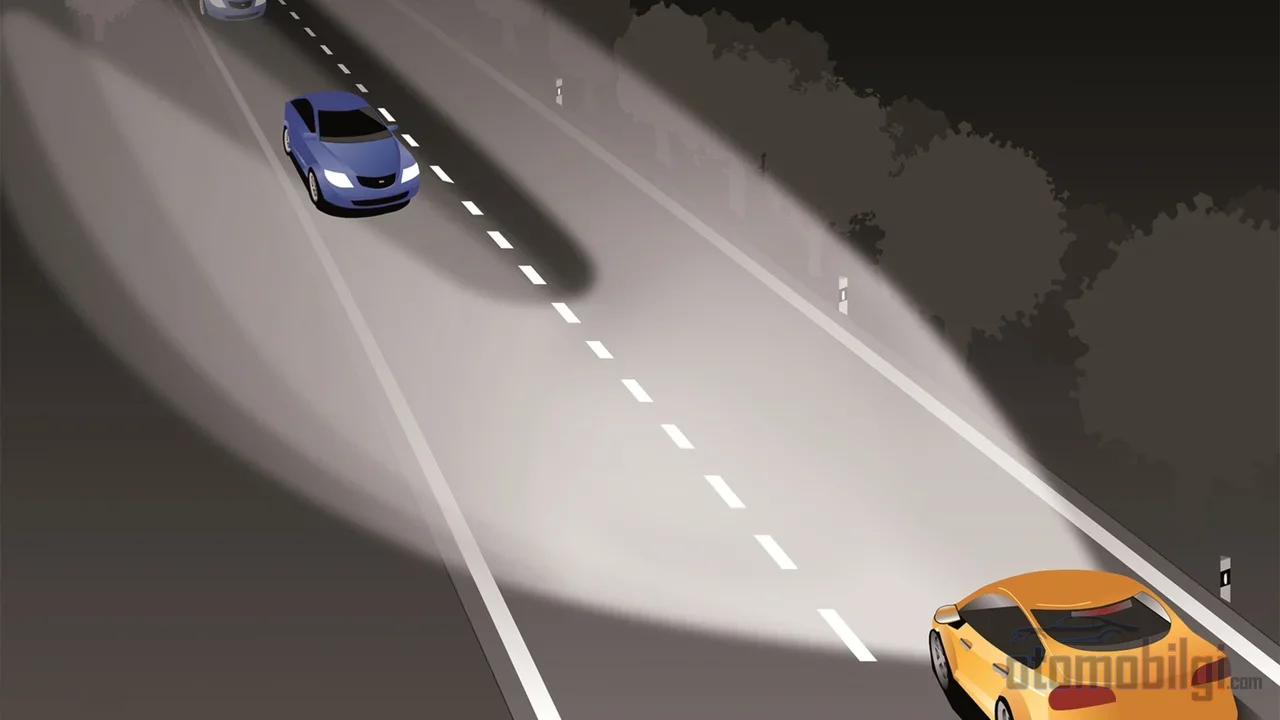
This is my favorite part. What turns the light inside the headlights is not a sci-fi magnetic field; it's plain, solid stepper motors, the kind that have been everywhere for years, from microwave ovens to printers. Each headlight unit typically has two: one in the horizontal plane, handling the swivel motion for curves, and one in the vertical plane, handling the leveling adjustment. A stepper motor's defining feature is that instead of spinning continuously, it moves in small, predetermined steps at precise angles. That's exactly what headlights need: the command "turn 3 degrees to the left, and stop there."
If you look at the reference designs published by semiconductor manufacturers, you can see this architecture clearly: driver circuits driving two stepper motors, one for dynamic headlight leveling and one for swivel. Modular solutions are the same; one motor drives the X axis, the other the Y axis. Mazda's official statement says the same: the stepper motors adjust the position of the LED lamps based on information from speed and steering sensors.
What if a failure occurs? In some systems this behavior is predefined: if the swivel function fails, the control module lowers the projector module down with the leveling actuators, meaning the headlight now points toward the road, on a safe axis. The control module also monitors the condition of the stepper motors and circuits and stores a diagnostic trouble code (DTC); when a diagnostic device is connected at the service shop, the problem is read from there.
Static and Dynamic Swiveling Headlights: Doing the Same Job Two Different Ways
Now we come to the distinction most often confused, because both are sold as "cornering lights" but their working principles are completely different. In a static cornering light, an additional light from a separate reflector or projector on the inside of the curve comes into play; the main headlights stay in place. In a dynamic cornering light, the main headlights are physically swiveled, and the beam moves along the road with the turn.
| Feature | Static cornering light | Dynamic (adaptive) cornering light |
|---|---|---|
| Working method | A separate auxiliary light comes into play | The main headlights physically swivel |
| Lighting character | Illuminates specific points | Continuously and dynamically adjusts the field of view |
| Typical activation | At low speeds and in reverse | While moving, at the start of a curve |
The practical difference is this: a fixed light point waits for you the moment you enter the curve; a swiveling beam illuminates your path along the curve together with you. In the Porsche example, the dynamic cornering light swivels the main headlights while the static cornering lights activate the auxiliary lights; in the PDLS Plus system, the dynamic main beam kicks in above about 40 mph (approximately 64 km/h). In some vehicles the speed threshold works in the opposite direction: the cornering lights, for example in US settings, come on when the steering is turned below 20 mph and in reverse. So corner illumination takes the lead in low-speed maneuvers, and the swiveling beam in fast curves.
Fog Lights and Wide-Angle Lighting: The Other Face of Cornering Light
Cornering lights are often designed as wide-angle, low-beam fog lamps, and when taking a corner, only the ones on the relevant side light up. The logic here is physics: a wide, low-angle beam helps you see the roadside, lane markings, and dangers hidden in the fog. The low angle's advantage in corners and obstacle detection is a bonus.
According to Polestar's owner's manual, cornering lights turn on automatically in low daylight or darkness to illuminate the area diagonally in front of the vehicle. So this is not just a nighttime feature; it can also kick in at dusk and in overcast weather. A small but important regulatory note: if the cornering lamp function is provided by the fog lamps, the light must be white. And pay attention to terminology: while the "cornering light" function illuminates the area in the direction of the turn at a wide angle, what some brands call "active light" is a separate thing - a system that physically swivels the headlamps themselves.
Calibration: Why Is a Service Visit Mandatory After a Headlamp Is Removed?
Here is the part nobody talks about but that determines everything. On a vehicle with AFS, headlamp calibration is required in most cases after replacing the sensors and modules that operate the headlamps; some vehicles demand calibration even after the headlamps have been removed. The procedures requiring calibration are not limited to these:
- Headlamp replacement
- Accident repair
- Windshield replacement (if the sensor is in the windshield)
- Some suspension and axle adjustment work
Calibration may require an identification device (scan tool), special targets, and suitable workshop conditions. If the headlamps lose their reference position, you need to enter the diagnostic software and make adjustments; some manufacturers' procedures are simple but disciplined: park the vehicle, open the hood, turn on the headlamps, adjust, and put everything back in place. Special headlamp aiming devices (beamsetters) are used to set the light distribution correctly.
If the calibration is faulty, the system works on paper but actually does the wrong thing: the headlamps do not follow the steering input correctly, visibility decreases, and it can cause glare for oncoming drivers. In other words, if the sensors are not precisely calibrated, the "adaptive" headlamp may be looking not at you but straight into the opposite lane.
Does It Really Contribute to Night Driving Safety?
Let's look at the numbers. Half of accidents occur at night, dusk, or dawn, during hours with less traffic. On dark corners, since the beam of standard headlamps sees objects late, the visibility advantage during these hours is of vital importance. As for curve-adaptive headlamps, they make hard-to-see objects on dark corners visible roughly one third of a second faster than standard headlamps. A third of a second may seem little to you, but at 60 km/h that means more than half a meter of road.
On the commercial side, the picture is also positive: across seven manufacturers, curve-adaptive headlamps reduced property damage liability claims by 5.8% and collision claims by 1.1% reduced by that rate. According to the NHTSA report on glare and driving performance, glare reduces the distance at which objects can be seen and lengthens the driver's reaction and recovery time; safety-based adaptive front lighting prototypes that reduce glare while maintaining visibility have also been evaluated. It is accepted that the visual performance improvements brought by adaptive cornering lighting can contribute to reducing nighttime accidents; it has even been shown that the IIHS evaluation program, which rewards headlamp designs that reduce single-vehicle nighttime crashes, has an encouraging effect in this direction.
Still, let's be honest: 5.8% is a modest figure. Some research notes that there are open questions about the effect of AFS on road safety that have yet to be fully clarified. In other words, the system works but it is not a miracle; a properly calibrated, guaranteed-to-function adaptive headlamp offers a tangible advantage in nighttime corners.
Terminology Confusion and What You Should Know
One of the most annoying things in the market is the same technology being called by ten different names. Under the umbrella term "adaptive headlights" lie brand-specific names such as adaptive front lighting system, cornering/swiveling/directional/articulated headlights, and curve-adaptive LED headlights. Porsche calls it "Dynamic Light System," Genesis calls it "Adaptive Cornering System." What's more, it can be confused with related but different systems like ADB and automatic high beam. So don't look at what the brochure says, look at what the system actually does: does the main headlamp physically swivel, or does only an additional auxiliary light come on? The answer to this question tells you whether you have static or dynamic.
And a fun historical note: the 1948 Tucker attempted the AFS idea very early with its central third headlamp controlled by the steering angle; because of this headlamp it earned the nickname "Cyclops," and the company was only able to produce 51 vehicles. More than 60 years later, modern stepper motor systems standardized this idea in series production. I hardly think the idea got old; when you turn the steering wheel and the road "looks back" at you, it is still a fascinating engineering detail.
In conclusion, AFS is more than a marketing flourish; it is a measurable safety chain consisting of sensors, a processor, and stepper motors. On your next night test drive, take another look at how the headlamp behaves before entering a corner; now you know what is behind the curtain.
Sources
- Adaptive Headlights 101 | What They Do & How They Work
- What Does AFS Mean?
- Stepper Motors Assist Adaptive Headlights
- Stepper-Motor Driver Reference Design for Adaptive Front Lights
- How to Build an Adaptive Front Lighting Solution in 3 Steps
- Adaptive Front Lighting System Explained
- Cornering Light – Enhanced Turning Visibility
- Adaptive Cornering Lights: Function and Advantages
- Front Fog Lamps / Cornering Lights – Polestar 2 Manual
- Adaptive Lighting Calibration After Headlamp Removal
- Bend Lighting: Function, Symptoms, Check
- Headlamp Adjustment – Instructions
- Nighttime Glare and Driving Performance – NHTSA
- Visual Performance and Safety Benefits of Adaptive Driving Beam Headlamps
- IIHS Headlight Ratings and Nighttime Crash Reductions
- Design and Implementation of an Adaptive Headlight System
- Impact of Adaptive Front-lighting Systems (AFS) on Road Safety