Why Are Women Drivers a Minority in Karting?
Share This Page
Women are a minority in karting because women make up only about 10% of the average participants on the tracks; in karting this figure peaks at 13%, while in the upper formulas it drops to 7%. Behind this lies not physical inadequacy, but high costs, unequal access to sponsorship, stereotypes, a lack of role models, and a structural system that condemns women to elimination at the critical points of the talent journey.
Highlights
- Karting, as the entry point to motorsport, accounts for 40% of women's participation.
- The last full-time female driver in F1 was Lella Lombardi, who raced in 1976.
- F1 Academy has opened up to young girls in karting with the Champions of the Future Academy Program.
- Ayşe Çebi became champion in the Senior category of the 2025 Türkiye Karting Championship.
- The 2026 FIA Karting Arrive and Drive World Cup is being promoted as the FIA Karting race with the highest number of female participants.
What Do the Numbers Actually Say?
Just think: if there are 30 people in a class, the number of female drivers is around 3 on average. That is exactly the overall picture of motorsport. 13% participation in karting may seem like a decent start; but as you climb the ladder, the number melts away. Dropping to 7% in junior formulas, it nearly falls to zero as you approach the top. Since 1950, only a very small number of female drivers have stepped into a Grand Prix weekend in Formula 1 history; and the last full-time name is still Lella Lombardi in 1976.
And there is another thing: this loss cannot be measured precisely. Because participation data for female drivers at the F4, F3, and F2 levels is not kept consistently, it is impossible to say for certain how many fall away at each rung of the ladder. In other words, the numbers may paint an even darker picture than we think. In the literature, this situation is called the leaky pipeline; talent trickles away drop by drop at the system's critical transition points.
Where Does the Critical Threshold Break on the Journey from Karting to F1?
The journey to becoming an F1 driver starts with karting for everyone; this is a fact known to every child spinning around the track in colorful racing suits. Karting develops all the skills needed for the climb, from braking technique to racecraft. Susie Wolff started her career exactly here, winning the Best Racing Driver award at the British Karting Championship at the age of 13. So talent reveals itself early, on the karting track.
But then what happens? This is exactly where the leaky pipeline kicks in. With every step from karting to national races, and from there to international formulas, costs rise exponentially, the number of seats shrinks, and the pressure to find sponsors grows. If a girl shines in karting, it does not mean her path is clear; she sees that the doors ahead of her narrow even further at the next step.
The Role of Money, Networks, and Prejudice: There Is No Free Victory
Motorsport is often presented as a fair race: the fastest one wins. In reality, things are far more complicated. Success is not down to talent alone; financial resources, a network built with the right people, access to the right information, and institutional recognition. Let me explain with a simple analogy: two students in the same class, one taking private lessons and the other not, will not have the same chance in an exam, right? The situation is the same in karting; the only difference is that the price of the lessons is much higher.
Female drivers start this equation with an extra handicap. Investors are more reluctant to provide funding to female drivers at an early stage; one of the reasons they cannot advance to the top levels is the difficulty of finding sponsors due to prejudice. Sponsorship plays a decisive role in visibility and career length; in other words, talent without money becomes invisible. The key barriers listed by More Than Equal point to the same picture: financial costs, limited track time, stereotypes, lack of role models, and the perception of motorsport culture as exclusionary.
Is Physics Not Enough of an Excuse? No, the Problem Is Perception
The inevitable line in these conversations is this: and there is even serious evidence against it. Jessica Hawkins, who conducted F1 testing at Aston Martin, refutes the claim that women physically cannot handle an F1 car with her own track experience, and predicts that a female F1 driver will be seen within the next few years. A major study also clearly shows that there is no physical reason why women cannot race in F1.
Moreover, there are highly competitive female drivers in karting today. In the FIA Karting European Championship, names like Luna Fluxá are challenging the standings amid the fierce competition among the boys. The physics argument is described as a myth; the real barriers are opportunities and preconceptions.
Culture and Psychology: The Hidden Cost of Being a Minority
Motor racing culture took shape during the industrial age, when technical mastery was identified with a masculine identity. It may sound like an old story, but that implicit stereotype is still at work: our ideal image of a driver is, by default, a male figure in our minds. The media does not help matters either; it often presents female drivers as novelties or exceptions, focusing on their looks rather than their performance. There are also studies on the socio-historical roots of sexist judgments in the media, specifically in the case of Türkiye; so this is not just a problem occurring in Europe.
There is also a sneaky mechanism called tokenism. When a female driver in the minority makes a mistake, that mistake is interpreted not as an individual error, but as proof of women's suitability for racing. Imagine: every missed gear shift being held to account on behalf of the entire gender. The lack of confidence formed under this pressure is read not as an individual flaw, but as a result produced by structural inequality.
F1 Academy, Girls on Track, and Women-Only Series: A Solution, or a Veil for Discrimination?
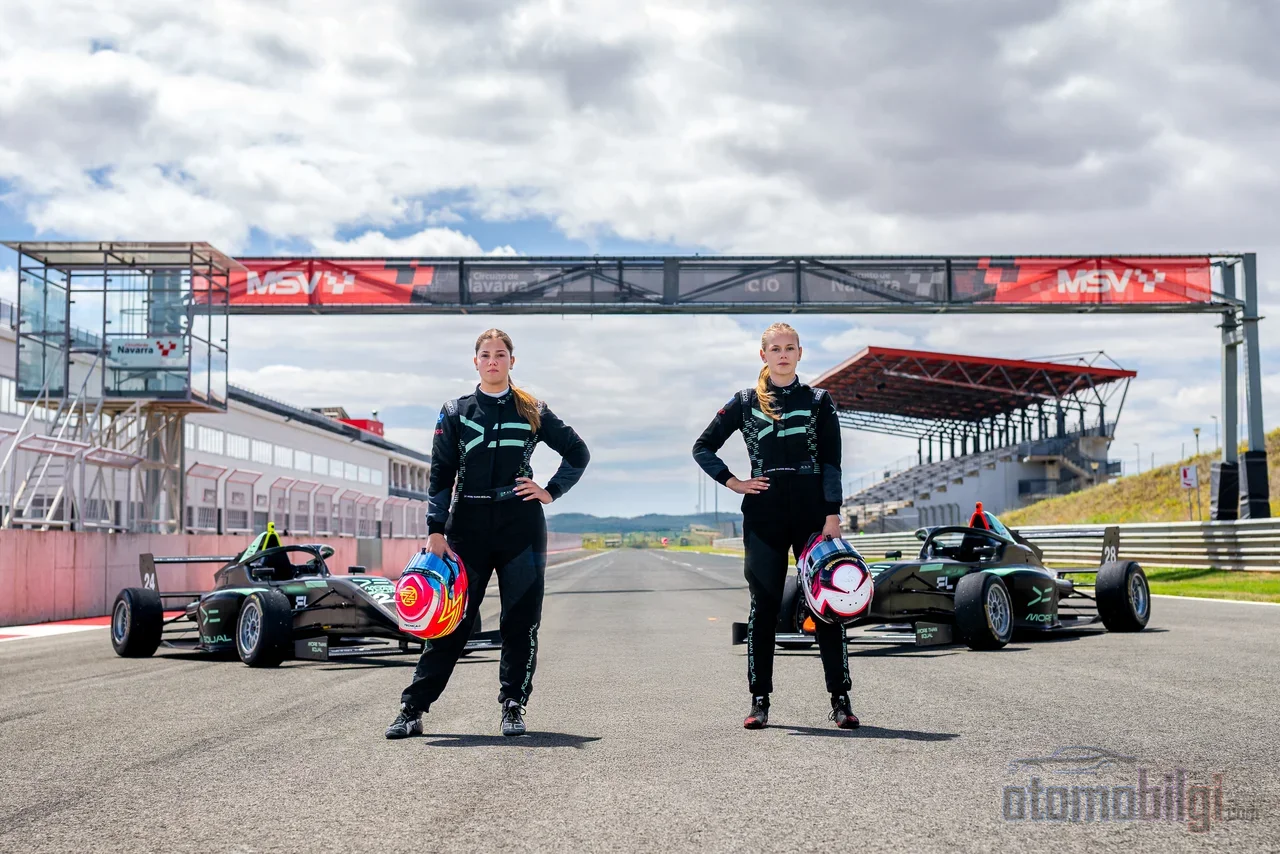
Established in 2023 by the Formula 1 Group, F1 Academy is a series for women competing at Formula 4 level, using identical Tatuus F4-T421 cars. It seems the series also extends to the karting side: it is noted to have increased women's participation in karting at the national level, and it partners with the global karting series Champions of the Future Academy Program, which targets young female participation. W Series no longer races; While women-only series open doors, they risk reinforcing the prejudice that women belong in a separate category.
There is ongoing activity on the FIA side as well. With its 2026 calendar, the FIA Girls on Track program offers a broad range of topics such as inspiration, career paths, and a mentoring summit. The program is based on a karting challenge model established in 2018-2019 with nine partners, and its 6th Rising Stars stage features a three-day training camp in Italy, with applications open. Events in Tashkent combining karting, workshops, and mentoring are also an extension of this model. In addition, there are Girls Karting Academy programs in the United Kingdom for girls aged 8-12; in one initiative, more than 400 girls have joined the Girls Karting program for the 8-15 age group. And the 2026 FIA Karting Arrive and Drive World Cup is being promoted as the event with the most female participants in an FIA Karting race.
But the other side of the coin is also being debated. While women-specific series open doors, they risk reinforcing the prejudice that women belong in a separate category. The essence of the criticism is this: most of these initiatives stop at symbolic inclusion rather than structural change. In other words, they both open the door and remind everyone why the door belonged to men. Do you think this is good or bad, compared to keeping the door closed? I think it's both; but the long-term solution should be for women to enter the main series through natural progression, not special series.
What Is the Situation in Türkiye? Women's Power on the Track
Women have a presence in Türkiye's karting scene. Ayşe Çebi, as a Borusan Otomotiv Motorsport driver, reached the championship in the Senior category of the Motul 2025 Türkiye Karting Championship; in other words, a woman stands at the top in the highest category. Young driver Zeynep Çukurova is also continuing her journey as one of the supported young female karting drivers.
The 2026 Türkiye Karting Championship also paints a promising picture. At the season opening, 59 drivers competed in 4 categories; the calendar, with its first round held on April 11-12 at the Bursa BŞB Karting Track and its second round on May 16-17 at the TOSFED Körfez Race Track, features open women's categories. Nilhan Yeşiltay stands out in Micro women, Ela Yeşiltay in Mini women, and Elif Yağmur Yeşiltay in Junior women. The visibility of female drivers even in the youngest age categories shows that the pipeline is not breaking at the very bottom; the real issue is keeping them in the upper levels.
The historical roots should not be forgotten either: Sâmiye Cahid Morkaya is remembered as the first woman driver to obtain a license from the Pangaltı American Garage. Seda Kaçan became the first female driver to win a race in Turkish circuit racing; and Sena Savaşer is known as Türkiye's first female Formula driver, and she debates the question of why everyone starts with karting. So the story of women on the tracks is not new; it was just a story that went unseen.
So What Should Be Done? The Road to Breaking This Imbalance
- Early-age access: Karting is the entry gate, with 40% female participation; girls should be systematically brought in through this gate.
- Financial support and mentorship: Equal access to sponsorship, academy programs, and mentorship from experienced names make it easier to hold on to the higher rungs of the ladder.
- Data transparency: As long as female participation data at the F4–F2 levels is not consistently reported, it is hard to know where the loss occurs.
- Narrative change: The media needs to show female drivers as normal, not exceptional; and focus on performance.
The picture I read is this: girls are already on karting tracks, and they are fast. What is missing is not talent, but the system that carries them upward. The next female F1 driver is on a karting track right now, perhaps gripping the wheel somewhere in Türkiye. Our task is to make sure that child stays on the track.
Sources
- Underrepresentation of Female Drivers in Elite Single-Seater Motorsport: A Narrative Review
- Inside Track: Exploring the Gender Gap in Motorsport - More Than Equal
- Outlining Motorsport's Gender Gap
- Prejudice preventing female growth in motorsport, study finds
- No reason why women can't compete in F1, says major study
- F1 ACADEMY - The Official Home of F1 ACADEMY
- F1 Academy expands into karting with new global series
- FIA Girls on Track 2026 Calendar
- Champions of the Future Academy Program
- Motorsport UK Girls Karting Academy
- FIA Karting - Arrive and Drive World Cup
- Sexism in Automobile Culture and Female Drivers in Türkiye
- Pistlerde Kadın Gücü - TurkMotorspor
- TURKRENT Supports Young Karting Driver Zeynep Çukurova
- 2026 MOTUL Türkiye Karting Championship - TOSFED
- Jessica Hawkins: We will see a female driver in Formula 1
- Get Involved in Formula 1 - Formula1.com
- Susie Wolff - London Speaker Bureau
- Driving Diversity: An Analysis of Sponsorship and Career Trends for Women in Motorsport