Why Did Mercedes Revert Russell to an Old Specification in Singapore?
Share This Page
Mercedes reverted George Russell's W17 car to the old specification in which he won in Azerbaijan, instead of the new floor and bodywork package introduced in Malaysia. The decision is not, on its own, an admission of failure; it is a calculated choice by a team seeking the most efficient way to test the old and new packages side by side in real race conditions under cost cap constraints. Russell himself proposed this strategy, finishing the race he started from the very back of the grid in 9th place; Kimi Antonelli, running the new package, made it onto the podium.
Highlights
- Mercedes ran two W17s with different aerodynamic packages in Singapore: Antonelli on the new one, Russell on the old specification.
- Russell 60 place grid penalty meant he started from the very back of the grid and finished 9th at Marina Bay.
- The new package measured more downforce at Sepang; the problem was the inconsistent distribution of that downforce.
- The new front wing was tried in only a single free practice session in FP1; it is planned to be used on both cars in Austin.
Why Didn't the Sepang Package Deliver What Was Expected?
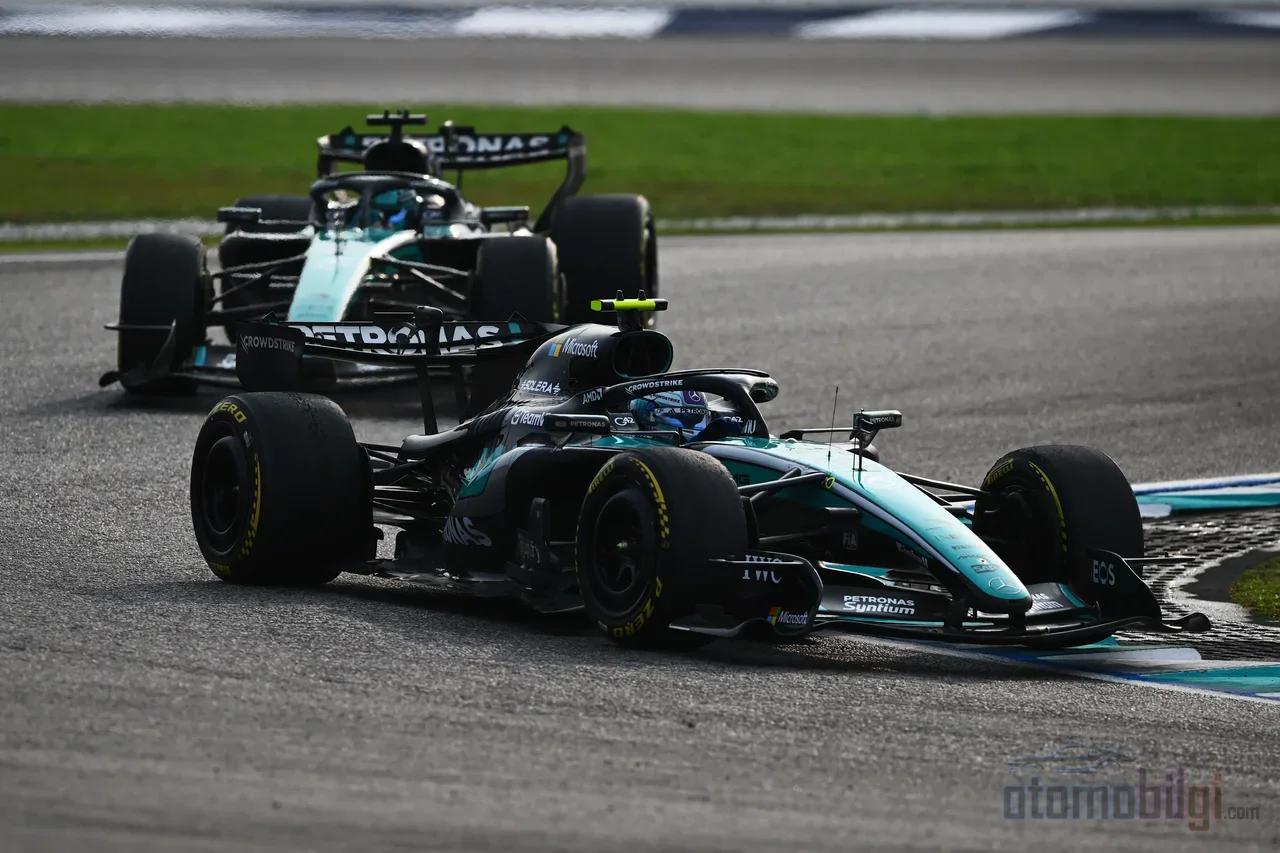
Mercedes introduced the new floor and bodywork package at the Sepang circuit in Malaysia, and the team's expectation was a clear performance gain. Wind tunnel and simulator data supported this; the package did indeed produce more downforce. However, the feedback from the track showed that the predictions did not match reality exactly. The team's deputy technical director Simone Resta explained that the downforce increase was not transmitted consistently to every region of the car, which upset the balance and produced a stronger front end than expected. In other words, the car was generating more load, but it could not distribute that load in a way the driver could use.
It is also worth noting that this is a fixable problem. According to Resta, the car's operating window needed to be re-centred; that is, the package cannot be written off as junk, it just needs to be put into the right window. Antonelli is also known to have made a similar observation: track temperatures exceeding 60°C and the rough asphalt make Sepang an exception unlike any of the circuits remaining later in the calendar. The findings gathered in these conditions are difficult to transfer directly to other circuits; the team acknowledged from the start that the data there fell outside the scale due to the track's asphalt texture, variable conditions and excessive tyre wear.
Why Does the Cost Cap Make the Split Specification Mandatory?
The point team deputy principal Bradley Lord emphasized was this: the cost cap was one reason the back-to-back test was done in Singapore. Operating under the cap is a constraint that always exists for every team, and producing a new component is far more expensive than keeping the old part waiting in the depot. In this environment, running the old and new packages side by side is both the fastest way to learn through real-world experience and the most efficient one. When the two cars run in different specifications, the team gets direct comparison data on the same track, in the same weather conditions; this is the kind of data the wind tunnel or the simulator cannot provide.
In the past, before the cost cap, such a decision would have looked only at the engineering calculation: you would produce as many parts as you wanted and fit whichever you liked. Now every carbon fiber component is a budget item, and in the face of the inconsistent behavior seen in Sepang, putting the old-configuration component set back into service is a far more meaningful test strategy than a single-car revert. Russell taking on this trial with a single car allowed the team to keep costs under control while collecting both data sets at once.
Why Did Russell Volunteer to Return to the Old Package?
One of the most interesting details here is that the idea of the back-to-back test came from Russell himself. For the driver who proposed using Singapore for this purpose before the Sepang race, what made the decision easier was the engine failure and the associated power unit penalty: a double power unit change, a 60-place grid penalty, and starting from the very back of the grid. For a driver starting from the very back at a track like Marina Bay, which is hard to pass on but prone to overtaking, the race outcome was already largely uncertain; that made the trial an unhesitating choice.
Russell also stated clearly that he saw no sign that the new package was not working. His argument is numerical: with the same car they took pole position in Azerbaijan by 0.8 seconds, but in Budapest they were 0.4 seconds behind; compared with their rivals, the fluctuation can reach up to 1 second. Looking at this picture, it is easy to conclude that the problem was specific to Malaysia. Adding that Red Bull's form in Sepang was above their performance, while the pace against McLaren and Ferrari remained similar, supports this reading. Resta appreciated the driver's volunteering for the test; in his words, Russell is always a great team player.
There is one fact Toto Wolff admits: the upgraded package produces a car that is a bit harder to drive. This admission, while defending the split-spec strategy, also suggests that what happened in Sepang was not entirely track-related. The team separates two matters: the package generating downforce is one issue, and turning that downforce into a drivable balance is another.
The Crash, the Used Parts, and the Real Story of P9
Russell's weekend did not go as planned. He crashed while leading Saturday's sprint race and the car was seriously damaged; the front wing, floor, front suspension and the entire rear section of the car were replaced. This is where the real problem began: the team had exhausted its new carbon fiber stock, so Russell had to run the Sunday race with used parts. Although the parts were of the same aerodynamic specification, the worn components naturally delivered less performance, and during qualifying low-fuel runs the tempo needed for a pole fight simply never came.
This situation led some fans to consider the possibility of deliberate sabotage: were used parts fitted to Russell to favor Antonelli? It is clear that this claim is baseless, because the parts fitted were not new, just worn examples of the same specification, and the stock shortage was a mechanical necessity. Under these conditions Russell finished the race in 9th place from the very back of the grid, and Wolff described the result as a successful damage limitation effort. For a weekend starting from zero, this is not a dry outcome.
One-Off Front Wing and the Austin Plan
Mercedes also introduced a new front wing in Singapore, but its story was different. Only a single example of the wing had been produced, and the team, accepting the risk of damage and the risk of starting from the pitlane, did not use it in qualifying, the sprint or the race. Antonelli tried the wing only in FP1 and immediately reverted to the old version. The aim was not race performance but data collection, and the team believes the single practice-session tryout was valuable.
The product of this data will be seen in Austin. Mercedes confirmed that the upgrade package introduced in Sepang will be used on both W17s at the United States Grand Prix, and it hopes the new front wing will make a better start together with the updated configuration. The development also has an eye beyond: the package is 2027 part of the work targeting the W18 season. In other words, the troubled weekend in Sepang should be read not as the cost of a single race but of a long-term development program.
Did the Results Validate the Strategy?
The picture is clear when you look at the numbers. Antonelli finished 2nd in Sepang with the new package and stepped onto the podium at Marina Bay, leaving him one step away from his first F1 championship; after Max Verstappen won Singapore, a chance emerged to seal the title in the race in Texas. Russell, meanwhile, managed to finish 9th from the last row of the grid. Of course, these results are not proof on their own: Antonelli's podium does not show the package improved, and Russell's P9 does not prove the old specification was superior. But that was the point of the strategy anyway; two data sets were collected, the reading that the problem was specific to Malaysia gained strength, and the team is heading to Austin with a clear direction. It is easy to tell a story of a failed upgrade; what actually happened was the effort of a Formula 1 team in the cost cap era to save both today and tomorrow by smartly allocating its resources. For someone who has followed these circles for thirty years, the thing that needs to be said is simple: the heroism of this business is usually seen not on the podium, but on the data screens in the garage.
Sources
- Why Mercedes switched George Russell to its old F1 car spec in Singapore
- Why splitting car specs is a 'no-brainer' for Mercedes
- George Russell forced to race with used Mercedes parts
- Why Kimi Antonelli can't revert to previous Mercedes spec in Singapore
- Antonelli one win from title after Verstappen wins Singapore F1 GP
- Facing double PU penalty, Russell will run old-spec Mercedes in Singapore
- Wolff concedes upgraded Mercedes is 'a little more tricky to drive' as he backs split-spec strategy