Why McLaren's Handling Problem Won't Be Solved Until 2027
Share This Page
McLaren's handling problem stems from the floor and aerodynamic architecture that forms the car's fundamental character; which is why it can only be solved not with part changes, but with a radical redesign. As team principal Andrea Stella also acknowledged, this change will be possible at the earliest in 2027, with the new regulations coming in the MCL41 . The team, which won two championships in 2025, has been dragged into a battle for third place in the season with Red Bull, due to the combination of the narrow operating window brought by the new car concept, reliability issues, and the customer team disadvantage.
Highlights
- Stella explained that the handling character cannot be improved without a radical change; and that this will be possible at the earliest with the MCL41 in 2027 .
- Of the first 12 Grands Prix in 5 the McLaren car failed to finish; two of them it could not even start the race in China.
- While the 2026 wheelbase shortens by 200 mm, the floor narrows by 100 mm; minimum weight dropped from 798 kg to 768 kg.
- In Singapore, Norris explained that the car was on a knife's edge in every corner and that a balanced lap was not possible.
- The FIA agreed on engine revisions to address the loss of straight-line speed for 2027; a nominal 50 kW increase in ICE power is anticipated.
What was the problem that emerged in Singapore?
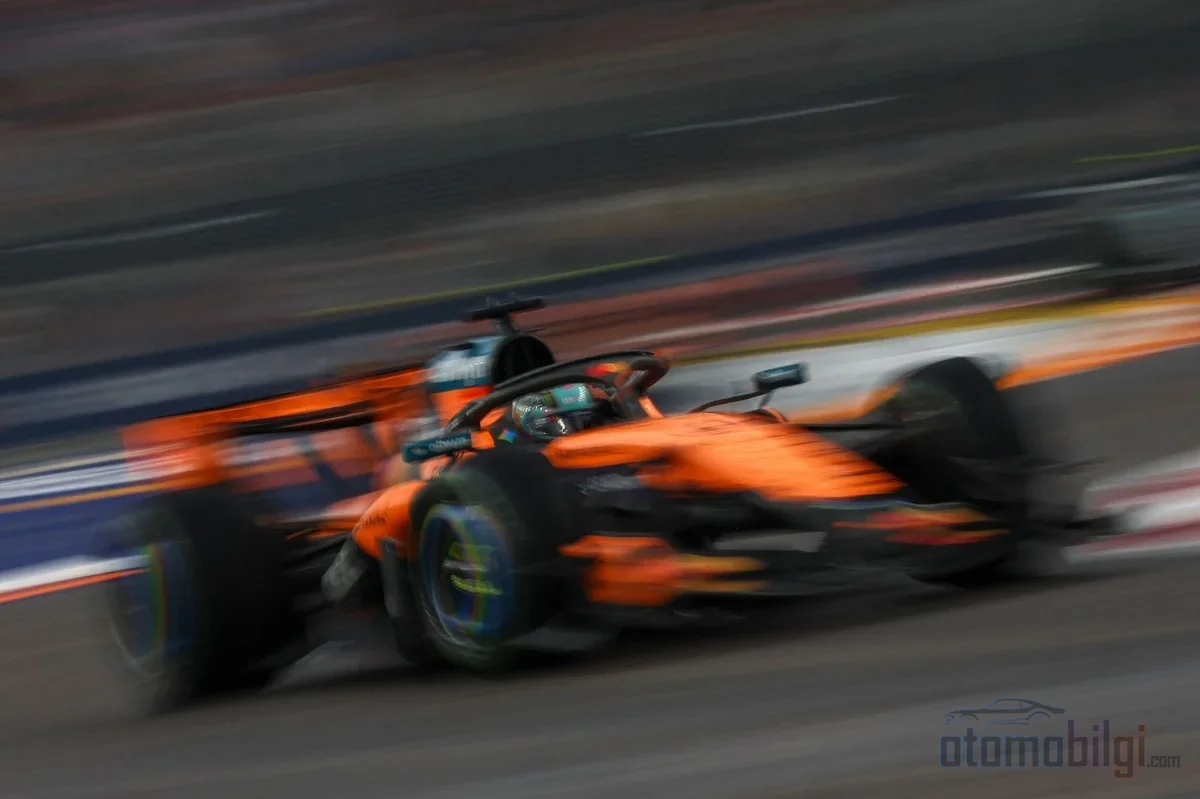
The Singapore Grand Prix weekend made the problem McLaren has lived with all season externally visible. Lando Norris said it was impossible to put together clean laps in qualifying, that the car did nothing on its own, and that the driver had to force the car in every corner. There is no such thing as balance anymore; you are either on top of the curb or in the hole. Sprint qualifying painted a similar picture, and the team admitted it could only decipher the pattern in the car's behavior as the race weekend progressed.
Stella's framing is more technical: throughout the season, the car demands a much higher steering input intensity compared to last year. In other words, to approach the limit of the tire, the driver needs to make constant and precise corrections. Since this character directly clashed with Oscar Piastri's clean and repeatable driving signature, the Australian is hit harder compared to Norris. The two drivers' natural styles are different; the car imposes the same narrow window on both.
Moreover, the problem is not only in corners. In Baku, Norris experienced a small straight-line speed deficit compared to Piastri, and the team did not hide its puzzlement at being unable to find the source. Before Singapore, Norris said he was not sure the problem causing this straight-line speed loss could be solved. When you can understand neither the cornering performance nor the straight-line speed deficit at its source in a Formula 1 car, there is a strong sign that the problem is not superficial but structural.
The technical reason they had to wait until winter
Stella's assessment is clear: adding downforce to the current car does not solve the problem, because what is missing is not the amount of downforce, but its distribution and character. Those who have been through this know the situation well; a poorly balanced car carries the added load in the wrong place too. The floor and aerodynamic platform determine the car's entire development path. Once this platform is established, the wing and surface updates introduced during the year can only bring improvement within the limits of that platform.
The 2026 regulations changed the foundation of this platform: the wheelbase was shortened by 200 mm, the floor narrowed by 100 mm, and long floor channels were abandoned in favor of flatter floors with wider diffuser openings. The lost downforce is being compensated with active aerodynamics and a more powerful hybrid system. McLaren's choices under this new geometry have trapped the car in an extremely narrow performance window, and the car shows sensitivity to tire temperatures. Decisions of this kind regarding the floor cannot be changed mid-season; fitting a new wing alone to a car struggling with tire degradation simply replaces one imbalance with another.
Reliability and the customer team disadvantage
Another factor that remains in the shadow of the handling problem but opens up the championship gap is reliability. The McLaren car failed to finish in five of the first 12 Grands Prix; in two of those, the race could not even be started in China. The team used two of the four winter testing ban exemptions it was entitled to early in the season: for extensive work such as the wiring loom and energy store main cover package after Norris's breakdown issues in Monaco, and then the exemption was used for a second consecutive time in Barcelona. This picture indicates that the problem lies not in isolated failures, but in the overall integration of the new power unit and chassis.
Another point Stella raised is that the team has dropped into a customer team position for the first time in this new regulation cycle. Stella emphasized that they were unable to take advantage of integration and timeline opportunities compared to rivals that build their own engines, and said they had never previously felt that being a customer team held them back. Looking at it from a thirty-year perspective, this is understandable; the first year of new regulations is not a year in which every team shares the same fortune. The working schedule with the engine manufacturer directly determines the rhythm of chassis development.
What can McLaren do in the remaining races?
The team appears to have three options, but in reality there is only one sensible path:
- Continue developing the current platform: McLaren announced that it will not close development of the 2026 car in August; it justified its weak start by the fact that Red Bull has to defend its championship pressure.
- Focus on closing the gap for the remaining races: the team stated that it aims to overtake Ferrari and Red Bull and plans to bring new development parts.
- Shifting resources to 2027: According to Stella's assessment, since a real solution is only possible with a fundamental change, the gains on the current car will naturally remain limited.
By mid-season, after 14 races, Norris sat on 186 points and Piastri on 120, a modest picture; the team had slipped from its dominant 2025 position into a fight with Red Bull for third. The Norris-Piastri contact on lap 20 in Singapore not only caused material damage to Piastri's gearbox but, with the team's internal relationship rules coming back into question, its cost went beyond the technical. The stewards issued no penalty; Norris said both drivers could have been more careful, Stella avoided assigning blame, and the team simplified its driver rules for 2026.
Why is 2027 a real reset opportunity?
The 2027 regulations address both of the issues McLaren has been unable to solve at once. On the car side, the FIA has agreed on aerodynamic revisions aimed at keeping downforce levels under control; on the engine side, the controversial 2026 rules are being reviewed, a nominal 50 kW increase in ICE power is envisaged to address the loss of straight-line speed, and a V8 return is being discussed with a correction of the 60/40 balance. In other words, MCL41, will be designed not to soften the character of the current car, but to be built on a different foundation.
At the same time, there is a warning implicit in Stella's remarks: the time granted to teams for the rule transition being measured only in weeks renders development programs inefficient and could push the real benefit to 2028. 2027 is a reset, but not an automatic reward. In the past, regulation changes used to give midfield teams a fresh start at the same time as championship contenders; now, the chaos of the first year favors not the team that reads the rules fastest, but the one that completes its integration earliest. The risk of the customer team disadvantage coming into play here again is the reason McLaren keeps its 2027 expectations moderate.
In short: the problem is not the part, it's the platform
McLaren's 2026 struggle is not the story of a single faulty part or a missing upgrade. The car concept built on a shortened wheelbase and narrowed floor produced a car that demands high driving intensity and operates in a narrow window; this character clashed with Piastri's style, left Norris struggling with a straight-line speed deficit, and combined with reliability problems pushed the team out of the championship fight. Stella's diagnosis is honest: adding downforce is not enough, a fundamental change is required. That change is only possible at the reset point brought by the new regulations, with the MCL41 in 2027. In the remaining races, McLaren's job is to extract the best from the current car and minimize the loss; the real reckoning will come after the winter in which the new platform is built.
Sources
- Why McLaren cannot fix its F1 car handling until 2027
- First hint at the root of McLaren's reliability problems
- Lando Norris uncertain McLaren can fix painful straight-line speed issue
- What's so serious for McLaren about the Norris-Piastri Singapore collision
- Explaining F1's new 2026 regulations
- Everything you need to know about the new F1 rules for 2026
- F1 to make changes to controversial engine rules for 2027
- F1's 2027 under-the-radar car changes explained
- Why McLaren won't turn off its 2026 F1 car development
- McLaren puzzled by persistent Norris-only F1 car problem
- Lando Norris vs Oscar Piastri rules to be streamlined