How Did the Japanese Car Conquer America?
Share This Page
Japanese automobiles entered the US market in 1958 as if it were a single factory defect; within twenty years, they dominated the market with small, fuel-efficient, and reliable cars that Detroit had long underestimated. Toyota's failed first step, Honda's entry through the back door, the watershed effect of the 1973 oil crisis, and the export quotas of the 1980s are the four critical stations of this conquest.
Highlights
- Toyota, 1958 sold only 288 cars in the US: 287 Toyopet Crown and 1 Land Cruiser.
- 1973 oil crisis turned small and fuel-sipping cars into mainstream demand.
- 1980 Japan produced 7 million automobiles and for the first time in history surpassed the US (6.4 million).
- 1981 voluntary export quota was limited to 1.68 million units per year, pushing Japanese brands into the luxury segment.
- The Toyota Production System (TPS) became the fundamental pioneer of the lean manufacturing philosophy.
An Industry Starting from Zero: Post-War Japan
In 1924, while the US produced 3.1 million cars per year, the number of registered passenger cars in Japan was below 18,000. In the same country, 105,000 rickshaws, 3.7 million bicycles, and 374,000 ox or horse carts were making the rounds. Before the war, the market was dominated by cars assembled from kits imported by US and British companies; Ford-Japan alone sold 18,000 cars in 1937 - a figure higher than the combined total of all Japanese manufacturers. In the island campaigns, the Japanese army had only 3,000 trucks; US forces had 100,000.
The war razed most Japanese factories to the ground. In 1949, the year production restrictions were lifted, the country could produce 1,070 passenger cars and 26,727 three-wheeled vehicles. Moreover, the advice coming from the postwar front was far from encouraging: one cabinet member suggested Japan should stop producing cars and import them from the US, while Bank of Japan economists argued that energy should be directed to the railways. In the early 1950s, even Soichiro Honda, who was then producing motorized bicycles, voiced similar doubt. Against this picture, the savior came from an unexpected place: the Korean War turned Japan into the economic supply depot for UN forces. Production reached 1,594 cars in 1950 and 20,220 in 1955; in 1958, annual passenger car production exceeded 50,000 for the first time.
The 1958 Toyopet Crown: Toyota's Only Certain Failure in America
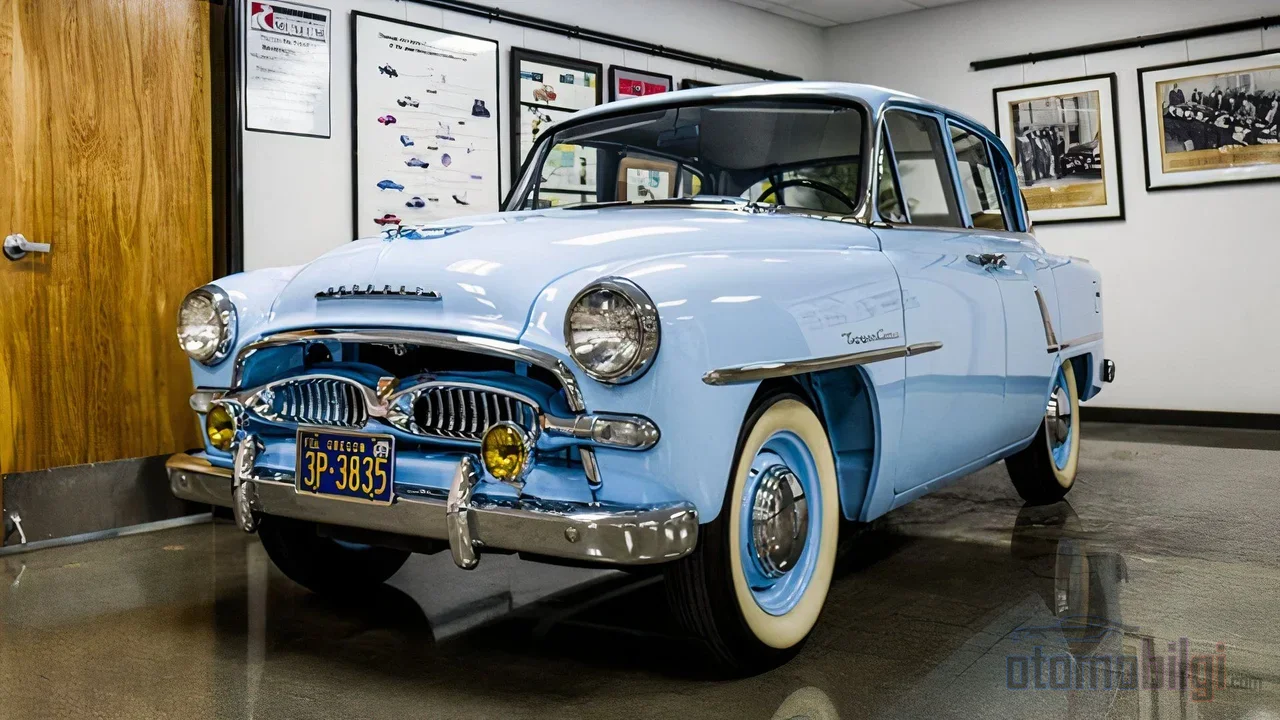
Toyota, following preliminary attempts in 1957, sent the Toyopet Crown to the US, while Nissan sent the Datsun Cedric. The reception was anything but warm. Toyota established its US distribution company in February 1958, but the results were brutal: in 1958, a total of 288 vehicles were sold - 287 Crowns and a single Land Cruiser. The following year, sales tripled to 821, while in 1961 the total remained at 576. Nissan's figures were similar: 1,131 sedans and 179 trucks in 1959, and 1,294 sedans and 346 trucks in 1960. The majority of sales were made on the West Coast, often to Japanese-American customers.
The Crown's problem was a clearly measurable engineering mismatch: the car's engine could not meet the performance expectations of America's fast highways, and its body was small by American standards. With sales below 2,000 in 1961, the Crown withdrew from the US market and went down in Toyota's history as its one definite American failure. In early 1960, Toyota abandoned the "Toyopet" brand entirely and set out to develop a car designed according to the needs of the US market.
From a Protected Market to Rise: MITI, Consolidation, and Honda's Back Door
The domestic market, unlike the export attempt, was growing rapidly. The number of privately owned vehicles in Japan exceeded 10 million in 1967, up from 6.3 million in 1965. The industry ministry MITI was pursuing consolidation: in the mid-1960s, on the grounds that there were too many car companies, it encouraged mergers toward a "third major" that would join Toyota and Nissan. Toyo Kogyo and Mitsubishi blocked this proposal; ultimately Nissan acquired the struggling Prince, Toyota acquired Hino, and in 1967 Toyota announced it would take roughly a 10% stake in Daihatsu. That same year, Toyota and Nissan's domestic market share had reached 60%. The Japanese parliament (Diet) also banned new entrants to the industry.
This ban opened the industry's most creative side door. Soichiro Honda overcame the barrier by seeking approval for a low-priced sports car (the S500) without asking for a license to produce sedans or trucks, and Honda entered the industry "through the back door." Meanwhile, Nissan was deliberately using a brand identity for the US: the name "Datsun," intended to erase its wartime past, was used in place of Nissan in the US. Between 1968 and 1970, the first car designed for the US market, the Datsun 510 sedan, the 240Z sports car, and a new generation of compact pickup were introduced; the 240Z was Nissan's first reliable volume sports car. Between 1970 and 1973, the Datsun 1200 was the brand's best-selling car in the US.
The 1970s: Rise Before the Crisis, Boom After It
The years when Japanese sales gained momentum began before the oil crisis. In 1969, Toyota and Nissan together sold 260,000 cars in the US; by 1971 this figure rose to 704,000 and in 1973 it reached 625,000. Even so, in those years German cars - led by the VW Beetle - were keeping the Japanese behind. The shift toward small cars had begun before the first embargo (October 1973 - March 1974); this detail is an important caveat against the narrative that the crisis alone explains everything.
The crisis, however, changed the scale. With the OPEC Arab members' embargo and the dollar's complete detachment from the gold standard, gasoline prices skyrocketed; American "gas guzzlers" lost their appeal. In April 1974, one of the headlines was striking: "Small cars, slow cars, gas sippers - the cars Detroit scorned for decades - are in demand." It soon became clear that the energy crisis was not a passing fad. Between 1970 and 1976, Japanese car sales in the US tripled, surpassing 1 million and reaching an 8% market share; sales continued at 695,000 units in 1975 and increased every year for the rest of the decade.
Honda, Mazda and Subaru: The Second Wave
Honda's first model, which arrived in 1970 N600, failed to attract American interest with its small, boxy design: 4,000 sales in the first year, 12,000 the next. In response, Honda introduced the AN600 with a CVCC (compound vortex-controlled combustion) engine, and in 1972 released the Civic, selling more than 20,000; the Civic was on the market as the N600's successor in 1973. Mazda (Toyo Kogyo) entered in 1970 with the RX-2 , powered by a Wankel rotary engine, selling 20,000 in its first year and 63,000 in its second. Subaru reached 24,000 in its first year; Mitsubishi cars, meanwhile, were sold through Chrysler dealerships under the "Colt" and "Arrow" names. In response to the first oil crisis, Toyota prioritized increased production of the Corolla: domestic sales peaked in 1973 and slipped slightly in 1974, but the Corolla kept selling on its own.
Toyota Production System: Turning Quality into a Measurable Discipline
The reputation of Japanese cars for reliability was no accident, but the output of a systematic production philosophy. The Toyota Production System (TPS) was developed largely by Sakichi Toyoda, his son Kiichiro Toyoda, and Toyota executives - particularly Taiichi Ohno and Eiji Toyoda. The core principle was "the complete elimination of waste in pursuit of the most efficient methods." Recognizing that inventory was a serious cost factor in production, Toyota turned this into a central design problem; this approach became the forerunner of what is known today as "lean manufacturing."
The system's second pillar is kaizen, or continuous improvement: every process is measured, questioned, and improved in small steps during every shift. From an engineering perspective, TPS's contribution is concrete - catching sources of error inside the production line, embedding quality at the production stage rather than at the end user. This discipline became the source of the quality control and lean manufacturing methods that US companies would directly copy in the 1980s while restructuring themselves according to the Japanese model.
The 1980s: Trade Tension, Quotas and the Price of Conquest
In 1980, history was made: Japan 7 million produced automobiles (6.2 million the previous year), while the US fell from 8.4 million to 6.4 million had fallen to - Japanese production had surpassed the United States for the first time. Exports to the US were just under 2 million. But it was a disastrous year for Detroit: GM lost $762 million, Ford $1.5 billion, Chrysler $1.7 billion and AMC $156 million. GM chairman Murphy had announced a five-year $40 billion renewal program in October 1979; Chrysler stayed afloat with a $1.5 billion federal government loan guarantee and concessions from the UAW union. Lee Iacocca's complaint about "unfair Japanese competition" continued for a decade. In February 1980, UAW president Douglas Fraser came to Japan in person to demand voluntary restrictions and US investment.
The result came with a diplomatic formula. In March 1981, Foreign Minister Masayoshi Ito held automobile trade talks in Washington; in April, MITI chief Rokusuke Tanaka proposed that Japan's exports to the US be limited to 1.68 million units per year (the 1979-80 average, a 7.7% drop from the previous year). The Reagan administration adopted these "voluntary restrictions." The quota was raised to 1.85 million in 1984 and 2.30 million in 1985 - but the cost fell on American consumers: the average price of Japanese cars rose by about $1,200 and according to a widely accepted analysis, the effect of the quotas was equivalent to a tariff rate exceeding 60%.
The quota created an unexpected side effect: Japanese manufacturers, wanting to allocate the limited export quota to the most profitable cars, shifted toward the luxury segment. Infiniti, Acura and Lexus brands were products of this period; the Honda Accord was the best-selling model for years. As a second move, Japanese companies opened factories in the US: Nissan went to Tennessee, while Toyota and GM formed a $300 million partnership to produce 200,000 Corollas per year in California - GM's aim was to closely examine Toyota's production techniques. In 1992, the best-selling American-made car in Japan was a Honda produced in Ohio. GM, meanwhile, raised prices by an average of $617 on its 1982 models; the quotas had given US manufacturers exactly this pricing flexibility. Adopting quality control and lean production (as in the case of Saturn), US companies restructured themselves according to the Japanese model.
Where Do Japanese Cars Stand in the American Market Today?
The conquest became permanent. The cumulative production investment of Japanese-brand manufacturers in the US reached a record $70 billion in 2025; 26 production facilities are still active. The combined US market share of Japan's six major automakers rose from 36.7% in 2024 to 37.4%. The new threats are familiarly economic: in the first three months of 2026, all six major Japanese manufacturers lowered their US sales compared to the previous year, and the industry is striving to absorb a tariff burden of roughly $28 billion. An industry that once knocked on the door with small and reliable cars half a century ago is now one of the founding pillars of the US automotive economy - and the engineering lesson learned from a failed Toyopet Crown still holds true: entering the market is not enough; you must design according to the market's requirements.
Sources
- Japan Becomes the World's Largest Automobile Producer
- Toyota 75-Year History: The High Rate of Economic Growth and Motorization
- Toyota 75-Year History: Establishment of Toyota Motor Sales, U.S.A. and Crown Exports
- Toyota 75-Year History: Response to the First Oil Crisis
- Toyota 75-Year History: Japan, U.S. Agree on Voluntary Restraints on Exports
- Toyopet Crown: America's First Japanese Car
- The Toyopet Crown: Rocky Start for a Future Giant
- Toyota Production System
- Lean Manufacturing Made Toyota the Success Story It Is Today
- The History of Manufacturing, Part 4: Toyota and Lean
- The Route to Japan's Voluntary Export Restraints
- Do Trade Restrictions Work? Lessons from Trade with Japan in the 1980s
- Voluntary Export Restraint System
- Voluntary Export Restraints on Automobiles
- The Import Quota that Remade the Auto Industry
- The Energy Crisis Spurs Demand for Small Cars
- The Switch to Smaller Cars Began Before the First Oil Embargo
- Can A Vintage Honda Econobox Make Your Morning Commute More Exciting
- Nissan History: Path from Datsun to Today
- When Nissan Was Still Datsun
- 1958 Toyota Toyopet Crown
- Japanese Auto's Cumulative U.S. Investment Reaches $70 Billion
- Japanese Carmakers Gain U.S. Market Share
- Japanese Carmakers See US Sales Fall in 2026