How Do Regenerative and Mechanical Brakes Work Together?
Share This Page
In an electric vehicle, the braking demand is first met by regenerative braking, which turns the electric motor into a generator; when the motor's torque is insufficient or the speed is very low, the hydraulic brakes engage. Distributing the work between these two systems in a way the driver never notices is called brake blending, and it is managed entirely through the calibration of the brake control software. The software establishes the balance between regeneration and friction braking within milliseconds, based on pedal position.
Highlights
- Regenerative braking can recover roughly 50 percent of the energy lost during braking
- The first commercial blended braking system was implemented on the GM EV1 in 1997-1998
- Regeneration effectively stops working below about 10 km/h
- In emergency braking, regeneration alone is not sufficient; the hydraulic brakes are mandatory
- EV brake discs rust faster because they are used less
What Is Brake Blending and Why Is It Necessary?
The braking torque required to slow a vehicle is a single quantity: the harder the driver presses the pedal, the more deceleration they demand. In an electric vehicle, there are two separate torque sources available to meet this demand. The first is the negative torque produced when the motor switches to generator mode, i.e. regeneration. The second is the conventional hydraulic friction brake consisting of a caliper, pads, and disc. The blending system is the control layer that splits the total demand between these two sources.
Why is the splitting necessary? Because regenerative braking alone cannot bring the vehicle to a safe stop. There may not be a motor on every wheel; in most EVs the motors are attached to the axles, and the rear wheels may have no motors at all. From a safety standpoint, it is essential that all four wheels can be braked independently. Additionally, large speed reductions, such as slowing from highway speed to a complete stop, exceed the maximum generation torque the motor can produce. This is why the hydraulic brake still remains the vehicle's primary safety system.
The gains are also tangible: regeneration recovers roughly half of the energy lost during braking, which translates into a 10 to 25 percent contribution to the vehicle's total range. While the blending software keeps this contribution as large as possible, it must also ensure that the driver feels no inconsistency at the pedal.
How Does the Control Software Establish the Balance?
The brake controller converts the driver's pedal input into a deceleration demand and distributes this demand according to instantaneous conditions: it can use the entire range from 100 percent regeneration to 100 percent friction braking. The goal is for a given pedal position to produce a predictable and consistent deceleration regardless of speed. If the pedal is at 20 percent, the vehicle should decelerate at the same rate at both 10 km/h and 90 km/h; otherwise the driver is forced to constantly readjust the brake.
The system's hardware components are familiar: a pedal simulator, a hydraulic modulator, and the motors in the powertrain. The real challenge lies not in the hardware but in the calibration. All three critical elements are adjusted by software: the smooth transition from regeneration to friction, consistent pedal feel, and stable system behavior when regeneration is cut off abruptly - for example, when the battery is full. These three criteria are precisely what distinguishes a well-calibrated system from a poorly calibrated one.
Calibration is directly tied to driver perception. The first part of the pedal typically engages regeneration; when the pedal is pressed a bit deeper, the hydraulic brakes come in. Some drivers report feeling this transition point; with good calibration, however, the transition goes unnoticed. This difference in feel explains why two vehicles with the same mechanical structure can give very different braking feels: the difference is not in the disc, but in the software.
How Does the Transition Work at Low Speed and Under Emergency Braking?
For regeneration to work, the motor must generate kinetic energy. When speed drops below about 10 km/h, this amount of energy becomes insufficient for generation, and regenerative braking is effectively deactivated. The hydraulic brakes alone cover the last few dozen meters. This is why some vehicles can come to a complete stop on flat ground in one-pedal driving, while on slight inclines they cannot hold steady with the motor alone and require hold brake assistance.
In an emergency braking situation, the picture is clear: regenerative braking is not sufficient, and the hydraulic brakes necessarily engage at full capacity. Although the blending software tries to make the most of regeneration, the friction brake is the main actuator in safety-critical decelerations. The coordination of ABS with regenerative braking is also an active engineering topic; when the risk of wheel lockup arises, the control strategy immediately switches to the hydraulic side.
The Brake Light Issue
Since regenerative deceleration happens without pressing the brake pedal, some models do not light up the brake light during this, and most regulations do not make it mandatory. This means the driver behind cannot anticipate the deceleration. China's GB 21670-2025 standard closed this gap: when regenerative deceleration exceeds 1.3 m/s², the brake light must now illuminate. The threshold falls within the typical deceleration range an EV can produce in one-pedal mode in daytime traffic, and the standard is a fine example of defining lamp behavior by condition rather than by software.
The Relationship Between One-Pedal Driving and the Blending System
One-Pedal Driving works by turning the release of the accelerator pedal into a request for deep regeneration, and in many scenarios the driver can bring the vehicle to a complete stop without ever touching the hydraulic brake. When needed, the vehicle automatically blends in the normal brakes to maintain a consistent driving feel; that is, one-pedal mode is a user experience layer on top of the blending system, not a replacement for it.
The efficiency debate, however, is not as clear-cut as it seems. There are views that one-pedal driving saves energy; on the other hand, it is often stated that in any vehicle with blended braking, the same regeneration can be achieved using the brake pedal, and that there is no meaningful efficiency difference between the two approaches. Some manufacturers also position one-pedal driving not as an efficiency claim, but as a matter of driving comfort and control preference. The honest engineering summary is this: the regeneration gain depends not on which pedal triggered it, but on how much of the blending the software delegates to the motor.
A historical warning is also in order. In early electric vehicle and tram applications, power and regenerative braking shared the same control positions, with a separate switch used to change between them. The 1948 Wädenswil rail accident, which resulted in the deaths of 21 people, stemmed directly from this ambiguous control design. Today's clear pedal separation and the centralized management of blending software are the product of that lesson.
Lightly Used Brakes: Rust and Maintenance Consequences
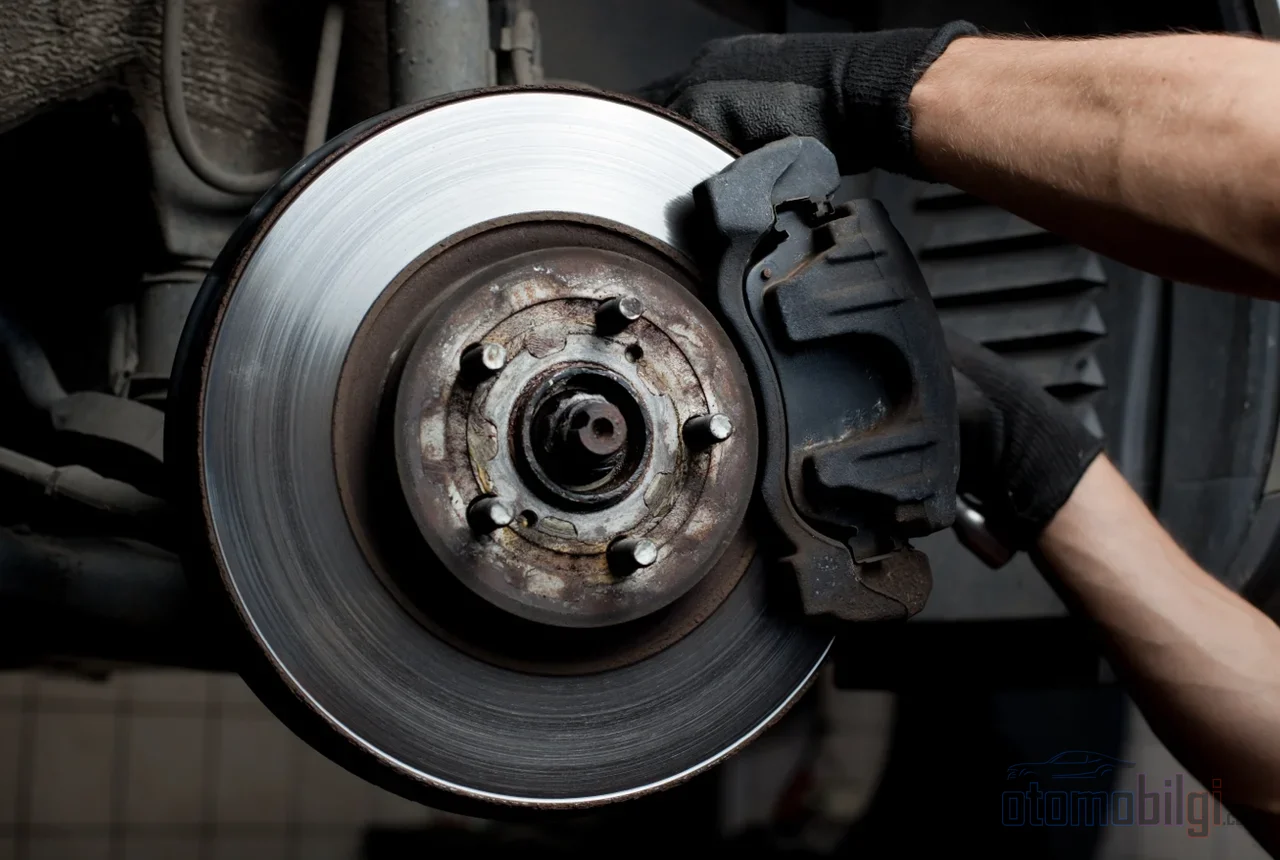
Because blending software delegates as much work as possible to regeneration, EV discs are subjected to far less friction than those in gasoline vehicles. This comfort comes at a practical cost: water, road salt, and oxygen accumulate on iron discs, and rust forms. Rust appears on the friction surface, at the edges of the rotor, on the hat section, and on the cooling fins. When the brakes are finally engaged, the pads must clean away this layer.
The effect is not distributed symmetrically: the rear rotors generally corrode faster than the fronts, because regeneration systems and the factory brake balance work the front discs more frequently. Components left inactive for long periods due to corrosion can seize and affect braking performance. For this reason, it is recommended that EV brakes be periodically inspected by a competent technician. On the driver's side, a practical habit also helps: occasionally using the friction brakes deliberately keeps the disc surface clean and reduces rust buildup.
A Brief History: From Trams to Software-Driven Vehicles
Regenerative braking is an older idea than you might think. It was introduced in 1886, and in the 1890s an electric landaulet in Paris was on the road with regeneration windings on its front wheels. In 1967, a concept car became one of the first examples to begin charging automatically when the brake was pressed; with the advancement of electronics, the process became fully automatic. The vehicle that first brought blended braking to commercial production in the modern sense was the GM EV1: two patents were granted for this brake-by-wire technology in 1997-1998, and the principle has not changed since that day.
Today the field is scaling up: the EV regenerative braking control systems market is projected to enter 2026 at $4.6 billion and reach $10.5 billion by 2036, with annual growth of 8.6 percent. In parallel, regenerative braking control strategies and ABS coordination in safety-critical situations remain intensively researched topics - meaning the blending software is a mature but still evolving engineering field.
Conclusion: Invisibility Is a Matter of Calibration
The success criterion of a blending system is strange: the less it is noticed, the better. The driver should only feel the deceleration they want at the pedal; no one should ever know whether regeneration or friction is working in the background, or whether the gain is being cut off because the battery is full. What makes this possible is not bigger discs or more powerful motors, but a calibrated control software. This invisible dance beneath the pedal is one of the most mature yet least appreciated software pieces of a modern EV.