How Does a Karting Race Day Work? Warm-Up, Qualifying and Final
Share This Page
A karting race day roughly goes through four stages: technical inspection and warm-up laps, qualifying, heat races, and the final. Qualifying laps determine the starting order of the heat races, while heat points shape the grid for the pre-final and final. So the grid is not the sum of a single lap, but of the entire weekend. So what exactly happens inside this machine, and when? Let's follow it from start to finish.
Highlights
- Qualifying usually lasts 5 minutes and determines the grid for the heat races.
- In the FIA Arrive and Drive format, the top 15 in qualifying heats are rewarded with a 25-22-19-17-15... point scale.
- In the OK and OK-Junior categories, the final grid is completed through the super heat stage.
- In Türkiye, there is an official 2-minute window for adjusting tire pressure before the grid.
- A bad qualifying is not the end: in a real example, a driver starting from 24th finished the race in 9th place.
Race Day Morning: Registration, Technical Inspection and Warm-Up Laps
The paperwork starts before the excitement on the track. The golden rule for every driver heading to their first race day is this: finish all registration and documentation procedures before you start fiddling with the kart. Dreaming of getting onto the grid without confirming your registration with the race secretary is like entering a stadium without buying a ticket. Once registration is done, technical inspection comes next; parts like the exhaust are shown to the technical inspection official before assembly, and their compliance with the rules is approved. This inspection is a step explicitly regulated in Türkiye's national karting rules as well.
Then come the warm-up laps. A short warm-up session run on Sunday morning prepares both the kart and the driver for the day. The warm-up lap is not a time-pressured session like qualifying; think of it as a breathing break to feel the track's grip, refresh your braking points, and bring the tires up to operating temperature. By the way, don't skip breakfast either - starting hydration the day before and bringing easily digestible snacks along are details that make a difference by the end of the day.
How Does the Qualifying Session Determine the Grid?
Qualifying is the weekend's first real exam. In the most common system, drivers are given a session of about 5 minutes, and whoever sets the fastest lap time starts at the very front of the heat races. During those five minutes, drivers push the pistons to the limit; the tires grip better with every lap, but if you accidentally get stuck behind a slower kart, your whole lap can go to waste. Some organizations use a single-lap system instead: each driver does one flying lap, with zero margin for error. It's like a penalty kick - either you score or you watch.
The debate between classic timed qualifying and heat-based formats never ends among clubs. Timed qualifying forces the driver to the limits and lays driving skill bare; heat races offer a different kind of excitement, because you fight for position in traffic like a knockout bout. Some clubs are based on rankings, others on the heats system - it's impossible to know which system applies without finding out which organization you're entering.
Heats: How Are Points Collected and How Is the Final Grid Shaped?
Heats are the most misunderstood part of karting. They are intermediate races: each one is run like a separate race but does not win the championship on its own. The points you earn are collected, and the cumulative result determines the starting order of the next stage - usually the pre-final or the final. So if you botch the heats while starting at the front in qualifying, you come from the back in the final grid. The system balances out the unfairness of a one-shot qualifying lap by spreading it across the weekend.
The beauty of heats is that they show nothing is lost yet. Let's go with a real case: In a 25-driver field, a pilot ranked 12th started the race from 24th after a poor start and crossed the finish line in 9th place. Qualifying was bad, the start was bad - but the race is long and every corner is a new opportunity. This is exactly where the fundamental rule of race tactics comes into play: you race for position, not for lap time. Sometimes while others try to set fast laps, you hold a defensive line and focus on overtaking the driver ahead.
How does the system work at the FIA world level?
The format worldwide is a bit more layered. In FIA Karting's Arrive and Drive championship, after qualifying heats, the top 15 drivers receive a descending points scale of 25, 22, 19, 17, 15, 13, 11.... In the OK and OK-Junior categories, there is also a super heat stage after the heats; these short races complete the grid one last time. At an event in Valencia, the super heats were run in the morning, and the two remaining heats finals set the table. In the KZ World Championship as well, the drivers who took the front two rows in the super heat drew the final grid with a 15-lap race.
How is it run in Türkiye?
In Turkish championships, the terminology is slightly different: TOSFED rules use the concept of Semi-Final, while world events have the pre-final and final structure. You can think of them as the Turkish and international names of the same logic - but since format details vary by organization, reading the official document before the race is a must. In the MOTUL 2026 Turkish Karting Championship, the 2nd round was run at the NİMOSK Circuit in 4 categories with 55 athletes; the 6th round was held in early October at Tuzla Karting Park. At the Uşak round, 47 athletes took to the track and the event could be watched for free - meaning you don't even have to be a racer to see this sport up close.
If we put the two systems side by side, the table looks like this:
| Stage | FIA/CIK world event | Türkiye (TOSFED championships) |
|---|---|---|
| Qualifying | Timed qualifying or heats, with a points scale (25-22-19...) | Qualifying sessions are regulated by the rules |
| Intermediate races | Heats + super heat | Semi-Final races |
| Final | Pre-final and final grid is determined by cumulative points | The final grid is formed according to the results of the preliminary stages |
| Before the grid | Starting grid and the start light system depend on specifications | A 2-minute tire pressure adjustment window |
Start Strategy: 2 Minutes, Lights, and Inside or Outside?
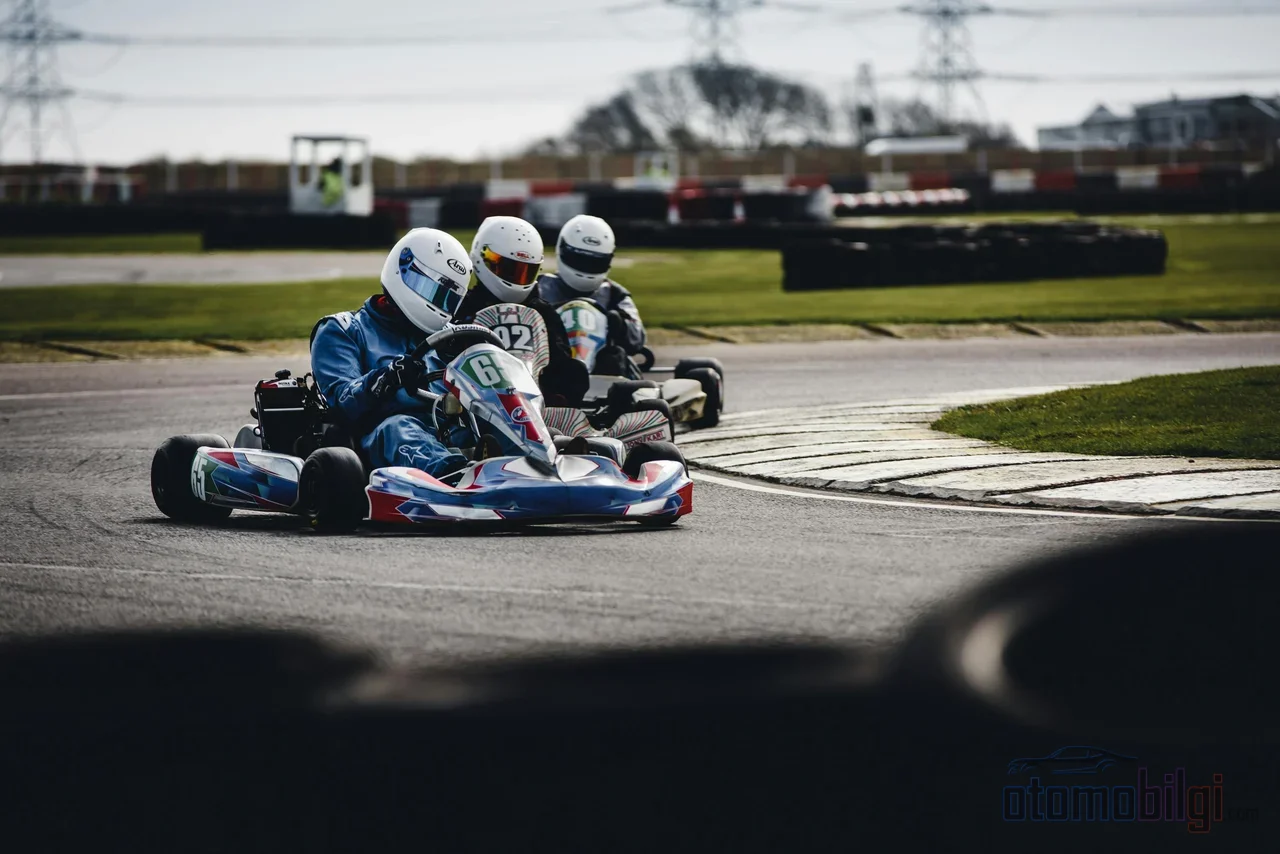
You have lined up on the grid; next comes the start. In races in Türkiye, this moment is governed by an official ritual: a "2 minutes" board is shown on the grid and an audible warning is given. This is the final adjustment window - you can set your tire pressure during those two minutes, and many teams do exactly that. Since the track temperature will change throughout the race, the morning setup may not be right for the final; that is why the team keeps calculating until the last moment.
Most starts are rolling type and are run according to steps under the tight control of race management; the aim is to offer everyone a fair and safe start. So what about tactics? The honest answer is this: every start is different. Whether you open on the inside or the outside changes according to the shape of the corner, the aggression of the driver next to you, and the grip of the surface. Some starts are more predictable than others - good drivers try to read which scenario will unfold before the lights go out. There is also the tire calculation: if the tires stick to the surface while waiting on the grid, it takes time to overcome that adhesion at the moment of the start and you lose pace. That is why managing the tires' relationship with the surface on the grid is a race in itself - an invisible one.
Decisions Between Sessions: Negotiating with the Tire, Chassis, and Surface
Race day is not static; you make mechanical decisions between every session. The basic inspection routine is simple but critical: rotating the four tires to check for damaged bearings or loose connections, tightening the wheel nuts, and checking tire pressure, fuel level, weight, and bolt tightness. Think of it like a chef's preparation before entering the kitchen - you don't go to the stove without your ingredients ready.
On the chassis side, it is all a game of grip. Hot weather pushes the tire's operating temperature up, the surface changes, and the setup window shifts. That is why teams update pressure and chassis settings from race to race with the data they gather from the warm-up lap and the first heats. For a beginner, the healthiest approach: make a single change after each session and note the result. If you change five things at once, you will never know which one worked - don't do trial and error, do manageable testing.
Your First Race Day: What Does a Beginner Bring, and What Should They Expect?
On your first race day, the most talked-about topic is the bag. Documents and registration come first; then comes the equipment checklist:
- A certified and properly fitting helmet
- A racing suit and gloves
- Racing shoes
- Rib protector
- For young drivers, a neck collar depending on the class
Your first goal on track should be learning, not speed: memorizing the track layout, grasping the racing lines, and establishing smooth, controlled braking. A common beginner mistake lies right here - jerking the steering wheel causes the front tires to lose grip and the kart to keep going straight. A kart turns with braking; not with your arms. The clearest sign that someone has moved past the cadet level is exactly this: being able to post consistent laps and drive smoothly alongside other pilots on track. Talk about consistency more than lap times.
There is also a psychological side to race day. In a beginner-level event, the program is kept short, with 2 laps for warm-up and 3 laps for the time trial; Contact with the cones (track edge markers) is penalized with a time penalty. Short programs do not require overthinking - the single goal is clean, error-free driving. On the FIA side, running off track is assessed with a 5-second time penalty; the rules get stricter as the level rises, but the logic is the same: stay on track, drive straight, learn.
Format Confusion Should Not Wear Down the Newcomer
One final warning: do not panic and drown in terminology. While club formats circulate concepts like LCQ (last chance race), grid by lottery, and transfer to the A Main, the CIK/FIA side has a chain of qualifying → heats → super heat → pre-final/final. Most beginners get overwhelmed by these words - which is perfectly understandable, since some clubs race under a completely different structure. The solution is simple: read the official race documents of the event you attend once, and direct your questions to the technicians or experienced families. The karting community is used to guiding newcomers all the way to the gate. Now it is time to prepare for your first grid - which stage you start from is in your hands.
Sources
- 2026 FIA Karting Arrive and Drive Championships - Competitor Information
- Changing conditions shake up the standings in Valencia
- Viktor Gustafsson Crowned FIA Karting KZ World Champion
- 2026 Karting Genk - Academy Junior Official Race Documents
- National Karting Rules - TOSFED 2026
- Race Format - KartStars Canada
- Heat Racing vs. Qualifying - Hamilton Karting Complex
- Kart racing - Wikipedia
- FIRST RACEDAY: What to expect
- Race Day Preparation Checklist for Kart Racers
- 7 Karting Mistakes Beginners Should Avoid
- Türkiye Karting Championship Held in Uşak