Hyundai STARIA Cargo and Türkiye's Electric Commercial Vehicle Goal
Share This Page
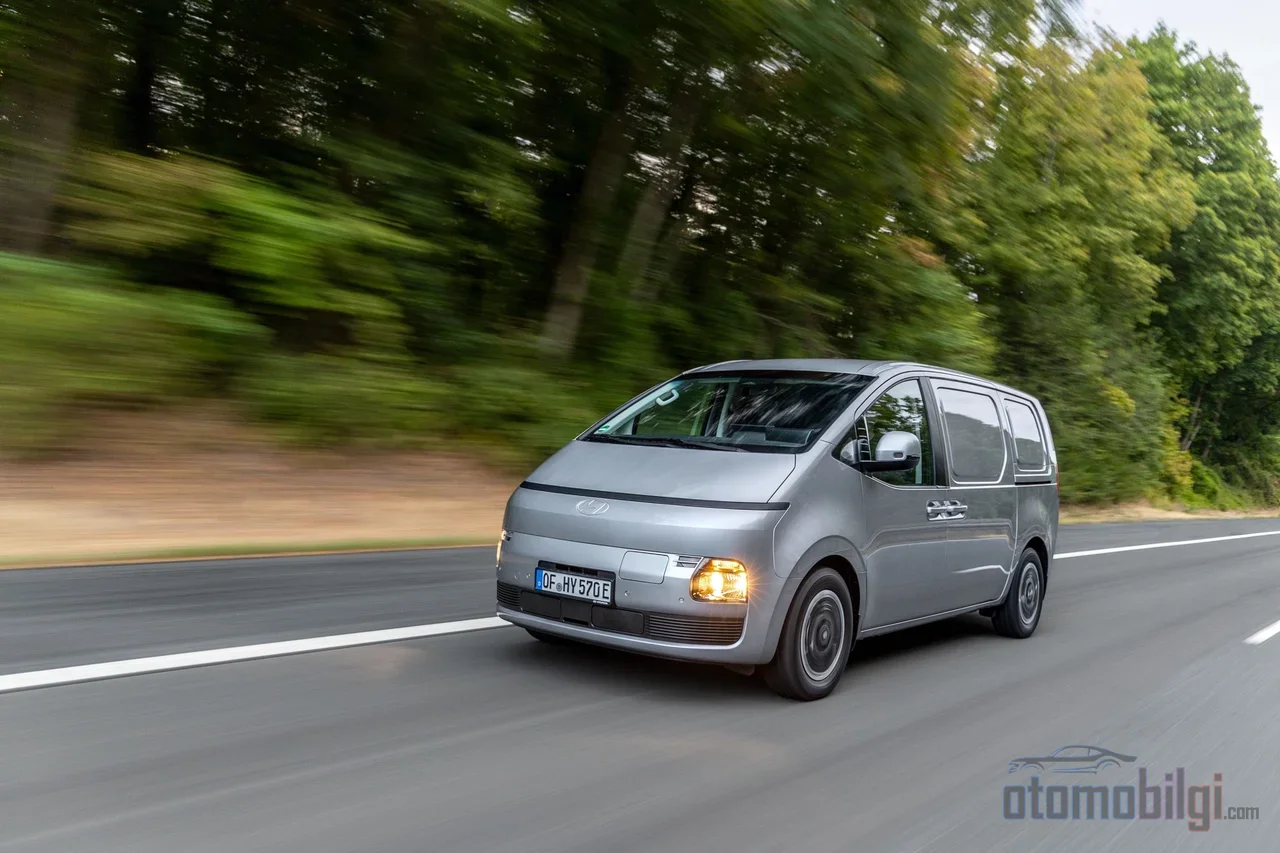
Introduced at the press day of the Paris Motor Show, the Hyundai STARIA Cargo enters the fully electric light commercial segment with an 800-volt architecture, up to 450 km of WLTP range and 1,040 kg of payload capacity. The model will go on sale in the second half of 2026, depending on the market; a definitive date and pricing for Türkiye have not yet been announced. In this article, we evaluate the STARIA Cargo's technical equipment, what it means for fleet users, and its place in Türkiye's electric light commercial vehicle market.
Highlights
- 84 kWh battery, 800-volt architecture, up to 450 km of WLTP range up to WLTP range
- 10-80% DC charging: 20 minutes; 11 kW AC onboard charging unit
- 1,040 kg payload capacity, fits three Euro pallets, 5,462 m³ cargo volume
- 3.5 kW V2L allowing it to serve as an energy source in the field
- Reveal: October 12, 2026, Paris Motor Show; Türkiye pricing and date not announced
When will the STARIA Cargo go on sale in Türkiye?
Hyundai showcased the model at the press day of the Paris Motor Show on October 12, 2026, and announced that sales will begin in the second half of 2026, depending on the market. This statement refers to the European launch; for Türkiye, neither the sales date nor the pricing has been officially announced at this stage. Hyundai unveiled three models at the show, including the world premiere of the new BAYON; the STARIA Cargo formed the commercial side of this showcase.
For someone who has been following this business for many years, this picture is not unusual. Manufacturers announce commercial vehicles in Europe first and then open up timelines market by market; the dealer network and pricing in Türkiye usually become clear after the launch. The price figures currently circulating have no official basis; definitive information should be expected from the upcoming official announcement.
Technical equipment: why is the 800-volt architecture important in this segment?
The most distinctive aspect of the STARIA Cargo is its 800-volt electric architecture, which is still rare in the light commercial segment. The practical result is simple: at a suitable DC fast-charging station, it can charge the battery from 10% to 80% in 20 minutes . The 84 kWh lithium-ion battery offers up to 450 km of range on the WLTP cycle; of course, this figure will drop in real-world conditions depending on load, route, ambient temperature, and air conditioning use.
The electric motor produces 160 kW (218 PS) of power and 350 Nm of torque, with front-wheel drive; top speed is 184 km/h. For a commercial vehicle, this figure is nothing to dismiss - considering that many electric light commercials in the segment are limited to 160 km/h, fleets making long-distance trips lose less time to speed restrictions. The 11 kW AC unit is standard for overnight depot and on-site charging; the charging port is located at the front, and charging without having to back up against a wall is a practical detail.
| Feature | Value |
|---|---|
| Battery | 84 kWh lithium-ion |
| Electric architecture | 800 volt |
| Range (WLTP) | Up to 450 km |
| Motor | 160 kW (218 PS), 350 Nm, front-wheel drive |
| DC fast charging | 10-80%: 20 minutes |
| Payload capacity | 1,040 kg |
| Braked trailer towing | 2,000 kg |
| Cargo volume | 5,462 m³ (three Euro pallets) |
| V2L | 3.5 kW |
Cargo area and commercial use: do three Euro pallets fit?
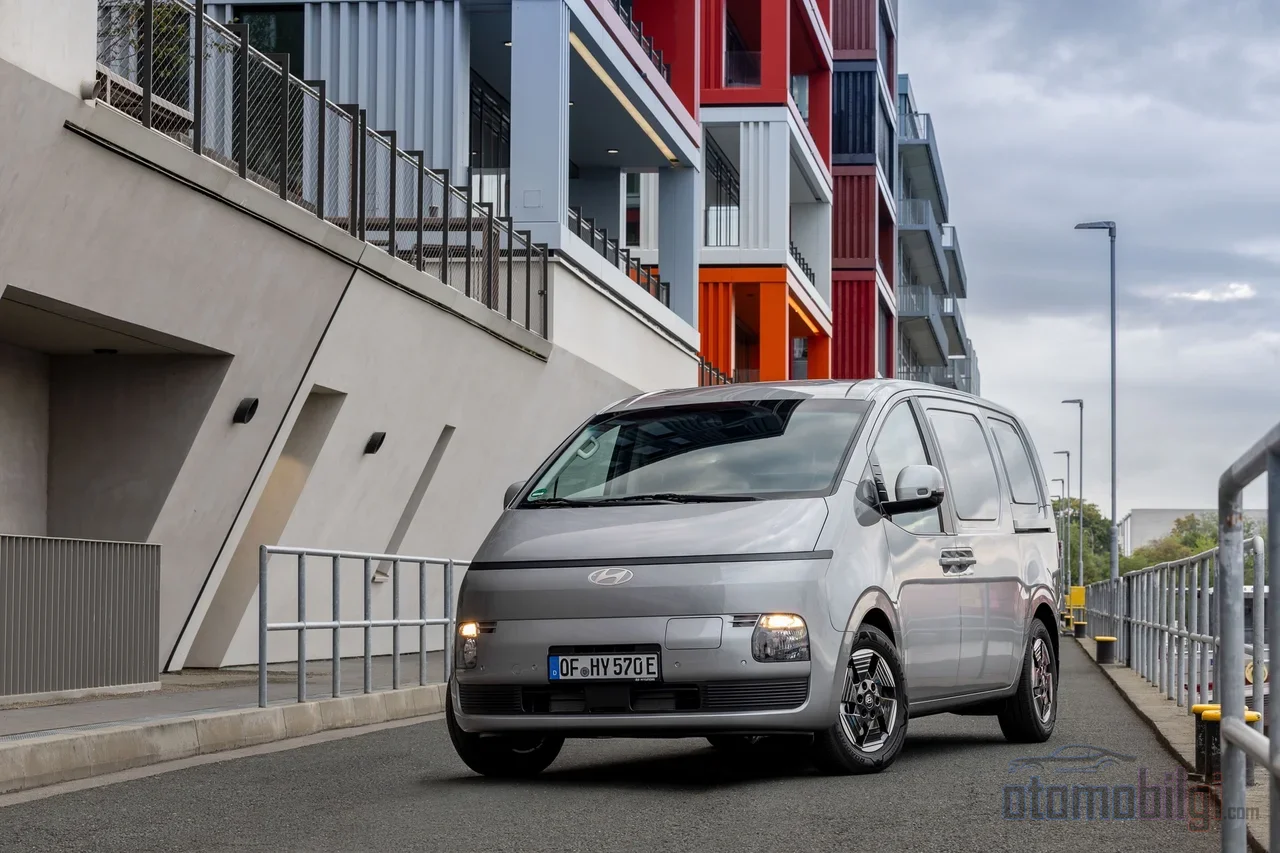
What truly makes a panel van commercial is not its range, but the shape of its cargo area. The STARIA Cargo has been thoughtfully designed in this respect: within a body of 5,253 mm in length, there is a cargo area measuring 2,500 × 1,640 × 1,436 mm and a 5.462 m³ volume, allowing three Euro pallets to be carried side by side. The loading height of 573 mm is easy on the knees; the side doors are twin sliding doors 870 mm wide, the rear doors open wide, and the cargo area is separated from the cabin by a steel bulkhead.
The vehicle comes as an N1 type-approved panel van with three seats. Maximum loaded weight is 3,450 kg and curb weight is 2,335 kg; the braked towing capacity is 2,000 kg. Although the ability to technically tow a trailer even when fully loaded in an electric commercial vehicle may seem like an ordinary feature for delivery and service fleets, it is an area of weakness in the segment. The turning radius is 11.9 m; in urban delivery with limited maneuvering space, it is worth looking at this figure.
What does the 3.5 kW V2L and cabin technology offer fleets?
V2L, meaning energy transfer from the vehicle to the outside, is offered on the STARIA Cargo with 3.5 kW of power, and power can be drawn not only from the external outlet, but also from the interior outlet in the cargo area. In practice, this means tool charging, running small equipment, and lighting at a job site without an outlet. For maintenance crews, installers, and businesses providing mobile services, it can eliminate the need to carry a separate generator - the famous gasoline generator once carried in the panel van's trunk is now being replaced by the battery.
On the cabin side, there is a 12.3-inch touchscreen and digital display with Hyundai's ccNC connected cockpit. Remote vehicle management, charging status monitoring, and climate control allow functions such as the fleet manager charging the vehicle overnight and sending it out in the morning with a pre-cooled or pre-heated cabin. Safety equipment includes Hyundai SmartSense as standard: forward collision avoidance assist, lane keeping and following assist, smart cruise control with stop-and-go, blind spot collision avoidance, rear view camera, and front and rear parking sensors. A three-year warranty package is also part of the announcement.
Businesses should not have to choose between electrification and efficiency. We developed the STARIA Cargo precisely for this reason.
Türkiye's electric light commercial vehicle target: where does the market stand?
While the Turkish automotive market contracted in the first nine months of 2026, the electric side continued its upward trajectory: the total passenger car and light commercial market shrank by more than 15 percent to 803,465 units, while the share of electric models grew. The light commercial segment itself presents a more mixed picture; some months during the year saw notable increases - in February 2026, the light commercial market rose by more than 24 percent to reach 18,263 units.
The fleet picture is becoming clear: 27 percent of companies in Türkiye have at least one electric vehicle in their fleets, and the share of electric vehicles in passenger fleets is expected to grow over the next three years. The projection that electric fleets will achieve a 15-25 percent lower total cost of ownership compared to internal combustion vehicles offers a compelling calculation, especially for distribution fleets operating urban routes. The vehicle type that facilitates this calculation is precisely the segment STARIA Cargo is targeting.
The incentive balance is shifting
There is also a complicating side to the same picture: with the July 2026 regulation, the base Special Consumption Tax rate for electric vehicles was raised from 10 percent to 25 percent. This balance between low operating costs and rising acquisition costs will be the most important variable determining the pace of fleet transition decisions. The electric commercial vehicle transition, which once progressed slowly due to range anxiety alone, is now also grappling with tax mathematics. Where STARIA Cargo's price in Türkiye lands within this new equation may determine the model's market success more than its range.
The Izmit investment context
Türkiye's role in this story is not limited to being a market. Hyundai continues its investments to transform the Izmit plant with a redesigned electric vehicle body platform, high-voltage battery integration, and power electronics; the plant, which exported 156,500 vehicles in 2025, is projected under the investment to increase production to 27,000 units in 2026 and 40,000 units in 2027. Türkiye is on its way to becoming Hyundai's electric car production base in Europe. It can be read as a unsurprising next step for the country to also embrace, on the commercial vehicle side, the electric technology produced on its own soil.
Its place in the segment: where does it stand compared to its rivals?
In the electric light commercial vehicle segment, an 800-volt architecture is still the exception; most vehicles in this class operate on a 400-volt architecture and have longer DC charging times. STARIA Cargo's combination of 450 km range, 20-minute charging, over one ton of payload, and 2,000 kg towing capacity forms one of the most balanced packages among next-generation electric commercial vehicles. Its 184 km/h top speed is also unusually high in the same context.
One point needs clarifying: STARIA Cargo should not be confused with the passenger-side STARIA Electric; the two are different products. The Cargo is positioned as a front-wheel-drive, N1 type-approved commercial vehicle capable of carrying three Euro pallets. Hyundai is also working with business partners for special conversion solutions aimed at local business customers and states that standardized conversions are being evaluated through its dealer network; details are expected to be announced at a later date.
Conclusion: the Türkiye timeline will determine everything
Technically, the STARIA Cargo offers something that has long been missing in the electric light commercial segment: fast charging that allows the fleet to keep working through the day in regions where charging infrastructure has matured, cargo space in real commercial dimensions, and V2L that provides energy in the field. On the hardware side, I see no point to dispute at the editor's desk. The real unknown is where the sales date in Türkiye and the price will land in the market reshaped after the SCT regulation. Once Hyundai announces these two figures, a clearer calculation can be made of how realistic its Türkiye target for the electric light commercial transition is.
Sources
- Hyundai Sets a New Standard in the Electric Light Commercial Vehicle Segment with STARIA Cargo
- Hyundai Unveils New BAYON and TUCSON at the Paris Motor Show
- Hyundai Staria Cargo: 800-volt technology and 450 km range
- Hyundai STARIA Cargo Arrives with 450 Km Range and 3-Pallet Load Capacity
- Hyundai's Electric Commercial Move: New STARIA Cargo Introduced
- Electrification and the Rise of Chinese Brands: Paris Motor Show
- 2026 Automotive Sales: The Market Shrank, Electric Vehicles Rose
- ODMD Press Release, March 3, 2026
- 715 Million Euro Investment in Türkiye
- 2026 Fleet and Mobility Barometer
- 5-Year TCO Analysis and the Transition to an Electric Fleet