Norris's Fuel Nightmare Dragging from Baku to Singapore
Share This Page
The problem that cost Lando Norris points in qualifying two weekends in a row, in Baku and Malaysia, was not a faulty part in the Mercedes power unit; it was hidden in the auxiliary components connected to fuel injection, in other words in the hardware on McLaren's own side of the fence. The team was only able to activate the fix ahead of the Singapore Grand Prix, and the two or three grid positions Norris lost remained on the table as a cost that directly hit his championship calculations.
Highlights
- 3.4 km/h: The gap by which Norris's final speed in Baku qualifying fell short of Piastri's.
- Per-lap loss, according to team principal Andrea Stella's measurement, was on the order of tenths of 1-2 seconds .
- Norris said he lost 2-3 positions in the last two qualifying sessions, adding "this cost me quite dearly."
- The problem was not on the Mercedes side but in the auxiliary components of McLaren's fuel system; it recurred at a milder level in Piastri's car.
- The permanent fix was delayed until Singapore because no spare parts were left.
What was Norris's fuel injection problem, and how did it emerge?
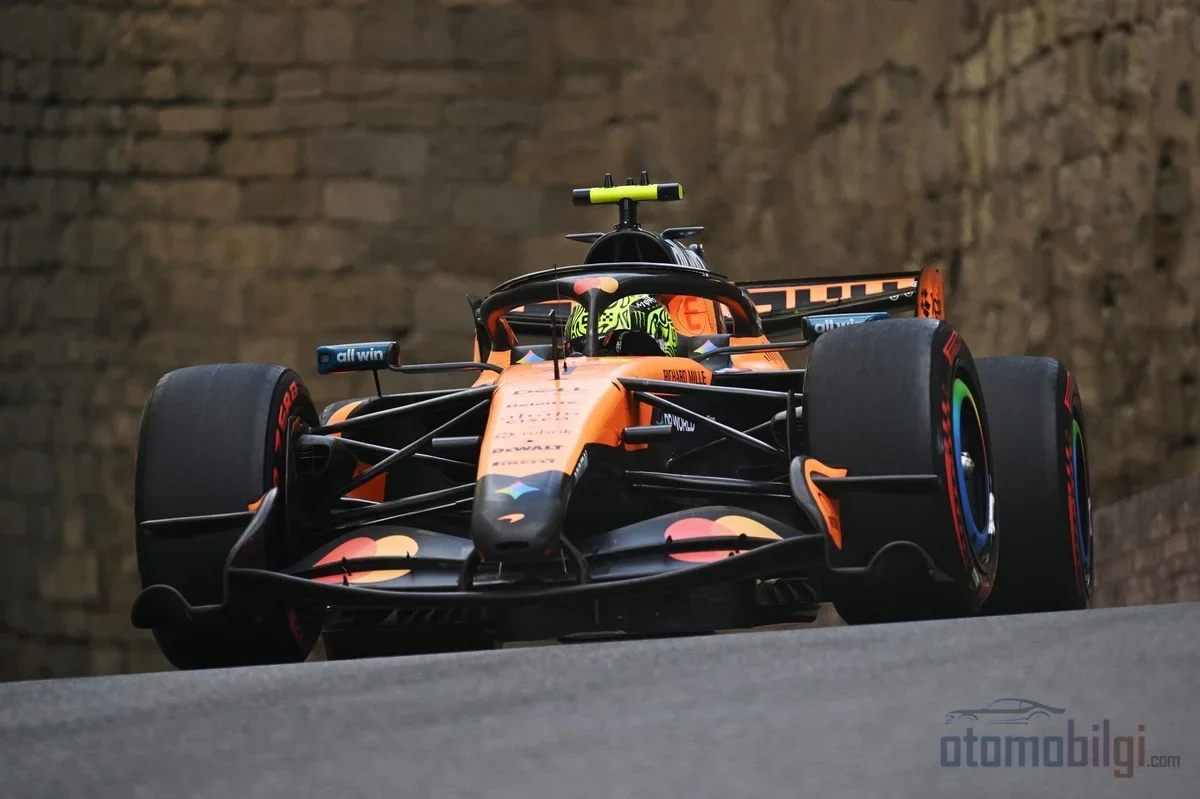
Coming out to qualify on Baku's wide boulevards, Norris failed to find the pace everyone expected. For a driver who had won 9 of the last 10 qualifying sessions against his teammate Oscar Piastri, seeing the worst gap of his season in Q3 was an unusual picture: the gap had reached a third of three seconds, and Norris was stuck in fifth place. The measurements clarified the nature of the picture; Norris's final qualifying speed was 3.4 km/h lower than Piastri's.
McLaren's overall picture was even worse. George Russell was 8.1 km/h faster than Piastri and 11.5 km/h faster than Norris in Baku. So two separate problems awaited Norris: it quickly became clear that one related to the straight-line efficiency of the package belonging to Lewis Hamilton's former team, while the other concerned the lack of power in Norris's own car. Team principal Andrea Stella put the diagnosis this way:
There is a power deficiency that appears to be linked to the behavior of the fuel injection; it has nothing to do with the overall behavior of the power unit.
This distinction matters, because there is a reflex familiar to anyone who has followed this world for years: when we see an engine problem, we all look first at the power unit supplier. Stella's emphasis breaks precisely that habit. The problem sat not in the engine itself but in the parts surrounding the system that feeds the engine.
Did the problem come from Mercedes or McLaren?
The technical answer is clear: the fuel system was in the auxiliary components on McLaren's side, not the Mercedes side. In other words, there was a snag in the peripheral hardware mounted outside the power unit that carries fuel from the tank to the high-pressure pump, and in Norris's car this snag manifested in full size. In Piastri's car, the same problem recurred at a milder level, which shows that the problem pointed not to the driver but to component differences between the two cars.
That said, it would also be wrong to blame the entire straight-line speed deficit in Baku on the fuel system alone. Stella himself admitted that Mercedes' package (chassis, aerodynamic ratios, drag) was more effective in a straight line. When asked about the speed deficit, Norris also answered "both": on one side Mercedes' efficient car, on the other McLaren's own drag problem. The diagnosis was not easy at first either; Stella had said it was difficult to determine whether the shortfall came from the power unit, from parameters on the chassis side, or from aerodynamic drag. However, he clearly stated that they took responsibility as a team for the lap time deficit.
Exactly how big was the loss?
Malaysia showed that the problem was not a temporary fluctuation. In Sepang, Norris qualified sixth and was six tenths behind pole position; Piastri was on pole and Norris was only 0.005 s behind. When Stella put the deficit into numbers, the picture became clear: the speed difference was 1-2 km/h, and the lap time loss was over 1 second, probably between one and two tenths. This seemingly tiny difference is enough to line the cars up in a zigzag order in qualifying; in modern Formula 1, tenths are worth as much as centuries.
Sepang was already a weekend below expectations. While it was thought that the MCL40's strengths would suit this track, McLaren could only be the fourth-fastest team on track; the likely reason cited is the interaction of the car's aerodynamics with the extremely bumpy track surface. Add to the weakened car a fuel problem specific to Norris, and we would not be exaggerating in saying that a weekend emerged that carries no Norwegian flag but is as merciless as the Norwegian cold.
| Weekend | Norris's qualifying result | Measured deficit | Note |
|---|---|---|---|
| Baku | 5th place | Top speed 3.4 km/h lower than Piastri | Worst Q3 gap of the season: one third of 3 seconds |
| Malaysia (Sepang) | 6th place | 1-2 km/h; one to two tenths per lap | Gap to pole: 0.060 s (Piastri 0.005 s ahead) |
| Singapore (before FP1) | - | Fuel system component change | Fix intended to remove the problem at its root |
Norris's reaction to this picture was an honest expression of a frustration that had lasted two weeks:
Two weekends in a row have been frustrating... I lost two or three positions in the last two qualifyings. That cost me quite dearly.
Why did the fix wait until Singapore?
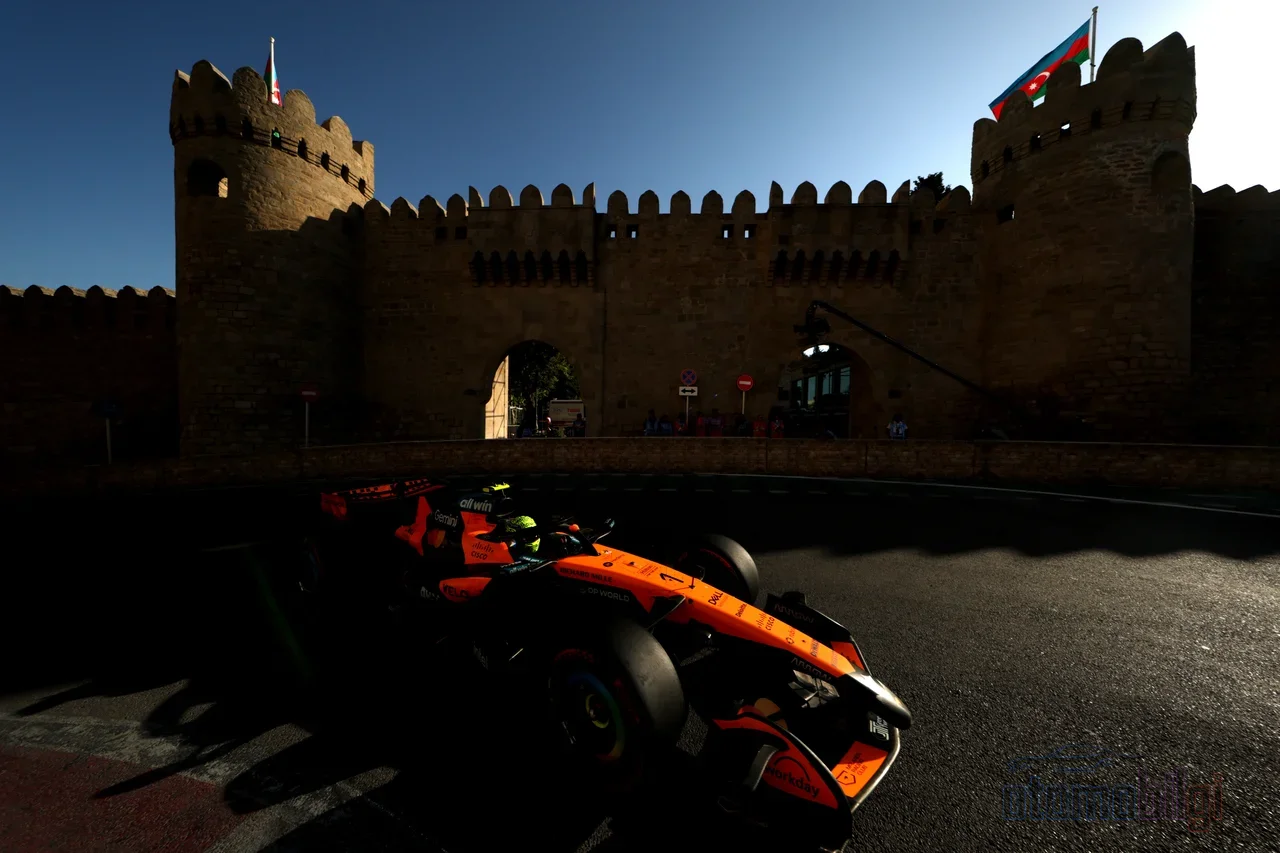
The less discussed but most critical aspect of the matter was this: there were no spare parts left to replace on Norris's car. In a period when part numbers depend on in-season quotas and logistics, removing a part without a sound component in hand means taking a risk. Stella admitted that the fix could wait only until Singapore; the team preferred to complete the diagnosis in the meantime and prepare the solution package.
The work carried out in Singapore involved a series of changes in the auxiliary components connected to the power unit, as well as in the fuel system involved in the problem. The goal was not to mask the flaw, but to eliminate it at its root. This distinction makes a big difference in engineering: adjusting a parameter softens the picture, while replacing a component buries the problem in history. McLaren's 2026 car uses high-pressure direct injection - a single injector operating at a maximum pressure of 350 bar. At this scale, even a small irregularity in fuel flow directly affects combustion inside the cylinder; therefore, the fact that the problem resided not in the injector itself but in the surrounding loop that delivers fuel to it is the detail that made diagnosis so difficult.
Meanwhile, the fuel system could not stop being a recurring headline for McLaren throughout the season. Early in the season, a fuel problem that cut short Piastri's run required the car to be completely disassembled. Amid the technical complexity brought by the 2026 regulations, this system remained one of the teams' most sensitive areas.
Did Singapore become a testing ground?
Singapore is one of the tracks on the calendar that shows the least sensitivity to power; at Marina Bay, where long straights are fewer, the mark a fuel problem leaves on lap time shrinks. But the battle among the front-runners was so close that McLaren believed it could not leave any performance on the table. That is why FP1 was read not merely as a practice session, but as the first test of whether the fuel system problems were truly behind them. The fastest in the session was Russell; Norris and Leclerc followed behind him. In the race, Max Verstappen won in Singapore for the second consecutive time, while Norris and Piastri passed inspection; the statement in McLaren's race report remained open: "it is clear that we are currently the fourth fastest."
Norris's attitude toward the solution was measured: he said he was hopeful the problem had been resolved, but could not say anything without seeing it on track. Not talking big like this is a maturity that someone who has spent long years going down to the pit would appreciate. In engineering, the distance between the laboratory result and the track result is often the very essence of a delayed victory.
What will the cost be to the championship table?
Norris's championship situation is tied to a story of determination that goes beyond the fuel problem. Saying he has shifted into an "I will either try it or die trying" mode regarding winning the 2026 world championship, Norris knows better than anyone what the 2-3 positions he lost in two qualifying sessions mean for championship calculations. It is said there are points that cannot be recovered without exceptional results from Piastri; every lost ranking position will be one of the questions to be answered at the end of the season.
The lesson to be drawn here is a familiar one even for the big teams: the environmental hardware around a component can determine the championship as much as the engine itself. In the past, whoever had the most powerful engine won, and the rest was considered detail; now, the turbulence inside the pipe feeding the injector can push one of the world's best drivers three places back in qualifying. McLaren says it has solved the problem at its root; what remained was for the track to confirm, under the neon lights of Marina Bay, that this claim was true.
Sources
- What was Lando Norris' top-speed problem in Baku qualifying?
- McLaren targets Lando Norris' costly fuel system issue with Singapore F1 power unit fixes
- McLaren puzzled by persistent Norris-only F1 car problem
- Lando Norris engine issue: why McLaren can't swap it yet
- What is the technical specification of our 2026 Formula 1 car?
- 2026 Singapore Grand Prix Race Report
- McLaren forced to 'strip down' MCL40 to chase fuel fault
- Stella Demands Answers From Mercedes HPP
- Lando Norris: 'I have to go for it or die trying' to win 2026 F1
- Max Verstappen delivers masterclass drive to take victory at Singapore GP
- Russell beats Leclerc and Norris in Singapore GP practice