The Environmental Cost of the Internal Combustion Engine and the Next 20 Years
Share This Page
An internal combustion car's environmental cost doesn't end at the exhaust pipe; it is the sum of a chain stretching from the production line to the fuel refinery, and from the 150,000 kilometers it spends on the road to the scrapyard where it ends up. This holistic view, which we call lifecycle analysis, shows that a standard mid-segment gasoline vehicle emits approximately 24 tonnes of CO₂e over its lifetime, and only two-thirds of that emission comes from burning fuel. The rest is generated at the factory, the refinery, and in the supply chain. This article unpacks that chain link by link, examines the role Euro 7 and the 2035 target assign to this engine, and discusses, with data, the internal combustion engine's realistic position in the age of electrification.
Key Takeaways
- The production-embedded carbon of a mid-segment gasoline ICE vehicle is approximately 5.6 tCO₂e; three-quarters of it comes from the steel in the body.
- A mid-segment BEV sold in the EU has lifecycle emissions 73% lower than a gasoline one: 63 g CO₂e/km versus 235 g.
- The BEV's ~40% production emission surplus is offset within the first 17,000 km of use.
- Euro 7 takes effect in 2026 and, for the first time, sets limits on brake and tire wear particles.
- From 2035 onward, the sale of new gasoline and diesel cars in the EU ends.
What Is Lifecycle Emission and Why Doesn't It Stop at the Exhaust?
Lifecycle emission is the total amount of greenhouse gases a vehicle produces at each of its production, use, and disposal stages. The definition covers not only the molecules leaving the exhaust, but also manufacturing, transporting the vehicle to its first point of sale, refining and transporting liquid fuels, and, in the case of an electric vehicle, the generation of the charging energy. Assessing a vehicle's environmental impact by looking only at the exhaust pipe is like judging a building's energy performance by looking only at its heating bill: the real picture is far broader.
This holistic accounting also refutes a common objection. The argument that "electric vehicles' emissions will merely be shifted to other sources" is frequently voiced; yet the production surplus remains a secondary item compared to the advantage it gains over its service life. Manufacturing accounts for 20–30% of a vehicle's total lifecycle emissions, and the main items are steel, aluminum, plastic, and battery production. This ratio applies to both internal combustion and battery-powered vehicles - what changes is the weight of the items.
Carbon from the oven: the production stage
The production-embedded carbon of a mid-segment gasoline vehicle is approximately 5.6 tCO₂e , and about three-quarters of that comes from the steel in the vehicle body (the chassis-cabin unit known in the industry as the glider). In a hybrid vehicle of the same size, this figure rises to 6.5 tonnes, and to 6.7 tonnes for a plug-in hybrid; in a battery electric vehicle it reaches 8.8 tonnes, accounting for 46% of the total carbon footprint. In other words, a battery-powered vehicle leaves the factory carrying nearly half of its total carbon burden before ever hitting the road. This doesn't excuse it; it simply clarifies where it needs to be accounted for.
The balance sheet of 150,000 kilometers
How does the usage advantage compensate for the production surplus? The complete lifecycle table looks like this: petrol vehicle 24 tonnes (23% production), hybrid 21 tonnes (31%), plug-in hybrid 19 tonnes (35%), battery electric 19 tonnes (46). Production emissions of hybrid and plug-in hybrid are higher than petrol because a second drivetrain and battery are added; in return, the reduction in fuel consumption pulls the total down. Diesel is also an interesting case of balance: over the same lifetime mileage it has almost the same total emissions as petrol, because the fuel efficiency advantage is neutralized by high production emissions.
Another comparison, 200,000 miles (approximately 320,000 km) of lifetime, is done on this basis: the combustion cycle adds 48 tonnes of greenhouse gases during this period, and raises the total of the internal combustion vehicle compared to the electric one to a level 41% higher . On a global scale the picture is similar: the lifecycle emissions of battery electric passenger cars registered in 2021 are 66-69% lower.
Grams Per Kilometer: The Current State of the ICE vs EV Comparison
If we break lifecycle emissions down per kilometer, a mid-segment battery electric vehicle charged with the EU's current electricity mix produces 63 g CO2e/km . A petrol vehicle in a similar segment produces 235 g, and diesel 234 g. The difference in between is 73%; if the electricity is generated entirely from renewable sources, this gap widens to up to 78% . Intermediate data point in the same direction: CNG vehicles run with 13% lower emissions than petrol, hybrids 20%, plug-in hybrids 30%, natural gas-based hydrogen vehicles 26% lower; with renewable hydrogen this figure can reach 79%.
| Drivetrain | Lifecycle emissions | Difference vs petrol |
|---|---|---|
| Petrol ICE | 235 g CO2e/km | - |
| Diesel ICE | 234 g CO2e/km | ~1% lower |
| CNG | 203 g CO2e/km | 13% lower |
| Hybrid (HEV) | 188 g CO2e/km | 20% lower |
| Plug-in hybrid (PHEV) | 163 g CO2e/km | 30% lower |
| Hydrogen (natural gas-based) | 175 g CO2e/km | 26% lower |
| BEV (EU average charging) | 63 g CO2e/km | 73% lower |
Two methodological notes matter when reading this table. First, the finding that an EV produces fewer emissions than its petrol equivalent "regardless of where it is charged" appears as a common conclusion in the assessments of both the US Environmental Protection Agency and MIT. Second, the classic mistake that distorts the comparison is to ignore the decarbonization trend of the electricity grid and to fail to account for the difference between test consumption and real-world consumption; this omission unfairly favors petrol, diesel, and hybrid vehicles over battery electric ones. Indeed, in 2021 the BEV's advantage was projected at 24% with the same calculation; with the grid getting cleaner, that figure has now extended to 73%. In other words, the gap is not a static number, but a widening pair of scissors over time.
Emission Control Systems: The Engineering Chain That Cleans the Exhaust
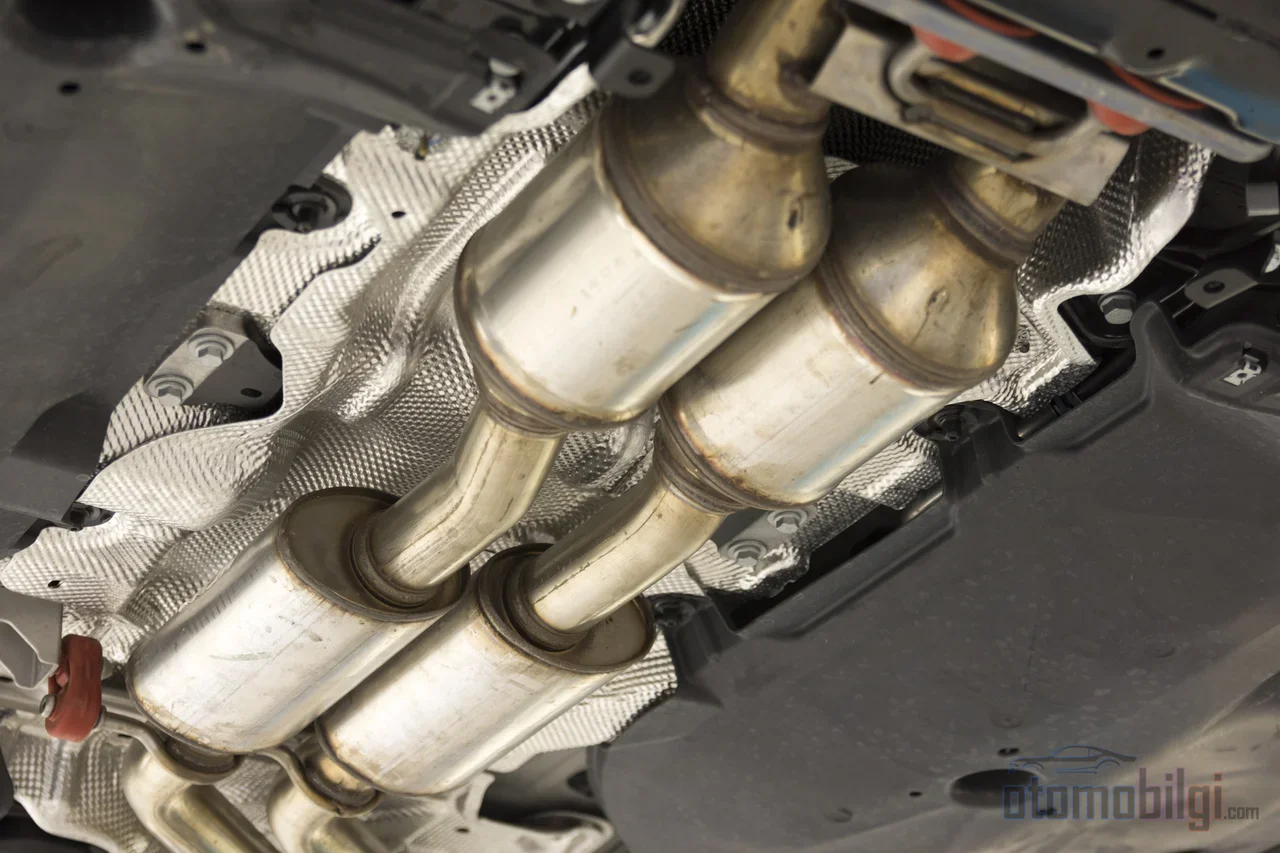
When discussing the environmental cost of the internal combustion engine, you need to know the cleaning chain inside the vehicle itself; because the Euro rules are based on this chain, and when a link in the chain fails, both emissions and inspection results suffer.
Catalytic converter
The catalytic converter is a chemical reactor mounted in the exhaust line that converts carbon monoxide, hydrocarbons, and nitrogen oxides in the exhaust gas into less harmful compounds. It is counted among the main emission control components designated by the US Environmental Protection Agency, and when it fails, the result is measurable: the most common catalytic converter-related inspection failures are excessive hydrocarbon, carbon monoxide, or NOx levels and the converter's efficiency error codes. Of course, the converter is not always the culprit; a faulty fuel cap, a dirty air filter, worn spark plugs, a faulty oxygen sensor, or an illuminated check engine light are also among the classic causes that can fail the test.
DPF: diesel particulate filter
The diesel particulate filter (DPF) is a porous ceramic unit that physically captures the soot and particulate matter passing through the exhaust system. As the name suggests, it is a filter, so it fills up and clogs over time. The main cause of clogging is that the usage profile is not hot and long enough for the soot accumulated in the filter to complete the burn-off regeneration cycles; short-distance, frequent stop-and-go use causes these cycles to be interrupted and the filter clogs. The DPF works as part of a multi-stage system together with the SCR: the DPF targets particulate matter, the SCR targets nitrogen oxides.
SCR and AdBlue
SCR (Selective Catalytic Reduction) is a system developed to reduce NOx emissions. Its working logic is simple: a urea-based fluid known as AdBlue (its trade name is DEF) is injected into the exhaust gas and, through a catalytic reaction, converts nitrogen oxides into harmless components: nitrogen and water. The combined operation of the DPF and SCR is the actual price of the modern diesel meeting Euro 6 and higher standards; this price is reflected in the driver's daily life not only as a cost but also as a maintenance and failure profile.
What Does Euro 7 Change?
The Euro 7 standard was adopted in 2024 and entered into force in 2026; application for passenger cars and light commercial vehicles begins from November 2026, while the calendar for heavy commercial vehicles and buses points to May 2028. The most striking innovation of the standard is that it moves control beyond the exhaust pipe: for the first time, limits are being placed on particulate matter emissions from brake wear and tire wear. This is a logical leap from an engineering standpoint, because as exhaust filters mature, the share of brakes and tire dust in road vehicle pollution grows; the standard follows the real source of the pollution.
The second important heading is durability. Euro 7 requires that, depending on the vehicle's category, up to 200,000 km or for 10 years requires it to remain compliant with the emission norm, and it also includes battery durability requirements. The meaning is clear: a vehicle that is "clean when it leaves the factory" is no longer enough - it has to be designed to stay clean throughout its lifetime. For operators preparing their fleets for this schedule, this means moving the long-term robustness of emission systems to the center of the maintenance strategy.
City Bans and the 2035 Target: How Is the Engine Being Pushed Aside?
Regulatory pressure is not coming only from vehicle manufacturing standards; cities are pushing in the same direction on their own scale. As of 2026, more than 300 European cities restrict diesel vehicles; Euro 4-6 diesels are banned in metropolises such as Paris, London, Berlin and Madrid, and the fines start from 68 euros. In Denmark, Copenhagen, Frederiksberg, Aalborg, Odense and Aarhus have been enforcing low emission zones (LEZ) since October 2023. Going a step further, three (partial) zero emission zones (ZEZ) are already in force in European cities, and all LEZ/ZEZ zones on the continent can be mapped country by country.
The key rule that narrows rather than closes the door is the EU's 2035 target: from 2035 onward, car manufacturers will have to meet the target of reducing exhaust emissions by 90 percent, and the sale of new gasoline and diesel vehicles in the EU will end. And the picture is not limited to the EU; among those planning to end the sale of new gasoline and diesel vehicles by 2035 are, alongside the EU, other countries and 12 US states. For the internal combustion engine, this does not mean being banned overnight; it means living in a market that shrinks year after year.
Hybrids and E-Fuels: The Realistic Future of the Internal Combustion Engine
In post-2035 scenarios, two headings stand out: hybrid technology and synthetic fuels. Both offer the internal combustion engine, indirectly, a lease - short or long.
Hybrids: transition tool or lasting solution?
According to one view, hybrid systems are the fastest way to reduce vehicle CO₂ emissions and are advantageous when evaluated on a life-cycle basis; a 2026 white paper positions hybrid technology as a "future-proof" balancing approach in the context of supply chain and grid readiness. In contrast, ICCT data paints a colder picture: a 20% emission reduction for hybrids and 30% for plug-in hybrids means three times higher emissions compared to the 73% reduction of battery electric vehicles, and the phase-out of ICE/HEV/PHEV registrations by 2035 appears compatible with EU climate targets. Moreover, even adding advanced biofuels to the mix at an optimistic rate reduces the life-cycle emissions of internal combustion vehicles by only 0.5-0.6% (3% for diesel), which does not change the climate trend. Practical interpretation: the hybrid is time gained until the grid and supply chain are ready, not a permanent destination.
E-fuels: synthetic hope and the efficiency problem
Synthetic fuels (e-fuels) are produced by capturing carbon with renewable electricity and converting it into liquid fuel, and in theory they are 100% CO₂ neutral; they can be used without requiring significant changes in existing internal combustion engines. That is why they are seen as a door for the engine to survive beyond 2035, and in Germany there was an intense lobbying debate over allowing the sale of e-fuel vehicles after 2035. The opposing argument, however, rests on the length of the energy chain: the conversion line from electricity to fuel and from fuel to wheel is inefficient; analyses questioning whether e-fuels are a suitable solution for automobiles in Europe place this inefficiency at the center. ICCT's assessment is also cautious: although e-fuel vehicles could theoretically achieve low life-cycle emissions similar to BEVs, the future of e-fuel supply for the road transport sector is uncertain and costs are expected to remain high. In short: the e-fuel door is not completely closed, but with today's data no key has been promised to anyone.
A final debate concerns the existing fleet: according to a view citing a study in the journal Science, retiring an internal combustion vehicle early and replacing it with an electric one can provide a greater climate benefit. Against this argument stands the reality of production carbon; every early scrappage decision is a balancing problem that must be made by calculating the recovered remaining lifespan of the scrapped vehicle together with the production carbon of the new vehicle.
The Engineer's Summary: What Changes, What Does Not?
Putting the numbers side by side makes the picture clear: over the past 20 years, the internal combustion engine has cleaned up its exhaust output to a remarkable degree with systems like catalytic converters, DPF, and SCR, yet its total environmental cost is still three to four times that of the electric alternative. Euro 7 shifts the focus to brake and tire dust, closing the exhaust-focused era; city bans are narrowing its area of use; and the 2035 target ties the end of sales to the calendar. While hybrids and e-fuels give the engine short-term room to operate, the current data show them standing as transitional solutions carrying a measurable reduction curve rather than a wish for a permanent future. The internal combustion engine will not disappear - heavy loads, special applications, and existing fleets will require it for a while longer - but its central role in passenger cars is approaching its end through a measured, calendar-bound process.
Sources
- Life-cycle greenhouse gas emissions from passenger cars in the EU: 2025 update (ICCT)
- Lifecycle emissions from cars (LowCVP/Ricardo)
- Lifecycle emissions (Green Vehicle Guide, Australian Government)
- Vehicle emissions and battery durability (Euro 7) - EUR-Lex
- Euro 7 emission standard: business impact and timeline (Geotab)
- Cars and vans - Climate Action (European Commission)
- Electric Vehicle Myths (US EPA)
- Are electric vehicles definitely better for the climate than gas-powered cars? (MIT Climate)
- Life Cycle Carbon Emissions of Electric and Combustion Vehicles (Transportation Energy)
- Understanding DPF and SCR Systems (DENSO)
- Will a Bad Catalytic Converter Make You Fail a Smog Test? (HotExhaust)
- E-fuels: Where will the road take us? (Kearney)
- Why are synthetic fuels not the solution for the car in Europe? (Carbone 4)
- The development trends of low- and zero-emission zones in Europe (Clean Cities Campaign)
- Diversity in transportation: Why a mix of propulsion systems? (ScienceDirect)