The Myth of the Triangular Rotor: The Rise and Silent Disappearance of the Wankel Engine
Share This Page
The Wankel engine is an internal combustion engine in which, instead of pistons, a three-cornered rotor travels in an orbit inside a peanut-shaped housing, with its three faces taking on the roles of intake, compression, combustion, and exhaust in turn. Its compact housing, small number of moving parts, and near-zero vibration made it the most fascinating engine architecture of the twentieth century; its high fuel consumption and challenging sealing problem, however, ended its career in road cars by the end of the century.
Highlights
- 1924: Felix Wankel designs the concept of a pistonless internal combustion engine; the first patent 1936 is granted.
- 1964: The NSU Wankel-Spider becomes the first production car with a rotary engine.
- 1991: The Mazda 787B becomes the first Japanese car to win the 24 Hours of Le Mans with its four-rotor engine.
- 2012: When RX-8 production ends, the last car to use a pure rotary engine as its sole power source also passes into history.
- 2023: The Wankel returns to life as a generator in the MX-30 e-Skyactiv R-EV.
How Did the Idea of a Pistonless Engine Come About?
In Felix Wankel's mind there was no cylinder or reciprocating piston; the combustion chambers would be cavities that opened and closed on a rotating housing. The young engineer began sketching this concept in 1924 and received his first patent in 1936. But turning the idea into metal had to wait until after World War II, for the collaboration he established with NSU. Prototype work began in 1954, and in 1957 the first working prototype, the DKM 54 fired for the first time.
The DKM 54 was in practice a laboratory monster: the engine's entire housing rotated together with the rotor, meaning that even changing the spark plugs required disassembling the engine. Hanns-Dieter Paschke, one of NSU's engineers, made a subtle but decisive move: he set the rotor orbiting and fixed the housing. This arrangement took the name KKM (Kreiskolbenmotor). Felix Wankel considered this simplification a betrayal of his own design; but history speaks clearly: the only form to enter series production was the KKM, and everything we today call the "Wankel engine" is Paschke's arrangement.
The numerical simplicity is striking. A piston engine doing equivalent work carries dozens of moving parts such as a crankshaft, rods, valves, valve springs, tappets, and a timing chain; in a Wankel the number of moving parts is three: two rotors and one eccentric shaft.
From NSU to Mazda: The Rotary Enters Road Cars
In 1964 the NSU Wankel-Spider took to the road as the first production car with a rotary engine. Then in 1967 came its single rigid-body sedan, the Ro 80
; its engine was technologically impressive, but development costs strained NSU and, together with the economic headwinds of the oil crisis, the company passed into history. The Ro 80's engine demonstrated, for the first time on a large scale, the distance between technology's promise and reality. The true owner of this story came from Japan. Mazda's first single-rotor prototype, the faced two serious problems: "devil's fingernail" wear marks left by vibrating apex seals that remained inside the housing, and heavy oil consumption. The oil problem was solved with heat-resistant oil seals. 1965 Onwards, the twin-rotor that entered series production 10A meanwhile produced 110 hp gross power at 7000 rpm in the Cosmo, and 982 cc proved with its displacement how compact the architecture could be.
The RX Series and the Rotor That Reached the Masses
Mazda's mastery was to turn the engine from a research object into an identity. 1978 arrived with the RX-7, introducing the rotary engine to a global sports car audience for the first time; 1985 a turbocharger was added to push it further, 1992 and with its twin-turbo version it was pushed to the very limit on the road car scale. In between, there was a peacetime record too: In 1974 the 12A engine validated its durability on the racing scene as the first engine from outside Western Europe and the USA to finish Le Mans.
What Were the Advantages of the Wankel Engine?
The appeal of the architecture lies in measurable figures. The rotary engine produces very high power relative to its size and weight; its power density is above piston equivalents, and its power delivery is noticeably smooth thanks to the absence of reciprocating mass. Vibration is nearly nonexistent, and the engine runs stubbornly reliably at constant speed. Precisely for this reason, the Wankel found a place for itself beyond the automobile, in aviation, drones, generators, and military-industrial units.
The comparison expressed in engineering language is as follows:
| Feature | Wankel (Rotary) | Piston Engine |
|---|---|---|
| Number of moving parts | 3 (two rotors, one eccentric shaft) | Dozens |
| Failure character | Gradual power loss | Can lock a piston, may end in catastrophe |
| Vibration | Almost zero | Noticeable |
| Power density | High | Lower relative to size |
| Weak point | Apex seal wear, emissions | Mature and low-emission |
The rotary engine's calmest and most valuable quality is that even on a bad day it does not die suddenly like a piston engine; it loses power gradually. This is a safety advantage, especially in aviation applications, that needs no explanation to anyone.
Apex Seals and Fuel Consumption: Where Did the Technical Problems Come From?
The sealing elements at the three corners of the rotor, namely apex seal as they are called, are the most critical and most fragile part of the architecture. These seals close the combustion chamber with only their contact surface; they face high pressure, high temperature, and constant friction. NASA's 2010 analysis measurably revealed that apex seal friction has a significant share in the engine's power loss. When the seals wear out, the picture is well known: compression drops, the engine struggles to start, oil consumption increases, and blue smoke comes from the exhaust.
The second problem arises from geometry. The Wankel's elongated, crescent-shaped combustion chamber has a high surface-to-volume ratio; the flame front cannot sweep this space as efficiently as a piston cylinder, and the fuel does not burn completely. This carries two costs: high fuel consumption and excess hydrocarbons in the exhaust. Mazda 1968 developed the REAPS system in response to Japanese emissions legislation, and 1971 in the 10A 0866 engine it used a cast-iron thermal reactor; but this was treating the problem, not solving it.
The oil-burning tendency that RX-8 owners know all too well should also be read in this context: it is a design that deliberately meters oil into the combustion chamber to lubricate the rotor surfaces, and it is part of normal operation. However, owners mistaking it for a defect and criticizing it also damaged the engine's reputation among the public.
Why Could the Mazda 787B Win Le Mans?
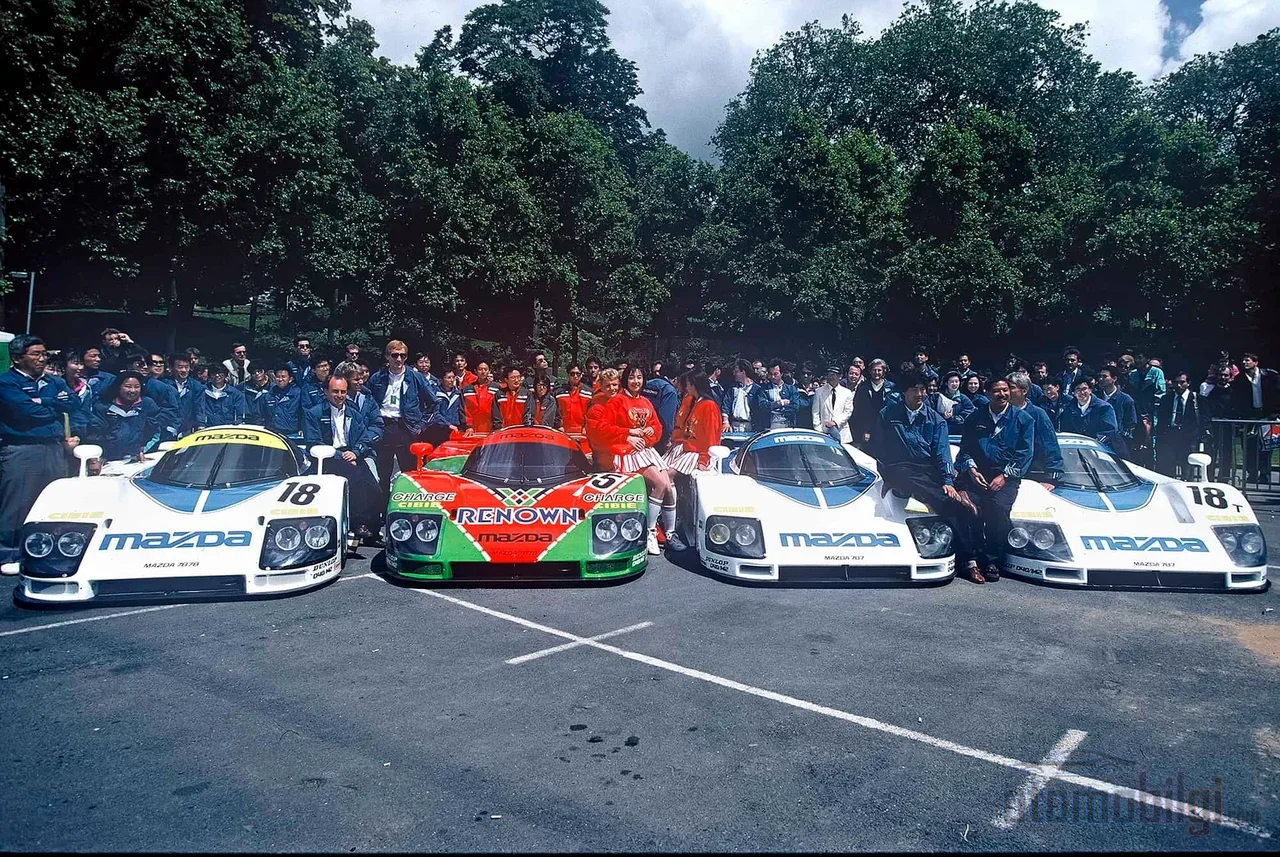
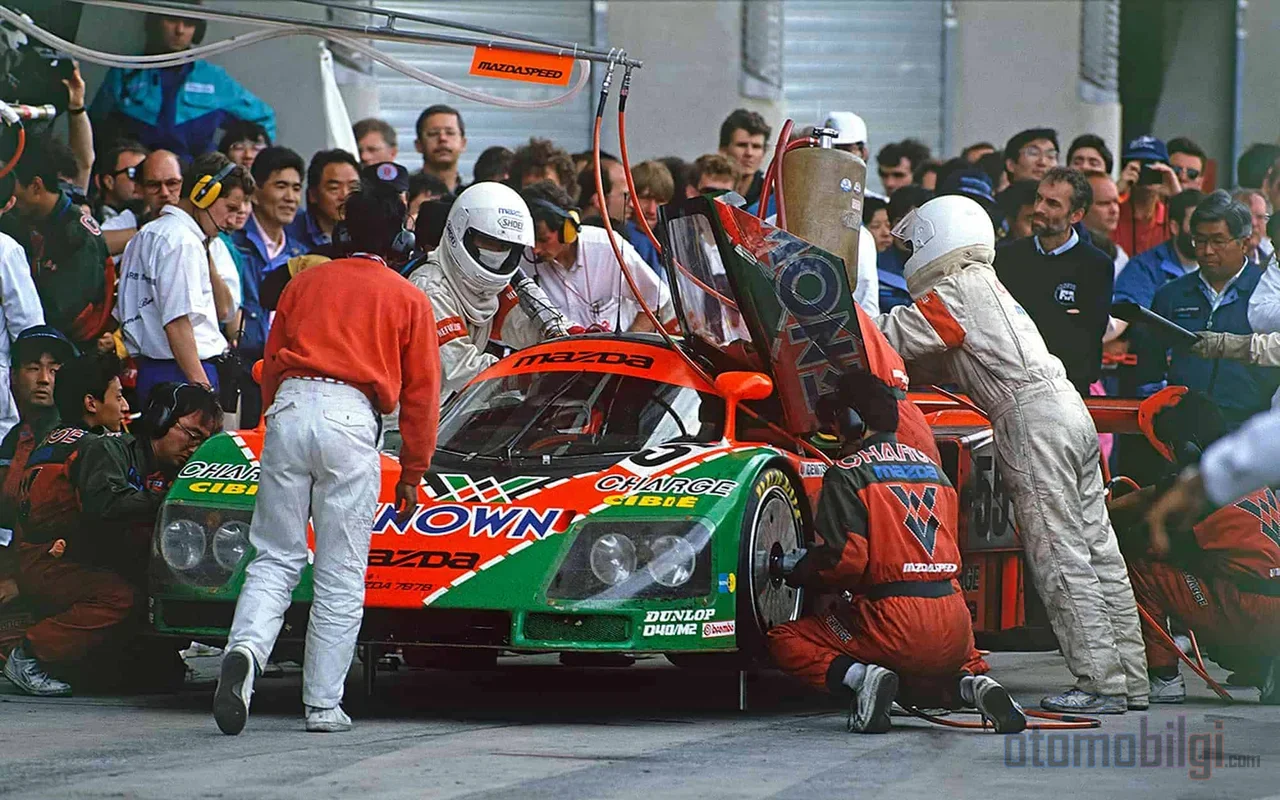
June 23, 1991 was the rotary engine's finest day. The Mazda 787B became the first Japanese car to win the 24 Hours of Le Mans, and no rotary-powered vehicle had ever won this race before. At the heart of the car was the R26B, 2.6 liters (2,616 cc) in displacement, a four-rotor unit that produced 700 hp at 9000 rpm . Peripheral intake ports, continuously variable-geometry intake manifolds, and the third spark plug added to each rotor were proof of how far the architecture could be pushed in racing.
The rule change that took effect after the victory is also meaningful: FIA banned rotary engines from racing the following year. Moreover, race organizations had already adopted a rule of doubling the declared displacement of the Wankel engine; due to this classification, the 787B was able to start with its 26B engine. This is also the answer to the question of "the fairness of the victory" that is still debated in forums: Mazda raced within the classification set by the rules and won.
Why Did Emission Rules Destroy the Rotary?
Mazda had not given up. Renesis (13B-MSP) entered production in the 2004 model year RX-8, and its design purpose was directly the two most recurring problems of the Wankel: emissions and fuel economy. Moving the exhaust ports to the side achieved a reduction in hydrocarbon output of compared to the previous 35-50% 13B-REW and met the US LEV-II standard. The result earned recognition: the International Engine of the Year award in
2003 , followed by two consecutive years on Ward's 10 Best Engines lists. But even this was not enough against the tightening standards in Europe. The RX-8 had to withdraw from the European market in 2010 because it could not meet emission limits; with the effect of declining sales, production ended in 2012. The last series-production car to use the rotary engine as its sole power source thus became history. It was not a sudden death: when compared with piston engines of the same size, the architecture faced natural selection at a point where its emission output could no longer compete.
Hydrogen Experiments and the 2023 Comeback
Mazda was the first to think the Wankel's final curtain had not fallen - because the architecture's most interesting side feature shone in hydrogen: since the combustion chamber is valveless and intake temperatures are low, it offers a more favorable environment for hydrogen, which is prone to backfiring, than a piston engine. Mazda 1991 showed its first hydrogen rotary concept, HR-X, 1995 tested the hydrogen rotary vehicle on public roads and 2003 introduced the world's first hydrogen-fueled rotary-engine production vehicle, RX-8 Hydrogen RE. This dual-fuel vehicle could run on both gasoline and hydrogen; hydrogen was carried in liquid form in a second tank, and up to the twin-rotor arrangement it produced 154 kW of power; 2009 the first example was delivered to Norway.
The real comeback, however, came in a different role. 2023 Mazda brought the Wankel engine back MX-30 e-Skyactiv R-EV as a range extender in the plug-in hybrid - that is, a compact generator feeding the electric motor that drives the front axle. This is a clever position that neutralizes all the architecture's weaknesses: in a generator running at constant speed, smoothness and compactness become advantages, while the emissions and fuel economy disadvantages are kept under control. The Wankel has left the heart of the road car, but it has not died as engineering.
What Does the Rotary Engine Tell Us Today?
The Wankel's story is a rare experiment measuring the distance between a technology's engineering elegance and commercial and legal reality. The rotor could run smoother and stronger than a piston engine with a third of the moving parts; but the incomplete combustion inherent in its geometry never once overcame tightening emissions legislation. Felix Wankel's vision withdrew from the road car; today it continues to live on as a silent generator, in the answer to the question energy conversion now carries. In both cases, the lesson to be learned is the same: good engineering is valuable when applied to the right question.
Sources
- Wankel engine - Wikipedia
- Mazda Wankel engine - Wikipedia
- The Rise and Fall of the Wankel Rotary Engine | Tampa Bay Automobile Museum
- LE MANS VICTORY COMMEMORATIVE SITE - Mazda
- How Mazda won the 24 Hours of Le Mans - Mazda Stories
- Mazda Builds First RX-8 Hydrogen RE for Norway - Mazda Newsroom
- Mazda RX-8 - Wikipedia
- Mazda RX-8 Hydrogen RE - Wikipedia
- Analysis of Apex Seal Friction Power Loss in Rotary Engines - NASA NTRS
- Two-Stroke Wankel Type Rotary Engine - MDPI Energies
- NSU/Mazda Wankel (1967) - How Engines Work
- Why Mazda Was Forced To Discontinue The RX-8 - SlashGear
- Advantages and Disadvantages of a Rotary Engine - National Speed