600 Horsepower Sandstorm: The Anatomy of a Rallycross Supercar
Share This Page
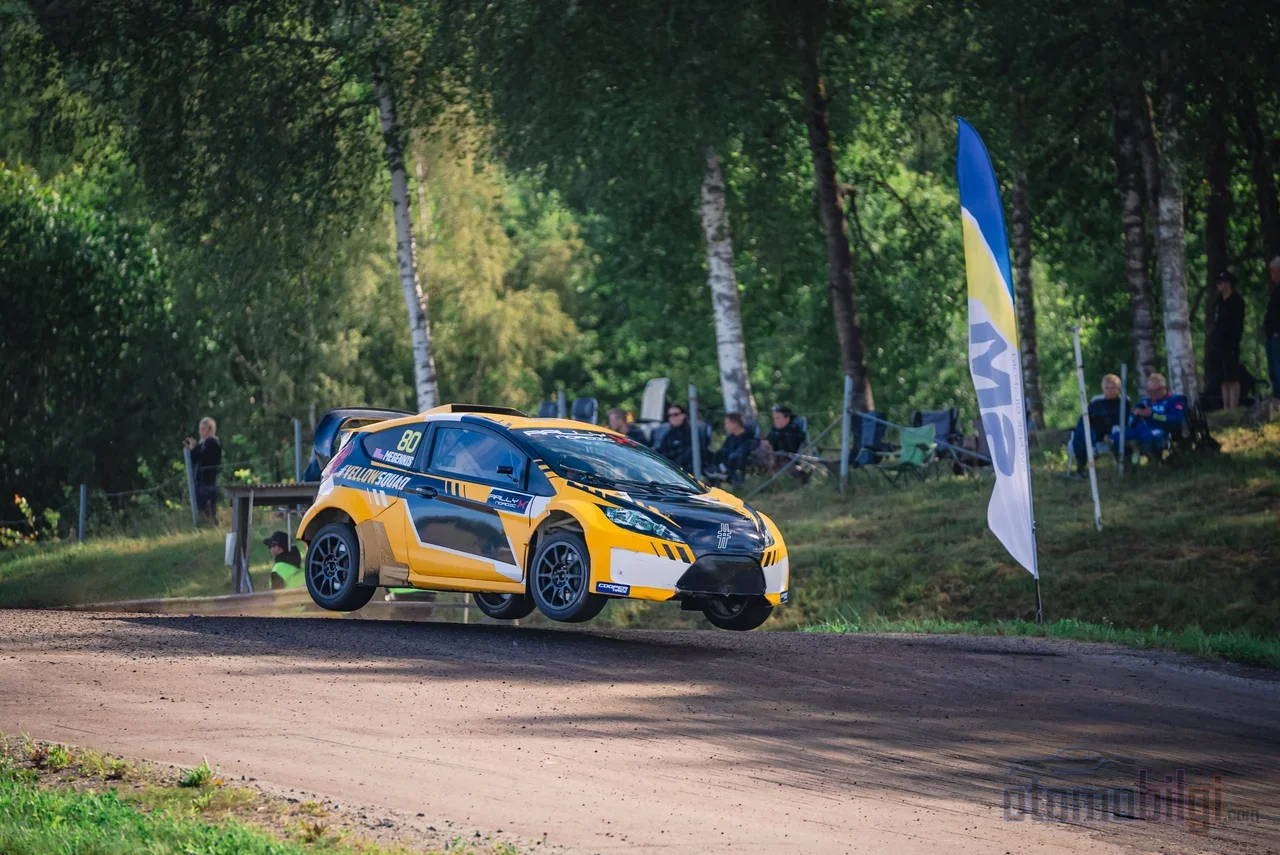
The Supercar rallycross car is the discipline's most creative machine, with up to 600 horsepower, 0-100 km/h acceleration in under 2 seconds, an antilag-equipped turbo engine and a suspension structure that withstands heavy jumps. It differs from WRC's Rally1 car both philosophically and technically: the goal here is not a long-stage record, but instant reaction in a sprint crammed into a few straights, with joker laps, contact and blind hits.
Highlights
- Modern Supercars produce up to 600 horsepower, 0-100 km/h is under 2 seconds.
- The electric FC1-X on the other hand, completes 0-60 mph with 1,000 hp in 1.5 seconds .
- Top-class engines are limited to a 2.0-liter turbo and a 45 mm intake restrictor; peak boost can exceed 3 bar .
- When antilag is off, the usable power band shifts above 4,000 rpm; the car cannot compete.
- The joker lap adds roughly 2-3 seconds to an average lap.
2 Seconds in 0-100: Acceleration Racing Gravity
Think about it: in high school physics class, gravitational acceleration is around 9.8 m/s². Global Rallycross cars completing 0-60 mph in 1.9 seconds means slightly above average acceleration - meaning the force that pins you to your seat at launch is almost the same as free fall. This is a figure even super sports cars struggle with, and moreover rallycross cars do it on a muddy, slippery and dusty surface.
The French rallycross federation's category definition paints a similar picture: in the Supercar class up to 550 hp of power, under 2.5 seconds for 0-100 km/h, under 1,300 kg of weight and four-wheel drive. Red Bull's Turkish guide, however, gives the upper limit as 600 horsepower, bringing acceleration close to Formula 1 level. Although different series use slightly different limits, the common point is clear: these cars are among the world's fastest accelerating race cars over short distances.
History also has something to say about this. Matti Alamäki's 1984 Porsche 930 rallycross car - with its twin-turbocharged 3.2-liter engine, four-wheel drive and approximately 750 horsepower of power, completed 0-60 mph in 3.1 seconds on wet surfaces. It is calculated that with dry surface and a suitable gear combination it could drop to around 2 seconds. So a "2-second lap" show was not invented in the 2010s; this discipline has been playing at the edge of the laws of physics for years.
The electric exception: FC1-X
Nitro Rallycross's FC1-X car, on the other hand, completely rewrites the rulebook: 1,000-horsepower fully electric, four-wheel-drive powertrain and just 1.5 seconds for 0-60 mph. The electronic management is handled by a MoTeC system. Of course, the other side of the coin is weight; that is why comparisons with petrol cars are still debated. The electric one accelerates faster, but its effect on track character and lap strategy is not as one-sided as assumed.
From Naturally Aspirated to Serial Turbo: The Evolution of the Engine
Rallycross's engine heritage is quite colorful. In the '80s, Renault's Gordini turbo units (over 350 hp from 1.4-1.6 liters of displacement), Zakspeed-built Ford BDA turbos (1.7 liters and up, 500 hp+) and Beetles with Subaru heads on VW blocks were the stars of the tracks. From the late '90s until the recent era, the stage was taken over by Cosworth YB engines. In the pre-restrictor era, there were minimum weight classes based on engine displacement; the 2.3-liter turbo class of the late '80s and early '90s, with a 1,100 kg weight limit, could produce approximately 750-800 horsepower Back then, it was accepted that the limit of "usable" power on slippery surfaces was around 550 hp - meaning power alone wasn't enough; putting it down to the ground was also a skill.
Today's formula: 2.0 turbo and 45 mm restrictor
Nowadays, top-class engines 2.0-liter turbo are limited, and the 45 mm intake restrictor keeps power at roughly 600 hp and around 700 lb-ft of torque. This rule came into effect in Europe around 1997 and in the UK around 2003. The restrictor is a kind of tap: it restricts the engine's breathing and keeps power at a reasonable level. But no matter how much air gets in, turbo pressure can push against the limits - for peak boost, these engines can see above 3 bar For comparison: most road cars' turbos operate at around 1-1.5 bar. These machines push more than double that.
Antilag: The engine's most important part
Now let's come to the most confusing but most exciting part: the antilag system (ALS). The turbocharger's biggest enemy is lag, that is, waiting for the boost to build when you press the throttle. Antilag sends air and fuel to the exhaust side even when the throttle is closed, keeping the turbo's speed high - so the moment you press the throttle coming out of a corner, full pressure is ready. According to rallycross drivers, with ALS off, the usable power band of a 2.0-liter turbo engine only starts above 4,000 rpm and the car can't compete. With the system on, the engine delivers instant response and uninterrupted torque like a naturally aspirated engine larger than 12 liters.
The common solution is the electronic air bypass valve from Swedish firm Tibuc; the most advanced versions use a valve-type system that pumps air directly into the exhaust manifold. The roots of this concept go back surprisingly far, to Audi's Group B car of the mid-'80s. So that sharp gunpowder-like "bang bang" sound you hear on the track isn't just for show - it's the sound of an engineering move that keeps turbo speed alive.
How Does Supercar Differ from WRC Rally1?
Both are all-wheel drive, both are monsters - but their design philosophies aren't similar. Rally1 is a technical specification written for the top level of the WRC; the goal is consistent speed over hours-long special stage routes. In rallycross, however, the target is agility and instant explosion: sharp maneuvers and mind-shaking acceleration on small, tight tracks. That's why rallycross cars are designed to be more compact and more reflexive.
The gearbox is also a place where the distinction is clearly visible. World RX rules 6-speed sequential manual gearbox makes it mandatory; depending on the gear ratios, the car can theoretically reach 200 km/h, but the tracks are so tight that this speed is rarely seen. In short, a rallycross car is not a long-distance runner but a 100-meter sprint athlete in training - its muscles come from entirely different places.
Roll Cage, Suspension and the Science of Jumping

Rallycross tracks usually feature at least one jump, and these jumps are taken at full throttle. For the car to endure this, the suspension needs extraordinary travel - that is, how much the suspension can go up and down. The suspension is designed precisely for this purpose, to maximize mechanical grip on bumpy, uneven ground. A jumping car with the throttle held open needs a suspension that can grip properly on landing; otherwise, the race ends right there.
On the safety side, the roll cage of a rally car typically consists of about 34 meters of chromoly steel tubing and weighs roughly 52 kg on its own. While this figure may seem light compared to the shell, it is in fact a structure of deadly importance that forms the skeleton of the car. The chassis is also customized to withstand terrain and contact conditions; because in rallycross, contact with walls, tire stacks, and rivals is part of the game.
The most beautiful proof of durability is the 2016 World RX round at Estering: Andreas Bakkerud managed to win the race with damaged suspension. Driving a car that is still setting times but has lost a great deal of its ideal grip - this is exactly that part of Supercar driving, almost a separate profession.
Joker Lap and Power Delivery: How Is the Strategy Built?
Rallycross rules say this: every driver must complete one joker lap in each race. The joker lap is a longer alternative route that leaves the main track and rejoins the main line, adding roughly 2-3 seconds to the average lap time. On some tracks the joker is longer, on others it's like a shorter penalty - meaning there is no single "correct" strategy.
So what does this have to do with technical anatomy? Everything, actually. High exit speed out of the joker lap means you are well positioned for the straight, and what makes that possible is zero-delay torque at corner exit. The instantly responsive character of the antilag and the 3 bar of turbo pressure are worth their weight in gold precisely in this exit maneuver. That's why the harmony between power delivery and tactics is a matter of strategy written into the engine block. If it were you, would you take the joker at the start of the race, or save it for the end? That's exactly where the duels break out.
Drivers, and the Situation in 2026 and Türkiye
Telling the story of technical evolution without the drivers would be incomplete. Petter Solberg had won the World RX round at Lohéac (France) with sold-out tickets; Timmy Hansen was chasing him in the overall standings at the time. At the 2026 FIA European Rallycross Championship, Marius Solberg Hansen will compete in Euro RX5 with a Renault Clio and in the third round of Euro RX4 with a Clio Mk5 racing under the AT Racing Team banner. Johan Kristoffersson secured the European championship with his Euro RX victory in Portugal. The 2026 Euro RX aluminum cars are named after Petter Solberg, Sébastien Loeb, Mattias Ekström, and Ken Block; 4WD RX1 Supercars produce over 600 hp. Allinkl Racing also announced it has built a new Supercar over the winter - fleet renewal is no easy task, and it is said that most Euro RX cars are 5-6 years old.
The ladder from Supercar Lite to Supercar
Driving these cars doesn't happen overnight. The first rung of the development ladder Supercar Lites: 2.4-liter Ford Duratec engine, Mountune development, 310 hp and 300 Nm - roughly half of the Supercar. No turbo, 0-100 km/h under 4 seconds. RallyX brought the Lites back to their roots with RallyX Academy in December 2025, and the 2026 Supercar Lites Academy winner will be connected to the development ladder.
The Türkiye side of the story is also a source of pride: the Turkish company Avitaş Motorsport manufactures SuperCar Lites vehicles, and these cars joined Global Rallycross America with 12 vehicles in 2013. Today they are used both on Turkish circuits and in world championships. What's more, on September 20-21, 2025 TOSFED hosted the "World RX of Türkiye" at Istanbul Park, and the 2025 World and European Rallycross champions were decided in Istanbul. World RX will once again be a 100% thermal (gasoline) European championship in 2026 - meaning this turbo-antilag anatomy we've described will remain at the center of the stage for a while longer.
Final Word: Why Are These Cars So Special?
A Supercar rallycross car is a rare design that combines the most contradictory demands of motorsport in a single body: acceleration close to Formula 1, the durability of rally cars, and the contact tolerance of closed-circuit racing. An engine restricted by a 45 mm restrictor that still reaches 600 horsepower, an antilag system that never lets the turbo sleep, a 52-kilogram roll cage, and suspension built to withstand jumps... They all exist for one purpose: full response at every moment in a crazy sprint lasting just a few minutes. If one day you get the chance to watch these launches from the stands at Istanbul Park, you'll now also know the engineering at work beneath them - it's a whole different experience, I promise.
Sources
- Rallycross: The maddest 'road car' based engines in motorsport
- How Global Rallycross Cars Can Accelerate Faster Than Gravity
- Categories - Rallycross France
- Things you need to know about rallycross
- FC1-X - One of the fastest accelerating race cars in the world
- WRC vs World Rallycross Cars: Petter Solberg's VW Polo tech talk
- Rally1
- What Makes JRD Rally Cars Unique
- Rally cars' structural integrity / roll cage
- The Science of the Global Rallycross Jump
- Andreas Bakkerud wins with broken suspension
- Rallycross Explained - Peugeot Sport
- 5 beginner tips for rallycross racing
- Solberg wins Loheac RX in front of sell-out crowd
- FIA Rallycross Championships - Official Website
- 2026 FIA European Rallycross Championship
- 2026 FIA Euro RX4 - Round 3 - Entry List
- Supercar Lites returns to its roots with the RallyX Academy
- RX2 cars technology: The rallycross tech guide
- Avitas Motorsport - Products
- Domestic SuperCar Lites from Avitas
- September 20-21, 2025 FIA World and European Rallycross Championship - World RX of Türkiye