Why Do Riders in MotoGP Take Corners Almost Touching the Ground?
Share This Page
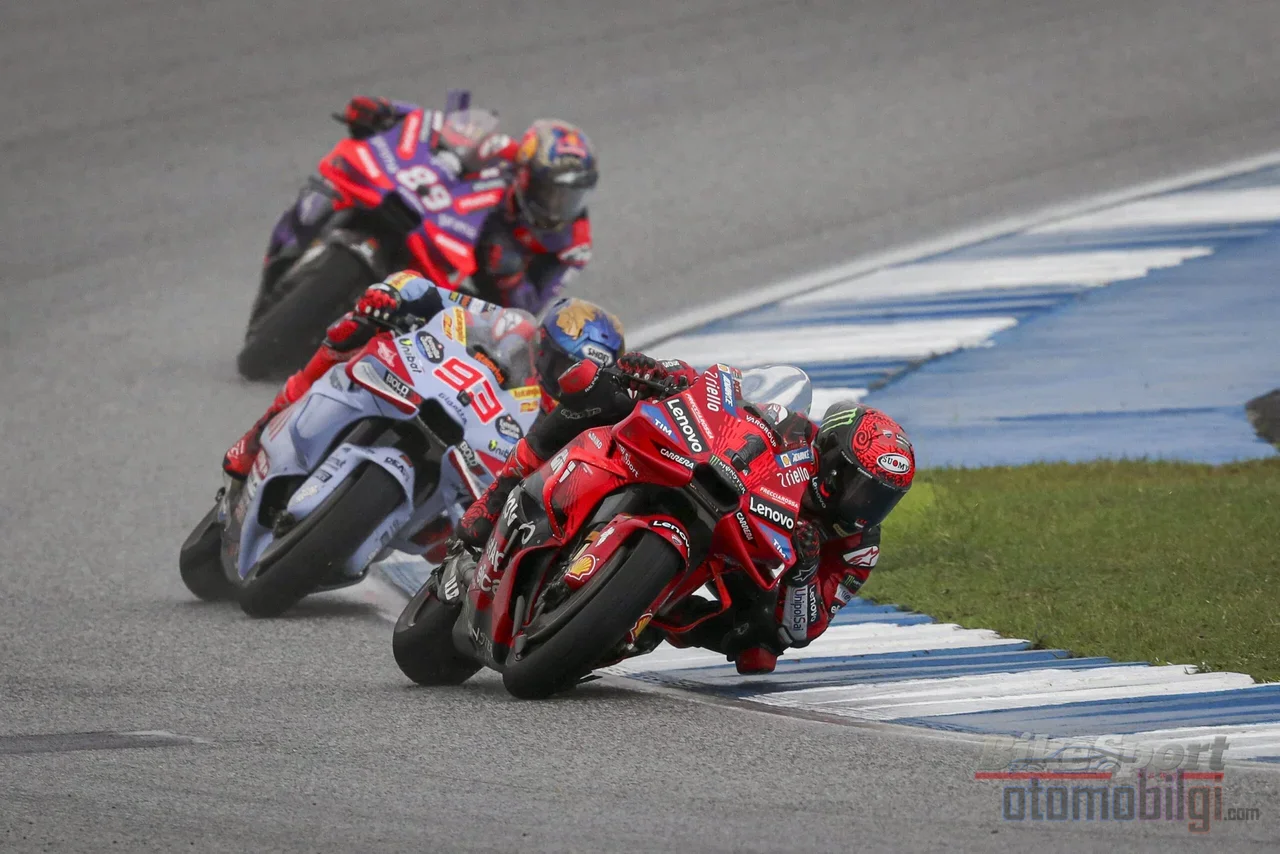
MotoGP bikes can lean more than 60 degrees from vertical in corners, even up to 65 degrees; the secret to them not falling is gravity and cornering force meeting in perfect balance, plus the extraordinary grip of racing tires that can handle this massive lean angle. So the rider isn't actually performing an acrobatic feat - they're following the fastest line that pure physics allows. How, you ask? Let's break it down step by step, because this topic genuinely excites me!
Key Highlights
- MotoGP machines can lean up to 65 degrees in corners; the human body's natural comfort limit is only 20 degrees.
- Racing riders can reach 1.2 G or more on slick tires; road riders typically stay in the 0.4-0.5 G range.
- The knee-down technique became widespread in the 1970s, and elbow-down was its natural evolution.
- Riders don't actually want extreme lean; they prefer to control the lean and straighten up quickly at the corner exit.
What does centrifugal force do in a corner?
Now let's get to the most crucial part. When a motorcycle enters a corner, a massive force is needed toward the center of the turn - we call this centrifugal force. What provides this force? The tire's grip on the road. The rider clearly experiences the outward push of this force in their body; it feels as if someone is pushing them toward the outside of the corner.
So why does the motorcycle lean? This is exactly where physics comes into play: while gravity wants to tip the motorcycle inward, the cornering force tries to push it outward. The balance of these two forces can only be achieved when the motorcycle is leaning. As speed increases, the cornering force grows, so the motorcycle has to lean more to stay stable. While a wide corner can be taken at low speed with little lean, the same corner at high speed demands a completely different geometry.
Here's the interesting part: at a given speed and corner radius, the required force is constant. In other words, even if you change the lean angle, the force needed to turn doesn't change - lean is simply how that force is balanced. Let me give you an analogy: if you take a tight corner slowly on a bicycle, you lean slightly; if you want to take the same corner fast, your body automatically leans much more. The same thing happens in MotoGP, just with speeds and angles at the extremes.
How does tire grip survive at 65 degrees?
The physics of friction is actually explained with a fairly simple formula: friction force equals the coefficient of friction times the normal force. In other words, the grip you can achieve is determined by the quality of the tire and the surface, and the magnitude of the load on the tire. Peak friction coefficients measured on dry surfaces hover around approximately 1.2 - racing slicks play in this zone, while ordinary road tires lag far behind.
Let me also explain the concept of G, because you need it to understand just how striking this difference is. G means acceleration measured in multiples of the force of gravity. A normal road rider typically operates in the 0.4-0.5 G range in corners. A MotoGP rider, meanwhile, can exceed 1.2 G with their slick tires. So the force that sticks to your face and presses you sideways on Earth becomes even stronger than gravity. I can compare it to the centrifuge capsules used in astronaut training, except this time the handlebars belong to a MotoGP prototype.
The Kamm circle: the budget of grip
Think of a tire's grip as a single budget: braking, throttle application, and cornering forces all draw from that same budget. The classic model that explains this is called the Kamm circle. Imagine the tire's capacity as a pie; if you load braking too heavily, the slice left for cornering shrinks, and if you open the throttle too early, lateral grip decreases. The whole secret of MotoGP riders is dividing this pie correctly at every moment of the corner. Braking should finish before the corner, and the throttle should be applied smoothly within it - because if the budget is exceeded, the tire gives up.
Does lean angle reduce grip? (No!)
There is a myth we often hear: that when you lean the motorcycle, the tire's cornering grip drops. From a physics standpoint, this is not true; lean angle itself does not automatically erode grip capacity. The real limit is the tire's lateral grip capacity - a fundamental value measured in the modified world as cornering stiffness - and how the contact patch works with the ground. On a good modern tire, grip typically starts to run out at lean angles of 50-60 degrees; racing slicks and proper ground clearance allow going beyond that. In other words, the tire behaves in sync up to as much lean angle as the hardware allows.
One more detail: At 60 degrees of lean, a racing motorcycle's suspension effectively stops working. The front fork and rear shock go almost completely into the leaned position. At that point the mechanical suspension has finished its job, and the tire's relationship with the ground takes over. That is why precision matters more as lean angle increases - every centimeter toward the tire's grip limit becomes more critical.
Why does the rider touch their knee and elbow to the ground?
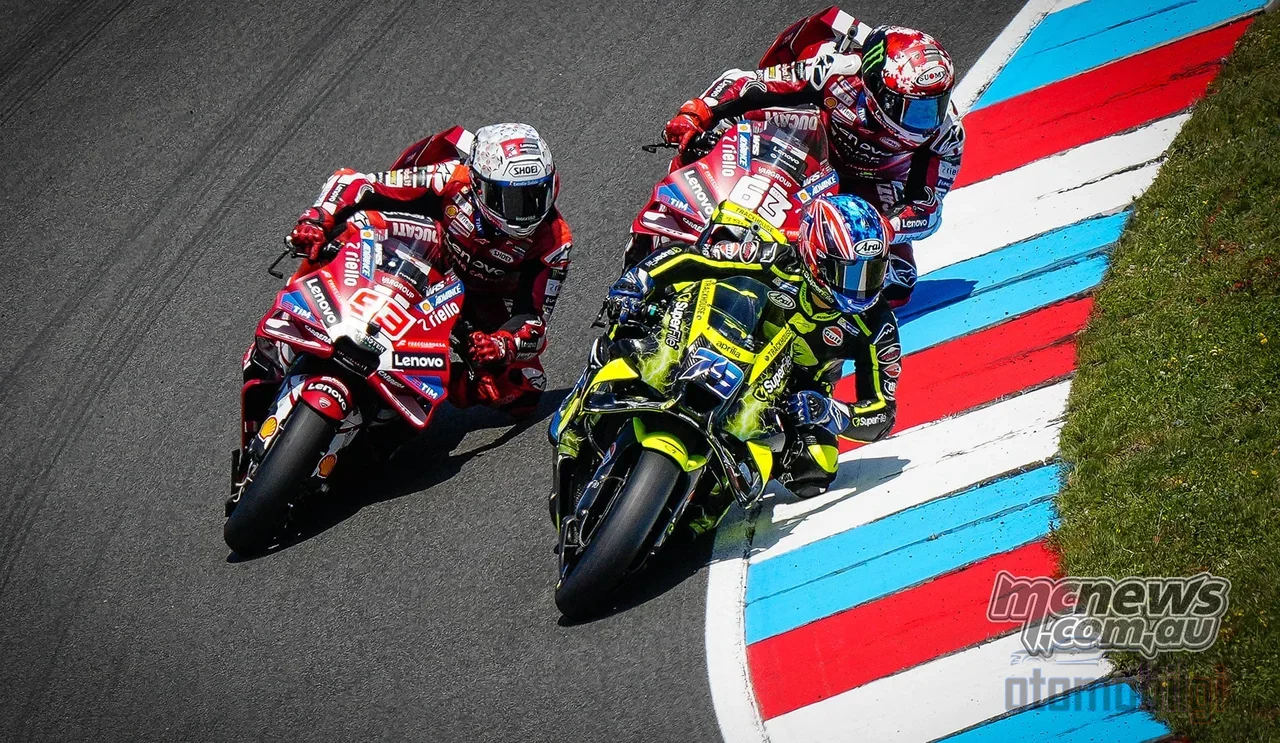
Now let's come to the most visually memorable part: the rider's knee sliding over the track. This is not just for show - it is pure physics and control. The rider hangs their body toward the inside of the motorcycle, that is, into the corner. This way, the combined center of gravity of the rider and motorcycle is positioned lower and further inside. The result? While balancing the same cornering force, the motorcycle needs to lean less. This keeps the tire in a safer zone and leaves room for correction on corner exit.
The history of knee dragging: from Kenny Roberts to today
The knee-down technique in MotoGP dates back to the 1970s. Until then, riders rode in a much more upright style, limiting the motorcycle's lean with the tip of their knee. Star rider Kenny Roberts carried this technique to the top of the scene while becoming 500cc World Champion three times in a row between 1978-1980. The inspiration was Jarno Saarinen, who pointed his knee toward the ground in corners and occasionally touched it down; unfortunately Saarinen's tragic crash at Monza in 1973 prevented this style from evolving further. Roberts turned Saarinen's seed into a world championship.
Then it was the elbow's turn. Marc Márquez combined the hanging off style he began developing in Moto2 during his step up to the premier class with the magnificent lateral grip of MotoGP tires: he lowered his body as far down from the motorcycle as possible, limited the motorcycle's lean angle somewhat, and dragged his elbow on the track through the corner. This style was so effective that within a short time the majority of riders imitated it. Today, seeing knee-down, elbow-down, and even shoulder-down positions in riders like Fabio Quartararo is now an ordinary sight.
What exactly is the purpose of dragging the elbow? You can think of it this way: riders are not deliberately trying to touch their elbow to the ground; it is a natural result of the lean angle and body position. But when it touches, it provides very valuable information: better assessing the lean angle, feeling the grip level of the track, staying close to the optimum racing line. The contact point works like a kind of sensor. Riders' knee and elbow sliders are also specially manufactured for this job; they are made of a durable compound, resist abrasion, and can be easily replaced. The leathers are tailored to the riders' body measurements by suppliers such as Alpinestars, Dainese, and Spidi.
What should the correct body position be like?
As Dani Pedrosa also explained, the fundamental principles are clear: elbows should be kept open, body weight should be shifted toward the corner, and the outside leg should be used to load the footpeg. The modern trend is to open the inside knee away from the motorcycle to load the peg; on corner exit, the head is at its lowest point. These positions are not merely for show - they all exist to optimize the center of gravity and tire load.
There is also this important fact: riders actually do not want maximum lean. For maximum performance, they prefer to keep the lean under control and stand the motorcycle up as quickly as possible on corner exit. Because standing up means being able to get on the throttle earlier and harder. Lean is a tool, not the goal - the goal is to exit the corner as fast as possible.
The moment of the slide: the physics of lowside and highside
What happens when a tire's grip runs out? Here are the two classic crash scenarios. A lowside occurs when the forces in the corner exceed the available grip: the motorcycle slides out from under the rider, and the rider falls with the motorcycle toward the inside of the corner. This is the most common type of crash in MotoGP. If the front tire goes away as if off a cliff, everything ends in an instant; that is why braking and downshifting must be completed before the corner.
A highside is a much more frustrating scenario: the rear tire first loses its lateral grip, then suddenly regains it. This sudden snap causes the motorcycle to rotate violently around its longitudinal axis and flings the rider over the handlebars. A lowside usually ends in a slide, in a predictable way; a highside forces the motorcycle to act like a catapult. That's why highside crashes are considered far riskier for riders.
Electronic aids shouldn't be forgotten either; systems like traction control try to keep the throttle from unsettling the tire and contribute to gear control. But the fundamental rule of physics doesn't change: once the tire's budget is exceeded, physics wins.
Can an ordinary road rider apply these techniques?
Let me be honest: It's not realistic for an ordinary road rider to copy MotoGP-level body position exactly. Those positions make sense at speeds above 200 km/h, on track-quality surfaces, and with years of training. But the basic physics applies to everyone: anyone with a basic understanding of physics doesn't doubt the advantage of keeping the rider's weight as low and as far inside as possible. The practical takeaway for a road rider is this - finish your speed before the corner, take a comfortable and balanced position in the corner, and open the throttle smoothly. It's the same Kamm circle, the same budget logic; just with far more modest numbers.
The human body is naturally accustomed to leaning up to 20 degrees. A MotoGP machine and rider, meanwhile, reach 65 degrees - exactly 45 degrees beyond the human comfort limit. That figure, in my opinion, sums it all up: MotoGP's art of cornering is proof of how far you can go when human limits are met by machine and tire technology that exceed them. Next time you watch a corner on TV, look again at those moments when an elbow touches the ground; you now know how much physics is in there!
Sources
- MotoGP™ elbow dragging: Why Do Riders Touch the Ground With Their Elbows?
- Lean Angle: Winning Is A Matter Of Degrees - MotoAmerica
- Motorcycle Tyres and Grip – some myths dispelled - British Superbike School
- Better Riding: When do I run out of grip? - Bennetts BikeSocial
- How Motorcycle Grip Actually Works - Canyon Chasers
- The Friction of Motorcycle Tyres - EVU Online
- Tyre dynamics - Racecar Engineering
- Way the cornering forces are felt when riding a motorcycle - Physics Forums
- Why Do Racing Motorcycles Lean So Much? It's Physics - Rhett Allain, Medium
- Highsider - Wikipedia
- Highside and lowside motorcycle crashes explained - DrivingTests.co.nz
- Motorbike crashes: highside and lowside crashes explained - Driver Knowledge Tests
- Body Position: Moto GP comparison just isn't realistic! - JP43 Training