How Does Tire Choice Determine the Race Result in MotoGP?
Share This Page
In MotoGP, tire choice determines the race result as directly as engine power and rider skill: compound hardness, carcass construction, front-rear combination, and tire pressure; operating in the 80-120°C range, these tires pre-determine how they will wear over the race, and the rider who makes the right choice makes the podium while the one who chooses wrong is trapped in the middle of the grid.
Highlights
- MotoGP slick tires 80-120°C deliver their best performance in this range.
- Each rider gets 22 slicks (10 front + 12 rear) and 13 rain tires for a Grand Prix weekend.
- Michelin has been the sole supplier since 2016; Pirelli takes over in 2027.
- Pressure rule penalty: in the Sprint, 8 seconds, in the long race 16 seconds.
- In MotoGP there are no intermediates; either wet compound or slick.
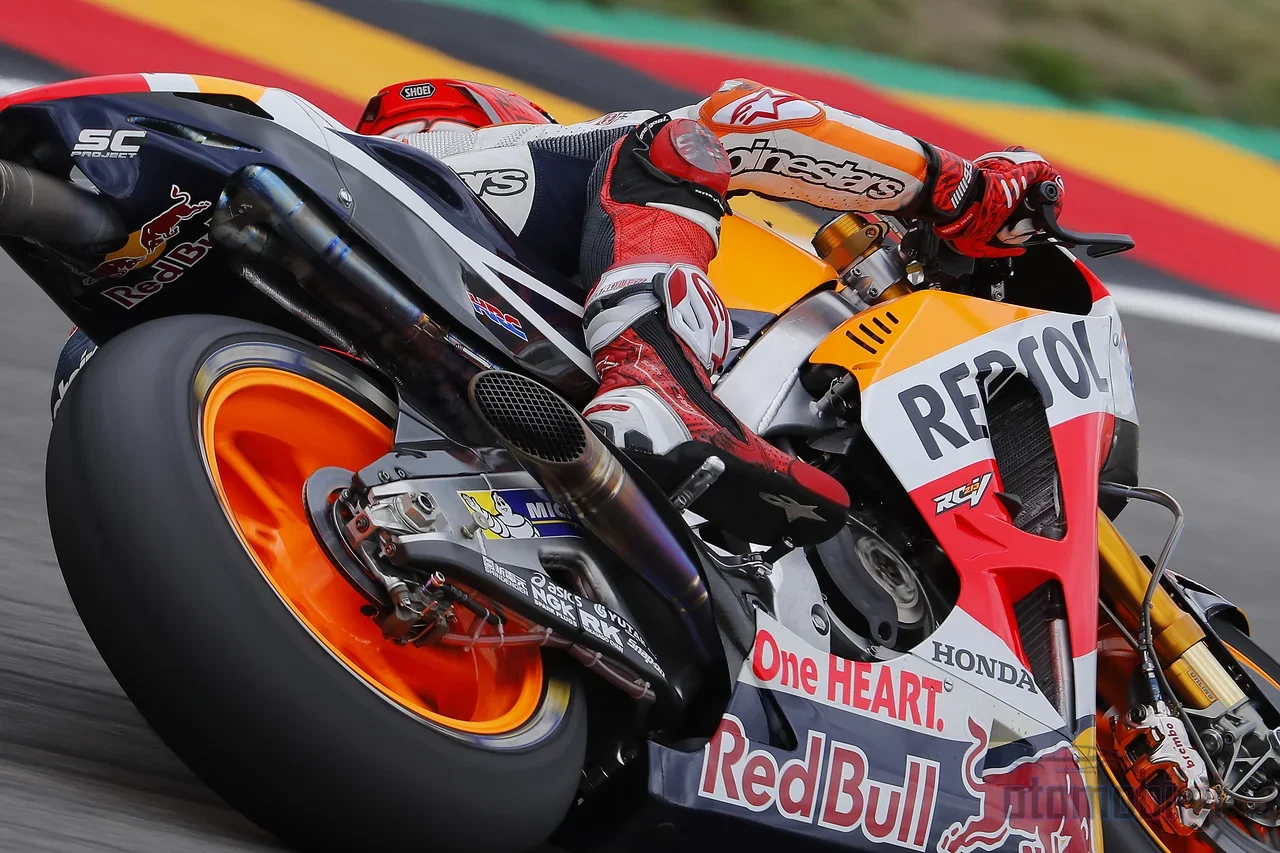
Think about it: a 1000cc prototype reaches speeds above 360 km/h, leans up to 64 degrees into corners, and does all of this relying only on a contact surface the size of the palm of a hand on just two tires. Sounds crazy, doesn't it? That's exactly why the tire topic in MotoGP is a technical universe as exciting as the engine itself. The most critical decisions of the weekend are actually made in the garage, in front of the tire rack. Come on, let's unravel this invisible war together.
How Does the Single-Supplier System Work?
In MotoGP, teams don't choose their tire brand themselves; the championship works with a single supplier. Since 2016, this role has belonged to Michelin. The 2026 season is Michelin's final season in MotoGP: from 2027 onwards, Pirelli will be the sole supplier in MotoGP, Moto2, Moto3, and MotoE, while Michelin moves to WorldSBK. So we are currently in a full transition period, and this makes the tire conversation more relevant than ever.
Here's how the system works: Michelin brings hundreds of tires to each Grand Prix, but these are not tires sold in stores - they don't even have a price, they are produced exclusively for the championship and teams cannot buy extra tires. Each tire contains an RFID chip; it stores data such as the compound recipe, carcass specification, and production batch. On the production side, the tires are vulcanized in heated steel molds with robotic layer application, and Michelin scans each tire with lasers for perfection. It's like science fiction, but it's real!
How Is Tire Choice Made Over the Weekend?
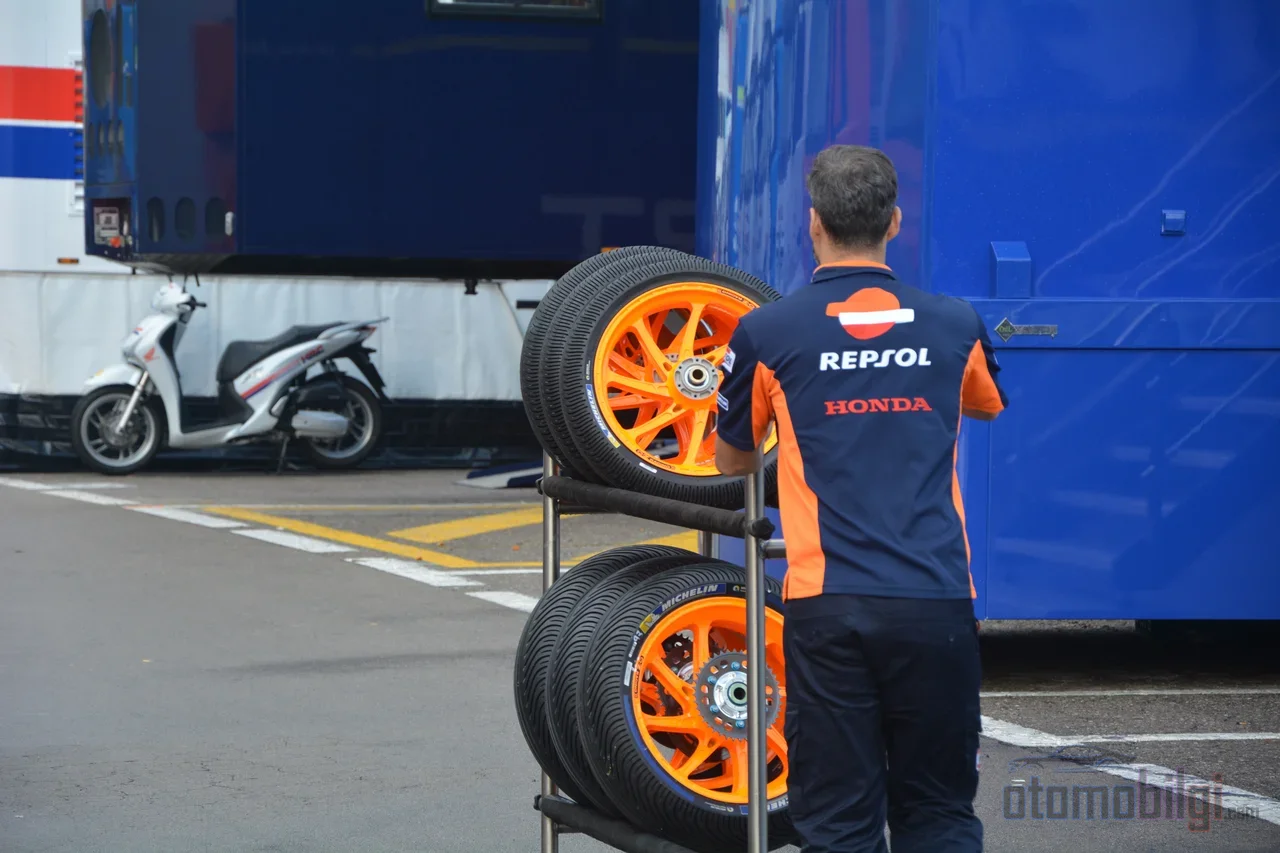
For each GP weekend, each rider basically takes 22 slick tires : 10 front, 12 rear. 13 rain tires are added alongside; if 3 of the week's 5 practice sessions are declared wet, they add one more set. The two riders who advance from Q1 to Q2 in qualifying also earn an extra qualifying tire - meaning reaching Q2 is an advantage not only on the timesheet but also in the tire budget.
The Compound, Carcass, and Asymmetry Trio
Not every tire is born the same. A hard compound heats up more slowly but lasts longer; a soft compound is like a rocket in the early laps but carries the risk of falling apart toward the end of the race. The carcass side is just as important as the compound: the structure woven from textile cords such as nylon, polyester and aramid determines how much the tire will flex, how much heat it will generate, and how much grip it will have at the limit. Michelin uses a reinforced carcass for high-load circuits that strain the tire, such as the Red Bull Ring and Buriram.
Now for the final layer of asymmetry: depending on the dominant cornering direction of the track, one shoulder of the tire can be made harder and the other softer. For example, at the Brazilian GP, where there was no track testing, a symmetric front and rear with a more resistant right shoulder was allocated based on simulation, along with a rear tire offered in two different carcass options. At COTA 2024, on the other hand, a symmetric front and a hard-right-shoulder asymmetric rear were preferred for the clay-based, variable surface. In other words, every track practically demands its own tire.
Why Is the Temperature Window So Critical?
MotoGP tires are designed for a range of roughly 80-120°C For the front tire, around 100°C is generally targeted, and 120°C or above for the rear. If you drop below this range, the tire loses grip - just like driving a car on a cold winter morning with cold tires, you can feel that something underneath is "solid." That's why riders swing the motorcycle from side to side on the straights: to keep the tires from cooling down. That zigzag dance you see in onboard lap videos isn't for nothing!
Track temperature also comes into play: in Phillip Island's cool autumn, the tire touches asphalt at 10°C, while at Qatar's Losail circuit the thermometer can hit 60°C. When choosing tires, the weather forecast, the character of the track, and the temperature data from practice sessions are all considered together. Michelin making a major tire change after the Motegi Sprint is the best example of this - at the Japanese GP, tire choice became the critical factor that determined the fate of the race.
How Does Riding Style Change Tire Preference?
Here's the most human part of the story: the same tire doesn't suit everyone. Marc Márquez's riding style works the rear tire hard, and it's well known that for years he preferred the hard rear option. The front-rear combination is like a puzzle: soft front + hard rear, or the other way around? Some of the fastest laps set in warm-up are done with a soft front and heat-treated hard rear combination - meaning riders solve this equation anew in every session.
Sprint races (since 2023) added a new line to this equation. Performance is required for the short Saturday race too, and riders who make the Sprint podium reveal which tires they chose for Sunday - meaning Saturday's boldness influences Sunday's strategy. What a cool domino effect, don't you think?
How Does Tire Wear Change Positions During the Race?
The tires are designed to cover 110-120 km in 45-minute races while withstanding the insane acceleration and braking forces of 1000cc prototypes. But even if the design is perfect, wear is inevitable, and it shakes up the standings in the final third of the race. Let's look at a few real examples:
- Ai Ogura said "the wear on the rear tire was incredible," noting that the long race would require far more delicate management.
- Jorge Martin reported that he experienced serious rear tire wear in the Japan GP Sprint due to the high grip of the new asphalt.
- Francesco Bagnaia admitted that tire wear in Sunday races was a recurring problem for him - tire management has become the biggest obstacle to his performance.
- Pramac conveyed the message from Toprak Razgatlıoğlu after the Germany GP Sprint that "tomorrow's race is longer, tire management is more important."
See? The motorcycle is the same, the track is the same, but because there is less rubber left in the tire, a rider who laps another rider is unable to escape a few laps later. That's why instead of saying "the fastest one wins," we say "the one who manages their tire best wins." Some fans are nostalgic: it's often said that in the 2003-2005 era riders were in attack mode throughout the entire race, whereas today management is far more dominant - there's some truth to it, but technology has changed at the same pace.
Why Is the Pressure Rule So Controversial?
And we come to perhaps the hottest debate of recent years. MotoGP has minimum tire pressure rules: in races longer than 15 laps, for at least 60% of the laps, and in the Sprint, for 30% of the laps minimum pressure must be maintained. The penalty is a deterrent: 8 seconds in the Sprint, 16 seconds in the GP. So why does such a rule exist? Because lower pressure gives more grip, but it weakens the tire's internal structure and creates the risk of a blowout - the rule was put in place for safety.
Technology also monitors compliance: since 2023 Silverstone, an encrypted, unified TPMS system has been monitoring tire pressure and temperature in real time, and riders can see it on their dashboard. The system is so sensitive that after Jorge Martin's crash at the 2025 Sepang test, it was announced that the tire cavitation temperature was 15°C below optimal and that the crash was caused by low tire temperature; Aprilia had objected to this finding. So the tire, beyond being a technical matter, is now a source of controversy.
And the riders are not happy. Pedro Acosta said the rules have made teams "weird" and affected the leading riders. The pressure has risen so much that there has even been talk of pressure penalties overshadowing the MotoGP show and of alternatives such as spot checks before the grid. Doesn't it seem strange to you too? In the world's fastest motorcycle race, a sensor threshold can determine the outcome of some Sunday races.
2027 and Beyond: What Will the Pirelli Era Bring?
2026 is the final season for both 1000cc engines and Michelin tires. 2027 brings 850cc engines, reduced aerodynamics, the removal of holeshot devices and, of course, Pirelli tires. Pirelli's statement is striking: they said they will build "a balanced tire for every rider," and will not produce a tire designed around a particular star rider. They also made their own statement about the controversial pressure rule.
On the Michelin side, there is an interesting regulation in 2026: at most Grand Prix events, the front tire options have been reduced from three to two, but the number of tires per specification has been increased from five to seven. Three options remain at a few tracks where weather conditions are variable. The planned new-generation front slick will not be introduced in 2026 - Michelin prefers to keep the course steady in its final season. And let's answer one thing people are curious about: there is no intermediate tire in MotoGP. Michelin did develop one at some point, but it was deemed "unnecessary" and dropped; if it's wet, you go with rain rubber, if it's dry, slicks. It's that simple.
In Short: The Race Is Won on the Tires
Next time you watch a MotoGP race, look not at the jostling in the final corner but at the moves in the last 5 laps. Most of those moves are the reward for the tire decision made on Friday and the patience shown throughout the entire race. The right compound, the right carcass, the right pressure, and lapping at the right pace - that's the art, and podiums are the work of that art. So what would you have done - would you have gone with the safety option, or attacked with the soft compound against all odds? Let's talk in the comments!
Sources
- How Are MotoGP™ Tyres Designed? Inside MotoGP's Race Rubber
- How does MotoGP™ tyre selection work?: The ultimate guide
- MotoGP Tyres - All You Need to Know About Them for 2026
- What are the MotoGP tyre pressure rules in 2026?
- Pressure, temperature, force and contact surface: the secrets of racing tyres
- Michelin, Official MotoGP™ Class Tyre
- How MotoGP tyres work and who pays for them
- MotoGP: What's Tires Got To Do With It?
- Why tyre management is becoming Francesco Bagnaia's biggest problem
- How Pirelli is preparing to become MotoGP's tyre supplier in 2027
- Michelin made a major tyre change after the Motegi MotoGP Sprint
- Ai Ogura: "The degradation of the rear tire was quite incredible"
- Why MotoGP's new tyre-pressure rule is a disaster for the championship
- Pedro Acosta: MotoGP tyre pressure rules